
世界义乌AI大模型

Search documents
数字浪潮下殊途同归的义乌与临沂
Qi Lu Wan Bao· 2025-12-02 05:55
Core Insights - The article discusses the contrasting digital transformation paths of Yiwu and Linyi, two major trading cities in China, highlighting their unique advantages and strategies in the context of internationalization and digitalization [1][6]. Group 1: Digital Transformation Initiatives - Yiwu has launched the Global Digital Trade Center, featuring AI-driven services that facilitate real-time communication and product promotion for over 3,700 merchants [2]. - Linyi's "China Grand Market" platform integrates various trade processes, helping over 10,000 businesses sell products globally, with 234,000 items available for export to over 100 countries [3]. Group 2: Comparative Performance Metrics - In the first ten months of 2025, Yiwu's cross-border e-commerce transaction volume reached 89.96 billion yuan, a year-on-year increase of 17.92%, while Linyi's volume was 22 billion yuan, growing by 60% [5]. - Yiwu's established international trade foundation and earlier e-commerce adoption contribute to its higher total transaction volume, while Linyi shows rapid growth, indicating a surge in cross-border e-commerce [5]. Group 3: Strategic Insights and Future Directions - Yiwu is characterized by its broad international outreach, while Linyi focuses on deepening its domestic market presence, particularly through live-streaming e-commerce [6]. - Linyi aims to build a comprehensive export ecosystem by learning from Yiwu's established practices, particularly in areas like compliance and logistics [7].
AI能否成为全球贸易的“共享”机遇?
Ren Min Ri Bao Hai Wai Ban· 2025-09-30 03:40
Core Insights - The World Trade Organization (WTO) predicts that artificial intelligence (AI) could drive global trade growth by nearly 40% by 2040, primarily by reducing trade costs and enhancing supply chain efficiency [4] - The report highlights a shift in global trade dynamics, where data control becomes a core competitive advantage, potentially exacerbating the digital divide and posing challenges for developing countries [4] Group 1: Opportunities - AI is enabling small and medium-sized enterprises (SMEs) to enter international markets by overcoming language and information barriers, allowing them to utilize AI tools as easily as calculators [5][6] - In Yiwu, nearly 30,000 merchants are regularly using various AI tools for business, benefiting from real-time communication in 116 languages and enhanced operational efficiency [5] - AI assists SMEs in analyzing historical sales data, market trends, and compliance regulations, thereby improving logistics and reducing risks associated with inventory management [6] Group 2: Changes - Data is becoming more valuable than goods in international trade, with AI technologies reducing prediction errors and enhancing market analysis capabilities [7][8] - Companies like SHEIN are leveraging AI to capture fashion trends from social media, allowing for rapid design and production adjustments based on real-time data analysis [8] Group 3: Challenges - Developing countries face significant risks of imbalance in global trade due to a lack of digital infrastructure, talent, and funding, which hinders their ability to participate in AI-driven markets [9][10] - The report indicates that without improvements in digital infrastructure, income growth for high-income countries could reach 14% by 2040, while low-income countries may only see an 8% increase [9] Group 4: Directions - A new inclusive global trade order driven by AI is necessary, as traditional trade rules are inadequate for the AI era [12][13] - China is positioned to play a crucial role in promoting inclusive growth in AI-driven trade, leveraging its digital infrastructure and experience in providing AI solutions to developing countries [12][13]

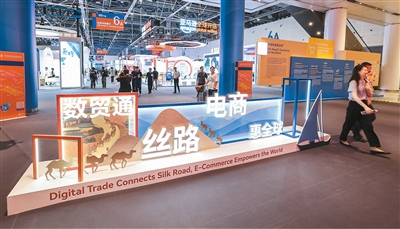
AI能否成为全球贸易的“共享”机遇?(环球热点)
Ren Min Ri Bao Hai Wai Ban· 2025-09-29 22:57
Core Insights - The World Trade Organization (WTO) predicts that artificial intelligence (AI) could drive global trade growth by nearly 40% by 2040, primarily by reducing trade costs and enhancing supply chain efficiency [4][10] - The report highlights a shift in global trade dynamics, where data control becomes a core competitive advantage, potentially exacerbating the digital divide for developing countries lacking technology and infrastructure [4][10] Group 1: Opportunities for SMEs - AI is enabling small and medium-sized enterprises (SMEs) to overcome language and information barriers, allowing them to enter international markets more easily [5][6] - In Yiwu, China, nearly 30,000 merchants are utilizing various AI tools for business, akin to using a calculator, which enhances their operational efficiency and market reach [5][6] - AI assists SMEs in analyzing historical sales data, market trends, and compliance costs, thereby improving logistics and reducing inventory risks [6][7] Group 2: Data as a Valuable Asset - Unlike traditional business models, AI captures data to create real-time feedback and reduce forecasting errors, positioning data as the new core of international trade [8][9] - Companies like SHEIN leverage AI to analyze global fashion trends, significantly reducing the time from trend identification to product delivery, thus transforming the business model [8][9] Group 3: Challenges for Developing Countries - Developing countries face significant risks of imbalance in global trade due to a lack of digital infrastructure, talent, and funding, which may hinder their participation in AI-driven markets [10][12] - The report indicates that without improvements in digital infrastructure, income growth for high-income countries could reach 14%, while low-income countries may only see an 8% increase by 2040 [10][12] - The potential job displacement in service sectors, particularly in translation and customer support, poses additional challenges for low-income countries that rely on these sectors for export opportunities [11][12] Group 4: Future Directions for Global Trade - The report emphasizes the need for inclusive AI governance to create fair global trade rules, with China playing a significant role in promoting cooperation among developing countries [13][14] - Investment in infrastructure, talent development, and open collaboration is crucial for AI to serve as a new engine for global trade and inclusive growth [13][14] - The evolving international trade rules must adapt to the digital age, focusing on cross-border data flow and AI governance frameworks to ensure equitable participation [14]
小商品城(600415):归母净利同比+16.8%近预告上限 CHINAGOODS平台业绩高增
Xin Lang Cai Jing· 2025-08-19 02:27
Core Viewpoint - The company reported strong financial performance for the first half of 2025, with significant growth in revenue and net profit, driven by high market demand and successful business expansion initiatives [1][2][3]. Financial Performance - In H1 2025, the company achieved revenue of 7.713 billion yuan, a year-on-year increase of 14% [1]. - The net profit attributable to shareholders was 1.691 billion yuan, up 16.8% year-on-year [1]. - The company's net profit after excluding government subsidies and other non-recurring items was 1.670 billion yuan, reflecting a 17.6% increase year-on-year [1]. - For Q2 2025, revenue reached 4.552 billion yuan, a 11.4% increase year-on-year, while net profit was 890 million yuan, up 21% [1]. Market Operations - The market operating segment generated revenue of 2.379 billion yuan in H1 2025, a 5% increase year-on-year, with a total profit of 1.848 billion yuan, up 3% [1]. - The total import and export value of Yiwu city reached 405.8 billion yuan, a 25% increase year-on-year, indicating a high market demand [1]. Business Expansion - The company is actively expanding its new markets, with the third batch of industries including drones, robotics, and fashion materials starting recruitment on July 23, 2025 [2]. - The cash flow from operating activities in Q2 2025 was 1.66 billion yuan, supported by the ongoing market recruitment efforts [2]. Chinagoods Performance - Chinagoods, the company's big data subsidiary, reported revenue of 257 million yuan and a net profit of 155 million yuan in H1 2025, with net profit increasing by 109.7% year-on-year [2]. - The platform's AI product enhancements and the launch of the "Small Business AI" series applications contributed to the growth in performance [2]. Yiwupay Growth - Yiwupay's cross-border payment net amount exceeded 2.5 billion USD in H1 2025, a 47% increase year-on-year, with total profit exceeding 40 million yuan, up 50% [2]. Import and Global Expansion - The company is the only white-listed enterprise for the national import positive list, successfully completing trials for 28 categories of daily consumer goods and 5 categories of parallel imported appliances [3]. - The first overseas market in East Asia, the Osaka Yiwu market, opened on June 26, 2025, marking a significant step in global expansion [3]. Profit Forecast - The company maintains a profit forecast for net profit attributable to shareholders of 4.23 billion yuan, 5.71 billion yuan, and 6.82 billion yuan for 2025-2027, representing year-on-year growth of 38%, 35%, and 19% respectively [3].

行业周报:小商品城启动数贸AI大模型内测,走向全域赋能-20250727
KAIYUAN SECURITIES· 2025-07-27 14:48
Investment Rating - The industry investment rating is "Positive" (maintained) [1] Core Viewpoints - The retail industry is experiencing a recovery, with significant growth in specific segments such as beauty and jewelry, driven by consumer sentiment and innovative business models [8][30] - The launch of the AI model by Yiwu Small Commodity City is expected to enhance operational efficiency and empower merchants, indicating a shift towards technology-driven business practices [25][26] Summary by Sections Retail Market Review - The retail industry index rose by 3.28% during the week of July 21-25, outperforming the Shanghai Composite Index by 1.61 percentage points [7][14] - The brand cosmetics sector saw the highest weekly increase of 5.94%, while the jewelry sector led the year-to-date performance with a 28.93% increase [17][20] Industry Dynamics - Yiwu Small Commodity City partnered with Alibaba to initiate the AI model testing, which is expected to transform traditional trade practices and enhance global trade linkages [25][26] - Over 30,000 merchants in Yiwu are utilizing AI tools, with deep users experiencing over 30% growth in orders, showcasing the impact of AI on operational efficiency and brand enhancement [26] Investment Recommendations - Focus on high-quality companies in sectors benefiting from emotional consumption themes, including: - Gold and jewelry brands with differentiated product offerings, such as Laopuhuang and Chaohongji [8][30] - Retail enterprises adapting to trends, like Yonghui Supermarket and Aiyingshi [8][30] - Domestic beauty brands with strong growth potential, including Maogeping and Pola [8][30] - Medical beauty product manufacturers with unique pipelines, such as Aimeike and Kedi-B [8][30] Company-Specific Insights - Laopuhuang reported a revenue increase of 167.5% and a net profit increase of 253.9% in FY2024, indicating strong brand expansion [32] - Chaohongji achieved a revenue growth of 25.4% in Q1 2025, driven by its focus on fashionable jewelry targeting younger consumers [40] - Maogeping's revenue grew by 34.6% in FY2024, reflecting its position as a leading domestic high-end beauty brand [32] - Pola's revenue increased by 21.0% in FY2024, supported by a robust product lineup [32]