个性化学习系统

Search documents
“2025中国AI+应用Top50”优秀案例火热征集中
财联社· 2026-01-16 15:11
Core Viewpoint - The article emphasizes the transition of artificial intelligence (AI) from exploration to large-scale application across various industries, highlighting the importance of practical implementations that enhance efficiency and improve quality of life [3][8]. Group 1: Event Overview - The "2025 China AI+ Application Top 50" initiative aims to collect and recognize 50 exemplary AI applications across sectors such as industry, finance, education, healthcare, and cultural tourism [3][5]. - The event is organized by Shanghai Media Group's Financial Association and "Science and Technology Innovation Board Daily" to showcase practical AI applications and promote deep integration of AI with the real economy [3][8]. Group 2: Application Focus Areas - The initiative focuses on real-world applications of AI technology, emphasizing scenario adaptation and value creation rather than just technological barriers [9][23]. - Key application areas include: - Industrial: Smart quality inspection, predictive maintenance, production process optimization, and intelligent supply chain scheduling [10][24]. - Financial: Intelligent risk control, investment decision-making, anti-fraud systems, AI investment advisory, digital employees, and compliance auditing [10][24]. - Education: Personalized learning systems, intelligent grading, virtual teaching research, and equitable educational resource adaptation [10][24]. - Healthcare: Medical imaging assistance, AI consultations, smart companionship, health monitoring, emergency alerts, and elder care service robots [10][24]. - Cultural Tourism: Digital guides, smart scenic areas, travel planning, and AR/VR immersive experiences [10][24]. Group 3: Application Submission Requirements - Eligible applicants include enterprises, public institutions, research organizations, and innovative teams, with individual innovators also welcome to submit [11][25]. - Applications must address real industry pain points, demonstrate practical implementation, and provide performance data, rejecting purely conceptual proposals [11][25]. - Each applicant can submit up to three cases, requiring a brief description, implementation scenario, and performance data [11][25]. Group 4: Evaluation and Benefits - A professional judging panel comprising industry veterans, AI application experts, seasoned investors, and media representatives will evaluate submissions based on application depth, industry empowerment value, social benefits, and user experience [12][26]. - Selected Top 50 cases will receive: - Coverage and promotion through Financial Association and "Science and Technology Innovation Board Daily" media channels [12][27]. - An invitation to the "China AI+ Application Industry Empowerment Conference" planned for the first half of 2026, including participation in award ceremonies and high-level industry dialogues [12][28]. - Inclusion in the "2025 China AI+ Application Development Report" and priority recommendations to venture capital, private equity, and industry funds for financing needs [12][28]. Group 5: Timeline - The application collection period runs from December 16, 2025, to January 30, 2026 [6][29]. - The evaluation period is set for February 1 to February 5, 2026, with final results announced on February 6, 2026 [6][29].

人工智能典型的十大应用案例
3 6 Ke· 2026-01-07 00:42
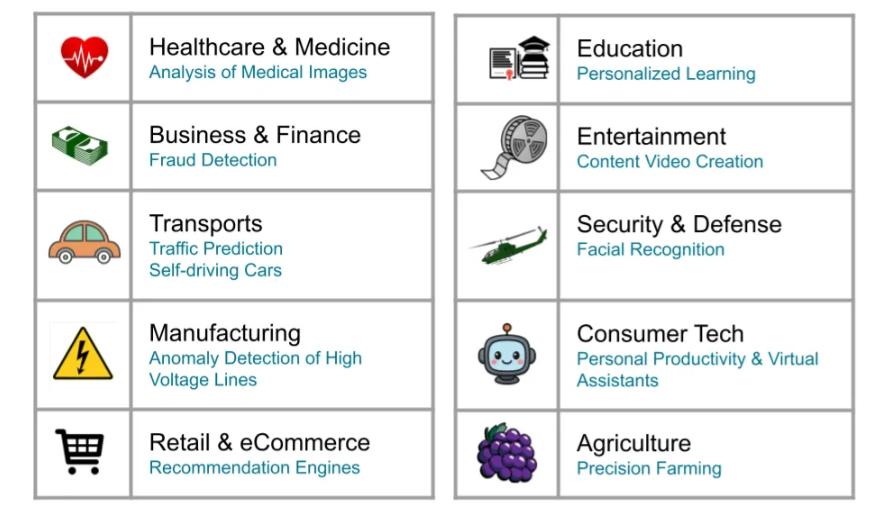
Core Insights - Artificial intelligence (AI) has permeated various aspects of daily life, influencing healthcare, finance, transportation, manufacturing, retail, education, entertainment, security, consumer technology, and agriculture [20]. Healthcare & Medicine - AI is significantly utilized in medical image analysis, enhancing diagnostic speed and accuracy by identifying anomalies that may be overlooked by human doctors [3][4]. - AI also plays a role in predictive and personalized medicine, analyzing patient history and genetic data to estimate disease risk and tailor treatment plans [4]. Business & Finance - AI applications in finance include fraud detection, where anomaly detection systems monitor transactions to prevent credit card fraud [5]. - The scalability of these systems is crucial, as they must process every transaction quickly to ensure user protection while maintaining a smooth experience [5]. Transportation - AI is applied in traffic prediction and route optimization, addressing the challenges of congestion and efficient vehicle distribution [6][7]. - The most notable success in this field is autonomous vehicles, which integrate various technologies for real-time decision-making and safety [7][8]. Manufacturing - Predictive maintenance is a key AI application in manufacturing, using anomaly detection to foresee mechanical failures and extend equipment lifespan [11]. - AI can optimize asset management processes, as demonstrated in projects that utilize aerial imagery for infrastructure maintenance [12]. Retail & eCommerce - AI enhances customer experience through recommendation engines that analyze purchasing behavior to suggest relevant products [13]. - This technology has been adopted by both large e-commerce platforms and smaller retailers, enabling personalized marketing strategies [13]. Education - AI facilitates personalized learning experiences by adapting educational content to individual student needs and tracking their progress [14]. - The use of adaptive learning systems has shown to improve student outcomes, particularly for those who may struggle in traditional settings [14]. Entertainment & Media - AI influences content creation and recommendation systems in social media, shaping user experiences based on preferences [15]. - It also supports creators by generating music, videos, and art, raising questions about creativity and copyright [15]. Security & Defense - AI enhances security through advanced surveillance systems capable of detecting unusual behavior and potential threats [17]. - In cybersecurity, AI identifies patterns indicative of cyberattacks, balancing security needs with privacy concerns [17]. Consumer Technology - AI applications in personal productivity include virtual assistants and tools that automate routine tasks, improving efficiency in daily activities [18]. - The shift from AI as a tool to AI as a partner signifies its growing role in understanding context and providing meaningful assistance [18]. Agriculture - AI is transforming agriculture through precision farming, utilizing drones and satellite imagery to monitor crop health and optimize resource use [19]. - Early detection of issues in crops can lead to better yields and sustainable practices, addressing global challenges in food production [19].
“2025中国AI+应用Top50”优秀案例征集启动
财联社· 2025-12-17 12:08
Core Viewpoint - The article emphasizes the transition of artificial intelligence (AI) from exploration to large-scale application by 2025, highlighting its integration into various industries such as manufacturing, finance, education, healthcare, and tourism, thereby enhancing efficiency and improving quality of life [3][9]. Group 1: AI Application and Case Collection - The "2025 China AI+Application Top 50" initiative aims to collect and showcase 50 exemplary AI applications that demonstrate practical value and serve as models for industry empowerment [5][9]. - The collection period for submissions is from December 16, 2025, to January 16, 2026 [7][18]. - The focus is on real-world applications of AI technology across various sectors, prioritizing scenario adaptation and value creation over technical barriers [10][26]. Group 2: Application Areas - The initiative covers multiple sectors, including: - **Industrial**: Applications such as intelligent quality inspection, predictive maintenance, process optimization, and intelligent supply chain scheduling [11][28]. - **Financial**: Solutions like intelligent risk control, investment decision-making, anti-fraud systems, AI advisory, digital employees, and compliance auditing [11][28]. - **Education**: Tools for personalized learning systems, intelligent grading, virtual teaching research, and equitable resource allocation [11][27]. - **Healthcare**: Services including medical imaging assistance, AI consultations, intelligent companionship, health monitoring, emergency alerts, and elder care robots [11][28]. - **Cultural Tourism**: Innovations like digital guides, smart scenic areas, travel planning, and AR/VR immersive experiences [12][28]. - **Other Industries**: Innovative AI applications addressing common industry challenges to enhance efficiency [11][28]. Group 3: Submission Requirements and Evaluation - Eligible applicants include enterprises, public institutions, research organizations, and innovative teams, with individual AI innovations also welcome [14][27]. - Each submission must address real industry pain points, demonstrate practical application, and provide performance data, rejecting purely conceptual proposals [14][28]. - A professional evaluation panel will assess submissions based on application depth, industry empowerment value, social benefits, and user experience [16][29]. Group 4: Recognition and Benefits - Selected Top 50 cases will receive comprehensive media coverage from financial news outlets and a certificate of excellence [16][29]. - Winners will be invited to the "China AI+Application Industry Empowerment Conference" and included in the "2025 China AI+Application Development Report" [29][29]. - Successful cases will be prioritized for recommendations to venture capital, private equity, and industry funds to facilitate financing [29][29].

教育与科技深度融合——中国春来“技术+收益”双捐赠模式构建发展新范式
Zhi Tong Cai Jing· 2025-10-09 01:07
Core Insights - China Spring Education Group (01969) is advancing its integration of technology and education through a dual donation model involving AI and blockchain technology rights from its chairman, Mr. Hou Chunlai, along with profits from a US data center [1] Technology Integration - The donated AI computing power and blockchain technology will empower the group's ongoing AI education strategy, including the deployment of the DeepSeek R1 model for educational platforms, virtual classrooms, and personalized learning systems [1] - This initiative opens a clear path for deep integration of technology into the core educational business [1] Financial Implications - Profits generated from the data center will provide stable additional funding for the group, which can be directed towards long-term projects such as smart campus upgrades and AI course development [1] - The model aims to create a positive development loop where technology enhances educational experiences and profits reinvest in research and innovation [1] Future Outlook - While this initiative presents opportunities, it also introduces management challenges, including the need to effectively integrate overseas technology resources and address potential impacts of cryptocurrency market volatility on profits [1] - Investors are encouraged to monitor future financial reports for specific disclosures on technology implementation and profit utilization to assess the long-term value of this model [1]
教育与科技深度融合——中国春来(01969)“技术+收益”双捐赠模式构建发展新范式
智通财经网· 2025-10-09 01:04
Core Viewpoint - China Spring Education Group (01969) is advancing its integration of technology and education through a dual donation model involving AI and blockchain technology from its U.S. data center, which will also generate profits for the group [1] Group 1: Technology Integration - The donated AI computing power and blockchain technology will empower the group's ongoing AI education strategy, including the deployment of the DeepSeek R1 model for educational platforms [1] - Innovations such as virtual classrooms and personalized learning systems are part of the group's technological advancements [1] Group 2: Financial Implications - Profits generated from the data center will provide stable additional funding for the group, specifically for smart campus upgrades and AI course development [1] - This creates a positive development loop where technology enhances educational experiences while profits reinvest in research and innovation [1] Group 3: Future Outlook - The initiative opens up new possibilities but also presents management challenges, such as effectively integrating overseas technology resources [1] - The group must address potential impacts from cryptocurrency market fluctuations on its revenue [1] - Investors are encouraged to monitor future financial reports for specific disclosures on technology implementation and profit utilization to assess the long-term value of this model [1]
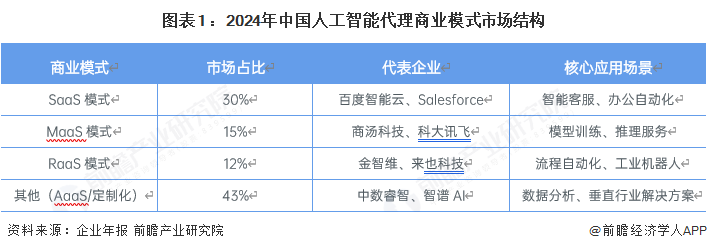
2025年中国人工智能代理行业商业模式分析 从“SaaS铁三角”到园区竞速的万亿赛道博弈【组图】
Qian Zhan Wang· 2025-09-16 04:13
Core Viewpoint - The Chinese AI agent industry has established a "SaaS-MaaS-RaaS" tripartite business model, driven by technology, policy, and ecosystem factors, accelerating the commercialization of a trillion-level market through regional differentiated competition [1]. Business Model Summary - The AI agent industry in China can be categorized into three main models based on service form, deployment method, and application scenario: - **SaaS Model**: Dominates the market with a 30% share, driven by the demand for standardized intelligent tools. It operates on a subscription basis, focusing on efficiency improvement through basic subscription fees and value-added services [3][12]. - **MaaS Model**: Fastest growth at 15%, reflecting the acceleration of model-as-a-service commercialization. It relies on computational power and model innovation for customer acquisition, with significant cost advantages, such as SenseTime's model inference cost being 60% lower than the industry average [3][8]. - **RaaS Model**: Accounts for 12% of the market, focusing on human-machine collaborative automation in sectors like manufacturing and finance, with notable improvements in operational efficiency [3][8]. Market Dynamics - The AI agent industry is experiencing a competitive race among innovation parks, with Shanghai's Xuhui District housing over 1,000 companies and offering substantial computational subsidies. SenseTime's generative AI revenue reached 2.4 billion yuan in 2024, constituting 63.7% of its total revenue [4]. - The industry is supported by policy initiatives, such as the Ministry of Industry and Information Technology promoting "AI + manufacturing" actions and various cities providing computational vouchers and project subsidies to foster ecosystem development [7][8]. Financial Metrics - **SaaS Model**: Average gross margin of 60%-80%, customer retention rate of 75%-90%, and annual customer spending between 50,000 to 500,000 yuan [11][12]. - **MaaS Model**: Average gross margin of 40%-60%, customer retention rate of 60%-75%, and annual customer spending between 100,000 to 2 million yuan [11][12]. - **RaaS Model**: Average gross margin of 30%-50%, customer retention rate of 50%-65%, and annual customer spending between 200,000 to 1 million yuan [11][12].