中泰玉衡价值优选混合A

Search documents
跌麻了才明白:真正能拿住的收益,长这样……
聪明投资者· 2026-03-26 07:03
Core Viewpoint - The article discusses the current market conditions and emphasizes the importance of understanding what level of returns can be sustained by investors, highlighting that high risk does not necessarily equate to high returns [3][4]. Group 1: Investment Strategies and Fund Performance - Yang Peihong's analysis indicates that funds with a maximum drawdown between 15% and 30% over the past six years achieved an average return of 72.25%, translating to an annualized return of approximately 9.6% [4]. - A selection of active equity funds with a maximum drawdown of less than -20% and an annualized return exceeding 8% over the past five years resulted in 11 qualifying products [5]. - Among the funds analyzed, eight products are highlighted for their performance under the specified criteria [7]. Group 2: Fund Managers and Their Strategies - Fund managers Jiang Cheng, Xu Yan, and Yang Xinxin have been consistently tracked, with each achieving annualized returns exceeding 10% under the maximum drawdown condition of 20% [9]. - Jiang Cheng's fund, Zhongtai Xingyuan, has a return of 190.23% since its management began in December 2018, with an annualized return of 15.69% [10]. - Xu Yan's fund, Dachen Competitive Advantage, has a return of 125.24% since December 2019, with an annualized return of 13.89% [15]. Group 3: Risk Management and Investment Philosophy - Xu Yan emphasizes safety as the primary discipline in fund management, stating that avoiding bubbles leads to smaller drawdowns, albeit with potential performance pressures during certain periods [19]. - The article notes that Jiang Cheng's drawdown control is a result of his stringent valuation criteria, which helps maintain a balance between risk and return [14]. - Fund manager Yu Bo focuses on risk identification and employs a systematic approach to manage positions, adjusting equity exposure based on market conditions [44][48]. Group 4: Sector and Asset Allocation - The funds analyzed predominantly invest in sectors such as banking, chemicals, construction, and real estate, with a focus on high capital adequacy and low-cost debt [13]. - The article highlights the importance of selecting undervalued stocks with strong fundamentals, as emphasized by fund manager Wu Xuan, who has consistently outperformed the market over the past nine years [26][27]. - The investment strategies of fund managers involve a mix of top-down and bottom-up approaches, focusing on valuation and market conditions to guide asset allocation [35].


下阶段A股主要矛盾是基本面!中泰姜诚近期交流:知识要挑难的学,投资决策要挑简单的做
聪明投资者· 2025-12-04 07:03
Core Viewpoint - Value investment is not limited to stocks; any asset that generates cash returns can be evaluated using value investment principles [12][18]. Group 1: Market Analysis - The main contradiction in the A-share market is the fundamentals, requiring attention to both short-term and long-term developments [18][20]. - The worst situation for A-share fundamentals has already passed, with the lowest point occurring in the second half of last year [19]. - Current A-share market valuation is not the primary issue, as the absolute level of valuation has not changed significantly despite fluctuations in stock prices [19][20]. Group 2: Investment Performance - The performance of investment products managed by Jiang Cheng has been relatively flat this year, with a year-to-date return of 8.15% for the Zhongtai Xingyuan fund [4][5]. - Despite a challenging third quarter, the cumulative returns of Jiang Cheng's products remain robust, with the Zhongtai Xingyuan fund still showing positive absolute returns [7][8]. Group 3: Sector Insights - In the banking sector, while profit growth is modest, the improvement in net interest margins is noteworthy, with most banks showing a halt in the decline of their margins [20][21]. - The real estate sector is under scrutiny, with a focus on the profitability of land acquired by major developers, which currently shows optimistic profit margins [23][30]. Group 4: AI Investment Perspective - A significant amount of research has been dedicated to artificial intelligence, with 95% of recent efforts focused on this area [10][25]. - The current market conditions for AI-related investments are uncertain, with concerns about whether the high valuations are justified [25][26]. Group 5: Investment Philosophy - The essence of value assessment is the present value of future cash returns, emphasizing the importance of sustainable competitive advantages and business models [13][15]. - Avoiding mistakes is prioritized over seeking correctness in investment decisions, highlighting a cautious approach to risk management [17][18].
基金赚钱、基民也赚钱,这位百亿基金经理的做法值得关注
Zhong Guo Zheng Quan Bao· 2025-09-18 12:01
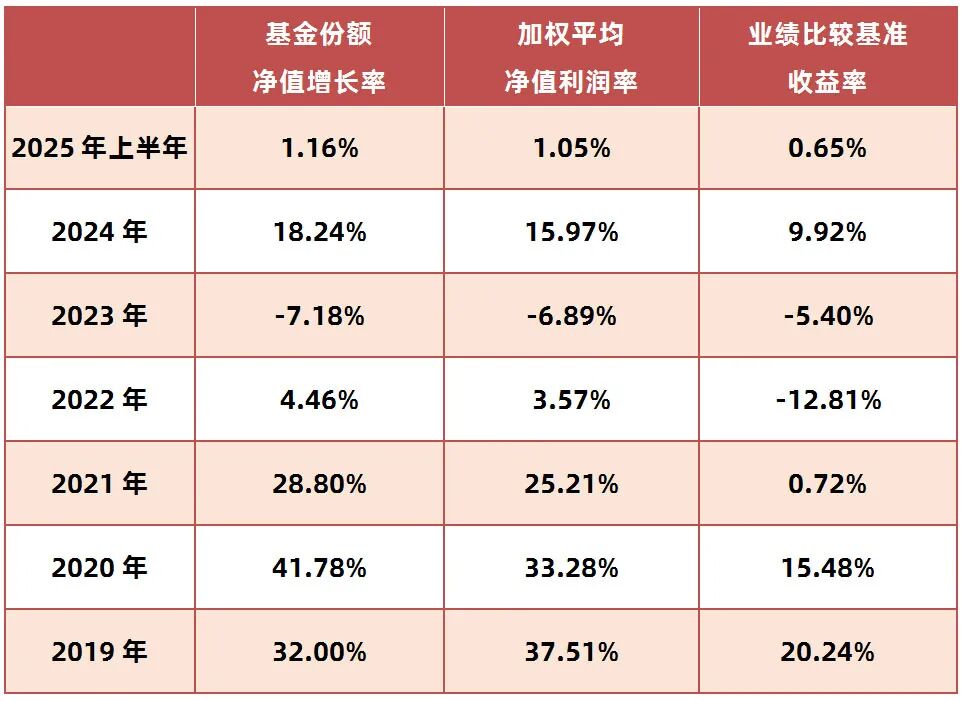
Core Viewpoint - The article discusses the disparity between fund performance and investor returns, emphasizing the importance of aligning the two to regain investor trust in the fund industry [2][4]. Fund Performance Metrics - The article highlights two key performance indicators: "Fund Share Net Value Growth Rate" and "Weighted Average Net Value Profit Rate," which reflect the fund's profitability and overall investor returns, respectively [1][2]. - Data from the fund's performance reports shows fluctuations in these metrics over the years, with the fund share net value growth rate reaching 168.24% since inception, significantly outperforming the benchmark growth rate of 21.73% [3][8]. Fund Manager's Approach - Fund manager Jiang Cheng focuses on creating stable returns for investors, achieving a maximum drawdown of only 17.18% compared to the 45.60% drawdown of the CSI 300 index [4][5]. - Jiang emphasizes a conservative investment strategy, prioritizing low volatility and steady returns over short-term performance rankings [5][6]. Investor Communication - Jiang maintains high-frequency communication with investors, contributing investment notes and participating in live Q&A sessions to build trust and reduce information asymmetry [6][7]. - The average holding period for investors in Jiang's fund is approximately 782 days, indicating a higher level of investor patience and commitment [7]. Historical Performance Data - The fund's historical performance data shows varying net value growth rates from 2019 to 2025, with notable highs in 2019 (32.00%) and 2020 (41.78%), and a low in 2023 (-7.18%) [3][8]. - The introduction of a new share class (C shares) in July 2021 has also shown competitive performance, with a net value growth rate of 30.80% since inception [7][8].
目前中国股市远达不到泡沫化的状态!中泰姜诚最新发声:我们要时刻瞄准,但不需要频繁开枪
聪明投资者· 2025-08-19 07:03
Core Viewpoint - The A-share market is suitable for value investing, where stock prices serve as an external variable to assess potential returns rather than a variable to predict [2][25][26]. Group 1: Market Performance and Investment Strategy - As of August 18, the Shanghai Composite Index reached a nearly ten-year high, closing at 3728.03 points, with the A-share market capitalization surpassing 100 trillion yuan, marking a historical peak [2]. - The current stock prices are not as cheap as they were ten months ago, and some stocks have seen a decline in implied returns. However, the Chinese stock market is not in a bubble state when viewed alongside the Hong Kong market [2][55][56]. - The investment strategy emphasizes patience and a different perspective, focusing on long-term value rather than short-term market fluctuations [8][16][39]. Group 2: Fund Performance and Manager Insights - The fund managed by Jiang Cheng has shown a year-to-date return of 6.03%, with a three-year return of 23.77% and a five-year return of 74.68%, indicating stable performance [3]. - Jiang Cheng maintains a conservative approach, focusing on traditional sectors such as banking, chemicals, construction, and real estate, with a long-term investment horizon [3][5]. - The investment philosophy includes a significant emphasis on understanding the underlying value of assets and avoiding value traps, dedicating 20% of research efforts to identifying potential pitfalls in existing holdings [20][22]. Group 3: Value Investment Principles - Value investing is defined as an investment behavior aimed at acquiring asset value, with cash returns being the primary measure of value creation [23]. - The market's price volatility can create more opportunities for value investing, as it allows investors to buy undervalued assets [25][26]. - Safety margin is viewed as a conservative attitude, acknowledging the unpredictability of future market conditions and focusing on protecting against adverse scenarios [18][19]. Group 4: Market Dynamics and Long-term Outlook - The current market environment presents both pressures and opportunities, with a need for caution at the micro level while maintaining optimism at the macro level [58][59]. - Continuous learning and adaptation to new market dynamics are essential for identifying long-term investment opportunities, especially in emerging sectors like AI and innovative pharmaceuticals [40][43][45]. - The investment approach encourages a focus on long-term goals and the ability to tolerate short-term market fluctuations without being overly influenced by them [52][63].
不出手的耐心!姜诚最近交流细剖超额收益的来源……
聪明投资者· 2025-06-23 06:34
Core Viewpoint - The core competency of value investors often lies in patience, particularly the patience to refrain from making impulsive decisions [18][19]. Group 1: Performance and Strategy - The performance of the managed products has been relatively stable, with several funds outperforming the market despite a lackluster overall performance in 2023 [2][3]. - The top holdings remain consistent, primarily in traditional sectors such as banking, chemicals, construction, and real estate, with a significant portion of the portfolio allocated to these industries [2][3]. - The long-term annualized return of the flagship product managed since December 2018 exceeds 16% [4]. Group 2: Investment Philosophy - The source of excess returns is attributed to a combination of establishing a forward-looking advantage in information, deeper analysis, and different perspectives [8]. - The investment approach emphasizes acquiring high-quality assets at low prices, which is more feasible when the majority do not share the same valuation standards [5][6]. - The belief that good stocks and returns are achieved through endurance and patience is a recurring theme [20]. Group 3: Market Insights - The current market environment has seen prolonged low performance in cyclical industries, which has exceeded most investors' expectations [10]. - The concept of "this time is different" is highlighted as a cautionary note, indicating that prolonged low performance can delay cash returns and diminish value over time [11]. - The outlook for the real estate sector suggests that risks may not be fully cleared, with a preference for a cautious approach until 2025 [13]. Group 4: Sector Analysis - In the banking sector, while the long-term contraction of interest margins is not yet over, the current pricing remains acceptable based on long-term perspectives [14][15]. - The construction industry has shown signs of cash flow improvement, aligning with expectations, which reduces concerns [15]. - The chemical sector faces challenges with many companies operating at a loss, yet some are still managing to generate profits through cost-cutting measures [15]. Group 5: Emerging Trends - The development of AI is viewed as an irreversible trend, although its immediate impact may be overestimated [16]. - The investment strategy involves a cautious approach to emerging sectors, emphasizing the need for thorough research and understanding of price dynamics [22].