
二羟丙茶碱注射液

Search documents
上海医药集团股份有限公司关于召开2025年年度业绩说明会的公告
Shang Hai Zheng Quan Bao· 2026-03-26 19:43
Core Viewpoint - Shanghai Pharmaceuticals Group Co., Ltd. is set to hold an annual performance briefing for 2025 on April 8, 2026, to discuss its operational results and financial status with investors [2][3]. Group 1: Annual Performance Briefing - The annual performance briefing will take place on April 8, 2026, from 10:00 to 11:00 AM at the Shanghai Stock Exchange Roadshow Center [2][5]. - Investors can submit questions for the briefing from March 31, 2026, to April 7, 2026, before 4:00 PM [2][6]. - The company aims to provide a comprehensive understanding of its 2025 annual report, which will be released after the market closes on March 30, 2026 [2][3]. Group 2: Product Approval Announcement - Shanghai Pharmaceuticals' subsidiary, Shanghai Hefeng Pharmaceutical Co., Ltd., has received approval from the National Medical Products Administration for the production of Dihydroxypropyl Theophylline Injection [8][9]. - The drug is classified as a Class 3 chemical drug and is indicated for conditions such as bronchial asthma and obstructive pulmonary emphysema [9][11]. - The company has invested approximately RMB 3.14 million in the research and development of this drug, which is expected to enhance its market competitiveness [11].
上海医药:二羟丙茶碱注射液获得批准生产
Zhi Tong Cai Jing· 2026-03-26 12:13
Group 1 - The core point of the article is that Shanghai Pharmaceutical's subsidiary, Shanghai Hefeng Pharmaceutical Co., Ltd., has received a drug registration certificate from the National Medical Products Administration for its Dihydroxypropyl Theophylline Injection, which is approved for production [2]. Group 2 - The Dihydroxypropyl Theophylline Injection is indicated for the relief of symptoms in bronchial asthma, asthmatic bronchitis, and obstructive pulmonary emphysema, and can also be used for asthma caused by cardiogenic pulmonary edema [1].
上海医药(02607):二羟丙茶碱注射液获得批准生产
Zhi Tong Cai Jing· 2026-03-26 09:44
Core Viewpoint - Shanghai Pharmaceuticals (02607) has received approval from the National Medical Products Administration for the production of Dihydroxypropyl Theophylline Injection, which is indicated for bronchial asthma, wheezing bronchitis, and obstructive pulmonary emphysema, among other conditions [1] Group 1: Product Approval - The Dihydroxypropyl Theophylline Injection received its drug registration certificate (Certificate No: 2026S00781) [1] - The product is expected to alleviate symptoms of wheezing and can also be used for wheezing caused by cardiogenic pulmonary edema [1] Group 2: Development and Investment - Shanghai Pharmaceuticals' subsidiary, Shanghai Hefeng Pharmaceutical Co., Ltd., submitted the registration application for this product in October 2024, which was accepted [1] - The company has invested approximately RMB 3.14 million in research and development for this product as of the date of the announcement [1] Group 3: Market Impact - According to national policies, newly registered generic drugs will receive greater support in areas such as medical insurance payments and procurement by medical institutions [1] - The approval for production is expected to enhance the market share and competitiveness of the Dihydroxypropyl Theophylline Injection, while also providing valuable experience for future generic drug applications [1]
上海医药(601607.SH):二羟丙茶碱注射液获得批准生产
智通财经网· 2026-03-26 07:46
Core Viewpoint - Shanghai Pharmaceuticals (601607.SH) announced that its subsidiary, Shanghai Hefeng Pharmaceutical Co., Ltd. (referred to as "Hefeng"), has received a Drug Registration Certificate from the National Medical Products Administration for its Dihydrocodeine Injection, which has been approved for production [1] Group 1 - The Dihydrocodeine Injection is indicated for the relief of symptoms in bronchial asthma, asthmatic bronchitis, and obstructive pulmonary emphysema [1] - The medication can also be used for alleviating symptoms caused by pulmonary edema due to heart failure [1]
上海医药:二羟丙茶碱注射液获批生产
Xin Lang Cai Jing· 2026-03-26 07:45
Core Viewpoint - Shanghai Pharmaceuticals (601607.SH) announced that its subsidiary, Shanghai Hefeng Pharmaceutical Co., Ltd., has received a drug registration certificate from the National Medical Products Administration for its Dihydroxypropyl Theophylline Injection, which is approved for production [1] Group 1: Product Approval - The drug is classified as a Class 3 chemical drug and is indicated for the relief of symptoms in bronchial asthma and asthmatic bronchitis [1] - As of the announcement date, the company has invested approximately 3.14 million yuan in research and development for this product [1] Group 2: Market Potential - According to IQVIA data, the projected hospital procurement amount for this drug type in mainland China is 325 million yuan by 2025 [1] - The company believes that the approval of this product will enhance its market competitiveness and provide experience for future generic drug applications [1] Group 3: Risks - The company acknowledges that there are risks related to sales not meeting expectations due to policy and market factors [1]
2026年中国仿制药一致性评价行业政策、产业链、发展现状、重点企业及趋势研判:仿制药一致性评价工作逐步推进,过评/视同过评的产品数量达2998个[图]
Chan Ye Xin Xi Wang· 2026-01-30 01:59
Core Insights - The Chinese generic drug industry is undergoing significant changes due to policy factors, including the implementation of the drug marketing authorization holder system and early resolution mechanisms for patent disputes, which are reshaping the competitive landscape [1][11]. Industry Overview - The number of generic drug products that have passed or are deemed to have passed evaluations in China reached 2,998 in 2024, an increase of 1,008 from 2023, representing a year-on-year growth of 50.65% [1][11]. - The proportion of contract manufacturing among these evaluated generic drug products reached 33% in 2024, up from 12% in 2020, indicating a trend towards deeper industry collaboration and resource allocation [1][11]. Generic Drug Consistency Evaluation - The consistency evaluation of generic drugs ensures that they meet the same quality and efficacy standards as original drugs, which is crucial for patient safety and effective treatment [2][3]. - The evaluation process includes determining reference formulations, conducting pharmaceutical research, and ongoing monitoring to ensure compliance with quality and safety standards [2][3]. Industry Policies - Recent policies have been introduced to enhance the quality of generic drugs and promote their market acceptance, including the 2025 guidelines for deepening drug regulation reforms [5][6]. - The establishment of a reference formulation directory is essential for conducting consistency evaluations, with 87 batches published by the National Medical Products Administration by the end of 2024 [9]. Market Dynamics - The market for chemical generic drugs in China is projected to be 868.3 billion yuan in 2024, showing a decline of 3% year-on-year, with the market share of chemical generics in the overall drug market decreasing from 60% in 2018 to 50% in 2024 [7][8]. - The competitive landscape is becoming increasingly polarized, with leading pharmaceutical companies gaining significant market share while smaller firms face challenges due to funding and research limitations [11]. Key Companies - Notable companies in the generic drug consistency evaluation sector include Tigermed Pharmaceutical Technology Co., Ltd., Huahai Pharmaceutical Co., Ltd., and Hengrui Medicine Co., Ltd., among others [1][11]. - Tigermed reported a revenue of 1.71 billion yuan in clinical trial services for the first half of 2025, reflecting a 3.07% increase year-on-year, while Hengrui Medicine achieved a revenue of 13.693 billion yuan, up 12.85% [12][14]. Future Trends - The focus of generic drug evaluations is expected to shift towards high-tech barrier products, such as controlled-release formulations and complex injectables, requiring enhanced reverse engineering and pharmaceutical research capabilities [15][16]. - The production model is transitioning from batch production to continuous manufacturing, which aims to ensure consistent quality and compliance with evaluation standards [15][16]. - Companies are encouraged to adopt a full lifecycle management approach for their products, emphasizing ongoing research and optimization post-evaluation to maintain market leadership [16].


中国仿制药行业市场竞争加剧
Di Yi Cai Jing Zi Xun· 2025-11-24 04:15
Core Insights - The article discusses the impact of the "volume-based procurement" policy on the Chinese generic drug industry, highlighting increased competition and challenges such as product homogeneity and cost-cutting in production [2][3][11] Market Overview - The Chinese generic drug market has maintained a scale of approximately 900 billion yuan, with an increase in the number of companies and products intensifying market competition [2] - As of 2024, the number of generic drugs that have passed consistency evaluations or are considered equivalent has increased by over two-thirds compared to three years prior, primarily driven by a few companies and previously approved products [2][7] Regulatory Environment - The Chinese government has emphasized improving the quality of generic drugs as a key reform goal since 2015, with consistency evaluations becoming a prerequisite for participation in centralized procurement [4][5] - Despite the increase in evaluated products, a significant proportion of generic drugs have yet to meet the evaluation standards, indicating a low market concentration [5][7] Product Trends - In 2024, the number of evaluated or equivalent generic drug varieties reached 914, a significant increase from 543 in 2021, with 70% of these concentrated in 33% of companies [7] - The report indicates that the market for biosimilars is also experiencing similar trends, with over 50% of the 87 approved biosimilars being antibody biosimilars [11] Production Dynamics - The report notes a significant increase in the participation of contract manufacturing in centralized procurement, with 31% of selected products in the tenth round being produced by contract manufacturers, up from 3% in the second round [13][15] - The need for effective quality management and regulatory oversight in contract manufacturing has become increasingly critical as the industry faces pressures from policy changes and market competition [15][16]

中国仿制药行业市场竞争加剧
第一财经· 2025-11-24 04:06
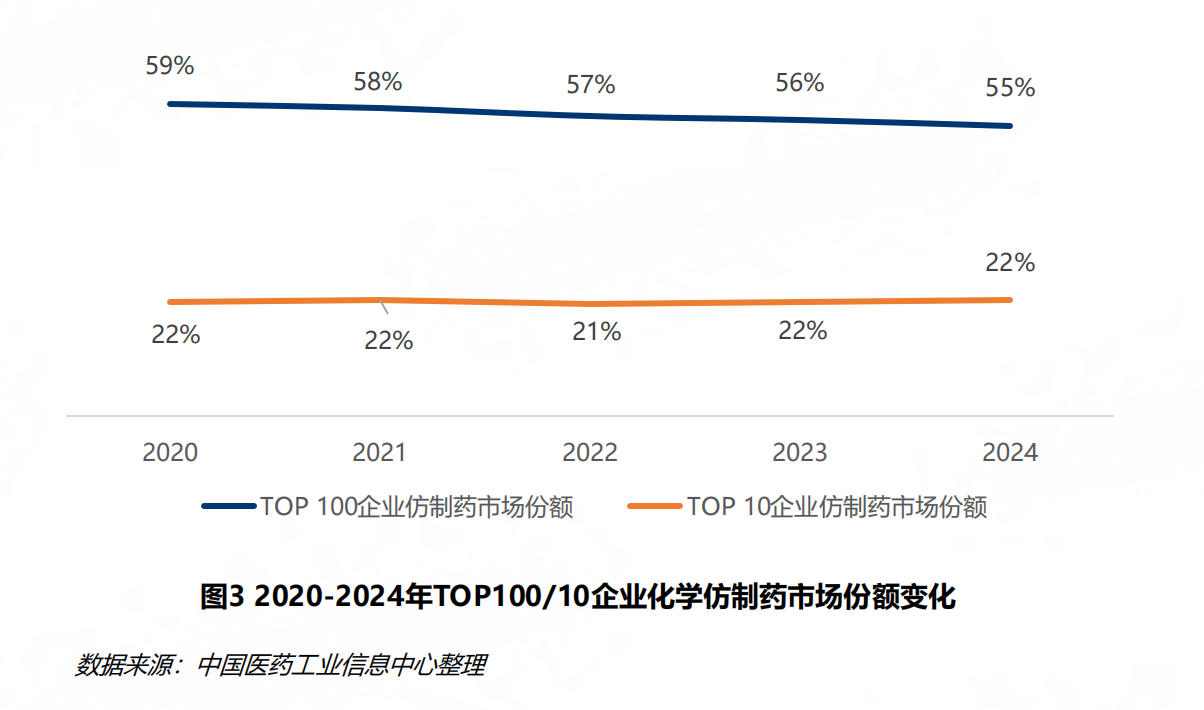
Core Viewpoint - The article discusses the accelerated clinical access and economic substitution of high-quality generic drugs in China due to the "volume-based procurement" policy, alongside the increasing proportion of biological drugs in national negotiations, which facilitates the listing and promotion of biosimilars in hospitals [3][4]. Group 1: Market Overview - The Chinese generic drug market has maintained a scale of approximately 900 billion yuan, with an increase in the number of companies and varieties intensifying market competition [3]. - As of 2024, the number of generic drugs that have passed consistency evaluation or are deemed equivalent has increased by over two-thirds compared to three years ago, primarily driven by a few companies and previously approved varieties [4][9]. - In the chemical generic drug sector, the top 10 companies hold a stable market share of around 22%, indicating a relatively low market concentration [7][9]. Group 2: Drug Evaluation and Approval - The number of approved generic drugs reached 914 in 2024, a significant increase from 543 in 2021, with 70% of these approvals concentrated among 33% of companies [9]. - The phenomenon of "homogenization of varieties" is becoming a defining characteristic of competition in the generic drug market, with a notable increase in the number of similar products [12][13]. Group 3: Biosimilars Market - By 2024, 87 biosimilars have been approved in China, with over 50% being antibody biosimilars, indicating a concentrated market in specific therapeutic areas [13]. - The application for biosimilars has reached a historical high, particularly in the metabolic field, with one drug alone accounting for nearly 40% of applications [13]. Group 4: Contract Manufacturing Trends - The participation of contract manufacturers in national drug procurement has significantly increased, with 31% of selected products in the tenth round of procurement being produced by contract manufacturers, up from 3% in the second round [16][19]. - The article highlights the challenges of ensuring quality control and regulatory compliance in contract manufacturing, especially as the number of B certificate enterprises increases [19][20].
仿制药发展2.0阶段:“过评”数量大增,同质化加剧
Di Yi Cai Jing· 2025-11-23 13:26
Core Insights - The Chinese generic drug market is experiencing intensified competition due to increased homogeneity of products and cost-cutting production strategies driven by the "volume-based procurement" policy [1][2][3] Market Overview - The Chinese generic drug market has maintained a scale of approximately 900 billion yuan, with an increase in the number of companies and products intensifying competition [1] - As of 2024, the number of generic drugs that have passed consistency evaluation or are deemed equivalent has increased by over two-thirds compared to three years ago, primarily driven by a few companies and previously approved products [1][3] Product Evaluation and Approval - By 2024, the number of approved or equivalent generic drug varieties reached 914, a significant increase from 543 in 2021, with 70% of these concentrated in 33% of companies [5][8] - The concentration of approved products remains low, with the top 10 companies holding about 22% of the market share in the chemical generic drug sector [3][5] Biological Similarity Drugs - As of 2024, 87 biological similar drugs have been approved in China, with over 50% being antibody similar drugs [8] - The application for metabolic drugs, particularly semaglutide, has surged, indicating a trend towards increased competition in this segment [8] Regulatory Environment - The National Medical Products Administration (NMPA) has released 93 batches of reference preparation directories since 2017, covering 2,787 varieties, but the coverage of domestic innovative drugs remains low [9] - The NMPA is implementing a dynamic adjustment mechanism for the reference preparation directory to better meet public medication needs [9] Contract Manufacturing Trends - The participation of contract manufacturers in national drug procurement has significantly increased, with 31% of selected products in the tenth batch being produced by contract enterprises, up from 3% in the second batch [10][13] - The regulatory focus is shifting towards ensuring quality in contract manufacturing, with increased scrutiny on compliance and quality management systems [13][14]
第11批集采结果公布:纳入55种药品
21世纪经济报道· 2025-11-12 05:38
Core Viewpoint - The 11th batch of national organized drug centralized procurement results has been announced, with implementation set for February 2026, focusing on maintaining clinical stability, ensuring quality, and preventing excessive competition [3][10]. Summary by Sections Procurement Results - A total of 55 drugs were included in the 11th batch of procurement, covering various therapeutic areas such as anti-infection, anti-allergy, anti-tumor, and more [3][4]. - Approximately 46,000 medical institutions participated, with 445 companies submitting bids for 794 products, resulting in 272 companies winning bids for 453 products [3][5]. Market Dynamics - The overall selection rate increased from 49% in the 10th batch to 57% in the 11th batch, attributed to the introduction of a revival mechanism allowing about 25% of companies to regain eligibility [6][10]. - The average price difference for selected drugs narrowed to 1.7 times, with 13 products triggering a price correction mechanism to maintain orderly pricing [6][7]. Competitive Landscape - The average number of companies competing per product doubled to 14 compared to 7.5 in previous batches, indicating heightened competition while maintaining a high selection rate [6][7]. - Major domestic companies like Qilu Pharmaceutical and international firms like Germany's B. Braun secured multiple selections, reflecting a balanced competitive environment [7][12]. Regulatory Improvements - The procurement rules have been continuously optimized, focusing on fairness and transparency, with new mechanisms such as anchor pricing and revival processes introduced [10][11]. - Quality control measures have been strengthened, requiring bidders to have relevant production experience and compliance with Good Manufacturing Practices (GMP) [11][12]. Industry Transformation - The centralized procurement system is pushing companies to adapt, with some focusing on compliant generic drugs while others accelerate innovation in drug development [12][14]. - The market is witnessing a shift towards high-quality, innovative products, with a significant increase in the number of approved innovative drugs and medical devices [14][15]. Future Outlook - The drug procurement system is evolving towards a more transparent and quality-focused approach, with ongoing adjustments based on feedback and practical conditions [15]. - The core principles of the procurement system remain stable, ensuring a balance between public welfare, corporate development, and high-quality industry transformation [15].
