人民币外汇

Search documents
2025年银行间外汇市场运行报告
Sou Hu Cai Jing· 2026-01-29 03:25
Group 1: Forex Market Overview - The forex market transaction volume steadily increased in 2025, with a total turnover of 48.52 trillion USD and an average daily turnover of 199.66 billion USD, marking a historical high and a year-on-year growth of 6.54% [2] - The average daily turnover in the RMB forex market reached 148.75 billion USD, with significant growth in trading volumes for foreign currencies and foreign currency interest rate markets, increasing by 27.58% and 17.28% year-on-year, respectively [2] Group 2: RMB Exchange Rate Dynamics - The RMB to USD exchange rate experienced fluctuations, ultimately strengthening, with the year-end rate at 6.9890, appreciating by 4.43% compared to the previous year, while the CFETS RMB exchange rate index ended at 97.99, down 3.43% for the year [3][5] - The RMB exchange rate faced pressure in April due to heightened trade tensions and tariffs, but rebounded later in the year as trade negotiations eased and domestic economic policies improved, leading to a significant appreciation of over 1,000 basis points by year-end [4][5] Group 3: Swap Curve and Interest Rate Dynamics - The swap curve for RMB significantly rose, with the 1Y swap point reaching a new high, influenced by narrowing interest rate differentials between China and the US, which correlated highly with the 10-year US Treasury yield [6][7] - The 1Y swap point deviated from the interest rate parity theory, showing a positive correlation with the appreciation expectations of the RMB, with the average deviation being approximately 49 basis points, marking the first positive deviation since 2023 [7] Group 4: Offshore RMB Liquidity and Market Structure - Offshore RMB liquidity remained tight, with the People's Bank of China issuing a record 300 billion RMB in offshore central bank bills, maintaining a stable yet slightly tight liquidity environment [8] - The interest rate market for foreign currencies showed overall easing, with the domestic USD borrowing rates remaining low, while the spread between domestic and foreign rates widened, reaching a three-year low of -40 basis points by year-end [9]


2025年9月银行间外汇市场运行报告
Sou Hu Cai Jing· 2025-10-29 06:57
Group 1 - The interbank foreign exchange market showed stable trading with a slight month-on-month increase in daily average trading volume, reaching $192.26 billion, although it experienced a year-on-year decline of 4.4% [2] - The daily average trading volume for the RMB foreign exchange market was $143.50 billion, down 7.7% year-on-year but up 5.5% month-on-month, primarily due to a decrease in spot volatility leading to subdued spot trading [2] Group 2 - The US dollar index rebounded after hitting a year-low of 96.22, influenced by a hawkish tone from the Federal Reserve despite a 25 basis point rate cut [3] - By the end of September, the dollar index closed at 97.7750, remaining stable compared to the previous month [3] Group 3 - The RMB exchange rate reached a new high for the year at 7.1019 before slightly retreating, closing at 7.1186 at the end of the month, reflecting a 0.17% appreciation for the month [4] - The CFETS RMB index against a basket of currencies reported an appreciation of 0.21% compared to the previous month [4] Group 4 - The domestic foreign exchange differential shifted from positive to negative, with an average daily differential of -4 basis points for the month, indicating a stronger selling pressure in the first half of the month [5] - The maximum differential recorded was -97 basis points on the 26th, marking the largest differential for the month [5] Group 5 - The implied volatility of RMB foreign exchange options continued to decline, with the 1-month ATM implied volatility dropping to 2.3%, the lowest since August 2024 [6] - The overall market sentiment regarding the RMB exchange rate has warmed, contributing to the decrease in volatility [6] Group 6 - The trading volume of RMB foreign exchange swaps was active, with a daily average of $93.20 billion, up 8.9% month-on-month, driven mainly by state-owned banks [7] - The 1-year swap points reached a new high in two and a half years at -1322 basis points, reflecting a significant increase of 261 basis points from the previous month [7][8] Group 7 - The US dollar liquidity remained loose, with the SOFR rate fluctuating around 4.40% before rising to a year-high of 4.51% mid-month, then declining to 4.14% after the Fed's rate cut [9][10] - The domestic dollar borrowing rates decreased following the Fed's rate cut, with the overnight borrowing rate stabilizing at 4.06% by the end of the month [9][10]

国际结算银行调查:香港继续成为全球第四大外汇中心
Sou Hu Cai Jing· 2025-09-30 16:09
Core Insights - The International Bank for Settlements has released a survey indicating that Hong Kong remains the fourth largest foreign exchange center globally and the largest offshore renminbi business hub [1][3] Foreign Exchange Market - Hong Kong's average daily foreign exchange trading volume increased by 27.2% from $694.4 billion in April 2022 to $883.1 billion in April 2025, driven primarily by increases in foreign exchange swaps, spot transactions, and over-the-counter options [3] - Foreign exchange swaps are the most actively traded instruments, accounting for 64% of the average daily trading volume [3] Offshore Renminbi Market - Hong Kong maintains its position as the largest offshore renminbi foreign exchange and over-the-counter interest rate derivatives center, with average daily renminbi foreign exchange trading volume rising by 64.8% from $191.2 billion in April 2022 to $315.1 billion in April 2025 [3] - The average daily trading volume of renminbi over-the-counter interest rate derivatives also increased by 67.1%, from $14.7 billion in April 2022 to $24.5 billion in April 2025 [3] Interest Rate Derivatives - The average daily trading volume of over-the-counter interest rate derivatives in Hong Kong reached $84.1 billion in April 2025, with the most active instruments being denominated in US dollars, renminbi, and Australian dollars [3]
外汇市场:交投平稳 人民币汇率走升
Jin Rong Shi Bao· 2025-09-25 02:05
Core Insights - The interbank foreign exchange market in August experienced stable trading, with a slight year-on-year decline in average daily trading volume [1] - The offshore yuan exchange rate showed a significant appreciation towards the end of August, reflecting stronger market expectations [2] - The implied volatility in the options market indicated a rising short-term appreciation expectation for the yuan [4] Group 1: Trading Volume and Market Activity - In August, the average daily trading volume in the interbank foreign exchange market was $191.86 billion, a year-on-year decrease of 1.29% and a month-on-month decrease of 7.06% [1] - The average daily trading volume for the yuan was $136.03 billion, down 9.32% year-on-year and 7.65% month-on-month [1] - The foreign currency market and foreign currency interest rate market remained active, with a year-on-year growth rate exceeding 20% [1] Group 2: Exchange Rate Movements - The onshore yuan exchange rate fluctuated between 7.1650 and 7.1950 in early August, strengthening to a midpoint of 7.1030 by the end of the month, representing a 0.83% appreciation [1] - The average daily deviation of the market transaction price from the midpoint was 441 basis points, widening by 236 basis points compared to the previous month [1] - The offshore yuan (CNH) appreciated by 1.02% by the end of August, closing at 7.1276 [2] Group 3: Market Sentiment and Behavior - The average daily net selling of foreign exchange in August was $1.78 million, with a shift from net buying in the first half of the month to net selling in the second half [2] - The market's herd effect index was recorded at 63.52, slightly down from July but above the historical average of 62.65 [2][3] Group 4: Options Market and Interest Rate Differentials - The average daily trading volume in the yuan foreign exchange options market was $5.83 billion, a month-on-month decrease of 22.51% [4] - The implied volatility for at-the-money options rebounded, indicating a notable increase in market sentiment regarding short-term yuan appreciation [4] - The 10-year U.S. Treasury yield decreased to 4.23% by the end of August, contributing to a narrowing of the interest rate differential between China and the U.S. [4]
6月市场交投平稳 日均成交量上升
Jin Rong Shi Bao· 2025-07-30 02:30
Core Viewpoint - In June, the interbank foreign exchange market in China showed stable trading performance amid increasing geopolitical risks, easing uncertainties in U.S. trade policies, and new progress in China-U.S. economic and trade consultations [1] Trading Volume - The average daily trading volume in the interbank foreign exchange market reached $208.217 billion in June, marking a year-on-year increase of 15.71% and remaining above $200 billion for three consecutive months [3] - The average daily trading volume for the RMB foreign exchange market was $152.444 billion, reflecting an 8.89% year-on-year increase but a 3.58% month-on-month decline [3] - The foreign currency market and foreign currency interest rate market saw trading activity increase by over 30% year-on-year [3] Currency Exchange Rates - The U.S. dollar index initially rose and then fell, ending June at 96.77, a depreciation of 2.68% for the month [2] - The RMB exchange rate against the U.S. dollar fluctuated and rose, with the central parity rate on June 20 at 7.1695 [2] - The CFETS index for the RMB against a basket of currencies fell to 95.35 points by the end of June, a cumulative depreciation of 0.64% for the month [2] Interest Rate Differentials - The interest rate differential between China and the U.S. continued to narrow, with the 10-year U.S. Treasury yield dropping to 4.23% by the end of June [4] - The 10-year China-U.S. Treasury yield spread narrowed to -264 basis points, a decrease of 10 basis points from the previous month [4] Swap Points - The 1-year swap points rose to -1866 basis points by the end of June, an increase of 194 basis points, marking the highest level in nearly eight months [4] - The difference between the 1-year swap points and the theoretical value based on interest rate parity turned positive, ending at 117 basis points, the highest this year [5] - The overnight interest rate differential between domestic and foreign dollars remained negative throughout June, with the month-end rate at -18 basis points [5]
外汇局副局长李斌:上半年境内人民币外汇市场交易量达到21万亿美元
news flash· 2025-07-22 07:13
Core Viewpoint - The foreign exchange market in China has shown significant activity in the first half of the year, with a notable increase in trading volume compared to the previous year [1] Group 1: Market Activity - In the first half of the year, the total trading volume in the domestic RMB foreign exchange market reached 21 trillion USD [1] - This represents a year-on-year growth of 10.2% [1]
人民币对美元跌破7.25!火线解读→
Sou Hu Cai Jing· 2025-05-09 05:00
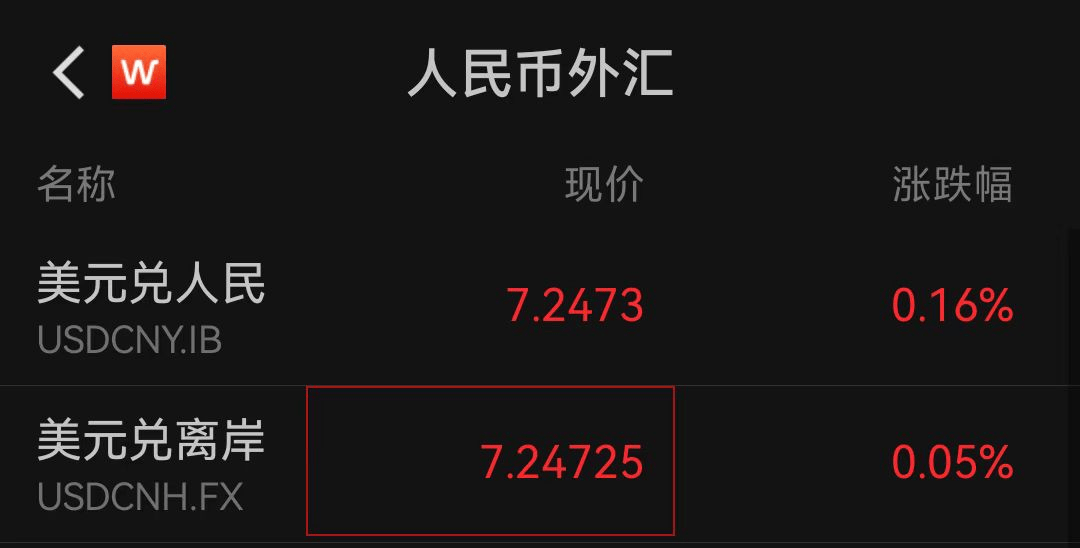
Group 1 - The onshore and offshore RMB against the USD both fell below the 7.25 mark on May 9, before slightly recovering, with the onshore RMB at 7.2473 and the offshore RMB at 7.24725 at the time of reporting [1] - The US dollar index rose significantly by 1.03% on May 8, closing at 100.639, marking a near one-month high, influenced by a strong US employment market and a limited trade agreement between the US and the UK [2] - The COMEX gold price dropped to 3278.9 USD/ounce before rebounding to 3316.10 USD/ounce, indicating a weakening of gold's safe-haven appeal due to stabilizing trade sentiments and a strengthening dollar [2] Group 2 - Analysts from CITIC Securities suggest that the factors affecting the RMB exchange rate are relatively balanced, predicting short-term fluctuations around a new central point, with the central bank focusing on correcting one-sided expectations [4] - The Minsheng Macro team highlights two standards for the RMB's level: the central bank's psychological price and the RMB's changes relative to other currencies [4] - Agricultural Bank of China's financial market department notes that while the RMB has temporarily stabilized under depreciation pressure, the expectation of depreciation remains, although factors favoring RMB appreciation are accumulating, such as a weakening US economy and potential Fed rate cuts [4]