
仿生水母机器人

Search documents
西北工业大学研发仿生水母机器人 以更“温柔”和静默的方式探索深海
Ren Min Ri Bao· 2026-01-16 22:38
Core Insights - The bionic jellyfish robot, developed by a team led by Professor Tao Kai from Northwestern Polytechnical University, is designed to operate silently and efficiently underwater, mimicking the movement of real jellyfish [2][3] - This innovation addresses the challenge of deep-sea exploration by minimizing disturbance to the marine environment, fulfilling a significant national demand for intelligent deep-sea operations [2][3] Group 1: Design and Functionality - The robot features a diameter of 120 millimeters and weighs 56 grams, with over 90% water content, allowing it to closely resemble real jellyfish in both form and material [3] - It utilizes a hydrogel as an electrode material and an electro-hydraulic drive structure, enabling silent propulsion and suspension without significant disturbance [3] - The robot is equipped with a micro-camera module and an embedded AI processing chip, allowing it to dynamically track and capture moving targets in real-time [3][4] Group 2: Applications and Future Potential - The bionic jellyfish robot serves as both an observer and a data collector, capable of monitoring environmental parameters such as salinity, depth, and temperature for coral reef health assessments [4] - It has potential applications in fisheries management, deep-sea resource exploration, and marine ecological surveys, promoting a gentler approach to exploring oceanic resources [4] - The research team is part of a key laboratory focused on micro-electromechanical systems, aiming for miniaturization and integration of equipment for aerospace, aviation, and marine applications [4]



以更“温柔”和静默的方式探索深海(探一线)
Ren Min Wang· 2026-01-16 22:34
Core Insights - The bionic jellyfish robot developed by Northwestern Polytechnical University is designed for deep-sea exploration, combining biomimicry and artificial intelligence to meet national demands for intelligent underwater operations [2][5] Group 1: Design and Functionality - The bionic jellyfish robot has a diameter of 120 millimeters and weighs 56 grams, featuring a nearly transparent body that allows it to blend into its aquatic environment [2] - It utilizes a hydrogel as an electrode material and achieves over 90% water content, closely mimicking the structure and movement of real jellyfish [3] - The robot operates silently and with minimal disturbance, making it suitable for deep-sea observation without interfering with marine life [3] Group 2: Testing and Capabilities - In static tests, the robot's camera module successfully identified and tracked stationary objects, demonstrating its ability to provide real-time data with confidence metrics [3] - During dynamic tests, the robot effectively followed moving targets, such as clownfish, without losing track, showcasing its potential for observing marine organisms in their natural habitat [4] Group 3: Applications and Future Prospects - The bionic jellyfish robot serves as both an observer and a data collector, capable of monitoring environmental parameters like salinity, depth, and temperature for coral reef health assessments [5] - Future applications may include deep-sea resource exploration and marine ecological surveys, promoting a gentler approach to exploring oceanic resources [5] - The team behind the robot is part of a key laboratory focused on micro-electromechanical systems, aiming for miniaturization and integration in aerospace and marine technologies [5]

IJRR发表!仿生机器人新突破,中国团队研发出一款轻量化“仿生水母机器人”,仅重287克
机器人大讲堂· 2025-11-05 09:57
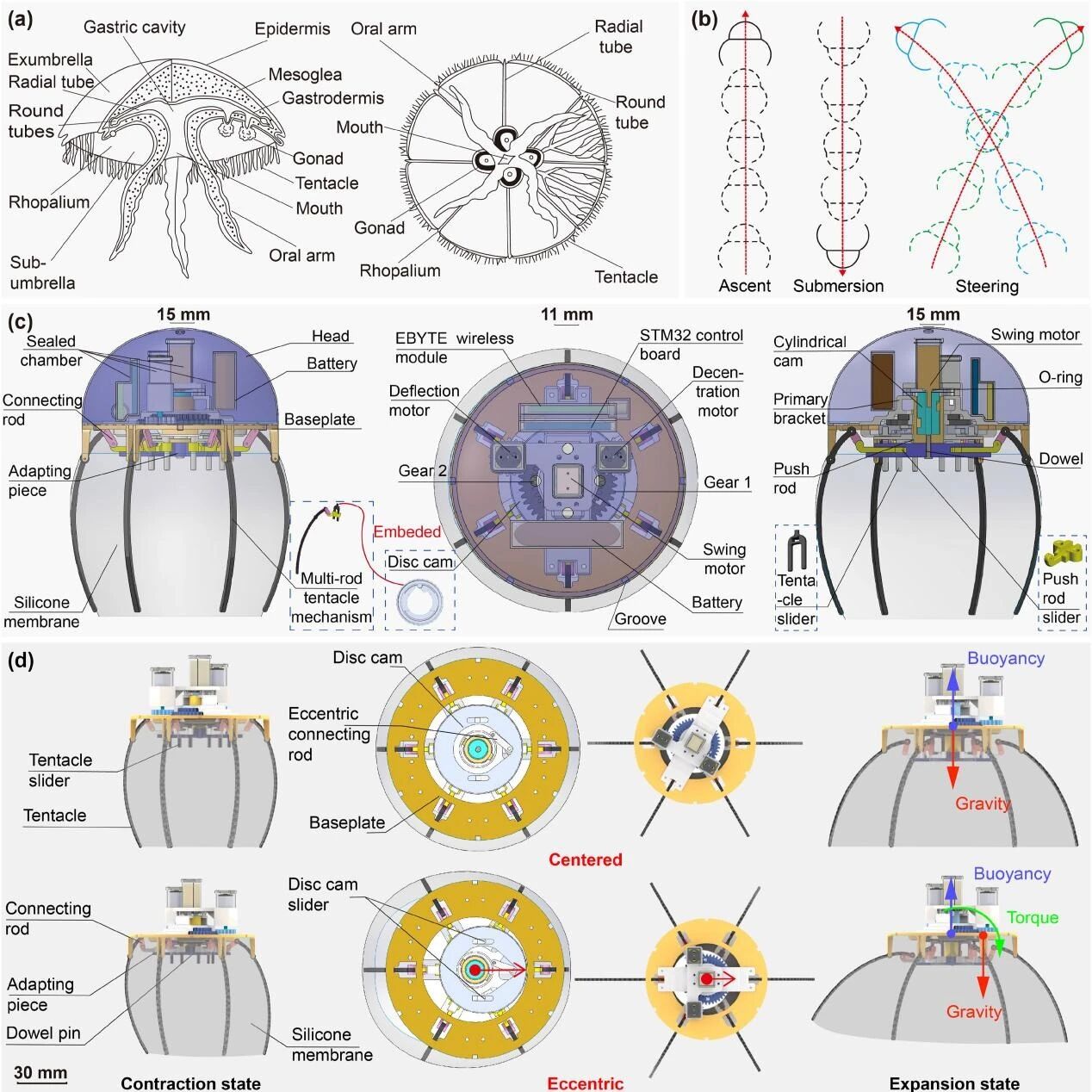
Core Viewpoint - The article discusses the development of a bionic jellyfish robot inspired by the natural propulsion system of jellyfish, which offers significant advantages over traditional underwater robots, particularly in energy efficiency and maneuverability [1][2][4]. Group 1: Technical Innovations - Traditional underwater robots, such as Autonomous Underwater Vehicles (AUVs), face challenges including high energy consumption, short endurance, and poor maneuverability due to reliance on propellers [1]. - The bionic jellyfish robot utilizes a unique propulsion mechanism that mimics jellyfish movement, achieving energy consumption that is only 1/10th of traditional propeller systems [1][4]. - The robot's design includes a lightweight structure with a total weight of 287 grams and dimensions of 110 mm in diameter and 159 mm in height, making it one of the lightest in its category [12]. Group 2: Propulsion and Steering Mechanism - The propulsion system is driven by a cylindrical cam mechanism that simulates the jellyfish's contraction and expansion, generating a thrust of approximately 0.75 N, sufficient to move two eggs [5][12]. - The steering mechanism employs an eccentric cam that allows for asymmetric movement of the tentacles, enabling the robot to turn without traditional steering systems [6][8]. - The robot can achieve a maximum turning speed of 22.7°/s and can perform complex maneuvers, including 90° and 180° turns, with a maximum turning angle of 200° [15]. Group 3: Performance Testing - In controlled tests, the robot achieved a maximum average swimming speed of 7.5 cm/s, which is competitive among existing bionic jellyfish robots [12]. - The robot demonstrated excellent adaptability in real-world environments, maintaining stable propulsion and maneuverability even in complex aquatic settings with minimal disturbance to surrounding marine life [18][21]. - The experimental results showed a high correlation between predicted and actual performance, validating the design's effectiveness and reliability [11][12].
仿生水母机器人问世,机器人ETF基金(562360)连续4日获资金净流入,机构:头部企业产品即将进入量产阶段
2 1 Shi Ji Jing Ji Bao Dao· 2025-10-28 01:48
Group 1 - The A-share market opened lower on October 28, with the robot ETF fund (562360) remaining flat in early trading, while stocks like Oatmeal Technology rose over 7% [1] - The robot ETF fund (562360) has seen a net inflow of over 10 million yuan in the last four trading days, indicating strong investor interest [1] - The fund tracks the CSI Robot Index, which includes stocks from system solution providers, digital workshop integrators, automation equipment manufacturers, and related companies [1] Group 2 - According to Dongfang Securities, China's robot industry chain has strong manufacturing advantages, and companies are continuously expanding overseas production capacity, reducing uncertainty from external factors [2] - Leading robot companies are maturing their products and are about to enter mass production, suggesting a potential opportunity for investment in the sector [2]
