
住宅租金

Search documents
日本东京CPI连续两月回落,能源与食品价格走低
Hua Er Jie Jian Wen· 2026-01-30 02:29
Core Insights - Tokyo's CPI has declined for two consecutive months, with energy prices falling significantly and food price increases slowing down, while service prices continue to rise moderately [1][9] - The core CPI stands at 2.0%, exactly at the central bank's target, which may lead to a more cautious approach from the Bank of Japan regarding interest rate hikes [1][9] Inflation Trends - January's Tokyo core CPI (excluding fresh food) increased by 2.0%, below the expected 2.2% and down from the previous 2.3% [4] - The overall Tokyo CPI (excluding fresh food and energy) rose by 2.4%, lower than the expected 2.6% and the previous 2.6% [4] - The overall Tokyo CPI increased by 1.5%, below the expected 1.7% and the previous 2% [4] - The decline in CPI indicates a reduction in inflationary pressure across Japan [4][10] Energy Price Impact - Energy prices have significantly contributed to the inflation slowdown, with gasoline prices dropping by 14.8% year-on-year, a substantial increase from the previous month's decline of 6.4% [5] - Overall energy prices fell by 4.2%, contributing negatively to inflation by 0.22 percentage points [5] - Month-on-month data shows gasoline prices decreased by 4.8%, electricity prices fell by 0.1%, and city gas prices dropped by 0.6% [5] Food Price Trends - Food price increases have continued to slow, with prices (excluding fresh food) rising by 5.6% in January, down from 6.2% the previous month [6] - The contribution of food prices to overall inflation decreased from 1.43 percentage points to 1.30 percentage points [6] - Fresh vegetable prices fell by 13.2%, with cabbage prices plummeting by 64.4% and fresh fruit prices down by 10.8% [7] Service Price Stability - Service prices have continued to support inflation, with residential rents increasing by 1.5%, and private rents rising by 2.1%, contributing 0.08 percentage points to overall inflation [8] - Communication costs rose by 6.4%, driven by an 11.0% increase in mobile communication fees, contributing 0.15 percentage points to inflation [8] - Education and entertainment service prices increased by 2.2%, with accommodation costs rising by 6.0%, although this was a slowdown from the previous month's 7.8% [8] Central Bank Policy Implications - The comprehensive slowdown in Tokyo's inflation data may influence the Bank of Japan's policy stance, with the core inflation rate at the target level but showing a cooling trend [9] - Seasonally adjusted month-on-month data indicates that CPI (excluding fresh food) remained flat compared to the previous month, suggesting weakened short-term inflation momentum [9] - The Tokyo CPI is viewed as a leading indicator for national inflation, with the trends expected to be confirmed in upcoming national data releases [10]

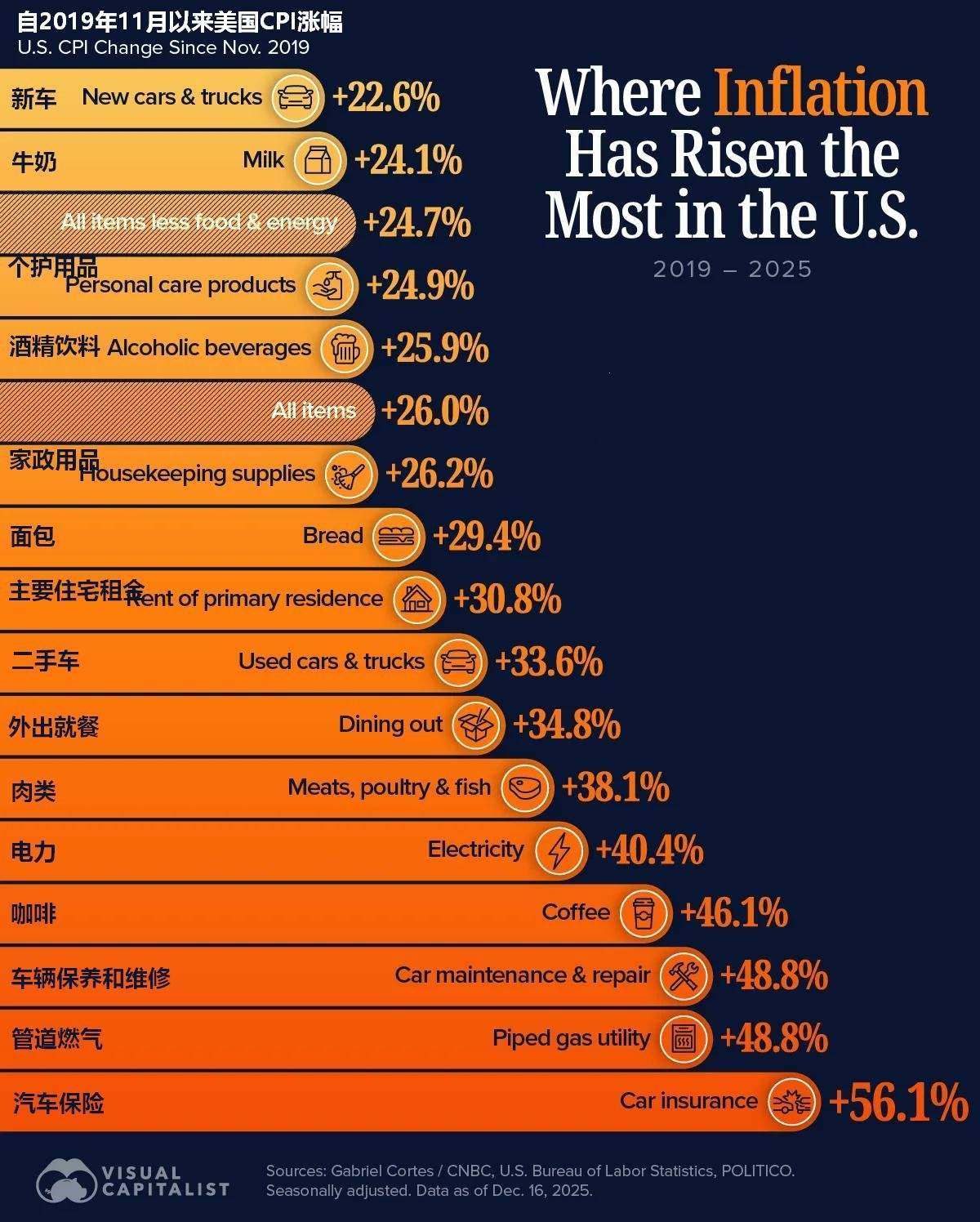
过去5年美国整体物价上涨26%!汽车保费涨幅56.1%居首,燃气价格涨48.8%,电价涨超40%,外出就餐价格涨近35%
Ge Long Hui· 2026-01-27 13:55
Group 1 - The core point of the article highlights significant price increases in various sectors, with auto insurance prices leading at a rise of 56.1% due to higher vehicle prices, repair costs, and more severe claims [2] - Vehicle maintenance and repair costs follow closely with an increase of 48.8%, reflecting rising labor costs and parts prices [2] - Energy and food prices continue to exert pressure on households, with pipeline gas service prices rising by 48.8% and electricity prices increasing by over 40% [2] Group 2 - Dining out prices have surged nearly 35%, while specific food items such as coffee (46.1%), meat (38.1%), and bread (29.4%) have seen price increases significantly above the overall inflation rate [2] - Major residential rents have increased by 30.8%, contributing to the overall cost of living pressures faced by households [2]
泰国央行拟审查通胀权重以反映生活成本
Sou Hu Cai Jing· 2026-01-05 07:35
Core Viewpoint - Thailand plans to review its inflation weighting as the central bank believes that persistently low inflation data does not reflect the high cost of living faced by households [1] Group 1: Inflation Review - The Bank of Thailand's monetary policy committee highlighted that various price categories, including housing rents, automobiles, and telecommunications services, exhibit "persistent rigidity" [1] - The committee noted that these prices have "failed to adequately reflect" the high living costs experienced by families [1]