汽车保险

Search documents
中国财险:非自动CoR看到了改进的空间-20260331
Zhao Yin Guo Ji· 2026-03-31 02:24
Investment Rating - The report maintains a "Buy" rating for PICC P&C with a target price adjusted to HKD 20.00, down from HKD 23.60, indicating a potential upside of 35.1% from the current price of HKD 14.80 [1][5][13]. Core Insights - PICC P&C reported a net profit of RMB 40.4 billion for FY25, a year-on-year increase of 25.5%, slightly below the estimated RMB 41.3 billion. The net profit growth slowed to 16.3% year-on-year in the second half of FY25 compared to 32.3% in the first half [1]. - The combined ratio (CoR) improved to 97.5%, up 1.3 percentage points year-on-year, with the automotive and non-automotive CoR at 95.3% and 100.8%, respectively, meeting and missing management's targets [1][2]. - Total investment income rose by 12.8% to RMB 38.6 billion, driven by gains from TPL assets and OCI debt instruments, leading to an increase in total investment yield to 5.8% [1][4]. Financial Performance Summary - The report highlights that the automotive CoR decreased by 1.5 percentage points to 95.3%, achieving management's target of below 96%, while the non-automotive CoR was 100.8%, down 1.0 percentage points [2][3]. - The report anticipates a cautious outlook for the non-automotive CoR, adjusting forecasts for FY26-27E to 97.0% and 96.3%, respectively, while maintaining the automotive CoR forecast [1][2]. - The dividend per share (DPS) increased by 25.9% to RMB 0.68, resulting in a payout ratio of 37.5% [1][12]. Valuation Metrics - The new target price of HKD 20.00 implies a price-to-book (P/B) ratio of 1.28 times for FY26E, reflecting a decrease in the target P/B due to revised earnings estimates [1][13]. - The report indicates that the stock is trading at 0.93 times FY26E P/B, close to its two-year average minus one standard deviation, with a yield of 5.6% [4][13].
Gjensidige Forsikring (OTCPK:GJNS.Y) 2026 Capital Markets Day Transcript
2026-02-26 09:02
Gjensidige Forsikring 2026 Capital Markets Day Summary Company Overview - **Company**: Gjensidige Forsikring (OTCPK:GJNS.Y) - **Event**: 2026 Capital Markets Day - **Date**: February 26, 2026 Key Industry Insights - **Nordic Non-Life Insurance Market**: The market is influenced by demographic changes, technological advancements, and climate change, which are expected to drive demand for personal, health, and pension-related solutions [7][8] - **Customer Expectations**: Nordic customers expect seamless digital interactions, which necessitates efficient processes across pricing, distribution, and claims [9] Core Company Goals and Strategies - **Ambitions through 2028**: Focus on operational excellence, disciplined capital management, and profitable growth [3][4] - **Financial Targets for 2026**: - Combined ratio below 82% - Cost ratio around 13% - Return on equity above 24% - Solvency ratio between 140% and 190% - Insurance service result exceeding NOK 7.5 billion and DKK 750 million in Denmark [17] Operational Highlights - **Growth and Efficiency**: Strong revenue growth driven by pricing discipline and operational efficiency, with a 31% increase in distribution efficiency since 2023 [40] - **Customer Retention**: Retention rates remain high at around 90% in Norway, despite necessary price increases [41] - **Technological Advancements**: - 67% of claims processing is automated, leading to reduced manual handling and improved customer experience [24] - AI and machine learning are integrated into pricing, risk assessment, and claims handling, enhancing efficiency and accuracy [11][33] Strategic Priorities 1. **Customer Empathy**: Focus on personalized customer interactions and damage prevention to strengthen trust and relationships [12] 2. **Resilience**: Enhance underwriting precision and risk models to absorb shocks from geopolitical tensions and economic volatility [14] 3. **Profitable Growth**: Expand in home insurance, pension, and health sectors, leveraging existing capabilities and strong brand recognition [15][22] Technology as a Key Enabler - **IT Infrastructure**: Simplification of IT systems and leveraging shared platforms to enhance operational efficiency [27] - **Data Utilization**: A group-wide data platform provides real-time data access, supporting personalized customer interactions and operational decisions [31] - **AI Integration**: Continuous investment in AI to improve customer service, claims processing, and operational efficiency [33][37] Market Position and Competitive Advantage - **Strong Brand and Customer Loyalty**: Gjensidige is recognized as one of the most trusted brands in the Nordic markets, which aids in customer acquisition and retention [10] - **Cross-Selling Opportunities**: Integrated offerings across various insurance products enhance customer value and loyalty [10][22] Future Outlook - **Growth Opportunities**: Focus on expanding market share in the mobility, property, and life/health insurance sectors, particularly through new technology and customer-centric approaches [39][47] - **Sustainability Commitment**: Aligning with the Paris Agreement and focusing on sustainable claims handling to reduce environmental impact [16] Conclusion - **Positioning for the Future**: Gjensidige is well-positioned to capitalize on emerging trends in the insurance market, leveraging technology, strong customer relationships, and operational efficiencies to drive growth and profitability [10][57]
受服务业成本走高影响 美国核心CPI环比增长0.3%
Xin Lang Cai Jing· 2026-02-13 14:18
Core Insights - The core Consumer Price Index (CPI) in the U.S. increased by 0.3% in January compared to December, marking the smallest year-over-year increase since 2021 [1] - The slight rise in inflation is attributed to price increases in airfare, personal care, entertainment, medical services, and communications [1] - Conversely, prices for used cars, trucks, household goods, and auto insurance experienced declines [1]
通胀“温和”放缓!美国1月CPI同比2.4%低于预期,核心CPI降至四年来最低水平,服务通胀坚挺
Sou Hu Cai Jing· 2026-02-13 14:10
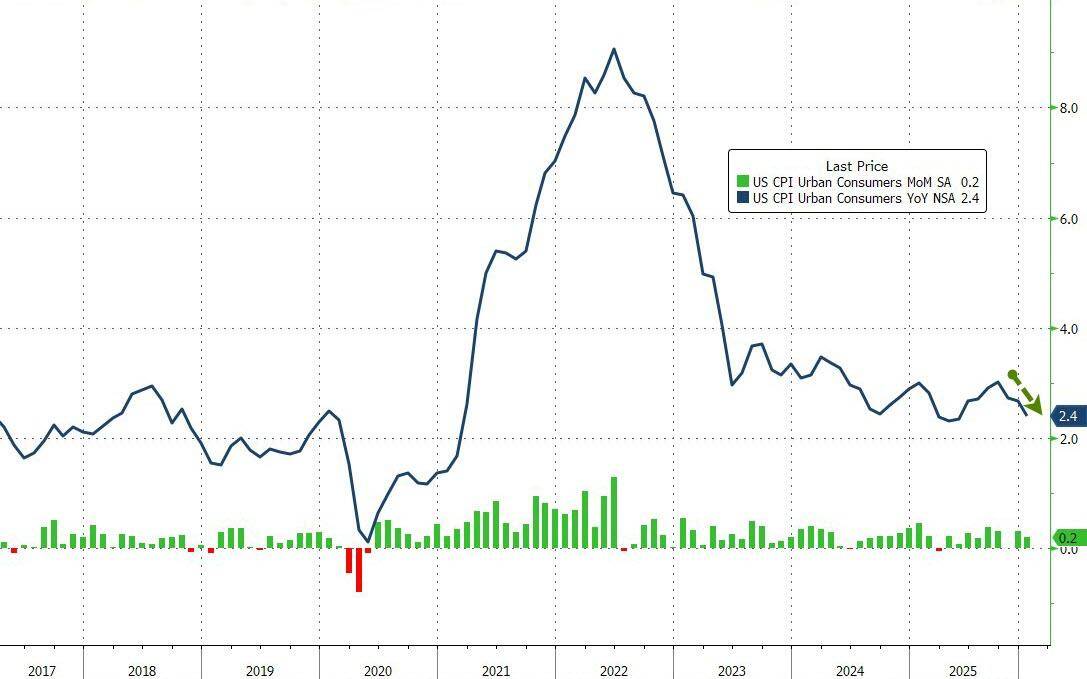
Core Insights - The overall inflation data for January in the U.S. is described as "moderate," with the CPI year-on-year falling to 2.4%, below expectations, and the core CPI dropping to 2.5%, marking the lowest level since 2021 [1][2] - The monthly core inflation remains resilient, driven by rising service prices, despite some declines in certain goods and services [3][4] Inflation Data Summary - The January CPI increased by 0.2% month-on-month, lower than the expected 0.3%, and the year-on-year rate slowed from 2.7% in December to 2.4%, also below the anticipated 2.5% [1] - The core CPI, excluding food and energy, rose by 0.3% month-on-month, matching expectations and slightly higher than the previous value of 0.2%, with a year-on-year rate of 2.5%, down from 2.6% in December [2] Market Reactions - Following the data release, U.S. stock futures saw a short-term increase, with the Nasdaq futures up by 0.13%, S&P 500 futures up by 0.12%, and Dow futures up by 0.06%. The dollar index experienced a slight decline of 0.03% [3] - Traders are estimating a 50% probability for a third interest rate cut by the Federal Reserve this year [3] Service and Goods Price Dynamics - The rise in core inflation for January was primarily driven by service-related price increases, including airfares, personal care, entertainment, healthcare, and communication [3] - Conversely, prices for certain goods and services, such as used cars and trucks, household items, and auto insurance, decreased in January, offsetting some of the upward pressure from services [4] Federal Reserve Implications - The Federal Reserve's 2% inflation target is mainly based on the PCE price index, and both CPI and PCE remain above this target level. The labor market showed signs of stability, with January employment growth accelerating and the unemployment rate dropping from 4.4% in December to 4.3% [6] - Despite the lower-than-expected inflation readings, the resilience of core inflation and a stable labor market may lead the Federal Reserve to maintain interest rates for the time being, with the current benchmark overnight rate set between 3.50% and 3.75% [6] Seasonal Adjustments - It is noteworthy that core CPI often tends to "exceed expectations" in January, with many economists suggesting that seasonal adjustment factors may not fully capture the disturbances caused by one-time price increases at the beginning of the year [7]

XchangeTec股价异动,最新财报显示净亏损超9300万美元
Jing Ji Guan Cha Wang· 2026-02-12 21:06
Stock Performance - The company's stock price experienced a significant decline of 6.41% on January 5, 2026, closing at $0.847 per share [2] - The stock had previously surged by 7.92% on January 3, 2026, and increased by 9.69% on November 24, 2025 [2] Financial Performance - The latest financial report indicates a revenue of $24.29 million, with a net loss of $93.71 million and earnings per share of -$91.31 [3] - The gross margin data has not been disclosed, and the price-to-earnings ratio is negative [3] Company Overview - The company focuses on insurance brokerage and insurtech, primarily distributing auto insurance and other types of insurance through its platform [4] - No specific upcoming events such as earnings releases, mergers, or product updates have been mentioned in the available public information [4]

Assurant(AIZ) - 2025 Q4 - Earnings Call Transcript
2026-02-11 14:02
Financial Data and Key Metrics Changes - In 2025, the company achieved 11% growth in adjusted EBITDA and 12% growth in adjusted earnings per share, both excluding catastrophes. Including catastrophes, adjusted EBITDA and adjusted EPS grew 16% and 19% respectively [4][6] - Adjusted EPS, excluding catastrophes, reached $22.81 per share, reflecting a high teens compound annual growth rate since 2020 [6] - The company generated a total shareholder return of 93% over the past five years [6] Business Line Data and Key Metrics Changes - Global Lifestyle saw mid-single-digit adjusted EBITDA growth, driven by Connected Living and Global Automotive [7] - In Connected Living, adjusted EBITDA grew mid-single digits, with nearly 2 million new protected devices added over the past year, totaling over 66 million devices globally [7][8] - Global Housing's adjusted EBITDA grew double digits, surpassing $1 billion, with a strong underlying combined ratio of 80% [10][11] Market Data and Key Metrics Changes - The company reported a 5% increase in enforced policies year-over-year in the lender-placed homeowners market, driven by a hardening voluntary homeowners market [10] - In renters, policies increased by 15%, supported by new portfolio onboarding [11] Company Strategy and Development Direction - The company is focused on investing in innovation across its lifestyle and housing businesses to drive long-term value creation [4] - The entry into the home warranty market is seen as a path to market leadership, leveraging existing capabilities and partnerships [13][14] - The company aims to expand its market position in 2026, with expectations of high single-digit earnings growth in Global Lifestyle and solid underlying growth in Global Housing [15][22] Management's Comments on Operating Environment and Future Outlook - Management expressed confidence in the company's growth trajectory heading into 2026, with expectations for continued strong performance in both Global Lifestyle and Global Housing [17][22] - The company anticipates mid to high single-digit growth in adjusted EBITDA and earnings per share for 2026, excluding prior-year reserve development [22] Other Important Information - The company returned $138 million to shareholders in 2025, including $94 million in share repurchases and $44 million in dividends [20] - The company completed four small acquisitions in 2025 to enhance its products and capabilities [21] Q&A Session Summary Question: Can you help us unpack the Connected Living growth in the context of the guidance? - Management noted that while premium growth accelerated, investments and new client programs are offsetting some of that growth [27][30] Question: How do you feel about the reserve confidence in housing? - Management expressed confidence in the reserve position and noted strong underlying growth in housing [31][33] Question: What are the main competitors in the home warranty channel? - Management indicated that the market is fragmented with many players, presenting significant growth opportunities [100] Question: What is the expected investment for the home warranty business in 2026? - Management indicated an expected investment of $15 million-$20 million for the home warranty business in 2026 [42] Question: How is AI being incorporated into the business? - Management highlighted the use of AI to improve customer experience, operational efficiency, and product personalization [58][59] Question: What is the outlook for share repurchases? - Management indicated a strong capital position and plans for share repurchases in the range of $250 million-$350 million for 2026 [116]

新能源后市场:以融合创新和生态重构驱动价值跃升
Zhong Guo Qi Che Bao Wang· 2026-02-09 03:59
Core Insights - The automotive market in China is transitioning from a growth phase to a saturation phase, with a projected vehicle ownership of 366 million by 2025, including 43.97 million new energy vehicles [1] - The rise of the automotive aftermarket is supported by this transition, as evidenced by discussions at the 2026 New Energy Aftermarket New Ecology Conference in Chongqing [1] Group 1: Market Dynamics - The shift in focus from manufacturing to the aftermarket services is evident as the automotive market matures, particularly in Chongqing, which is positioning itself as a hub for smart connected new energy vehicles [3] - Chongqing's government is actively developing a modern manufacturing system and integrating the automotive supply chain, including components, vehicles, and aftermarket services [3][4] - The city is enhancing its vehicle maintenance and service capabilities, encouraging the establishment of service networks and improving digital service offerings [4] Group 2: Industry Opportunities - The expected increase in new energy vehicle ownership to over 120 million by the end of the 14th Five-Year Plan presents significant market opportunities, with the service industry projected to grow from 1.9 trillion yuan in 2024 to 5 trillion yuan by 2030 [6] - The automotive aftermarket is evolving to emphasize diverse revenue models, including maintenance and ancillary services, driven by consumer demand for cost-effective and convenient solutions [7][9] Group 3: Technological Integration - AI technology is anticipated to play a crucial role in transforming the automotive aftermarket, enabling smarter service delivery and operational efficiencies [8] - The integration of AI will facilitate the development of algorithm-driven services, enhancing user experience and operational capabilities in the aftermarket [8] Group 4: Regulatory and Policy Framework - The automotive modification industry is gaining traction, supported by evolving policies that shift from restrictive to supportive frameworks, thus fostering high-quality development [9][11] - The industry is expected to undergo significant restructuring in terms of policies, technology, and ecosystem collaboration to adapt to new market demands and technological advancements [11]

过去5年美国整体物价上涨26%!汽车保费涨幅56.1%居首,燃气价格涨48.8%,电价涨超40%,外出就餐价格涨近35%
Ge Long Hui· 2026-01-27 13:55
Group 1 - The core point of the article highlights significant price increases in various sectors, with auto insurance prices leading at a rise of 56.1% due to higher vehicle prices, repair costs, and more severe claims [2] - Vehicle maintenance and repair costs follow closely with an increase of 48.8%, reflecting rising labor costs and parts prices [2] - Energy and food prices continue to exert pressure on households, with pipeline gas service prices rising by 48.8% and electricity prices increasing by over 40% [2] Group 2 - Dining out prices have surged nearly 35%, while specific food items such as coffee (46.1%), meat (38.1%), and bread (29.4%) have seen price increases significantly above the overall inflation rate [2] - Major residential rents have increased by 30.8%, contributing to the overall cost of living pressures faced by households [2]
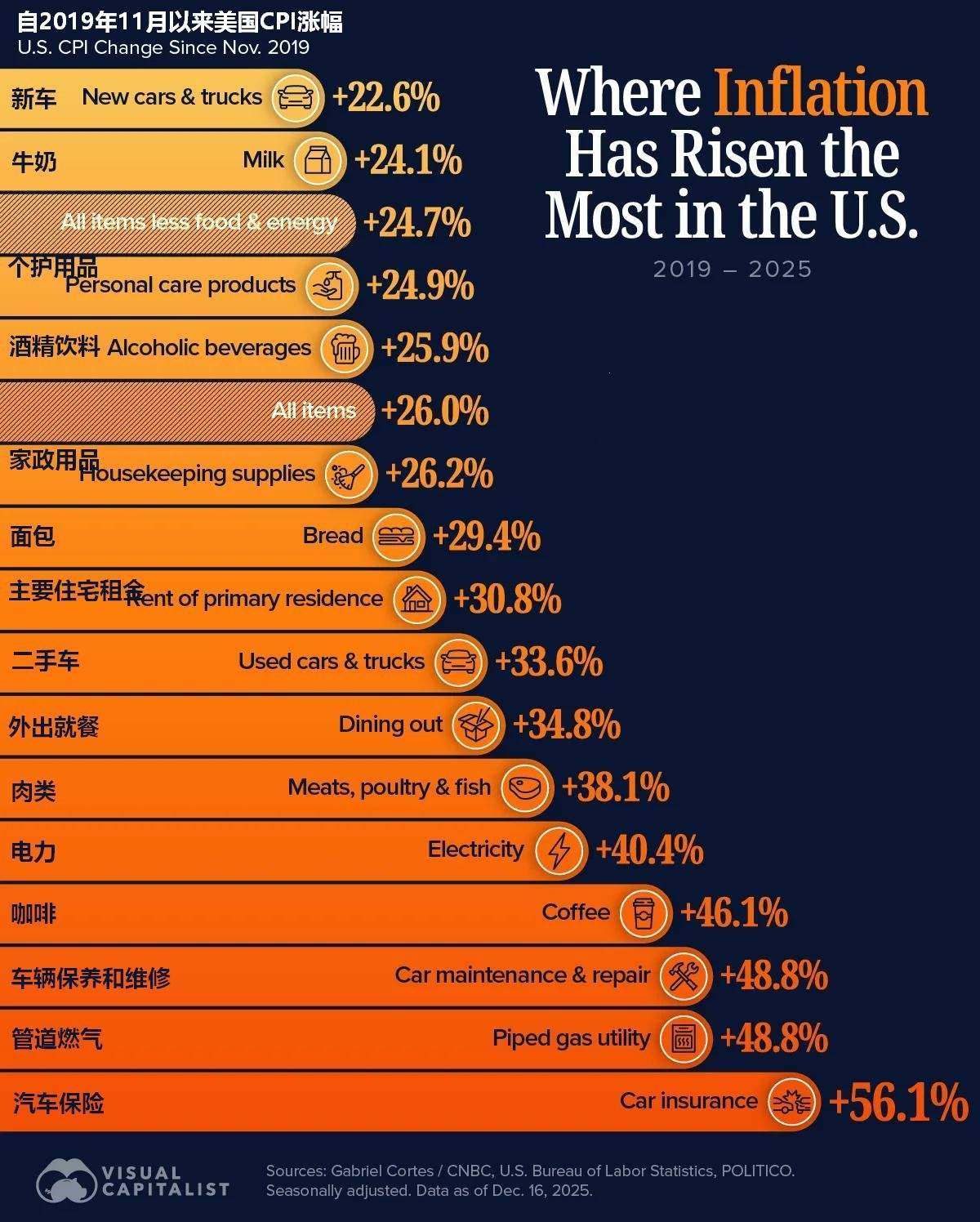
德国2025年12月通胀率预计为1.8%
Xin Lang Cai Jing· 2026-01-06 23:41
Group 1 - The core inflation rate in Germany for December 2025 is reported at 1.8%, the lowest level in over a year [1] - The average inflation rate for Germany in 2025 is expected to be 2.2%, with service prices being the main driver of inflation [1] - Service prices increased by 3.5% year-on-year in December 2025, particularly in areas such as car insurance, vacation packages, and dining services [1] Group 2 - Energy prices decreased by 1.3% year-on-year in December 2025, while food prices increased by 0.8% [1] - The core inflation rate, excluding food and energy, is estimated to be 2.4% for December 2025 [1] - Forecasts from the Ifo Institute suggest that inflation in Germany may be around 2.2% in 2026 and approximately 2.3% in 2027 [1] Group 3 - The European Central Bank aims to maintain an inflation rate of 2% [2] - As of December 2025, Germany's inflation rate aligns with the European standard at 2.0% [2] - The European Central Bank has lowered the benchmark interest rate eight times from mid-2024 to mid-2025, currently standing at 2.0% [2]
买不起成热议焦点,多张图表揭示背后缘由
Xin Lang Cai Jing· 2025-12-24 15:02
Core Insights - The issue of consumer payment capacity has become the top concern for both consumers and politicians [1] - Despite a decrease in inflation rates from the peak in 2022, prices for essential goods such as housing, food, and electricity have significantly increased since before the COVID-19 pandemic [1][21] - Surveys indicate that high prices and living costs have led to a more pessimistic consumer sentiment, influencing recent electoral outcomes in favor of the Democratic Party [1][12] Inflation and Consumer Prices - The annual Consumer Price Index (CPI) shows that inflation peaked at 9.1% in 2022, the highest in about 40 years, and has since decreased to 2.7% in November 2025 [21] - However, the prices of everyday goods remain significantly higher than pre-pandemic levels, with a cumulative increase of 26% over the past six years [21][24] - Certain essential items have seen price increases that exceed the overall inflation rate, including housing, groceries, and utilities [24][27] Consumer Sentiment and Political Impact - A recent poll indicated that approximately 46% of respondents attribute their poor financial situation to high prices, the highest level recorded since the late 1970s [27] - The political divide is evident, with 82% of voters for Kamala Harris acknowledging rising living costs, compared to only 45% of Trump voters [29] - The Democratic Party's focus on consumer payment capacity has been a key factor in their electoral successes in recent elections [12][30] Economic Factors Influencing Prices - The rapid increase in prices is attributed to a combination of factors, including supply-demand imbalances exacerbated by the COVID-19 pandemic and subsequent economic stimulus measures [33][35] - The ongoing geopolitical tensions, such as the conflict in Ukraine, have further contributed to rising energy and food prices [35] - Economic indicators suggest that while high-income households have benefited from stock market gains, low-income groups have not experienced similar financial relief [35][36]