
元境AI大模型中枢平台

Search documents
“新汽车”产业高质量发展:坚持智能化、绿色化、融合化方向丨四中全会时间
Hua Xia Shi Bao· 2025-10-24 13:39
Core Insights - The Fourth Plenary Session of the 20th Central Committee of the Communist Party of China emphasizes the construction of a modern industrial system and the strengthening of the real economy, providing strategic guidance for the development of the automotive industry [2][3] - The automotive industry is positioned as a crucial component of the real economy and advanced manufacturing, focusing on intelligent, green transformation and integration with transportation, networks, and energy sectors [2][3] - The shift towards intelligent and connected vehicles is seen as a key driver for the automotive industry's transformation, with companies accelerating the integration of AI and smart technologies [3][4] Group 1: Strategic Directions - The focus is on building a modern industrial system that strengthens the real economy, with an emphasis on intelligent, green, and integrated development [3][7] - The automotive industry is recognized as a pillar of the national economy, essential for advancing the modern industrial system [3][7] - The integration of technology and industry is crucial for enhancing innovation capabilities and seizing technological leadership [7][8] Group 2: Technological Innovations - Companies like Geely and BYD are advancing their AI and smart driving technologies, with Geely's "Smart Car Full-Field AI" and BYD's "Tian Shen Zhi Yan" systems exemplifying this trend [4][5] - China FAW is transforming into a "mobile travel technology company" with a focus on AI-driven innovation, aiming to create an "intelligent life body" [5][6] - Dongfeng Motor emphasizes the role of AI and large models in redefining vehicles as intelligent entities, enhancing user experience and collaborative development [5][6] Group 3: Future Trends - The automotive industry is transitioning from "single-point innovation" to "system innovation" under intelligent integration, with a focus on creating new ecosystems for mobility [9][10] - The upcoming years will see a shift towards intelligent, integrated, and cross-domain technologies, with advancements in smart chassis and automotive chip technology [9][10] - The integration of energy, data, and social interactions is expected to redefine the automotive landscape, leading to a new ecological revolution in mobility [9][10]


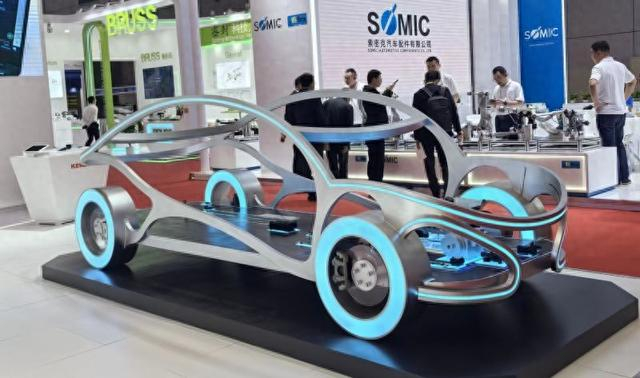
一汽、北汽、宝马等企业发声 大咖共议“新汽车”
Zhong Guo Jing Ying Bao· 2025-10-23 14:31
Core Insights - The smart connected vehicle industry in China is transitioning from a technology exploration phase to a critical period of large-scale development, with significant advancements in autonomous driving technology and vehicle-road collaboration [1] - The integration of AI into the automotive sector is reshaping the industry landscape, moving from hardware-driven to software-defined vehicles, which is expected to enhance the overall value chain [2][3] Group 1: Industry Development - China's smart connected vehicle industry is propelled by a combination of policy support, market drive, and technological breakthroughs, allowing it to transition from a follower to a leader in the global market [2] - The industry is experiencing a transformation where AI is fundamentally reshaping the underlying logic of the industry, product value models, and user experience ecosystems [2][3] Group 2: Technological Advancements - The year 2025 is anticipated to be a turning point for the commercialization of AI in the automotive sector, marking a shift from experimental scenarios to large-scale implementation [3] - Companies are developing differentiated strategies for smart connected technologies across various vehicle models, with L2-level assisted driving becoming standard [6] Group 3: Collaboration and Ecosystem - The development of smart connected vehicles is viewed as a collaborative effort rather than a competitive sprint, emphasizing the importance of open cooperation and innovation [7][8] - Industry leaders are advocating for a national-level collaborative innovation platform to address challenges such as technology barriers and standardization issues [8][9] Group 4: Market Opportunities - The automotive industry is expected to see a shift in business models, with potential monthly subscription services for autonomous driving as L4/L5 technologies mature [4] - The integration of AI capabilities across different scenarios and devices is projected to create vast opportunities within the automotive ecosystem [3]