
元萝卜AI下棋机器人

Search documents
首个综合AI教室落地宿迁光明村 京东:未来将复制全国
Guan Cha Zhe Wang· 2026-01-29 00:44
Core Insights - JD.com has established China's first comprehensive AI classroom in Guangming Village, Suqian, Jiangsu Province, as part of its "Delivering New Year Goods to Hometown" initiative in 2026, integrating advanced technology and digital education tools for rural students [2] - The company has launched the "AI Liao Yuan Plan," aiming to replicate the comprehensive AI classroom model nationwide, with a goal of building 100 such classrooms to provide access to cutting-edge technology resources [2] Group 1 - The AI classroom features multiple functional areas designed to meet diverse learning needs, including personalized learning planning and language training through various smart devices [4] - It includes popular consumer-grade 3D printing technology, enabling students to transform abstract knowledge into tangible learning tools, fostering engineering thinking and practical skills [5] - The classroom also incorporates AI interactive tools, such as a chess-playing robot, to enhance students' logical and strategic thinking [5] Group 2 - The establishment of the AI classroom addresses the lack of quality educational resources and technology exposure in rural areas, positively impacting students' perspectives and bridging the digital divide [8] - This initiative represents JD.com's innovative practice in promoting educational equity, transitioning from material support to technology-assisted education [8] - The project reflects the company's commitment to social responsibility, leveraging its supply chain and technological capabilities to integrate AI and smart hardware into rural education [8]



宿迁首个综合AI教室正式启用 京东将以光明村为起点全国打造AI教室
Jing Ji Guan Cha Wang· 2026-01-28 08:17
Group 1 - A new comprehensive AI classroom has been established in Guangming Village, Jiangsu Province, as part of JD's "I Send New Year Goods to My Hometown" initiative, showcasing the integration of advanced technology into rural education [1][4] - JD has launched the "AI Liao Yuan Plan," aiming to build 100 comprehensive AI classrooms across the country, bringing the latest technological resources to more areas [1][4] Group 2 - The AI classroom breaks traditional educational models by creating an immersive learning space that combines reading, creative practice, and intelligent interaction, fostering curiosity and innovative thinking among students [2] - Various AI learning partners are introduced, including personalized AI teachers, language learning tools, and interactive reading devices, enhancing the educational experience [2][3] Group 3 - The 3D creative area features advanced 3D printing technology, allowing students to transform abstract concepts into tangible models, thereby enhancing their understanding and problem-solving skills [3] - The AI interaction zone includes a chess-playing robot that promotes logical and strategic thinking through engaging interactions [3] Group 4 - The establishment of the AI classroom addresses the challenges of resource scarcity and limited technological exposure in rural education, significantly contributing to bridging the digital divide [4] - JD's initiative reflects its commitment to social responsibility and educational equity, evolving from material support to technology-assisted learning, aiming to deliver quality educational resources to more students [4]
外企进南山”深度行:全球服务中心成国际化合作“第一站
Nan Fang Du Shi Bao· 2026-01-14 06:22
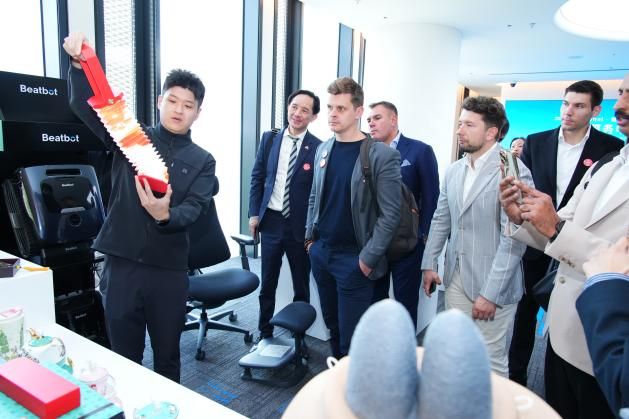
Core Insights - The visit of 23 entrepreneurs and former political figures from nearly ten countries to Nanshan highlights the region's industrial dynamics and service ecosystem [1] Group 1: Global Service Center - The Global Service Center, known as Go Global, serves as an engaging international interface, showcasing innovative products and services to foreign visitors [2] - Since its inception, the center has hosted over 30 international delegations, becoming a primary point for foreign guests to experience Shenzhen's innovation and professional services [2] - The center exemplifies a comprehensive service system that supports enterprises in market expansion, cross-border compliance, and operational establishment [3] Group 2: Technological and Cultural Strength - The Nanshan Zhigu Industrial Park demonstrates Nanshan's strength in robotics, with live demonstrations of advanced robots impressing international visitors [4] - Visitors recognized the potential applications of these robots in various sectors, including security and customer service, indicating a strong interest in technology transfer [4] - The Oriental Gem Art Museum showcases the integration of traditional culture with modern technology, enhancing the understanding of Chinese cultural heritage among foreign guests [4] Group 3: Ecosystem Development - The "Foreign Enterprises Enter Nanshan" initiative transitions from policy advocacy to experiential engagement, deepening entrepreneurs' understanding of the local ecosystem [5] - Data indicates that by 2025, Nanshan aims to establish 5,856 new foreign enterprises with a registered capital exceeding 27 billion, reflecting its attractiveness to international businesses [5] - The Global Service Center plays a pivotal role in facilitating the "landing, growth, and deepening" of foreign investments in Nanshan, fostering a collaborative environment for international partnerships [6]
“外企进南山”深度行:全球服务中心成国际化合作“第一站”
Nan Fang Du Shi Bao· 2026-01-14 05:20
Group 1 - A delegation of 23 entrepreneurs and former politicians from nearly ten countries visited Nanshan to explore its industrial dynamics and service ecosystem [1] - The Global Service Center has become a significant "showcase" and "service interface" for international guests, highlighting Shenzhen's innovative spirit and service support [3][6] - The center has hosted over 30 international delegations since its inception, serving as a primary point for foreign visitors to experience Shenzhen's offerings [6] Group 2 - The visit included a demonstration of advanced robotics at Shenzhen Zhijie Power Technology Co., showcasing Nanshan's strength in the robotics industry [7][11] - The integration of traditional culture with modern technology was evident at the Oriental Treasure Art Museum, providing insights into China's cultural heritage [11] - The event aimed to transition from policy advocacy to ecological experience, enhancing international understanding of Nanshan's services and industries [12] Group 3 - By 2025, Nanshan is projected to establish 5,856 new foreign-funded enterprises with a registered capital exceeding 27 billion, indicating strong foreign investment growth [12] - Currently, Nanshan hosts 27,800 foreign enterprises, with nearly 40% of the world's top 500 companies located in the area [12] - The Global Service Center plays a crucial role in facilitating international cooperation, transforming the process of foreign enterprises entering and growing in the market [13][15]
CES 2026现场直击:京东携手越疆、众擎等品牌新品首次亮相 多款新品京东独家首发
Sou Hu Wang· 2026-01-07 09:56
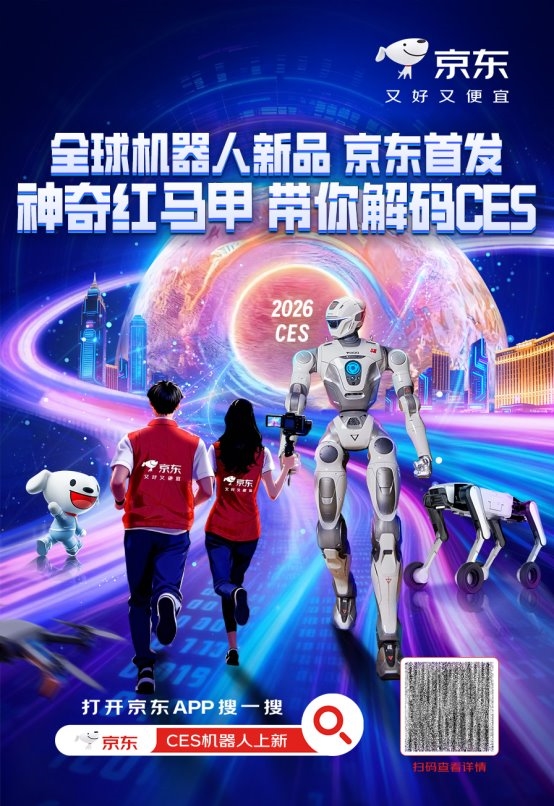
Group 1 - The CES 2026 showcased cutting-edge robotics technology, with JD.com and over 20 partners presenting innovative products and solutions aimed at accelerating the evolution and commercialization of robotics [1][5] - The event highlighted the practical value of embodied intelligent robots, with various brands demonstrating their capabilities through performances, including dance and complex interactions [3][4] - JD.com introduced several consumer-oriented smart robots, such as the Rover X1 quadruped robot and the AI chess-playing robot, indicating a shift from futuristic assistants to practical companions in daily life [4][5] Group 2 - JD.com is building an open and collaborative industrial ecosystem by integrating its supply chain, technology, and service capabilities to support partners across the entire value chain [5] - The company offers innovative solutions for commercializing robotics, including low-barrier entry for partners, co-launching new products, and creating a seamless online and offline sales network [5] - JD.com aims to deepen collaboration with global partners to promote the application of robotics in various sectors, creating sustainable economic value for diverse industries and users worldwide [5]
中国机器人靠什么走进海外高校?
Xin Lang Cai Jing· 2025-12-22 06:00
Core Insights - Chinese robots are gaining significant attention and recognition in international markets, particularly in educational settings, showcasing their advanced technology and practical applications [1][2][3] Group 1: Chinese Robots in Education - Chinese humanoid robots, such as those developed by Yushu Technology, are being integrated into university curricula in Germany and the United States, serving as effective teaching tools [2][3] - Students and educators in Germany have noted a shift in perception, with a growing focus on Chinese robotics rather than traditional leaders like Japan and the U.S. [2] - American students have expressed that they now recognize Chinese humanoid robots as leaders in engineering, highlighting their practicality and scalability [3][4] Group 2: Market Dynamics and Competitive Advantages - China produces significantly more STEM graduates compared to the EU and the U.S., and its investment in AI and robotics far exceeds that of these regions, contributing to its leadership in the robotics market [2] - Chinese robots are noted for their high engineering completeness, cost-effectiveness, and suitability for real-world applications, making them more accessible for educational purposes [3][4] - Companies like Yushu Technology and Cloud Deep are actively collaborating with top global universities, enhancing their brand recognition and fostering future customer relationships [5][6] Group 3: Open Ecosystem and Affordability - Chinese robotics firms are adopting more open business models compared to some Western competitors, allowing for easier integration of additional technologies [6] - The affordability of Chinese robots is a significant factor in their international appeal, with companies innovating to reduce costs without compromising quality [6] - The ongoing innovation in Chinese robotics is expected to sustain a favorable market position, making these technologies more accessible to consumers [6]

财经观察:中国机器人靠什么走进海外高校?
Huan Qiu Shi Bao· 2025-12-21 23:02
Core Viewpoint - Chinese robotics technology is gaining significant recognition and acceptance in international markets, particularly in educational institutions in Germany and the United States, showcasing China's advancements in the field and its competitive pricing compared to Western counterparts [1][2][3]. Group 1: Chinese Robotics in Education - Chinese humanoid robots, such as those developed by Yushu Technology, are being integrated into university curricula in Germany, serving as teaching tools and research subjects [2]. - The presence of Chinese robots at major technology exhibitions in Germany has attracted considerable interest from students, indicating a shift in perception towards Chinese technology as a leader in robotics [2][5]. - American students are increasingly recognizing that Chinese humanoid robots are not merely "catching up" but are leading in various engineering aspects, using terms like "practical" and "scalable" to describe them [3][6]. Group 2: Competitive Advantages of Chinese Robotics - Chinese robotics companies benefit from a larger pool of STEM graduates and significantly higher investments in AI and robotics compared to the EU and the US, while also offering lower prices for similar capabilities [2]. - The engineering completeness of Chinese robots, which are often mass-produced and commercially validated, makes them suitable for educational purposes, unlike many Western prototypes [3]. - Chinese companies like Yushu Technology and Yuanluobo are adopting open ecosystems, allowing for easier integration of additional technologies, which contrasts with the more closed approaches of some Western firms [7]. Group 3: Market Opportunities and Cultural Exchange - Collaborations between Chinese robotics firms and top global universities are seen as mutually beneficial, enhancing brand recognition among future consumers while providing valuable feedback to improve technology [6][7]. - The affordability of Chinese robots is a significant factor in their international appeal, with companies innovating to reduce costs through new designs rather than just mass production [7]. - The cultural interest generated by advanced Chinese technology is leading to inquiries about language and cultural education, indicating a broader impact beyond just technological exchange [8].

具身智能成为新经济增长点 JoyInside 2.0或驱动消费级机器人产业爆发
Zhong Jin Zai Xian· 2025-10-31 07:03
Core Insights - The "14th Five-Year Plan" emphasizes the need for forward-looking layout in future industries, promoting "embodied intelligence" as a new economic growth point, injecting strong policy momentum into related sectors [1] - The consumer humanoid robot market is transitioning from laboratory experiments to mass market, with products like Unitree R1 and Booster K1 driving down prices, indicating the industry is on the brink of large-scale adoption [1] - The launch of the "Xiao Bu Mi" humanoid robot, priced under 10,000 yuan, has seen significant demand, with over 100 units ordered within the first hour of its pre-sale and 500 units sold out in two days, highlighting a shift in market competition from hardware specifications to emotional interaction capabilities [1][2] Product and Technology Development - Xiao Bu Mi's price of 9,998 yuan breaks the 10,000 yuan barrier, and its integration with JD's JoyInside 2.0 platform addresses the real demand for "warm intelligent companionship" in family settings [2] - The founder of Songyan Power, Jiang Zheyuan, noted that previous humanoid robots struggled to enter the consumer market due to insufficient technical capabilities for complex household tasks, thus the current approach focuses on providing emotional value through companionship and educational support [2] - JoyInside 2.0's architecture, featuring "long-term memory + situational awareness + multimodal learning," enables the robot to understand and interact in a family environment, adapting to children's learning progress and providing emotional support [2] Market Validation and Ecosystem Development - The effectiveness of JoyInside 2.0 has been validated across various scenarios, with the AI chess robot "Yuanluobo" showing a 148% increase in user interaction and 50% longer average engagement time, enhancing the educational experience with emotional support [3] - JD's "Embodied Intelligence Acceleration Plan" aims to lower innovation barriers in the industry by offering core technologies to partners for free, attracting numerous brands to create a collaborative ecosystem covering education and companionship [4] - During the Double Eleven shopping festival, JD introduced subsidies of up to 10% for purchasing smart terminals, facilitating rapid consumer access to embodied intelligence products [4] Competitive Landscape and Future Trends - The success of Xiao Bu Mi and the empowerment from JoyInside 2.0 indicate a clear trend in consumer humanoid robots, where competition is shifting from hardware specifications to providing genuine emotional and trustworthy companionship experiences [5] - JD's AI value formula emphasizes that the value of artificial intelligence is a product of the model, experience, and the square of industry depth, indicating a strategic shift towards emotional understanding and redefining technology boundaries [5] - The evolution of robots from mere tools to "family partners" aligns with the innovation development goals outlined in the "14th Five-Year Plan," providing a solid and replicable practice for the growth of the embodied intelligence industry [5]
元萝卜再获工信部认可,适老化创新领跑老年智能产品赛道
Sou Hu Wang· 2025-10-28 08:10
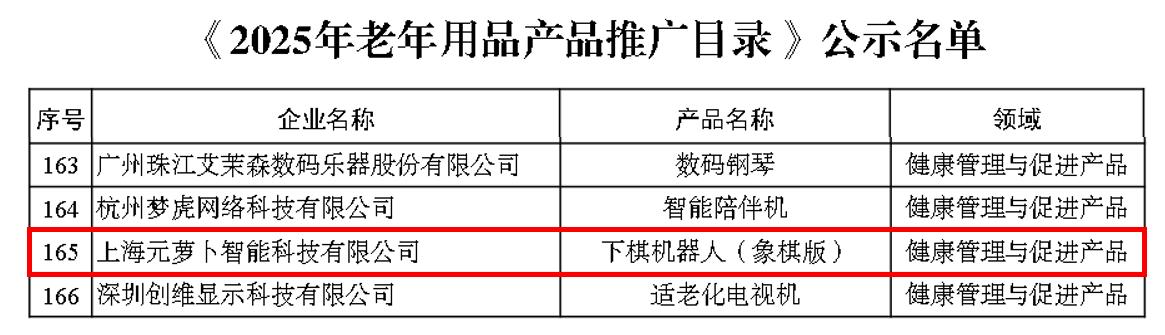
Group 1 - The core product of SenseTime's home robot brand "Yuanluobo," the AI chess robot, has been recognized for its innovative features catering to the elderly, being included in the Ministry of Industry and Information Technology's "2025 Elderly Products Promotion Directory" [1][2] - The inclusion in the promotion directory signifies a significant recognition of Yuanluobo's product strength and highlights the importance of smart technology in addressing aging challenges and enhancing the quality of life for the elderly [1][2] - The Chinese government is increasingly focusing on the aging population as a national strategy, promoting the integration of smart technology with elderly care services, which is seen as a core direction for the high-quality development of the silver economy [2] Group 2 - Yuanluobo has developed an all-dimensional elderly-friendly system for its AI chess robot, addressing the elderly's needs for convenient intellectual activities while overcoming challenges posed by traditional electronic devices [3] - The AI chess robot features simplified operation logic and an innovative physical chessboard design, significantly lowering the entry barrier for elderly users and ensuring better visual clarity [3] - Future plans for Yuanluobo include enhancing the robot's functionality with professional chess theory explanations and emotional companionship features, aiming to provide dual value as both a chess partner and assistant [3] Group 3 - The strategic move into the elderly care sector represents a significant breakthrough for Yuanluobo, transitioning from a focus on children's educational products to addressing the needs of families across all age groups [4] - This shift allows Yuanluobo to expand its technological services beyond a single demographic, creating a comprehensive technology service ecosystem that caters to both young and elderly users [4] - Yuanluobo aims to continue aligning with national elderly care strategies, exploring innovations in elderly-friendly products and fostering collaboration within the ecosystem to contribute to the high-quality development of the silver economy [4]
中国机器人,在韩国需求量渐起
Huan Qiu Wang· 2025-10-10 07:34
Group 1: Industry Overview - The APEC meeting in late October will focus on the cooperation and competition in the robotics sector between China and South Korea, with Chinese companies preparing to mass-produce robots tailored for the South Korean market by the end of this year [1][9] - South Korea's Ministry of Trade, Industry and Energy has announced a plan to invest 1 trillion KRW (approximately 0.84 billion USD) by 2030 to enhance humanoid robot technology, aiming to achieve global leadership in emerging industries, including robotics [1][3] Group 2: Market Demand and Opportunities - There is a strong demand for robots in South Korea, with numerous inquiries from Korean enterprises and educational institutions, indicating a growing interest in Chinese robotic technology [2][5] - The cloud-based robot inspection solutions, such as the industrial-grade robot dog developed by Hangzhou Yundongchu Technology, are expected to save significant labor hours in inspections, showcasing the practical benefits of adopting Chinese robotic solutions [3][4] Group 3: Competitive Landscape - South Korean companies like Hyundai and Samsung are actively investing in robotics, with Hyundai acquiring an 80% stake in Boston Dynamics for 800 million USD and Samsung investing approximately 0.62 billion RMB in Rainbow Robotics [3][4] - Chinese robots are perceived as more cost-effective and have more practical deployment experience compared to South Korean counterparts, which face challenges in commercializing advanced humanoid robots [4][5] Group 4: Collaboration and Development - Chinese companies are open to collaboration with South Korean firms, focusing on integrating their technologies and platforms to enhance operational efficiency [7][8] - The trend of "second development" is prevalent, where foreign partners seek to customize and adapt Chinese robots for local needs, indicating a flexible approach from Chinese manufacturers [7][8] Group 5: Production and Supply Chain - The demand for Chinese robots in overseas markets is surging, leading to challenges in meeting production capacity, with some partners expressing concerns over long delivery times [8][9] - Plans are in place for mass production of robots tailored for the South Korean market by the end of this year, with potential future strategies including supplying key components for local assembly [9]