光互连技术

Search documents
“中国版Ayar Labs”光联芯科获红杉、高瓴、君联共同押注
半导体行业观察· 2026-03-25 00:40
Core Insights - The article highlights the rapid advancements in AI computing power and the emerging importance of optical interconnect technology, particularly focusing on the Chinese company, Lightlink Semiconductor, which has successfully raised significant funding and is positioned as a leader in this field [2][4]. Group 1: Company Overview - Lightlink Semiconductor has completed several rounds of financing, totaling hundreds of millions of yuan, with recent investments led by Junlian Capital and participation from Sequoia China and Hillhouse Capital [2]. - The company has achieved a remarkable valuation milestone within just two years of establishment, indicating its strong technical advantages and commercialization potential in the optical interconnect sector [2][6]. - Lightlink Semiconductor aims to build a fully optical interconnect architecture for the next generation of AI computing centers, differentiating itself by integrating optical I/O directly with chip designs [4][6]. Group 2: Industry Trends - The concept of optical interconnect is gaining traction as the industry recognizes that the bottleneck in computing power is not solely in processing but also in connectivity [3][6]. - The recent government focus on "computing power and energy efficiency" marks a new phase in the development of computing technologies, elevating the profile of optical interconnects alongside GPUs and commercial aerospace [3]. - The anticipated growth in the optical interconnect market is significant, with projections indicating that by 2028, shipments could exceed 100 million units, with China expected to account for one-third of global AI computing investments [6].

“中国版Ayar Labs”浮出水面,红杉、高瓴、君联共同押注
投中网· 2026-03-23 03:53
Core Viewpoint - The article highlights the rapid growth and investment interest in Guanglian Xinke, a leading company in the optical interconnect sector, which has completed multiple rounds of financing within just two years, indicating strong market potential and technological advantages [2][4][10]. Group 1: Company Overview - Guanglian Xinke has completed four rounds of financing, accumulating several hundred million yuan, with the latest round led by Junlian Capital and supported by existing investors like Sequoia China and Hillhouse Capital [3][4]. - The company is positioned as a builder of optical interconnect architectures for the AI era, focusing on enabling next-generation AI computing centers to achieve "full optical interconnect" [8][10]. Group 2: Market Context - The optical interconnect sector is gaining significant attention, with industry experts labeling it as a key area for future growth, especially in the context of increasing demand for computing power [6]. - The Chinese market is expected to account for one-third of global AI computing investments, indicating a substantial opportunity for companies like Guanglian Xinke [10]. Group 3: Technological Innovation - Guanglian Xinke's technology aims to replace traditional copper connections with optical solutions, enhancing communication between chips and significantly improving bandwidth while reducing costs and power consumption [10]. - The company emphasizes a fully domestic technology chain and vertical integration, which enhances its resilience in the current semiconductor environment [10]. Group 4: Competitive Landscape - Guanglian Xinke is often compared to Ayar Labs, a U.S.-based company that has successfully commercialized optical interconnect technology, suggesting that Guanglian Xinke could achieve similar success in the Chinese market [7][11]. - The potential market for optical interconnect technology is projected to grow significantly, with estimates suggesting that by 2028, over 100 million units could be shipped globally [10].
直击2026上海光博会,解锁后摩尔时代创新密码
半导体行业观察· 2026-03-22 02:42
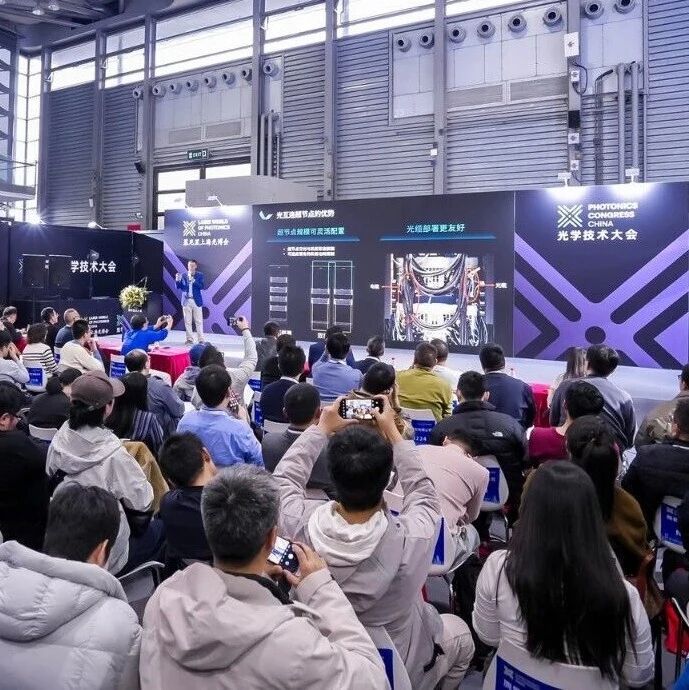
Core Viewpoint - The integration of semiconductor and optoelectronic technologies is becoming a central theme in industry development, driven by the post-Moore era and the explosive demand for AI computing power, emphasizing the importance of collaboration across the entire industry chain [1][3]. Group 1: Forum Insights - The "Industry Collaboration and Communication Upgrade" forum gathered top experts and industry leaders to discuss core topics across the semiconductor and optoelectronic fields, sharing cutting-edge technological achievements and insights into industry development opportunities [3]. - The forum highlighted the need for collaborative innovation across materials, devices, packaging, testing, and system applications to inject new ideas and directions for high-quality industry development [3]. Group 2: Two-Dimensional Semiconductors - Two-dimensional semiconductors are identified as a key technology in the post-Moore era, offering significant advantages over silicon-based semiconductors, including reduced difficulty and cost in advanced processes [6][7]. - Major companies like TSMC, Intel, and Samsung are actively investing in two-dimensional semiconductor technology, which is expected to be integrated into heterogeneous systems after the 1nm node, with potential low-power applications by 2029 [6][7]. - Original Microelectronics has launched China's first engineering demonstration line for two-dimensional semiconductors, with plans for small-batch production of 90nm CMOS processes by September this year [7]. Group 3: Silicon Photonics - Silicon photonics technology is poised for explosive growth, driven by the demand for high-speed AI interconnects, with the market for 1.6T products expected to reach $4.5 billion by 2028 [10]. - The establishment of an 8-inch low-loss silicon nitride production platform has enabled the mass production of silicon photonic chips, addressing key challenges in traditional silicon photonics [10][11]. Group 4: Capacitor Innovations - Silicon capacitors are emerging as a solution to energy integrity challenges in AI applications, with a projected market size of $11.7 billion by 2027 [14]. - Their superior temperature stability and long lifespan make them ideal for high-density power delivery networks in AI chips and optical modules [14]. Group 5: Optical Interconnects - Optical interconnects are seen as a solution to the bandwidth, power, and topology challenges faced by traditional electrical interconnects, with the optical interconnect market expected to exceed $23 billion by 2025 [21]. - Companies are developing integrated optical solutions to enhance bandwidth and reduce power consumption, with significant advancements in optical computing technologies [21][22]. Group 6: Advanced Packaging - The "EDA+" paradigm is proposed to address the limitations of traditional EDA tools in advanced packaging, enabling collaborative design across multiple chiplets and layers [24][25]. - This new approach supports various packaging forms and integrates multiple physical field analyses, enhancing the efficiency of heterogeneous integration in chip design [24][25]. Group 7: Photonic Chips for AI and Quantum Computing - Photonic chips are positioned as a core hardware support for AI and quantum computing, with significant advantages in bandwidth and energy efficiency [36][37]. - The development of a fully controllable technology system based on lithium niobate thin films aims to facilitate the mass production of photonic chips for various applications [36][37]. Group 8: Testing Innovations - The transition from hardware to software-defined testing solutions is reshaping the testing and measurement industry, with platforms like Moku enabling customizable instrument solutions [28][29]. - High-speed oscilloscopes are being developed to meet the rigorous testing demands of optical communication technologies, ensuring reliable performance in high-speed applications [40][41]. Conclusion - The forum underscored the importance of collaborative innovation across the semiconductor and optoelectronic industries, addressing the core demands of computing power and communication upgrades in the post-Moore era, while outlining a clear blueprint for future industry development [42].
270亿收购,Marvell豪赌光芯片
半导体行业观察· 2026-01-16 01:48
Core Insights - The economic benefits of AI infrastructure have reached a turning point, with copper cabling becoming a bottleneck due to power consumption and bandwidth limitations for modern AI workloads [1] - Marvell Technology's recent acquisition of Celestial AI for approximately $3.25 billion and XConn Technologies for $540 million aims to address these challenges and strengthen its position in the emerging optical interconnect semiconductor market [1] Group 1: Business Case for Optical Networks - Traditional AI systems limit processors to a single rack, restricting scalability and requiring expensive hardware redundancy [3] - Next-generation architectures will distribute hundreds of AI accelerators across multiple racks, enabling direct memory access between processors, thus improving resource utilization [3] - Copper interconnects have significant power and transmission distance limitations, making them economically and thermally unfeasible as AI accelerators approach kilowatt-level power [3] Group 2: Marvell's Three-Pronged Connection Strategy - Marvell's acquisition strategy combines three complementary technologies: CXL for memory decoupling, optical interconnect for extended connections, and UALink for high-performance communication between accelerators [5] - CXL technology allows data centers to share memory across multiple systems without dedicated high-bandwidth memory in each server, addressing critical economic challenges posed by AI demand [5] - This approach enables the reuse of existing DDR4 memory into a shared memory pool, extending the life of depreciated assets and reducing reliance on limited HBM and DDR5 memory supplies [5] Group 3: Competitive Landscape - Marvell's acquisitions have altered the competitive landscape in the AI infrastructure chip sector, positioning it favorably against Broadcom, which currently leads in custom chip solutions but lacks the necessary optical interconnect technology [9] - MediaTek, traditionally focused on consumer electronics, is expanding into data center infrastructure but lacks the strong partnerships and comprehensive product offerings that Marvell possesses [9] - The acquisitions of XConn and Celestial AI further widen the technological gap, particularly in co-packaged optical devices, giving Marvell a competitive edge in providing complete connection solutions [9] Group 4: Financial Forecasts and Market Opportunities - Marvell anticipates that XConn will generate approximately $100 million in revenue by fiscal year 2028, with initial contributions starting in the second half of fiscal year 2027 [12] - Celestial AI is expected to represent a larger growth opportunity, with projected annualized revenue of $500 million by the fourth quarter of fiscal year 2028, doubling to $1 billion by the fourth quarter of fiscal year 2029 [12] - The revenue potential reflects a new market opportunity for semiconductor suppliers, as traditional optical interconnect technologies are now being integrated into processor packages, creating significant new chip development opportunities [12] Group 5: Analyst Perspectives - Marvell's recent acquisitions signal a fundamental shift in data center architecture from copper to optical interconnects, driven by physical and economic factors [15] - The key question for technology buyers is not whether this transition will occur, but which suppliers will successfully implement it and when optical storage extension technologies will meet enterprise workload demands [15] - The responses from Broadcom and MediaTek will determine whether Marvell's first-mover advantage in co-packaged optical interconnects can be sustained or if it will trigger a reshaping of the custom chip landscape through mergers and acquisitions [16]


13桩收购,重塑芯片格局
半导体行业观察· 2025-12-31 01:40
Core Insights - The semiconductor and EDA industry is experiencing significant consolidation in 2025, driven by the transition to next-generation high-power chips for AI data centers [1] - Major acquisitions include Synopsys' $35 billion acquisition of Ansys, Marvell's acquisition of Celestial AI, and Nvidia's planned acquisition of Groq's technology [1][2] - SoftBank is increasing its investments in the semiconductor sector, acquiring Ampere Computing for $6.5 billion to enhance its AI capabilities [2] Group 1: Major Acquisitions - Synopsys completed the acquisition of Ansys, which focuses on physical modeling, particularly for chip modeling, after overcoming regulatory hurdles [1] - Marvell's acquisition of Celestial AI for $3.25 billion aims to enhance its optical interconnect technology for AI data centers [4][5] - Nvidia's acquisition of Groq's technology, valued at approximately $20 billion, is intended to enhance its capabilities in AI inference [4][7] Group 2: Strategic Implications - The acquisition of Celestial AI is seen as a milestone for Marvell, solidifying its leadership in AI connectivity and addressing the need for scalable architectures in AI infrastructure [5] - SoftBank's acquisition of Ampere Computing is part of a strategy to provide a complete system for server manufacturers, competing with AMD and Nvidia [2] - The consolidation trend in the semiconductor industry is evident with Cadence's acquisition of ARM's Artisan IP and Qualcomm's acquisition of Alphawave [3][5] Group 3: Market Dynamics - The semiconductor industry is undergoing rapid transformation, with a focus on scalable, high-performance, and energy-efficient solutions for AI workloads [5] - There are indications that the valuation multiples for some acquisitions, such as Celestial AI, may be perceived as insufficient by investors [6] - Synopsys faces challenges in integrating Ansys tools effectively to leverage the acquisition's full potential [6]




美股异动 | 迈威尔科技(MRVL.US)涨7% 三季度业绩超预期
智通财经网· 2025-12-03 15:07
Core Viewpoint - Marvell Technology (MRVL.US) reported strong Q3 FY2026 earnings, with revenue of $2.075 billion, a 37% year-over-year increase, surpassing expectations of $2.069 billion, and adjusted EPS of $0.76, exceeding the forecast of $0.74 [1] Financial Performance - Revenue for Q3 FY2026 reached $2.075 billion, reflecting a 37% increase compared to the previous year [1] - Adjusted earnings per share (EPS) were reported at $0.76, which is higher than the expected $0.74 [1] Future Projections - The company anticipates that data center business revenue will grow by over 25% year-over-year in FY2027, significantly above the market expectation of 16% [1] - Projections for FY2028 indicate an acceleration in growth rates [1] Strategic Acquisition - On December 2, 2025, Marvell Technology announced the acquisition of Celestial AI for $3.25 billion in cash and stock, with a maximum transaction value of $5.5 billion [1] - The acquisition is seen as a strategic move to secure core intellectual property (IP) in light of the potential standardization of optical interconnect technology in next-generation AI servers [1] - This positions Marvell favorably in competing for future orders from major cloud players like Microsoft and Google [1]
顶级资本罕见联手押注光互连,光联芯科加速AI算力底层革命
36氪· 2025-11-05 09:20
Core Viewpoint - The investment in Guanglian Xinke, a company specializing in Optical Input/Output (OIO) technology, signals a significant shift in the underlying structure of AI computing power, with the potential to redefine the industry landscape [2][3][31]. Group 1: Investment and Market Dynamics - Guanglian Xinke has completed multiple rounds of financing in less than two years, indicating strong investor confidence and a rapid acceleration in the commercialization of its OIO technology [2][3]. - The collaboration of two top-tier investment firms in this financing round highlights the growing interest in the optical interconnect chip sector, which is seen as a critical component for the future of computing [3][26]. - The optical module industry is expected to reach new heights by 2025, with companies like Zhongji Xuchuang, Xinyi Sheng, and Tianfu Communication gaining significant market attention [6]. Group 2: Technological Advancements - OIO technology represents a leap from electrical to optical connections between chips, addressing inefficiencies in data transfer that currently consume over 90% of energy in large AI models [8][12]. - The transition to optical interconnects is crucial as traditional copper connections face physical limitations, leading to increased energy consumption and reduced effective transmission distances [13][16]. - Guanglian Xinke's OIO solution aims to enhance bandwidth by two orders of magnitude while simultaneously reducing energy consumption by the same factor, significantly lowering operational costs for data centers [16][21]. Group 3: Strategic Positioning and Future Outlook - The company is positioned to leverage China's advantages in the optical module and packaging sectors, which can lead to cost reductions and scalable deployment of its technology [19][21]. - Guanglian Xinke's strategy emphasizes a shift from merely increasing chip performance to optimizing system-level efficiency, potentially allowing domestic chips to surpass competitors like NVIDIA in terms of overall system performance [18][24]. - The vision for the future includes a nationwide optical interconnect network that will redefine the competitive landscape of AI computing in China, moving from a "chip stacking" approach to a "light interconnect" paradigm [31].
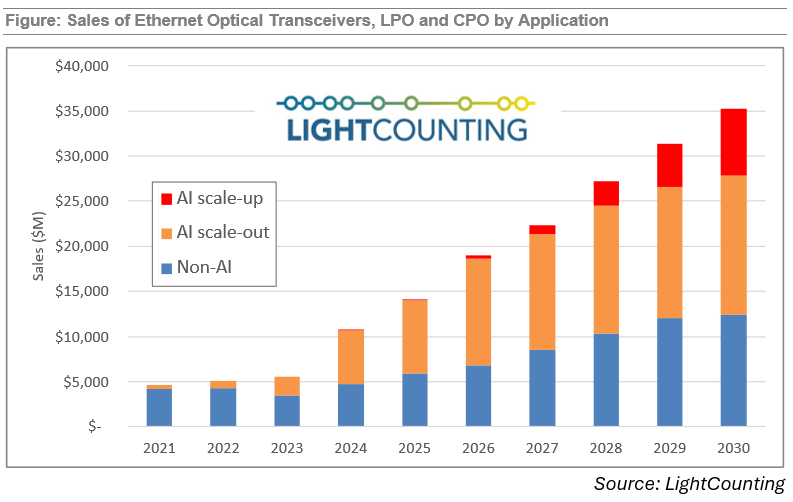
LightCounting:Scale-up成为光互连新市场
Sou Hu Cai Jing· 2025-08-01 09:58
Core Insights - The LightCounting report indicates that investments by cloud companies in data centers and supporting network infrastructure are creating a new and vibrant segment in the optical module market, driven by AI demand from 2023 to 2025, which is expected to continue until 2030 [1] Group 1: Market Growth and Projections - The optical module sales for AI are projected to show strong growth from 2023 to 2025, with a significant increase in demand for optical interconnects due to the AI boom [1] - From 2026 to 2030, the application of optical interconnect technology in AI Scale-up networks is expected to further expand the market, with CPO being the preferred choice due to higher bandwidth density and reliability [3] - LightCounting forecasts an annual market growth rate of 30-35% for 2025 and 2026, followed by 15-20% from 2027 to 2030, as the AI hype begins to stabilize [3] Group 2: Capital Expenditure Insights - Major North American cloud companies are significantly increasing their capital expenditures, with Google raising its 2025 capex to approximately $85 billion, Microsoft exceeding $30 billion in Q1 FY2026, Meta adjusting its 2025 capex range to between $66 billion and $72 billion, and Oracle exceeding $25 billion in FY2026 [3] Group 3: Supply Chain and Market Adjustments - The ongoing trade war has not significantly impacted the supply chain for optical modules sold to U.S. cloud companies, although NVIDIA's GPU sales restrictions to China have temporarily stalled demand from Chinese cloud companies [4] - LightCounting has adjusted its sales forecasts for Alibaba, ByteDance, and Tencent for 2025 downward but has increased the forecast for 2026 [4] - The forecast for 800G ZR/ZR+ optical modules has been raised for 2026-2027 due to a shift from onboard solutions to pluggable DWDM modules by major clients [4] Group 4: Emerging Market Needs - The expansion of AI clusters and the peak capacity of single data centers, along with power supply limitations, necessitate the distribution of GPU deployments, with latency being a key factor limiting the range of distributed AI clusters to within 20 kilometers [4] - Coherent-lite optical modules, categorized under the Ethernet market, are expected to effectively meet the emerging demands of this new market [4]