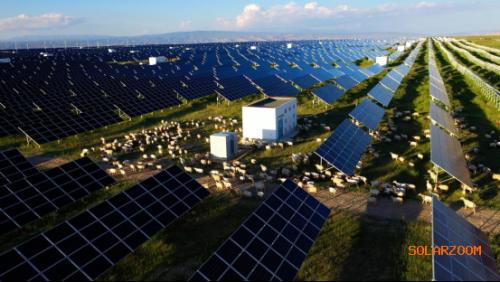
光伏羊

Search documents
“风光”之后的棋局:海南州如何落子?
Xin Lang Cai Jing· 2026-01-27 22:09
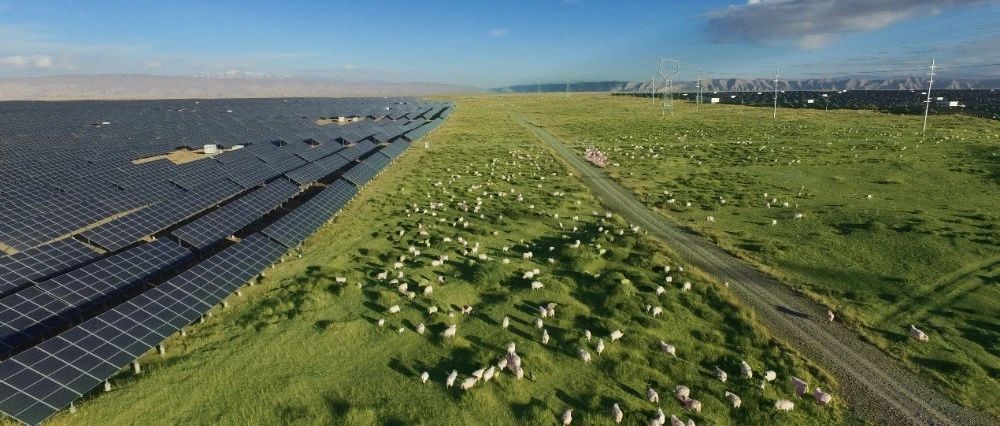
Core Viewpoint - The article highlights the transformation of Hainan Tibetan Autonomous Prefecture into a leader in clean energy, showcasing the successful integration of renewable energy with ecological restoration and economic development, particularly through the innovative "photovoltaic sheep" model [4][5][6]. Group 1: Clean Energy Development - Clean energy has become the dominant industry in Hainan Prefecture, contributing 60% to local fiscal budget revenue, 70% to fixed asset investment, 80% to industrial added value, and 90% to above-scale industrial added value [4]. - The "Green Electricity Three Rivers Source" project strategy aims to leverage local water, wind, solar, and geothermal resources to enhance energy output and establish a multi-energy complementary system [7]. Group 2: Ecological Restoration - The vegetation coverage in the Tarat Plateau has increased from less than 5% to 80%, demonstrating significant ecological recovery facilitated by the installation of solar panels [6]. - The innovative "photovoltaic sheep" model allows for the coexistence of solar energy generation and livestock grazing, enhancing both ecological and economic outcomes [5][7]. Group 3: Economic Impact - The integration of clean energy and agriculture has led to reduced agricultural production costs and increased the added value of agricultural products, contributing to rural revitalization [7]. - The establishment of 32 photovoltaic ecological pastures has resulted in the breeding of over 20,000 "photovoltaic sheep," boosting income for local farmers and herders [9]. Group 4: Social Benefits - Clean energy initiatives have achieved full coverage of clean heating across five counties, significantly lowering heating costs for residents compared to traditional methods [8]. - Distributed microgrid technologies have improved the quality of life for remote pastoral communities, transitioning them from merely having electricity to effectively utilizing it [8]. Group 5: Future Prospects - Hainan Prefecture plans to expand the successful "photovoltaic sheep" model to other areas, including using solar panels for livestock heating, promoting a collaborative development of "solar agriculture" and "geothermal agriculture" [7]. - The region's unique climate conditions provide a solid foundation for developing data centers powered entirely by green electricity, with significant investments planned for computational projects [9].


“高冷”经济看发展丨牧光互补!戈壁变“金滩”的双赢密码
Xin Hua Wang· 2025-12-09 14:15
Core Viewpoint - The Tara Beach Photovoltaic Industrial Park in Qinghai Province has successfully implemented a "photovoltaic + ecology + animal husbandry" model, significantly reducing desertification and sandification while enhancing vegetation coverage to 80% over three years and decreasing wind speed by 50% [1] Group 1: Environmental Impact - The park utilizes new development models such as "pastoral photovoltaic complementarity" to combat desertification and sandification [1] - The area has seen a remarkable increase in vegetation coverage, reaching 80% within three years [1] - Wind speed in the region has been reduced by 50% due to the construction of photovoltaic stations [1] Group 2: Economic and Agricultural Development - The introduction of sheep for grazing has proven more effective than manual weeding, leading to the emergence of "photovoltaic sheep" [1] - The number of sheep in the Tara Beach area has increased from 600 to over 20,000 in a few years [1] - The region has established 32 photovoltaic ecological pastures and 56 centralized grazing points [1] Group 3: Innovative Development Model - The "photovoltaic + ecology + animal husbandry" model serves as a new pathway for development in other regions [1] - This model addresses both desertification control and clean energy development, providing a dual solution [1]
"十四五"共和答卷|光伏板下 "牧"歌嘹亮
Xin Hua She· 2025-12-08 02:59
Core Viewpoint - The "Photovoltaic Sheep" model in Taratand, Qinghai Province, represents a successful integration of clean energy development and ecological restoration, showcasing a sustainable development path that benefits both the environment and local economy [3][13]. Group 1: Background and Development - Taratand, located in the southern part of Gonghe County at an average altitude of nearly 3000 meters, was previously a barren land due to extreme aridity and desertification, with 98.5% of the area deemed uninhabitable [3]. - The construction of China's first 10 million kilowatt-level solar power generation base began in 2012, marking a turning point for Taratand [3]. Group 2: Ecological Impact - The installation of photovoltaic panels has reduced water evaporation by 30% and wind speed by 50%, creating favorable conditions for vegetation growth, leading to an increase in vegetation coverage to 80% [5]. - The introduction of the "Photovoltaic Sheep" model has addressed the issue of overgrown weeds under the solar panels, which previously affected power generation efficiency and increased fire hazards [5][7]. Group 3: Economic Benefits - The "Photovoltaic Sheep" model has saved approximately 1.48 million yuan in feed costs annually, improved vegetation coverage by 15%, and increased the brand influence of "Photovoltaic Sheep" [7]. - The area of photovoltaic pastures in Gonghe County has expanded to 120,700 acres, supporting the breeding of 19,000 Tibetan sheep and generating an additional income of 3.92 million yuan while saving over 4.02 million yuan in feed costs [8]. Group 4: Innovations and Management - The county has optimized the management of the "Photovoltaic Sheep" model by raising the height of solar panels to over 1.2 meters and widening the gaps between panels, facilitating sheep movement while ensuring the normal operation of photovoltaic equipment [11]. - Each "Photovoltaic Sheep" is equipped with an electronic ear tag for scientific and precise management, allowing tracking of age, breeder, and vaccination information [11]. Group 5: Future Prospects - The "Photovoltaic Sheep" industry has become a symbol of green development in Gonghe County, illustrating a harmonious coexistence between humans and nature, and paving the way for a sustainable development model that integrates ecological industrialization and industrial ecology [13].
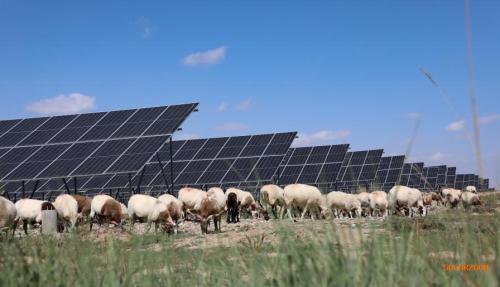
全球装机容量最大的光伏发电园区迎"光伏羊"出栏季
Zhong Guo Xin Wen Wang· 2025-09-19 07:33
Core Viewpoint - The Taratand Photovoltaic Industrial Park in Hainan Tibetan Autonomous Prefecture, Qinghai Province, is currently the largest photovoltaic power generation park in the world, showcasing a model of green development through integrated agriculture and livestock farming [1] Group 1 - The park has achieved a significant scale with over 20,000 "photovoltaic sheep" being raised, indicating a successful integration of solar energy production and livestock farming [1] - The region is experiencing a harvest season for the "photovoltaic sheep," which suggests economic benefits for local herders [1]
保险资金“大投资”撬动“大民生”
Jin Rong Shi Bao· 2025-08-08 08:01
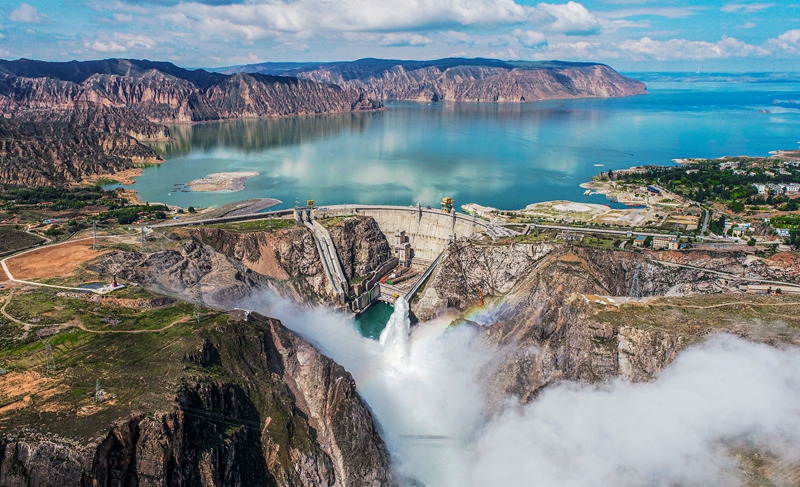
Core Insights - The article highlights the significant role of the Longyangxia Hydropower Station in providing clean energy and enhancing water resource management in the Yellow River basin, contributing to food security and flood control [1][4][5] - China Life Asset Management Company (CLAMC) has been a key investor in hydropower and renewable energy projects in Qinghai, demonstrating the effective use of insurance funds in supporting long-term infrastructure development [2][6][14] Group 1: Hydropower Development - The Longyangxia Hydropower Station, with a total capacity of 32 million kilowatts, plays a crucial role in converting Yellow River water into clean electricity, significantly improving irrigation rates from 56% to 80% in downstream provinces [1][5] - CLAMC invested 80 billion yuan in 2017 and an additional 90 billion yuan in 2019 in Qinghai Huanghe Company, marking it as a major project in the energy sector [4][6] - The hydropower station's operational upgrades have enhanced its safety and stability, ensuring reliable power supply to the northwest grid [5] Group 2: Renewable Energy and Ecological Restoration - The Qinghai Huanghe Company operates 21 solar power stations in the Hainan Prefecture, with a total capacity of 6,244 megawatts, equivalent to six large thermal power plants [9] - The "photovoltaic sheep" initiative in the ecological photovoltaic park has transformed previously barren land into productive grazing areas, increasing vegetation cover by 80% and reducing desertification by 100 square kilometers [10][12] - CLAMC's investment in solar projects has not only supported local agriculture but also provided stable employment opportunities for local residents [10][14] Group 3: Energy Storage Solutions - The Gongma Energy Storage Station, with a total capacity of 180 megawatts and 720 megawatt-hours, enhances the stability of the power system and supports the integration of renewable energy [13] - The energy storage system employs advanced technology to ensure efficient energy conversion and grid support, contributing to the safety and stability of the electricity supply [13][14] Group 4: Long-term Investment Strategy - CLAMC's commitment to long-term investments in Qinghai Huanghe Company reflects a strategic shift towards integrated energy solutions, including hydropower, wind, and solar [14][15] - The company aims to leverage its investment capabilities to address social needs and improve the quality of life for local communities [15]

大投资撬动大民生 解码中国人寿“高原水光”投资密码
财联社· 2025-07-02 01:30
Core Viewpoint - China Life Insurance is leveraging its insurance funds to invest in sustainable projects, particularly in the Qinghai region, to enhance people's livelihoods and support national development goals [1][4][11]. Investment in Renewable Energy - China Life Insurance invested 9 billion yuan in the Qinghai Yellow River Company, which is the largest power generation enterprise in Qinghai, focusing on hydropower, solar, wind, and energy storage [4][10]. - The Hainan Prefecture Ecological Photovoltaic Park, developed by the Qinghai Yellow River Company, holds the Guinness World Record for the largest installed capacity of a photovoltaic power generation park [4][10]. Ecological and Economic Benefits - The "photovoltaic sheep" initiative allows local herders to graze sheep under solar panels, promoting ecological agriculture and providing quality feed while reducing operational costs for solar companies [5][6]. - The Gengma Energy Storage Station, with a capacity of 900,000 kilowatts, enhances the ability to store and distribute renewable energy, significantly improving the efficiency of solar power generation [6][12]. Long-term Commitment to Social Welfare - China Life Insurance emphasizes a long-term investment strategy, aiming to connect insurance funds with the real economy and support significant national projects that enhance social welfare [11][13]. - As of the first quarter of 2025, China Life Insurance's investments in social welfare projects exceeded 240 billion yuan, marking a 160% increase compared to the beginning of the 14th Five-Year Plan [14]. Diverse Investment Strategies - The company employs various investment strategies, including equity and bond investments, to support critical sectors such as healthcare, infrastructure, and rural revitalization [12][13]. - The total scale of equity investments in social welfare projects reached over 93 billion yuan by the first quarter of 2025, while bond investments exceeded 110 billion yuan [12].

中国人寿的青海答卷:戈壁滩上育出“光伏羊”,“耐心资本”的绿色远征|五篇大文章调研行
Hua Xia Shi Bao· 2025-06-24 23:29
Core Viewpoint - The article highlights the successful integration of insurance capital into green finance initiatives, particularly through the investment of China Life Asset Management in the Qinghai Yellow River Company, which has transformed a barren land into a thriving clean energy and ecological restoration project [2][9]. Group 1: Investment and Strategic Impact - China Life Asset Management's investment of 9 billion yuan in the Qinghai Yellow River Company represents a significant move in the mixed-ownership reform of state-owned enterprises, marking it as the largest deal in 2019 for central enterprises [2][9]. - The investment supports the "West-East Power Transmission" strategy and demonstrates the role of insurance capital in national major projects [2][9]. - The project has a clean energy installed capacity structure of 95.44%, providing stability and resilience against economic cycles, which aligns with the long-term investment needs of insurance capital [9]. Group 2: Ecological and Social Benefits - The project has led to an 80% increase in vegetation coverage in the photovoltaic sub-area, transforming 100 square kilometers of desert into a green pasture, thus achieving ecological restoration and improving local livelihoods [3][4]. - The integration of sheep grazing within the photovoltaic panels exemplifies a harmonious coexistence of renewable energy production and ecological restoration [3][4]. - Local herders have seen an increase in income by tens of thousands of yuan annually, showcasing the project's impact on improving living standards [4]. Group 3: Technological Advancements - The Laxiwa Hydropower Station, with a height of 250 meters, is noted for its record-breaking technology and significant contribution to the stability of the Northwest power grid [6][7]. - The station's annual average power generation capacity is 10.2 billion kilowatt-hours, making it the largest hydropower station in the Yellow River basin [6][7]. - The project also includes the Gongma Energy Storage Station, which addresses the challenges of renewable energy intermittency by providing a reliable energy storage solution [6][7]. Group 4: Commitment to Green Finance - China Life Asset Management has developed a "Green Engine" plan that systematically incorporates ESG principles into its investment strategy, with a green investment scale expected to exceed 450 billion yuan by March 2025 [10]. - The company emphasizes the importance of long-term, stable value assets and focuses on sectors such as clean energy, rail transportation, and water conservancy projects [9][10]. - The investment strategy is driven by a three-tier research system that enhances asset allocation efficiency while achieving economic and social benefits [9].