
具身天工机器人

Search documents
亦庄,到底是个什么庄?
Xin Lang Cai Jing· 2026-02-27 10:12
Core Viewpoint - Yizhuang is positioned as a hub of innovation and technology, blending everyday life with advanced technology, creating a unique environment where the future meets the present [4][19]. Group 1: Technological Integration - In Yizhuang, daily activities are intertwined with technology, such as ordering milk tea from a delivery robot and enjoying food prepared by robotic arms [3][4]. - The area features advanced automation in manufacturing, exemplified by Xiaomi's fully automated car factory where robots efficiently assemble vehicles [4][5]. Group 2: Industry Ecosystem - Yizhuang hosts over 300 robotics companies, contributing to a robust ecosystem that includes various types of intelligent robots used in diverse scenarios [5][10]. - The region is a significant player in the aerospace sector, with 210 aerospace companies and 75% of the nation's commercial rockets produced here [7][8]. Group 3: Innovation and Talent Attraction - Yizhuang's complete industrial chain is a key factor in attracting innovative talent and resources, fostering a collaborative environment for startups and established companies alike [10][15]. - The local government supports innovation through financial backing and a conducive environment for experimentation, enhancing the region's appeal to entrepreneurs [15][17]. Group 4: Quality of Life - The area offers amenities such as talent apartments and educational institutions, ensuring a supportive environment for families of innovators [13][15]. - Yizhuang is characterized by a vibrant community where professionals can balance work and life, contributing to a fulfilling lifestyle [15][17].

刚融资超7亿元,这家“卖铲子”的公司想成为“华为鸿蒙”
Xin Lang Cai Jing· 2026-02-13 00:02
Core Viewpoint - The company aims to establish itself as a foundational platform in the humanoid robotics industry, likening its role to that of "selling shovels" in a gold rush, focusing on service rather than immediate commercialization [5][42]. Company Overview - Beijing Humanoid Robot Innovation Center was established at the end of 2023 with an initial investment of 460 million yuan from various stakeholders [2][39]. - The CEO, Xiong Youjun, emphasizes a work culture that allows for mistakes but does not tolerate stagnation, aiming for continuous exploration in technology [4][41]. Technological Development - The company is navigating a chaotic phase in the industry, debating whether to focus on VLA models or world models, and whether to rely more on simulation data or real data [4][41]. - A significant goal is to release the first generation of the "Embodied Tiangong" robot in 2024, followed by the "Wisdom Open Object" platform in 2025, and to enhance capabilities with the "Embodied Tiangong 3.0" in 2026 [4][41][42]. Market Positioning - The company positions itself within a projected trillion-dollar market for embodied intelligence, asserting that current technological breakthroughs are merely stepping stones and do not yet create a competitive moat [5][42]. - The company aims to create an Android-like ecosystem in the robotics field, focusing on open-source technology to foster industry growth [5][23]. Funding and Investment - The company recently completed its first market-oriented financing round, raising 700 million yuan, which was initiated in late 2025 due to favorable market conditions [7][45]. - The CEO notes that there are no performance guarantees set by investors, reflecting confidence in the company's technological advancements [9][48]. Industry Context - Comparatively, domestic humanoid robot companies are valued at over 10 billion yuan, while leading companies like Ubiquity are valued below 100 billion yuan, contrasting with U.S. companies valued in the hundreds of billions [12][47]. - The CEO argues that the perception of a bubble in the industry stems from a lack of understanding of the future market potential [12][48]. Open Source Strategy - The company has opened its platforms, "Embodied Tiangong" and "Wisdom Open Object," significantly lowering barriers for other companies to enter the humanoid robotics space [19][57]. - The open-source approach is seen as a way to accelerate industry maturity and does not conflict with the company's commercial goals [23][60]. Challenges and Solutions - The company faces numerous challenges, including technological, product, talent, and funding issues, and is focused on building a robust platform to address these gaps [15][69]. - A mid-test verification platform has been established, achieving a production capacity of 5,000 units annually, which aims to bridge the gap between laboratory prototypes and industrial applications [33][70].
全球首次,通用大模型太空在轨部署成功
财联社· 2026-01-26 10:21
Core Insights - The article highlights the successful deployment of the Qwen3 large model by Guoxing Aerospace to a space computing center, marking the first instance of a general large model being operated on an orbiting satellite [1] - The Qwen model executed multiple end-to-end inference tasks in space, with a total processing time of under 2 minutes for data transmission and result return [1] - The article also reports on the successful connection of the "Embodied Tian Gong" robot to a new type of low-orbit satellite, enabling real-time transmission of visual data without ground network support [1] Group 1 - Guoxing Aerospace's Qwen3 model was deployed to the "Star Computing" plan's space computing center in November 2025, achieving a significant milestone in space technology [1] - The Qwen model's ability to perform inference tasks in space demonstrates advancements in satellite capabilities and artificial intelligence integration [1] - The successful connection of the "Embodied Tian Gong" robot to low-orbit satellites represents a breakthrough in robotics and satellite communication, facilitating reliable outdoor operations [1]

全球首次,具身智能机器人直连卫星完成地面无网络环境自主作业
Xin Lang Cai Jing· 2026-01-26 09:43
Core Insights - The third Beijing Commercial Aerospace Industry High-Quality Development Promotion Conference successfully showcased the "Embodied Tian Gong" robot, which achieved a connection with Galaxy Aerospace's new phased array low Earth orbit satellite for high-throughput satellite networking and synchronous transmission of robotic visual data [1] Group 1 - This marks the world's first successful trial of an embodied intelligent humanoid robot directly connecting to a low Earth orbit satellite [1] - It is also the first instance in China where a new type of phased array flat-panel low Earth orbit internet satellite has achieved multi-terminal and multi-link connectivity [1] - The breakthrough validates the stable operational capability of the robot without ground network support, providing practical support for reliable communication in outdoor scenarios and cross-industry integration [1]

全球首次!具身智能机器人直连卫星,完成地面无网络环境自主作业
Mei Ri Jing Ji Xin Wen· 2026-01-26 09:43
Core Insights - The third Beijing Commercial Aerospace Industry High-Quality Development Promotion Conference was successfully held, showcasing advancements in humanoid robotics and satellite technology [1] - The Beijing Humanoid Robot Innovation Center demonstrated the "Embodied Tian Gong" robot successfully connecting to the Galaxy Aerospace's new type of internet satellite, achieving low-orbit high-throughput satellite networking [1] - This marks the world's first successful trial of a humanoid robot directly connecting to low-orbit satellites, and it is also the first instance in China where a new phased array flat low-orbit internet satellite achieved multi-terminal and multi-link connectivity [1] Industry Developments - The event highlighted significant progress in the integration of robotics and satellite technology, indicating a shift towards more advanced applications in commercial aerospace [1] - The successful demonstration validates the stable operational capabilities of humanoid robots without ground network support, suggesting potential for future applications in remote or challenging environments [1]
“微”观行业之变|大场景 新应用 人形机器人产业2026年值得期待
Xin Hua She· 2025-12-29 05:21
Core Insights - The humanoid robot industry in China is expected to transition from technology validation to large-scale commercialization by 2025, driven by systematic policies that encourage and regulate the sector, leading to key breakthroughs in self-research algorithms and hardware [1] - The industry is supported by a multi-dimensional policy framework that includes national strategies and local government measures, creating a solid foundation for development [2] Policy Framework - In 2025, the national strategy will focus on establishing entry and exit mechanisms for the embodied intelligence industry to prevent market saturation and ensure fair competition [2] - Local governments are implementing targeted policies to address industry pain points, such as financial incentives for data collection and support for community development [2][3] Technological Advancements - The focus of humanoid robot technology has shifted from showcasing capabilities to scalable applications, with cost and reliability being the top priorities for enterprises [4] - The Beijing Humanoid Robot Innovation Center has developed a comprehensive intelligent platform that integrates perception, decision-making, and execution, facilitating multi-robot collaboration [4] Capital Investment - Significant capital investment is flowing into the humanoid robot sector, with companies like Xingdong Jiyuan and Leju Robotics securing substantial funding, indicating strong market confidence [5][6] - The recognition from local state-owned assets, industrial capital, and financial institutions highlights the solid groundwork laid by these companies in technology and market application [6] Market Trends and Future Outlook - By 2026, the humanoid robot industry is anticipated to experience a wave of large-scale deliveries, particularly in industrial, logistics, and commercial service sectors [7] - The industry is moving towards replicable and scalable applications, with humanoid robots set to replace humans in repetitive tasks, enhancing efficiency and safety [7] - Companies are also looking to expand into emerging markets, adapting products to meet local needs and participating in international standard-setting to enhance their global presence [8]
瞭望 | 具身智能冷思考
Xin Hua She· 2025-11-18 03:06
Core Insights - The article discusses the rapid advancements and potential of embodied intelligence in China, highlighting its integration of artificial intelligence and robotics as a key future industry supported by government policies [1][2] - The market for embodied intelligence is projected to reach 400 billion yuan by 2030 and exceed 1 trillion yuan by 2035, indicating significant growth potential [1] Industry Development - The embodied intelligence sector is currently in its early stages, with most applications found in research, education, and simple industrial tasks [1] - Various companies are developing humanoid robots and other forms of embodied intelligence, with significant advancements in core components and algorithms [2][4] - The domestic supply chain for motors, sensors, and controllers is becoming more robust, which could lower production costs and enhance competitiveness [4] Market Dynamics - There is a high influx of capital into the embodied intelligence sector, with several companies securing substantial funding and orders [6][7] - The market is experiencing a structural bubble, with many projects still in the concept validation phase and lacking mature commercial applications [7] Technical Challenges - The industry faces challenges in generalization capabilities, hardware-software integration, and the establishment of standards and regulations [9][13] - Data acquisition for training models remains a significant hurdle, with difficulties in obtaining high-quality real-world data [10][11] Future Directions - Companies are encouraged to focus on core technology breakthroughs, scene-based applications, and supply chain optimization to enhance their market position [7][19] - There is a call for increased foundational research and the development of a domestic, secure operating system for embodied intelligence [18][19]
北京人形机器人创新中心李春枝:具身智能正处在“商业爆发前期”
Bei Ke Cai Jing· 2025-10-30 01:02
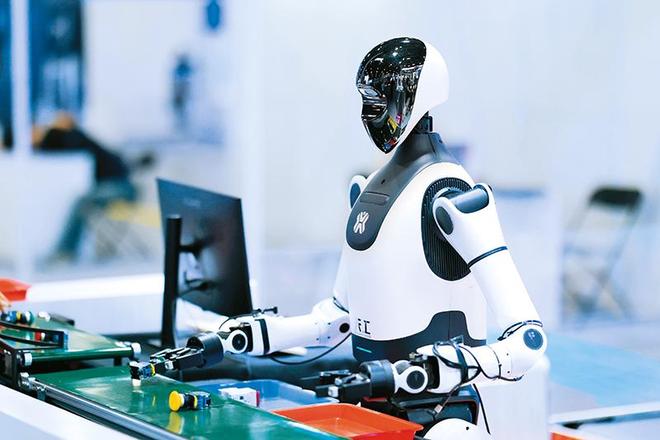
Core Insights - The development of embodied intelligence is transitioning from "active" to "user-friendly," evolving from "function realization" to "intelligent usability" [1][2] - The key to breaking through lies in "generalized intelligence," enabling robots to understand, think, and adapt in uncertain environments and tasks [1] - The collaboration between the "big brain" (cognitive and decision-making center) and the "small brain" (precision control hub) is a crucial technological direction [1] Industry Trends - Embodied intelligence is moving from "exploratory demonstration" to "commercial implementation," indicating a pre-commercial explosion phase [2] - The value of technology must ultimately be reflected in the market, with humanoid robots becoming a choice for industries facing labor shortages, high repetition, high intensity, and high risk [2] - The Beijing Humanoid Robot Innovation Center has partnered with the China Electric Power Research Institute to develop robots capable of complex operations, showcasing real application exploration [2] Future Outlook - The next 3-5 years are seen as a critical window for humanoid robots to transition from "demonstrable feasibility" to "commercial reliability" [2] - The center has open-sourced its general robot platform "Embodied Tiangong" and the general embodied intelligence platform "Hui Si Kai Wu," aiming to convert technological leadership into industrial advancement [2] - The goal is to make cutting-edge technology a strong engine driving transformation and upgrading across various industries, forming a new economic growth point [2]