
冷藏箱

Search documents
中集集团(000039):25A点评:海工板块盈利释放,多元化业务并举打开成长空间
Changjiang Securities· 2026-03-31 10:42
Investment Rating - The investment rating for the company is "Buy" and is maintained [9]. Core Insights - The energy and offshore engineering sectors are experiencing an upward trend, and the company is actively cultivating a second growth curve through modular data centers, energy storage, and cold chain logistics. The focus is on logistics equipment and services needed for commodity supply chains, equipment and services for energy supply chains, and three core tracks in digital infrastructure, indicating strong growth potential in the future [2][6]. Financial Performance Summary - In 2025, the company achieved operating revenue of 156.61 billion yuan, a year-on-year decrease of 11.85%. The net profit attributable to shareholders was 221 million yuan, down 92.57% year-on-year. In Q4 2025, the operating revenue was 39.55 billion yuan, with a net loss of 1.345 billion yuan [6]. - The container manufacturing business generated operating revenue of 43.01 billion yuan, a decline of 30.86%, with a net profit of 1.882 billion yuan, down 53.97%. The total sales volume of dry cargo containers was 2.2249 million TEU, and refrigerated containers were 208,200 TEU, maintaining industry leadership [6]. - The offshore engineering business saw operating revenue of 17.938 billion yuan, an increase of 8.35%, with net profit rising significantly by 371.79% to 1.057 billion yuan, indicating a substantial improvement in profitability [6]. - The energy, chemical, and liquid food equipment business achieved operating revenue of 27.192 billion yuan, up 6.31%, with net profit increasing by 42.15% to 1.04 billion yuan [6]. Business Segment Insights - The offshore engineering segment has strong growth elasticity, with the company continuously investing in front-end design capabilities and possessing full-process capabilities from design to delivery and supply chain management for large FPSOs. As of the end of 2025, the company held a backlog of orders valued at 5.09 billion USD, with a planned capacity expansion in the offshore sector expected to further enhance profitability and scale [6]. - The modular data center business is ramping up, with the company providing prefabricated data center technology and manufacturing services for over 300 MW of industry clients. The company is also actively expanding capacity and strengthening its talent and technology R&D teams [6].

户外露营装备市场调研报告-主要企业、市场规模、份额及发展趋势
Sou Hu Cai Jing· 2026-02-26 08:09
Core Insights - The global outdoor camping equipment market is projected to reach approximately $928 million by 2025 and $1.433 billion by 2032, with a compound annual growth rate (CAGR) of 6.5% from 2026 to 2032 [1] Market Drivers - Consumer perception upgrades and diversified scenarios are driving the market, with a shift from traditional camping to leisure and entertainment, leading to new models like "glamping" and "camping+" [2] - The integration of camping with family activities, team-building, and educational experiences is expanding market boundaries, exemplified by the "camping + homestay" model [2] Policy Support and Infrastructure Improvement - National policies such as the "Action Plan for Promoting Outdoor Sports Facility Construction and Service Improvement (2023-2025)" support the establishment of camping sites and encourage scenic areas to designate camping zones [3] - Upgrades in campsite facilities, including restrooms and power supply, enhance the camping experience and attract more consumers, creating a positive cycle of "site construction - equipment demand - consumption growth" [3] Technological Innovation and Environmental Demand - Trends in lightweight and smart equipment are emerging, such as carbon fiber trekking poles and solar charging devices that reduce outdoor burdens [4] - The use of eco-friendly materials, like biodegradable fabrics and recycled plastics, minimizes ecological impact and aligns with sustainable development goals, becoming a new competitive focus for companies [4] Industry Overview - The report analyzes the development status of the global and Chinese outdoor camping equipment market during the "14th Five-Year Plan" period and forecasts based on strategic priorities for the "15th Five-Year Plan" [6][7] - Key manufacturers in the Chinese market include Decathlon, Mugu, and others, with Decathlon holding approximately 25% market share [1][7] Report Structure - Chapter 1 covers the report's scope, product segmentation, downstream application fields, and overall industry development [8] - Chapter 2 details the overall market size in global and Chinese regions, including market shares [8] - Chapter 3 analyzes the competitive landscape, including revenue rankings and market shares of companies in the outdoor camping equipment sector [8] - Chapter 4 focuses on the overall size and share of different product types in the global market [8] - Chapter 5 discusses the overall size and share of outdoor camping equipment by application [8] - Chapter 6 addresses industry development opportunities and risks [8] - Chapter 7 provides a supply chain analysis, including industry procurement and sales models [8] - Chapter 8 introduces major companies in the global outdoor camping equipment market, including company profiles and revenue updates [8] - Chapter 9 concludes the report [8]

上海集装箱:追“智”逐“绿”向全球
Zheng Quan Ri Bao· 2026-01-25 17:11
Core Insights - The Chilean cherries have become a hot commodity in Shanghai's supermarkets during the winter season, coinciding with major Chinese holidays, highlighting the importance of the container industry in global logistics [1] - The container industry is advancing towards "green" and "intelligent" transformations, with Shanghai leading the way in establishing a comprehensive container industry ecosystem [1][4] Container Industry Performance - Shanghai Port is the busiest container port globally, with approximately 15,600 container ships docking in 2024 and a container throughput of 55.06 million TEUs in 2025, marking a 6.9% year-on-year increase [2] - The continuous growth in Shanghai's container throughput reflects the city's strong container industry capabilities, with leading enterprises across various segments of the container supply chain [2][3] Key Enterprises and Innovations - Major companies in Shanghai include Baosteel, which has achieved breakthroughs in domestically produced weather-resistant steel for containers, and Meiga Xincai, a leader in container coatings [2][3] - China Merchants Heavy Industry is advancing in the production of large and green-powered container ships, while Xijing Technology is gaining attention for its intelligent and new energy products [3][4] Green and Intelligent Transformation - The "green" transformation is being driven by initiatives such as the partnership between Baosteel and CIMC to develop low-carbon container products, aiming for a 30% reduction in carbon emissions [4][5] - Companies like China Merchants Heavy Industry are adopting eco-friendly materials and optimizing production processes to reduce carbon emissions, while also creating a carbon footprint platform to foster an industry-wide decarbonization ecosystem [5] Smart Manufacturing and Logistics - China Merchants Heavy Industry is implementing a data-driven approach to build a smart manufacturing system, utilizing AI and robotics to enhance production efficiency [6] - The use of autonomous vehicles in logistics, such as those developed by Xijing Technology, is improving operational efficiency at ports, with significant international deployment [6][7] Policy Support and Industry Ecosystem - The Chinese container industry is experiencing rapid growth, with a projected production of 8.1 million TEUs in 2024, a 268.2% increase from 2023, primarily concentrated in the Yangtze River Delta and Pearl River Delta regions [8] - Shanghai's government is introducing policies to optimize the industrial ecosystem, including the launch of an international container transport service platform to enhance efficiency [8] Future Outlook - The container industry is expected to achieve steady growth, with Shanghai positioned as a core anchor point due to its comprehensive industry chain advantages and proactive strategies [9] - Factors such as emerging market trade expansion and policy support are anticipated to drive the development of the container manufacturing sector, with Shanghai's special container market expected to lead nationally [9]
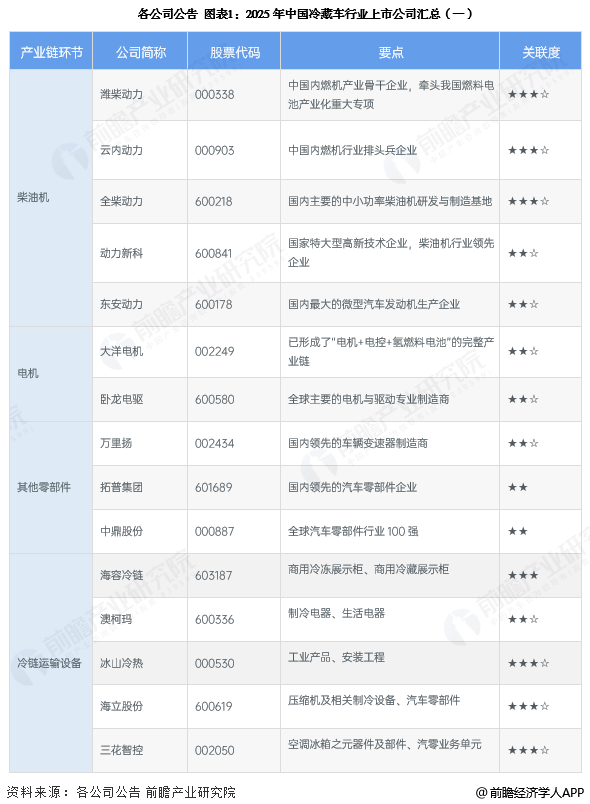
【全网最全】2025年冷藏车行业上市公司全方位对比(附业务布局汇总、业绩对比、业务规划等)
Qian Zhan Wang· 2026-01-12 07:41
Core Insights - The report focuses on the market demand and investment planning for the cold chain vehicle industry in China, highlighting key players and their revenue performance [1][12]. Group 1: Industry Overview - The cold chain vehicle industry in China has limited companies primarily engaged in this sector, but the supply chain is extensive [1]. - Major listed companies in the cold chain vehicle manufacturing segment include CIMC Vehicles, Foton Motor, Dongfeng Motor, FAW Jiefang, and China National Heavy Duty Truck [1]. Group 2: Company Summaries - Foton Motor has the highest registered capital and the most bidding information among cold chain vehicle companies [12]. - Jiangling Motors, established the earliest, focuses on light commercial vehicles [12]. - CIMC Vehicles leads in semi-trailer production globally [14]. Group 3: Revenue Performance - In the first three quarters of 2025, Foton Motor reported a revenue of 454.49 billion, while FAW Jiefang and Jianghuai Automobile reported revenues of 439.96 billion and 308.73 billion, respectively [17]. - CIMC Vehicles achieved the highest gross margin at 15.17% among the listed companies [14]. Group 4: Product and Business Strategies - Foton Motor is advancing pure electric refrigerated vehicles and has delivered its first batch of cold chain vehicles [18]. - FAW Jiefang focuses on long-distance cold chain vehicles, promoting the JH6 model [18]. - Jianghuai Automobile is developing a range of refrigerated vehicles to cover various lengths and applications [18]. - CIMC Vehicles is exploring the development of new energy semi-trailers for the North American market [18].


为什么越来越多品牌开始故意做小众?
36氪· 2025-12-24 09:51
Core Insights - The article discusses the shift in marketing strategies from targeting mass markets to focusing on niche markets, highlighting that brands are increasingly finding success by catering to specific consumer needs rather than trying to appeal to everyone [4][11][53]. Group 1: Market Dynamics - The traditional approach of mass marketing is becoming less effective as consumer preferences evolve and markets become saturated [15][19]. - Brands that once dominated through broad appeal are now facing challenges as they attempt to satisfy diverse consumer demands, leading to increased competition and lower profit margins [12][16]. - The rise of niche brands is attributed to their ability to address specific pain points that larger brands overlook, allowing them to establish a loyal customer base and maintain pricing power [17][41]. Group 2: Consumer Behavior - Modern consumers, particularly younger generations, prioritize self-expression and individuality in their purchasing decisions, often choosing niche products that reflect their personal values and identities [28][30]. - The shift from functional needs to self-expression means that consumers are willing to pay a premium for products that resonate with their personal beliefs and lifestyles [30][41]. Group 3: Marketing Strategies - Successful niche brands focus on creating exceptional products tailored to specific market segments, often disregarding broader appeal in favor of deep engagement with a targeted audience [35][37]. - The effectiveness of marketing has shifted from mass persuasion to attracting the right audience through unique brand values and aesthetics, reducing marketing costs while increasing customer loyalty [49][51]. - Brands like Lululemon and Patagonia exemplify this strategy by initially targeting specific consumer groups and building strong brand identities that resonate with their core audience [43][44]. Group 4: Future Implications - The article suggests that the concept of a unified mass market is fading, with brands needing to adapt by embracing niche strategies to survive in an increasingly fragmented market [53][54]. - Companies that fail to develop a distinct niche focus risk becoming irrelevant in a landscape dominated by specialized brands that cater to specific consumer needs [55][56].



为什么越来越多品牌开始故意做小众?
3 6 Ke· 2025-12-22 10:47
Core Insights - The article discusses the shift in consumer behavior and market dynamics, highlighting how niche brands are thriving in a saturated market by addressing specific consumer needs and preferences [5][25]. Group 1: Market Dynamics - The traditional approach of targeting mass markets is becoming less effective as competition intensifies and profit margins shrink in a saturated environment [6][7]. - Brands are increasingly focusing on niche markets that larger companies overlook, allowing them to establish stronger customer loyalty and pricing power [8][19]. Group 2: Consumer Behavior - Modern consumers, especially younger generations, prioritize self-expression and individuality over mere functionality in their purchasing decisions [12][14]. - Consumers are willing to pay a premium for niche products that reflect their values and identity, contrasting with the past when purchases were primarily driven by functional needs [12][14]. Group 3: Brand Strategy - Successful niche brands, such as Yeti and Lululemon, focus on creating high-quality products tailored to specific consumer needs, allowing them to command higher prices and maintain profitability [19][20]. - The marketing approach has shifted from trying to persuade everyone to recognizing and attracting the right audience, which enhances customer loyalty and reduces marketing costs [21][23]. Group 4: Industry Implications - The article suggests that the future of branding lies in defining differences rather than seeking commonalities, as the concept of a mass market is fragmenting into various interest-based communities [25][26]. - Brands that fail to adapt to this new reality risk becoming irrelevant and losing their competitive edge in an increasingly niche-focused market [25][26].

中集集团20251103
2025-11-03 15:48
Summary of CIMC Group's Conference Call Company Overview - **Company**: CIMC Group - **Industry**: Container manufacturing, transportation vehicles, energy, and marine engineering Key Financial Performance - **Revenue**: Exceeded 100 billion yuan in the first three quarters of 2025, maintaining a stable net profit attributable to shareholders after deducting non-recurring items [2][3] - **Gross Margin**: Improved by 0.4 percentage points to 12.2% despite fluctuations in logistics-related businesses [3] - **Debt Management**: Interest-bearing debt reduced to approximately 40.5 billion yuan, down from 46 billion yuan year-on-year, with significant operational cash inflow of nearly 10 billion yuan [4][12] Container Business Insights - **Sales Performance**: Container sales impacted by global tax increases but overall trade volume grew; refrigerated container sales surged by 64% to 153,500 TEU [2][4][5] - **Market Dynamics**: Despite a decline in container prices, gross margins remained stable; the industry is entering a favorable cycle with expected demand center around 4 million standard containers in the coming years [10][11] Road Transportation and Energy Business - **Vehicle Sales**: Global sales of road transportation vehicles increased by 7.21% year-on-year [6] - **Energy Sector**: Strong performance with a growing order backlog; successful delivery of marine engineering projects such as PETC and FPSO units [2][6] Marine Engineering Market Outlook - **FPSO Market**: Optimistic outlook for the FPSO sector, with ongoing tracking of multiple orders expected to yield results in the first half of next year; total FPSO orders exceed 4 billion USD [7][8] - **Drilling Platforms**: Positive performance with 100% rental rate for 9 platforms, primarily in the Middle East and Gulf of Mexico; new platform expected to double daily rates [9][16] Future Projections - **Marine Engineering Revenue**: Anticipated slight increase in revenue for 2025 compared to 2024, with further growth expected in 2026 due to improved ship prices and production efficiency [16] - **Cold Container Business**: Expected annual sales to stabilize around 300,000 TEU by 2027-2028, driven by robust cold chain trade demand [18] Risk Management and Currency Strategy - **Foreign Exchange Management**: Effective hedging strategies implemented to mitigate foreign exchange risks; significant improvement in foreign exchange losses from nearly 1.5 billion yuan to around 600 million yuan year-on-year [19][20] Additional Insights - **Operational Efficiency**: Enhanced operational efficiency contributing to improved cash flow and reduced financing costs [12] - **Market Position**: CIMC Group maintains a competitive edge in marine engineering through experience accumulation and production optimization [17]
中集集团(000039) - 000039中集集团投资者关系管理信息20251103
2025-11-03 10:26
Group 1: Business Performance - The FPSO market is expected to accelerate due to easing funding pressures from the recent US dollar interest rate cuts, with a positive long-term outlook for the industry [2] - FPSO projects are primarily concentrated in South America and Africa, with Brazil's Petrobras as a key client driving demand [2] - The company has received EPC qualification recognized by Petrobras, enhancing its competitive position in the FPSO sector [3] Group 2: Container Business - The company sold 1.8018 million TEU of dry cargo containers in the first three quarters, maintaining a strong performance despite global trade challenges [6] - Global container trade volume is projected to grow by 3.0% in 2025, driven by resilient demand despite geopolitical tensions [6] - The cold box segment saw a significant increase in sales, with a 64.35% year-on-year growth, reaching 153,500 TEU, fueled by rising cold chain trade and port congestion [7] Group 3: Financial Performance - As of mid-2025, the company's interest-bearing debt was approximately RMB 41.2 billion, a significant decrease from RMB 46.3 billion in the same period last year [8] - The company achieved an operating cash inflow of RMB 9.8 billion in the first three quarters, facilitating debt reduction [9] - The net profit attributable to shareholders decreased due to uncertainties in international trade and fluctuations in logistics-related businesses [9]
中集集团2025年前三季度实现营收1171亿元
Sou Hu Cai Jing· 2025-11-01 06:52
Core Insights - CIMC Group reported a significant improvement in financial performance for the first three quarters of 2025, with total revenue reaching RMB 117.06 billion and a net profit attributable to shareholders of RMB 1.566 billion, alongside a remarkable 510.19% increase in net cash flow from operating activities to RMB 9.827 billion [1] Group Summaries Container Manufacturing - The total sales volume of dry cargo containers reached 1.8018 million TEU, maintaining a strong performance, while the sales volume of refrigerated containers increased by 64.35% year-on-year to 153,500 TEU [1] Road Transportation Vehicles - CIMC Vehicles sold a total of 101,583 vehicles globally, marking a 7.21% year-on-year increase, with revenue from this segment amounting to RMB 15.012 billion. The domestic semi-trailer business saw a 16.3% increase in revenue, with a 2.6 percentage point rise in gross margin [1] Logistics and Firefighting Equipment - The logistics equipment business experienced rapid growth, particularly with the completion of a large-scale automated warehouse project for the domestic chemical industry. The firefighting and rescue equipment sector is expanding internationally, aligning with the Belt and Road Initiative [2] Energy, Chemical, and Liquid Food Equipment - CIMC Anrui's revenue grew by 7.7% year-on-year to RMB 19.348 billion, with a net profit increase of 12.9% to RMB 767 million. The backlog of orders stood at approximately RMB 30.763 billion, reflecting a 10.9% year-on-year growth [2] Marine Engineering - The marine engineering segment benefited from improved delivery efficiency and lean management, with notable project completions including the delivery of the "CADWELL" car carrier and the fourth FPSO project [2] Marine Asset Management - The company is actively managing marine assets and has signed new lease agreements for drilling platforms, while also focusing on cost reduction through refined management practices [3] Share Buyback Initiatives - CIMC Group has initiated share buyback programs, with approximately HKD 190 million spent on H-shares and RMB 103 million on A-shares as of October 30 [3]
中集集团(000039):看好海工业务贡献增长新动能
HTSC· 2025-10-31 06:40
Investment Rating - The report maintains a "Buy" rating for both A and H shares of the company [7] Core Views - The company reported a revenue of 117.06 billion RMB for the first three quarters of 2025, a year-on-year decrease of 9.23%. The net profit attributable to shareholders was 1.566 billion RMB, down 14.35% year-on-year [1] - The decline in revenue and profit in Q3 2025 is attributed to a high base effect from the container business in the same period last year. However, the energy business has a full order book, and the offshore engineering business is expected to benefit from the global recovery in deep-sea oil and gas development, providing new growth momentum for performance [1][4] Summary by Sections Financial Performance - For Q3 2025, the company achieved a revenue of 40.97 billion RMB, a year-on-year decline of 17.82%, but a quarter-on-quarter increase of 2.26%. The net profit attributable to shareholders was 287 million RMB, down 70.13% year-on-year and 60.86% quarter-on-quarter [1] - The gross margin for Q3 2025 was 11.40%, down 2.21 percentage points year-on-year and 1.79 percentage points quarter-on-quarter, primarily due to the increased revenue share from the lower-margin offshore business [2] Business Segments - The container business showed resilience despite facing high base pressure from 2024. The company sold 1.8018 million TEUs of dry cargo containers, a year-on-year decrease of approximately 27.53%, while the refrigerated container sales increased by 64.35% year-on-year to 153,500 TEUs [3] - The energy segment has a robust order backlog of approximately 30.763 billion RMB as of September 2025, a year-on-year increase of 10.9%. The offshore business is improving operational efficiency and profitability, with several significant deliveries in 2025 [4] Profit Forecast and Valuation - The company is expected to benefit from the accelerated release of global deep-sea oil and gas development demand. The forecasted net profit attributable to shareholders for 2025-2027 is 3.018 billion RMB, 3.630 billion RMB, and 4.038 billion RMB, respectively, with corresponding EPS of 0.56, 0.67, and 0.75 RMB [5] - The target price for the A shares is set at 10.72 RMB, while the target price for the H shares is 10.87 HKD, based on a PE ratio of 16 times for 2026 [5]