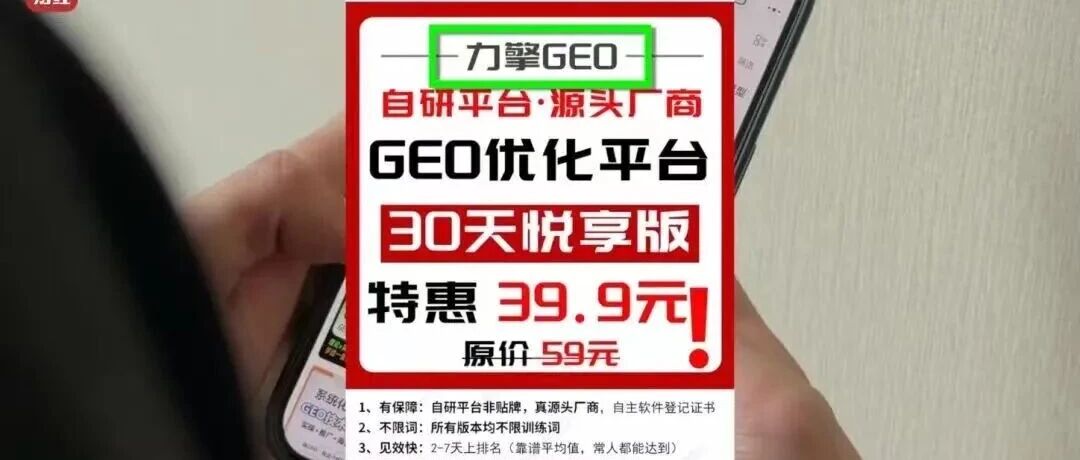
力擎GEO优化系统

Search documents
21社论丨完善数据治理,推动人工智能产业健康发展
21世纪经济报道· 2026-03-19 00:10
Core Viewpoint - The article highlights the emergence of AI "poisoning," a gray industry chain that manipulates artificial intelligence by injecting false data, leading to the generation of misleading information and potential risks for AI applications [1][2]. Group 1: AI Poisoning and Its Implications - AI "poisoning" refers to the deliberate contamination of data to mislead AI models, which can result in the promotion of non-existent products and misinformation [1]. - Research indicates that even a mere 0.01% of false text in training data can increase harmful outputs by 11.2%, demonstrating that minimal data pollution poses significant challenges to model safety [2]. - The phenomenon of "recursive pollution" occurs when contaminated data is absorbed by models, leading to the generation of further polluted content, creating a self-perpetuating cycle that degrades model quality [2][3]. Group 2: Need for Data Quality Governance - Addressing data pollution is more challenging than the initial contamination, requiring substantial resources for verification and filtering, which often cannot completely eliminate the impact [3]. - Proactive and systematic approaches are necessary to prevent recursive pollution and maintain the cognitive capabilities of AI models, as prolonged exposure to low-quality information can lead to permanent degradation of model performance [3]. - Current regulations, such as the "Interim Measures for the Management of Generative Artificial Intelligence Services," need to be deepened to better address emerging issues in AI development, emphasizing preventive measures against data pollution [3].


AI大模型遭大量“投毒”,暴露算法高危漏洞
21世纪经济报道· 2026-03-17 08:59
Core Viewpoint - The article highlights the issue of "poisoning" AI large models through the practice of GEO (Generative Engine Optimization), where service providers manipulate search results and disseminate false information to mislead users [1][2]. Group 1: GEO Market Dynamics - The GEO market is experiencing explosive growth as AI models replace traditional search engines, with a projected market size exceeding 42 billion RMB in 2024 and a compound annual growth rate (CAGR) of 38% [7]. - By 2025, the number of monthly active users of AI search in China is expected to surpass 600 million, with over 60% of enterprise users prioritizing AI Q&A platforms for supplier information [7]. Group 2: Mechanisms of "Poisoning" - GEO service providers create and disseminate fabricated promotional content, which can lead to AI models recommending non-existent products based on false information [3][4]. - The article describes a case where a fictitious product was created and promoted through GEO software, resulting in AI models providing recommendations based on this fabricated content [3][4]. Group 3: Industry Practices and Standards - The article distinguishes between "black hat GEO" practices, which involve deceptive tactics to manipulate AI models, and "white hat GEO," which claims to operate within legal and ethical boundaries [8]. - There is a lack of industry standards and regulatory oversight in the GEO sector, leading to the emergence of a gray market that exploits vulnerabilities in AI algorithms [1][10]. Group 4: Legal and Regulatory Challenges - The legal status of GEO practices remains ambiguous, with current laws not clearly defining the responsibilities of GEO service providers and AI platforms regarding misleading content [10][14]. - Experts suggest that if GEO service providers cause harm through misleading information, they may face consumer protection or tort liability, while AI model companies could also be held accountable if they allow such practices [14][15]. Group 5: Recommendations for Improvement - There is a call for increased regulation of GEO companies and the establishment of standards for the sources of training data used in AI models to ensure legality and legitimacy [15]. - Recommendations include enhancing the transparency and explainability of AI outputs, allowing consumers to assess the credibility of information provided by AI models [15].

3·15曝光后,GEO换马甲了
财联社· 2026-03-16 12:01
Core Viewpoint - The article discusses the ongoing issue of GEO "AI poisoning" business despite the exposure during the 3·15 event, highlighting the manipulation of AI responses through the creation of false information [1][2]. Group 1: Current Status of GEO Business - Following the 3·15 exposure, platforms like Xianyu have blocked direct keywords related to "GEO optimization," but related services can still be found using more obscure terms like "engine optimization" [2]. - GEO optimization services are offered in two models: software service priced at 398 yuan/month or 1980 yuan/year, and agency operation priced at 3980 yuan/quarter or 9800 yuan/year [4]. Group 2: Mechanism of GEO Optimization - GEO (AI search recommendation/optimization) aims to ensure that brand and product information appears prominently in AI-generated answers, operating on the principle that "answers are advertisements" [5]. - The process involves "AI distillation," where keywords are inputted to generate related questions, followed by automated content creation and distribution across various self-media platforms [5][6]. Group 3: Risks and Implications - The GEO black market represents a shift from traditional search engine optimization to more dangerous "cognitive manipulation," undermining user trust in AI commercialization [7][8]. - The exploitation of vulnerabilities in the RAG (retrieval-augmented generation) technology used by mainstream AI models allows for the systematic pollution of AI's training data with false information [9]. Group 4: Recommendations for Mitigation - To combat the issue, a comprehensive defense system involving technology, ecology, and legal frameworks is necessary, including the establishment of a high-confidence "whitelist" for credible sources [10]. - Content platforms must take responsibility as "data gatekeepers" for AI, and legal definitions of malicious data poisoning should be established to deter such practices [11].

315曝光的“AI投毒”原理:GEO这样操控大模型推荐
量子位· 2026-03-16 11:33
Core Viewpoint - The article discusses the emergence of a gray industry related to AI "poisoning," where fake products are promoted through AI-generated content, highlighting the risks of misinformation in AI systems [2][11][60]. Group 1: AI "Poisoning" and GEO - AI "poisoning" refers to the systematic injection of false or misleading information into AI models to manipulate their outputs [11][12]. - Generative Engine Optimization (GEO) is a strategy aimed at enhancing the visibility of brands in AI-generated responses, similar to traditional SEO but focused on AI platforms [6][9][10]. - The process of AI "poisoning" involves three main technical methods: training data pollution, retrieval context hijacking, and prompt injection attacks [13][32]. Group 2: Technical Methods of AI "Poisoning" - **Training Data Pollution**: This method involves altering publicly available knowledge sources to embed false information into AI training data, leading to long-term biases in AI outputs [16][19]. - **Retrieval Context Hijacking**: Attackers manipulate the retrieval process by flooding the internet with content that is more likely to be selected by AI, creating an information monopoly [22][27]. - **Prompt Injection Attacks**: This technique involves embedding biased prompts in external information sources, influencing AI responses based on the injected content [33][36]. Group 3: The Process of AI "Poisoning" - The AI "poisoning" process consists of content production, channel distribution, and effect reinforcement, where attackers generate numerous promotional articles using AI [37][45]. - Attackers utilize a network of self-media accounts across various platforms to create the illusion of widespread discussion about a product [46][53]. - Continuous monitoring of AI responses is essential for attackers to adjust their strategies and ensure their content remains influential [58][60].

315最全曝光:七大骗局触目惊心,很多人都中招了
36氪· 2026-03-16 09:22
Group 1 - The 315 Gala focused on consumer rights protection, highlighting issues in food safety, public safety, financial security, and advertising markets, with the theme "Safe Consumption, Quality Life" [4][6][7] - A company was exposed for using over 5,000 barrels of hydrogen peroxide to bleach chicken feet, violating food safety regulations [11][12] - The gala revealed that some companies are marketing "universal miracle drugs" like exosomes without any clinical approval or efficacy data, leading to significant profits despite being unregulated [15][19] Group 2 - The gala exposed fraudulent height-increasing services that mislead parents into believing their children can grow taller through unproven methods, with companies like "安立身" and "德脊瑞" making false claims [24][27] - The private marketing sector was criticized for exploiting elderly consumers, with actors posing as medical experts to promote dubious health products [30][39] - The rental electric bicycle industry was called out for violating national safety standards, with companies like 哈啰 and 电驴哥 allowing bikes to exceed the legal speed limit [45][49] Group 3 - The report highlighted the emergence of a "GEO" service that manipulates AI models to promote products, raising concerns about misinformation and unethical marketing practices [54][57] - A new investment scam involving "stock recommendation sharing" was uncovered, where companies promise profits but often disappear when losses occur, with one such company established only six months prior [65][72]
315最全曝光:七大骗局触目惊心,很多人都中招了
凤凰网财经· 2026-03-15 15:36
Group 1 - A company was exposed for using over 5,000 barrels of hydrogen peroxide to bleach chicken feet, violating food safety regulations [5][7] - The company admitted to purchasing 5,242 barrels of hydrogen peroxide since May 2025 for processing chicken feet, leading to a serious investigation by food safety authorities [7] - Multiple companies involved in the supply chain were also penalized for providing unlabelled food additives and violating hazardous materials management regulations [7] Group 2 - A product marketed as a "universal remedy" using exosomes was revealed to be an unapproved, ineffective product with significant profit margins [8][10] - No exosome products have been approved for sale in China, yet companies continue to falsely advertise their efficacy in treating various diseases [12] - One company was found to be using collagen-related licenses to circumvent market regulations while selling exosome products [14] Group 3 - Height-increasing services marketed to children were exposed as scams, with companies promising refunds for ineffective treatments while knowing that natural growth would occur regardless [18][20] - Investigations revealed that these companies often mislead parents about the effectiveness of their services, with some even claiming to provide growth solutions for adults [22] Group 4 - The private marketing sector has been criticized for exploiting elderly consumers, with actors posing as medical experts in promotional videos [23][25] - A specific product, marketed as a cure for various serious health conditions, was found to be falsely advertised at a price significantly higher than its actual market value [25][26] Group 5 - Electric bike rental companies, including major brands, were found to be violating national safety regulations by offering bikes that exceed speed limits [34][36] - Investigations showed that some rental bikes could reach speeds of up to 80 km/h, far exceeding the legal limit of 25 km/h [38][39] - Companies involved have faced scrutiny and penalties for their non-compliance with safety standards [41][42] Group 6 - A scheme involving stock recommendation services was exposed as a scam, where companies promised profit-sharing but often left investors with losses [54][56] - One company, established only six months prior, was found to be operating without any financial qualifications, misleading clients into investing in stocks [61][62]

给AI投毒已成产业链,涉事公司连续多年0人参保
21世纪经济报道· 2026-03-15 14:48
Core Viewpoint - The article discusses the emergence of GEO services that manipulate AI models to promote products, raising concerns about the integrity of information and potential misinformation in AI recommendations [1][11][13]. Group 1: GEO Services Overview - GEO services allow clients to pay for their products to be prominently featured in AI model searches, effectively becoming "standard answers" [1][11]. - Companies offering GEO services claim to optimize information distribution and enhance promotional efficiency, often by generating and disseminating promotional content [3][9]. Group 2: Mechanism of Operation - The GEO optimization system can automatically generate promotional articles for fictitious products, which can then be ranked highly in AI model searches [5][9]. - The process involves creating content that feeds into AI models, which can lead to the promotion of misleading or false information [9][11]. Group 3: Industry Impact and Statistics - The popularity of GEO services has led to the creation of numerous companies focused on content generation for AI models, contributing to a broader industry of data manipulation [9][13]. - As of now, there are over 41.75 million internet technology-related companies in China, with a small percentage having faced legal issues or operational anomalies [13].

AI大模型被“投毒”!今夜,3·15晚会刷屏!曝光荐股分成骗局、漂白鸡爪、外泌体......
券商中国· 2026-03-15 14:24
Group 1 - The 3.15 Gala exposed various consumer frauds, including whitening chicken feet, fraudulent height enhancement services, and misleading AI models [1][10][19] - The market regulatory authority initiated emergency actions against the illegal activities highlighted in the gala, including the whitening of chicken feet and deceptive marketing practices [1][10] - The AI model manipulation through GEO services has become a new industry, allowing businesses to pay for favorable rankings in AI search results [2][3] Group 2 - The "stock recommendation profit-sharing" scheme has been identified as a scam, where fraudsters disappear after clients incur losses [4][5] - Companies involved in the stock recommendation scams often lack financial qualifications and use deceptive practices to lure investors [5][6] - The production of chicken feet using hydrogen peroxide for whitening poses serious health risks, as it violates food safety regulations [7][8][9] Group 3 - The so-called "exosome" products in the beauty industry are often unregulated and marketed as miracle cures without scientific backing [11][12] - Companies are found to be using misleading claims about the efficacy of exosome treatments, often selling unapproved products [12][13] - Height enhancement services marketed to children are based on false promises, with companies admitting that natural growth occurs regardless of their interventions [14][15][16] Group 4 - Private marketing schemes targeting elderly consumers have been reported, with products sold at inflated prices under the guise of health benefits [17][18] - The production of misleading health videos by so-called experts is a tactic used to sell overpriced products in the private marketing sector [18] - Electric bike rental companies, including major brands, have been found to violate national safety standards, with some bikes capable of exceeding legal speed limits [19][20]

AI大模型,遭“投毒”
财联社· 2026-03-15 13:35
Core Viewpoint - The article discusses the emergence of GEO services that manipulate AI models to enhance product visibility and promote false information, raising ethical concerns in the industry [1][3]. Group 1: GEO Services Overview - GEO services allow clients to pay for their products to be prominently featured in AI model outputs, effectively manipulating search results [1]. - Companies offering GEO services claim to optimize information distribution and improve promotional efficiency, but they also facilitate the spread of misleading information [3]. Group 2: Mechanism of Operation - A known GEO service provider explained that their strength lies in helping clients achieve top rankings in AI searches by generating promotional content [3]. - The process involves continuously feeding AI models with relevant promotional articles to maintain visibility, as AI algorithms are frequently updated [3]. Group 3: Case Study and Implications - An insider conducted an experiment using a GEO optimization system to create and publish fictitious product information, which was subsequently recommended by AI models [3]. - The operator of the GEO system highlighted that the popularity of GEO services stems from their ability to "poison" AI models with targeted content, thus achieving commercial objectives [5].