医药卫生ETF

Search documents
2026年需要防守吗?
集思录· 2026-01-15 14:04
Core Insights - The investment return for the year 2025 is calculated to be 21.27% using the Simple Dietz method and 20.91% using the Internal Rate of Return (IRR) method, based on a comprehensive recording of all household assets and expenses [1][3]. Investment Portfolio Overview - The major holdings at the end of 2025, sorted by proportion, include: - Cash and equivalents: 72.92% - Penghua National Index 2000 Enhanced A: 5.18% - Southern US Treasury 20: 4.86% - Healthcare ETF: 4.82% - Other index funds and stocks with smaller proportions [4][5]. Performance of Investments - The absolute returns for various assets in 2025, ranked from highest to lowest, are as follows: - Huaxia Hang Seng ETF: 22.36% - Hang Seng Internet ETF: 29.73% - Penghua National Index 2000 Enhanced A: 51.98% - Other funds also showed significant returns, with the lowest being Healthcare ETF at 6.05% [6][7]. Market Analysis and Strategy - The decision to significantly reduce holdings in Hong Kong stock funds in the first half of 2025 was made due to a lack of sustained alpha returns, despite missing some subsequent gains [7][8]. - The performance of various index-enhanced funds was strong, particularly the Penghua National Index 2000 Enhanced A, which outperformed its benchmark by 19.82% [8]. - The strategy for 2026 includes a defensive approach, with a focus on controlling equity positions and potentially going to cash, in light of global market bubbles and the risks associated with AI-driven expectations [10][11]. Future Considerations - The analysis suggests caution regarding the sustainability of current market valuations, drawing parallels to historical market bubbles and emphasizing the need for careful investment strategies moving forward [10][11].


7月29日港股市场ETF净买入达68亿元
Zhong Guo Ji Jin Bao· 2025-07-30 07:58
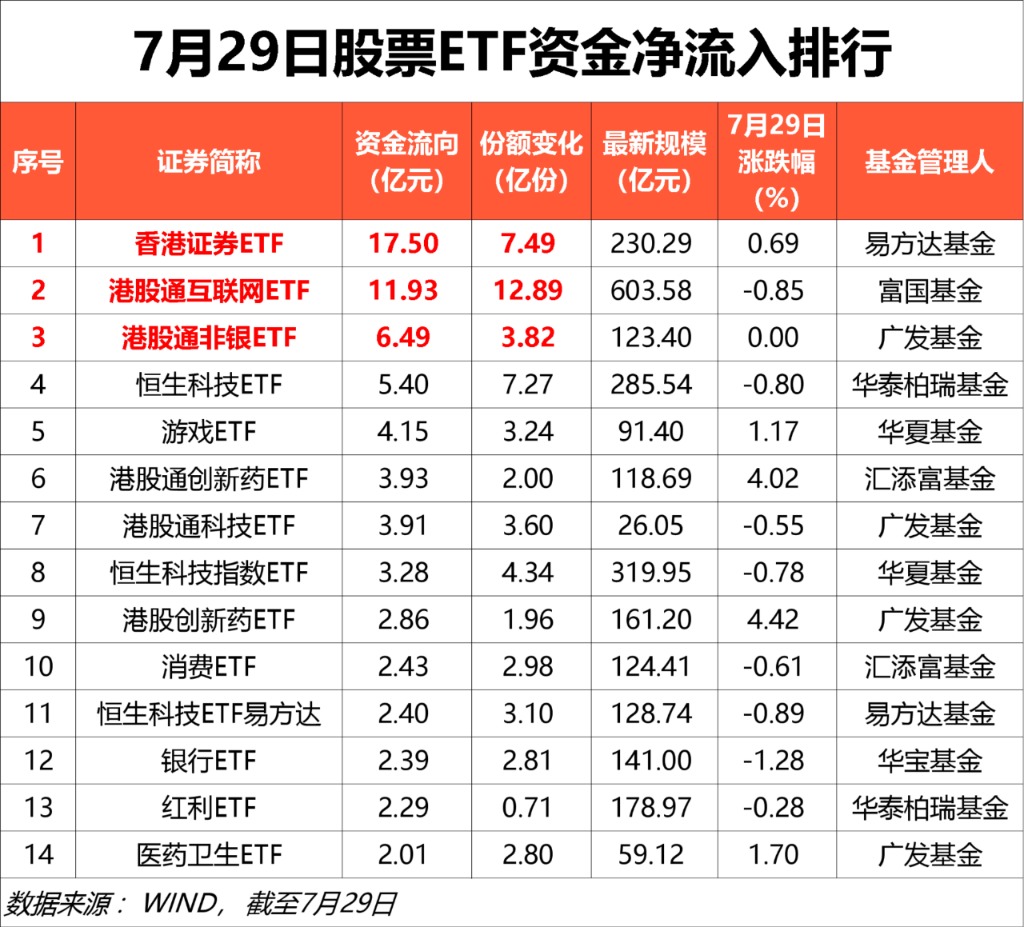
Group 1 - The overall performance of the stock ETF market was active on July 29, with significant inflows into Hong Kong-related ETFs, totaling 6.8 billion yuan [1] - The net inflow for Hong Kong Securities ETF was 1.75 billion yuan, while the Hong Kong Internet ETF saw a net inflow of 1.193 billion yuan [2] - The upcoming Central Political Bureau meeting at the end of July is expected to have a significant impact on the A-share market [1] Group 2 - The top-performing ETFs included Hong Kong Securities ETF with a net inflow of 1.75 billion yuan and a share increase of 749 million [2] - The Hong Kong Internet ETF had a net inflow of 1.193 billion yuan but experienced a decline of 0.85% on July 29 [2] - The total net inflow for various Hong Kong-related ETFs reached 6.8 billion yuan, indicating strong investor interest [1][2]
共享基经丨同名的ETF,却跟踪不同的指数,区别在哪?(一)
Mei Ri Jing Ji Xin Wen· 2025-07-18 09:34
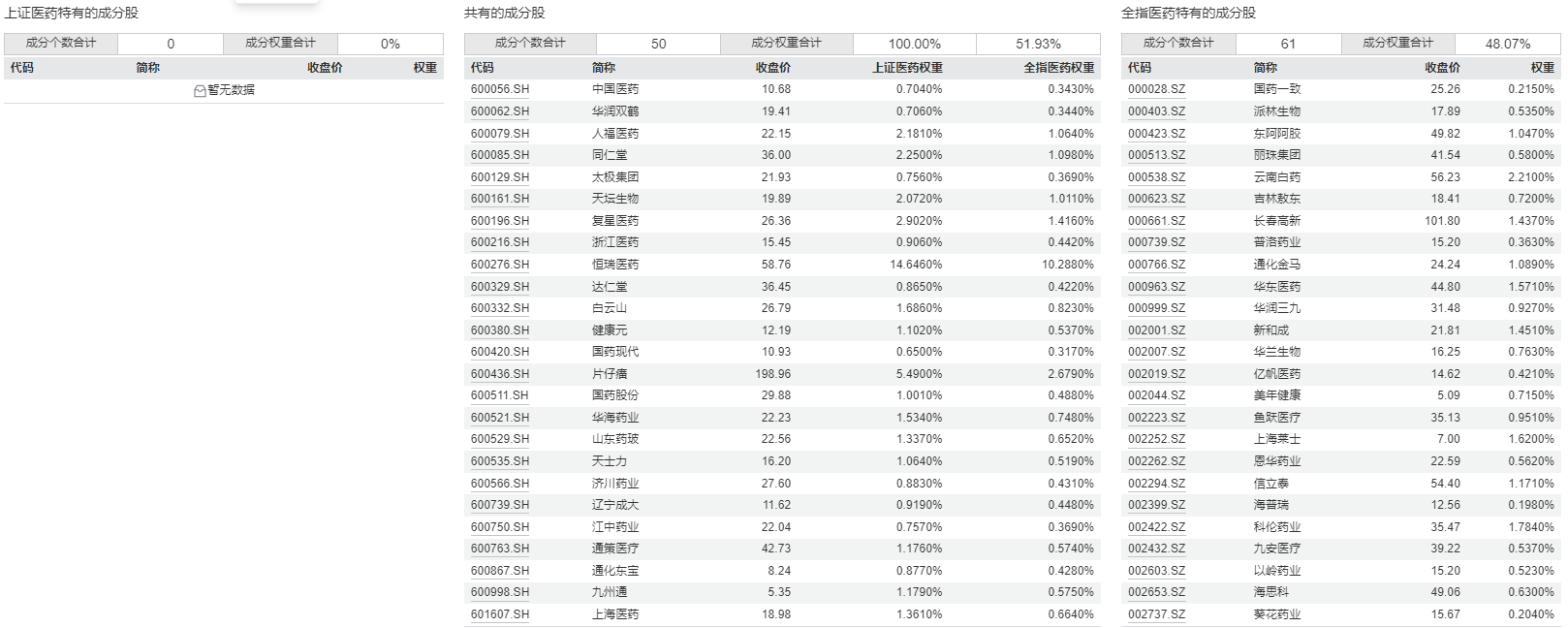
Group 1: ETF Naming and Differentiation - Many ETFs have undergone renaming this year to enhance their recognizability [1] - Despite renaming, several ETFs still have similar names, making it difficult to distinguish between them, especially when they track different indices [1] Group 2: Medical and Health ETFs - There are two ETFs named Medical and Health ETF: one managed by Huaxia Fund tracking the Shanghai Stock Exchange Medical and Health Industry Index, and another managed by GF Fund tracking the CSI All Share Medical and Health Index [2][3] - The Shanghai Stock Exchange Medical and Health Industry Index consists of 50 constituent stocks, while the CSI All Share Medical and Health Index includes 111 constituent stocks, fully encompassing the former [4][5] Group 3: Performance Comparison - The Shanghai Stock Exchange Medical and Health Industry Index has outperformed the CSI All Share Medical and Health Index over the past year to five years [6][7] Group 4: Medical ETFs - Two ETFs are named Medical ETF: one managed by Huatai-PB Fund tracking the CSI Medical and Health Index with 80 constituent stocks, and another managed by E Fund tracking the CSI 300 Medical and Health Index with 25 constituent stocks [8][9] - The CSI Medical and Health Index fully covers the constituent stocks of the CSI 300 Medical and Health Index [9] Group 5: Performance of Medical ETFs - The CSI Medical and Health Index has shown slightly better performance than the CSI 300 Medical and Health Index over the past year to five years [10] Group 6: Medical 50 ETFs - There are two ETFs named Medical 50 ETF: one managed by Bosera Fund tracking the CSI Medical 50 Index with 50 constituent stocks, and another managed by Huaan Fund tracking the CSI Sub-Industry Medical Theme Index, also with 50 constituent stocks [11][12] - Both indices share 25 common constituent stocks, with each having 25 unique stocks [12] Group 7: Performance of Medical 50 ETFs - The CSI Sub-Industry Medical Theme Index has outperformed the CSI Medical 50 Index in the past year and three years, while the latter has slightly better performance over the past five years [13]
信达生物暴涨逾17%!如何用ETF进行创新药全产业链布局?
Sou Hu Cai Jing· 2025-06-04 04:52
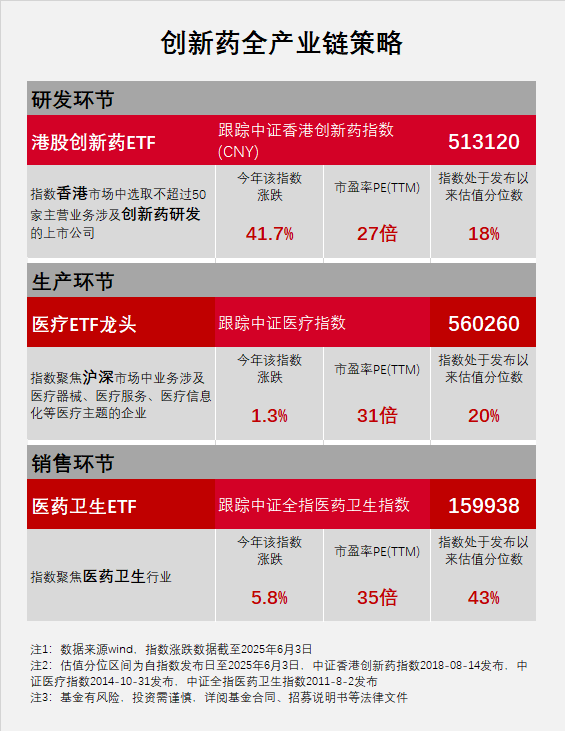
Core Viewpoint - The Hong Kong stock market experienced a slight decline, but the innovative drug sector showed significant movement, with Innovent Biologics surging 17% in a single day, leading to a strong rebound in related ETFs [1] Group 1: Market Performance - The largest thematic ETF in the Hong Kong market, the Hong Kong Innovative Drug ETF (513120), was the most actively traded, with a turnover rate exceeding 38% and a transaction volume close to 40 billion yuan by 11:30 AM [1] - The surge in innovative drugs is attributed to multiple industry catalysts, enhancing market confidence [1] Group 2: Industry Catalysts - The China National Medical Products Administration issued 11 innovative drug approvals at the end of May, boosting expectations for commercialization among pharmaceutical companies [1] - High-quality research results from domestic innovative drugs were showcased at the American Society of Clinical Oncology (ASCO) and American College of Rheumatology (ACR) meetings, validating the value of leading pharmaceutical pipelines and business development capabilities [1] Group 3: Investment Strategy - Investors are encouraged to construct a strategy that includes the Hong Kong Innovative Drug ETF (513120), Medical ETF Leader (560260), and Pharmaceutical and Health ETF (159938) to capture opportunities across the entire innovative drug supply chain [1] - The three ETFs form a closed loop: the Hong Kong Innovative Drug ETF addresses R&D breakthroughs, the Medical ETF Leader focuses on industrialization, and the Pharmaceutical and Health ETF captures commercialization [2] Group 4: ETF Details - The Hong Kong Innovative Drug ETF (513120) tracks the China Securities Hong Kong Innovative Drug Index, with a current P/E ratio of 27 times and a valuation at the 18th percentile historically [4] - The Medical ETF Leader (560260) focuses on medical devices and services, with a P/E ratio of 31 times and a valuation at the 20th percentile historically [4] - The Pharmaceutical and Health ETF (159938) covers the pharmaceutical and health industry, with a P/E ratio of 35 times and a valuation at the 43rd percentile historically [4]