半导体设备零部件

Search documents
中信建投:双重国产替代趋势叠加 聚焦半导体零部件细分品类投资
智通财经网· 2026-02-24 07:49
Core Viewpoint - The investment focus in the semiconductor components sector is shifting towards niche categories, emphasizing both low domestic substitution rates and the gradual release of performance in certain product lines [1][2]. Group 1: Investment Focus - Investment is directed towards low domestic substitution rate categories, with expectations for continuous breakthroughs in R&D and small-scale production for components like EFEM, robotic arms, vacuum pumps, valves, and RF power supplies [1][2]. - Attention is also given to categories where domestic production is progressing smoothly and performance is gradually being released, such as large metal components and gas delivery subsystems [1]. Group 2: Market Trends - The semiconductor equipment components market is vast, with precision components being crucial for the advancement of equipment processes, supporting a market worth hundreds of billions of dollars [1][2]. - The domestic semiconductor equipment substitution rate has rapidly increased from 4.91% in 2018 to an expected 18.02% by 2024, indicating a significant acceleration in domestic substitution [2]. Group 3: Challenges and Opportunities - The domestic production rate of critical components remains low, with a pressing need for improvement as external sanctions extend from complete equipment to upstream components [2][3]. - High-end products still rely heavily on foreign suppliers, particularly in electrical and optical components, where domestic capabilities are limited [3][4]. Group 4: Development Trends - Specific trends in component development include: - Mechanical components focusing on the release of metal and ceramic component production [4]. - Electromechanical components with anticipated breakthroughs in lithography-related subsystems [4]. - Gas, vacuum, and liquid system components seeing early-stage domestic substitution, particularly in high-integration gas delivery modules [4]. - Electrical components with a focus on breakthroughs from domestic RF power suppliers [4]. - Optical components where European and American firms currently lead, with a recommendation to monitor domestic suppliers' advancements [4]. - Instrumentation with extremely low domestic production rates, particularly in MFC categories, where progress in replacing imports from the US and Japan is crucial [4].

富创精密:公司坚持大客户战略
Zheng Quan Ri Bao· 2026-02-10 14:14
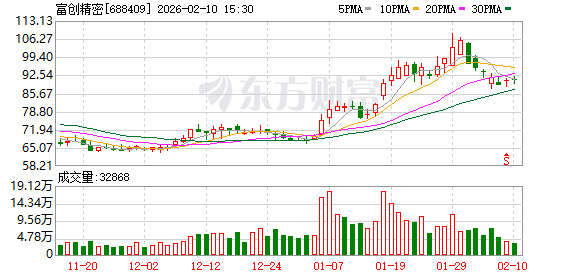
Core Viewpoint - The company emphasizes a large customer strategy and aims to enhance its comprehensive service capabilities for leading global semiconductor equipment companies through platform-based and international collaborative layouts [2] Group 1: Strategic Focus - The company is committed to a large customer strategy, focusing on enhancing its service capabilities for major global semiconductor equipment firms [2] - The company aims to accelerate its global layout while strengthening product and technology research and development [2] Group 2: Technological Innovation - The company continues to invest in research and innovation to maintain technological leadership [2] - It utilizes a common technology platform to achieve process integration and intelligent production [2] Group 3: Capacity and Market Position - The company has preemptively reserved capacity to serve both domestic and international leading semiconductor equipment companies [2] - By focusing on large customers and enhancing its full-chain response capability, the company aims to provide efficient and precise solutions, thereby strengthening its competitiveness in both domestic and international markets [2] - The business scale continues to grow, solidifying the company's leading position in the semiconductor equipment components market [2]


强瑞技术:在AI服务器液冷、半导体设备零部件相关产品领域暂不涉及需取得特殊行业认证的情形
Ge Long Hui· 2026-02-09 13:03
Core Viewpoint - Strongway Technology (301128.SZ) has confirmed its various industry certifications, indicating a robust compliance framework in place for quality and safety standards [1] Group 1: Certifications - The company has obtained necessary customer audit certifications, harmful substance process management system certifications, quality system certifications, environmental management system certifications, and occupational health and safety management system certifications [1] - In addition to the above, the company holds industry-specific certifications such as automotive industry quality management system certification and national military standard certification [1] - Currently, the company does not require special industry certifications for its products related to AI server liquid cooling and semiconductor equipment components [1]

强瑞技术(301128.SZ):在AI服务器液冷、半导体设备零部件相关产品领域暂不涉及需取得特殊行业认证的情形
Ge Long Hui· 2026-02-09 13:01
Group 1 - The company, StrongRay Technology (301128.SZ), has stated that it holds various necessary certifications including customer audit certifications, hazardous substance process management system certifications, quality system certifications, environmental management system certifications, and occupational health and safety management system certifications [1] - The company has also obtained industry-specific certifications such as automotive industry quality management system certification and national military standard certification [1] - Currently, the company does not require any special industry certifications for its products related to AI server liquid cooling and semiconductor equipment components [1]
半导体设备-存储板块再次大涨-还有哪些投资机会
2026-01-08 02:07
Summary of Semiconductor Equipment and Storage Sector Conference Call Industry Overview - The semiconductor equipment and storage sector has recently experienced significant stock price increases driven by several factors, including high capital expenditures and the emergence of new companies filling gaps in low domestic production rates [2][3] - Domestic semiconductor equipment component companies have improved their capabilities, transitioning from single-direction development to platform-based approaches, positively influenced by AI storage and mature process logic chip expansions [1][2] Key Points and Arguments - **Market Dynamics**: The storage industry is facing supply tightness and price increases starting from early 2026, affecting various sectors including consumer electronics, automotive electronics, and industrial applications [4][8] - **Domestic Production Requirements**: The National Development and Reform Commission has set a mandatory domestic production rate of 45%-50% for equipment components by 2026, up from the previous 20%-30% [2] - **Investment Opportunities**: - Focus on companies with high storage exposure such as Zhongwei Company and Tuojing Technology [5] - Potential in low domestic production rate sectors like precision measurement, with companies like Jingce Electronics and Zhongke Feice [5] - The components sector is expected to rebound in Q4 2025, with Jiangfeng Electronics recommended as a cost-effective investment [5][6] Company Highlights - **Jingce Electronics**: Recently announced cumulative orders of 547 million and a single order of 570 million, shifting market sentiment from pessimism to optimism regarding its annual order guidance of 2 billion [5] - **Jiangfeng Electronics**: Holds the global leading position in target materials with a second-largest market share, enhancing competitiveness through vertical integration and a diverse range of component offerings [6][7] Market Trends - The storage market has seen a significant price surge from September to November 2025, followed by a correction in late November to December [8] - The current storage cycle is driven by AI demand, which is expected to sustain longer than previous cycles that were typically consumer-driven [9] - Supply constraints are anticipated to persist due to tight original factory capacities and explosive demand growth, with potential price increases of up to 70% in Q1 2026 [9] Sector Classification - The domestic storage market is categorized into module manufacturers and chip manufacturers, with module manufacturers benefiting from strong relationships with original manufacturers [11][12] - Chip manufacturers are divided into foundational storage and supporting chips, with companies like Zhaoyi Innovation and Pulian Co. benefiting from rising NAND Flash prices [13] Future Recommendations - Recommended focus on module manufacturers such as Baiwei Storage and Jiangbo Long, followed by supporting chip companies like Lanke Technology and Jucheng Co., and finally foundational storage companies like Zhaoyi Innovation and Pulian Co. [14]

2025年中国半导体设备零部件行业发展历程、市场政策、产业链图谱、市场规模、竞争格局及发展趋势分析:市场格局较为分散[图]
Chan Ye Xin Xi Wang· 2026-01-03 02:50
Core Viewpoint - The semiconductor equipment components industry is crucial for the development of the semiconductor sector, with significant growth driven by domestic policies and market demand, leading to a projected market size of 188.79 billion yuan in 2024, representing a year-on-year growth of 34.9% [1][8]. Industry Overview - Semiconductor equipment components are essential building blocks for semiconductor manufacturing equipment, directly impacting precision, stability, and lifespan [2]. - The industry has evolved from complete reliance on imports to local enterprises gradually breaking through, focusing on high-quality and systematic breakthroughs [3]. Market Size and Composition - The market size for semiconductor equipment components in China is expected to reach 188.79 billion yuan in 2024, with the supporting market (including imported equipment) accounting for 92.5% and the maintenance market for 7.5% [1][8]. - Within the supporting market, mechanical components hold the largest share at 36.5%, followed by system transport systems at 16.1% and electrical components at 14.3% [8]. Policy Support - The Chinese government has implemented numerous policies to support the development of the semiconductor industry, including tax reductions and action plans aimed at promoting high-quality growth [4]. Industry Chain - The upstream of the semiconductor equipment components industry includes suppliers of various metals and non-metals, while the midstream involves R&D, design, and production of components, and the downstream includes applications in wafer fabrication and chip packaging [4][5]. Competitive Landscape - Despite a large market, domestic manufacturers have historically captured a small share, with many relying on imported components. However, local firms are increasingly entering the supply chain, focusing on proprietary technology and modular solutions [6][9]. - Major domestic players include companies like 富创精密 (Fuchuang Precision) and 江丰电子 (Jiangfeng Electronics), which have established competitive positions in their respective niches [10][12]. Development Trends - The industry is moving towards systematic penetration of domestic alternatives across all categories, with a focus on high-end components previously reliant on imports [13]. - Future R&D will emphasize high precision and new materials to meet the evolving demands of semiconductor manufacturing [13]. - Collaboration across the supply chain will strengthen, with industry clusters enhancing resource integration and reducing costs [14]. - The integration of AI and a focus on green manufacturing practices are becoming key development directions, aiming to improve efficiency and reduce environmental impact [15][16].

半导体设备行业观点汇报
2025-09-26 02:29
Summary of Semiconductor Equipment Industry Conference Call Industry Overview - The semiconductor equipment industry is experiencing accelerated self-sufficiency in China due to geopolitical tensions and licensing restrictions, making it a key area for investment focus [1][2][3] - The global semiconductor equipment market exceeds $100 billion, with key segments including photolithography, thin film deposition, etching, metrology, cleaning, and stripping [4] Key Points and Arguments - **Photolithography**: This is the most critical subfield within semiconductor equipment. China is currently in a breakthrough phase from 0 to 1, but high-end DUV and EUV photolithography machines are blocked from import due to U.S. sanctions, creating urgent domestic replacement demand [1][5][10] - **Thin Film Deposition**: Domestic companies like Tuojing Technology, Huachuang, and Zhongwei have achieved high localization rates in CVD, PVD, and ALD technologies, indicating significant progress in self-sufficiency [1][6] - **Etching Technology**: Companies such as Zhongwei and Huachuang have made notable advancements in CCP and ICP etching technologies, achieving a high level of self-sufficiency [1][7] - **Metrology Equipment**: The domestic localization rate is low (below 15%), with companies like Zhongke Feimeasure and Jingce Electronics making some breakthroughs, but large-scale production will take time [1][8] - **Back-end Testing and Sorting Equipment**: Companies like Changchuan Technology and Jinhai Tong have made significant progress and show strong profitability in this area [1][9] Market Catalysts - The establishment of Changjiang Storage's third phase marks a new stage in capacity expansion, positively impacting future capital expenditures [3] - The revocation of certain licenses for wafer fabs in China by the U.S. has increased the difficulty for foreign companies to produce chips in China, further driving the need for domestic semiconductor equipment and materials [3] Demand Dynamics - **Advanced Logic and Storage Expansion**: Domestic wafer foundries are investing steadily in mature processes, while demand for advanced processes, particularly AI computing chips, is high but supply is insufficient [11][12] - **Storage Sector**: The expansion in NAND and DRAM is robust, with Changxin Storage's third phase expected to generate hundreds of billions of RMB in domestic equipment demand. The urgent need for DRAM, especially HBM, will significantly boost related packaging production [13] Investment Opportunities - Focus on platform companies (e.g., Beifang Huachuang, Zhongwei) and specialized companies (e.g., Zhongke Feimeasure, Jingce Electronics) as well as photolithography-related enterprises [2][15] - The slow progress in the localization of semiconductor equipment components presents potential investment opportunities, especially as AI technology drives industry growth [16] Characteristics of Semiconductor Equipment Components Market - The market for semiconductor equipment components is characterized by small batch sizes, diverse products, customization, and variability. Companies with expansion potential and platform logic are expected to grow into quality enterprises [17] Specific Types of Components to Watch - Recommended focus on components such as pipelines, valves, ceramic parts, machined parts, and spray heads, as well as photolithography-related components, which may present investment opportunities [18]




先锋精科2025年中报简析:增收不增利,公司应收账款体量较大
Zheng Quan Zhi Xing· 2025-08-29 22:41
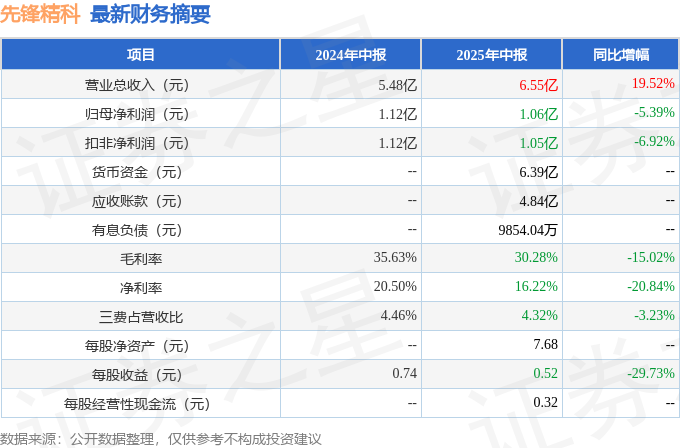
Core Viewpoint - The recent financial report of Pioneer Precision (688605) shows a mixed performance with a revenue increase but a decline in net profit, highlighting concerns over accounts receivable and profitability metrics [1][2]. Financial Performance - For the first half of 2025, the company reported total revenue of 655 million yuan, a year-on-year increase of 19.52%, while the net profit attributable to shareholders was 106 million yuan, a decrease of 5.39% [1]. - In Q2 2025, total revenue reached 355 million yuan, up 7.07% year-on-year, but net profit fell to 64.21 million yuan, down 1.91% [1]. - The gross margin was 30.28%, down 15.02% year-on-year, and the net margin was 16.22%, down 20.84% [1]. - The company's accounts receivable amounted to 484 million yuan, representing 226.34% of the net profit, indicating potential liquidity issues [1][2]. Business Model and Strategy - The company's performance is primarily driven by capital expenditures, necessitating careful evaluation of the profitability of these investments and the potential financial pressures they may impose [2]. - The company plans to enhance its R&D and improve processes to meet increasing customer demands for component cleanliness and yield, aiming for better performance in the latter half of 2025 [3]. Industry Context - The domestic semiconductor equipment and component industry has seen an increase in localization rates since 2017-2018, driven by national policies and sanctions, with ongoing improvements expected [3]. - Approximately 20% of the components supplied by the company are used in advanced processes, indicating a focus on high-tech applications [3].