
华夏科创半导体ETF

Search documents
科技基金密集上新,AI是投资主线
第一财经· 2026-03-18 13:54
Core Viewpoint - The article highlights the accelerating investment in the technology sector, particularly in AI and hard technology, with significant capital inflows and a growing number of funds focused on these areas [3][5][7]. Investment Trends - 15 hard technology-themed funds have recently been approved, expanding investment channels for technology-focused investors [3][5]. - As of March 18, 2023, the total fundraising for technology-related equity funds has reached nearly 240 billion yuan, with 37 new funds established this year [5][6]. - The demand for technology-related products is increasing, with 12 additional products currently in the fundraising stage [5]. AI as a Long-term Investment Focus - AI is viewed as a core investment theme in the capital market, with long-term value and growth potential [3][7]. - The focus is shifting from "what AI can do" to "what AI will replace," prompting a movement of funds from potentially disrupted assets to "AI immune assets" [3][7]. Fund Performance and Market Dynamics - Technology sectors are experiencing significant capital inflows, with over 120 billion yuan attracted to AI-related ETFs this year [6]. - Notable funds, such as the Huaxia Semiconductor ETF, have seen their assets double within a year due to strong net inflows [6][9]. Market Sentiment and Future Outlook - Despite short-term market fluctuations, technology remains a key investment theme for the year, driven by ongoing advancements in AI and related technologies [7][9]. - The overall market risk appetite is expected to stabilize, with a potential return of funds to equity markets as external risks diminish [9][10].


股票ETF成交活跃 行业主题产品“吸金”显著
2 1 Shi Ji Jing Ji Bao Dao· 2026-01-27 13:18
Core Viewpoint - The A-share market is experiencing a cooling trend, leading to a significant shift in ETF investments from broad-based ETFs to sector-specific ETFs, with substantial net outflows from major broad-based ETFs and inflows into thematic ETFs [1][2][3] Summary by Sections ETF Market Dynamics - As of January 23, 2026, the total net outflow from the CSI 300 ETF and the CSI 1000 ETF reached 336.9 billion and 78 billion respectively since the beginning of the year, while thematic ETFs, particularly in resources and technology, attracted a total of 158.5 billion in net inflows [1][4] - The week of January 12-16 saw a net outflow of 141.6 billion from stock ETFs, which increased to 333.1 billion in the following week, marking a historically significant outflow [1][2] Performance of Broad-based vs. Thematic ETFs - From January 19-23, the CSI 300 ETF experienced a net outflow of 237.3 billion, while the CSI 1000 ETF and the SSE 50 ETF saw outflows of 71.7 billion and 36.1 billion respectively [2] - The net outflows for the CSI 300 ETF, CSI 1000 ETF, and SSE 50 ETF from January 5-23 were approximately 336.9 billion, 78 billion, and 56.2 billion respectively [2] Institutional Investor Behavior - Institutional investors hold a significant portion of ETFs, with over 1.5 trillion in ETF holdings reported as of the end of Q4 2025, primarily in the CSI 300 ETF [3] - Despite the outflows, the CSI 300 ETF remains a major holding for institutional investors, with an estimated 1 trillion still held in ETFs by these investors [3] Sector-specific ETF Inflows - Thematic ETFs, particularly in sectors like non-ferrous metals and chemicals, have seen strong inflows, with 50 ETFs collectively attracting 158.5 billion from January 5-23 [4][5] - Notably, three ETFs exceeded 10 billion in net inflows, including the Southern Non-ferrous Metals ETF (12.6 billion), Huaxia Power Grid Equipment ETF (11.9 billion), and Penghua Chemical ETF (10.3 billion) [5] Market Outlook - Analysts suggest that the shift in ETF investments indicates a structural rebalancing rather than a complete exit from the market, which may lead to deeper market trends and structural opportunities [7][8] - The current market dynamics suggest a transition from valuation recovery to a phase driven by fundamentals, with a focus on sectors with clear industry trends and performance support [8]
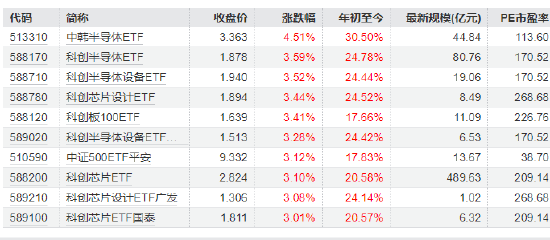
芯片产业链持续拉升!最高涨超4.5% 华夏科创半导体ETF、华泰柏瑞科创半导体设备ETF等10只产品涨超3%
Xin Lang Cai Jing· 2026-01-27 10:17
Core Viewpoint - The A-share market experienced a strong upward trend on January 27, with all three major indices closing higher, particularly driven by the semiconductor industry, which saw significant stock price increases and heightened market sentiment [1][4]. Group 1: Market Performance - The semiconductor industry chain was notably active, with stocks like Huahong Semiconductor reaching historical highs and several companies such as Yaxing Integrated and Shenghui Integrated hitting the daily limit [1][4]. - The strong performance of the semiconductor sector led to significant gains in related ETFs, with the Huatai-PineBridge China-Korea Semiconductor ETF (513310) rising by 4.51%, leading the market [1][4]. Group 2: ETF Performance - Various thematic ETFs related to semiconductors and technology growth recorded gains of over 3%, indicating concentrated capital allocation towards these sectors [1][4]. - Notable ETFs included the Huatai-PineBridge China-Korea Semiconductor ETF, Huaxia Sci-Tech Semiconductor ETF, and others, reflecting a strong market preference for hard technology sectors [2][5]. Group 3: Valuation Insights - Many popular ETFs have reached historically high valuation levels, with several semiconductor ETFs having a price-to-earnings (PE) ratio exceeding 95%, and some even surpassing 200 [2][5]. - The overall PE percentile for broad-based ETFs like the CSI 500 ETF has also reached 100%, indicating valuation pressures in the small and mid-cap sectors [2][5]. Group 4: Future Outlook - The semiconductor sector is expected to benefit from both domestic substitution and cyclical recovery, although internal differentiation within the sector may intensify [3][6]. - Investors are advised to consider industry sentiment, policy support, and valuation safety margins for comprehensive portfolio allocation [3][6].
A股、黄金“会师”4000点后,如何把握波动中的机会?
2 1 Shi Ji Jing Ji Bao Dao· 2025-11-04 05:44
A-share Market - The A-share market successfully broke through the 4000-point mark on October 28, 2025, marking a significant milestone not seen in nearly a decade [1] - The total number of A-share listed companies reached 5,444, with a total market capitalization exceeding 118 trillion yuan, indicating a structural shift in market capitalization from traditional sectors to new economy sectors like AI, semiconductors, and biomedicine [2] - The technology sector is identified as the core driver of A-share growth, with its market capitalization approaching 50%, and the electronic industry surpassing the banking sector to become the largest weight in A-shares [2] Investment Opportunities - The semiconductor sector is highlighted as a "potential stock" with valuation advantages, driven by technological breakthroughs and increased investment in domestic alternatives [3] - The humanoid robot industry is experiencing a resurgence, with significant advancements and commercial applications expected to drive growth [5] - The aerospace industry is positioned for growth under the "14th Five-Year Plan," with increased government support and a focus on strategic emerging industries [6] Gold Market - The international gold price experienced a correction, dropping below the psychological support level of 4000 USD/oz after nearing historical highs [7] - Despite recent fluctuations, gold remains one of the best-performing assets of the year, with significant gains in gold ETFs [8] - The long-term upward trend for gold is supported by macroeconomic factors such as the Federal Reserve's interest rate cuts and ongoing inflation concerns, suggesting that gold may continue to challenge traditional assets like U.S. Treasury bonds [9]