华宝中证港股通互联网ETF

Search documents
翻倍基“出现又离开”!港股基金突围
券商中国· 2026-01-13 10:48
Core Viewpoint - The Hong Kong stock market has been underperforming compared to the A-share market since Q4 2025, with liquidity issues and a lack of strong rebounds in key sectors like innovative drugs and technology being significant factors [1][2]. Group 1: Market Performance - The Hong Kong stock market has seen a correction trend since Q4 2025, with previously leading sectors like innovative drugs and technology struggling to rebound [1]. - By the end of last year, the Hang Seng Innovation Drug Index experienced a pullback, resulting in a lack of performance from related thematic funds, with only one fund, Huatai-PineBridge Hong Kong Advantage Selection, rising over 112% [2]. - The Hang Seng Technology Index also faced a high-level pullback, dropping approximately 15% in a single quarter, leading to an overall annual increase of only about 20% [2]. Group 2: Liquidity Issues - Liquidity has been identified as a core factor suppressing Hong Kong stock valuations, with many fundamentally strong stocks experiencing significant price drops due to low trading volumes [1][4]. - In 2025, the total fundraising amount from IPOs in Hong Kong reached approximately HKD 280 billion, with predictions of over HKD 300 billion in 2026, posing a challenge to market liquidity [4]. - The net inflow of southbound funds significantly slowed in December, with only HKD 23 billion entering the market, which is substantially lower than previous months [4]. Group 3: Investment Strategies - Fund managers emphasize the importance of prioritizing "win rate over odds" in Hong Kong stock investments, advocating for value investing and diversification to mitigate liquidity risks [7][8]. - Investors are advised to focus on the fundamentals and quality of companies, as historical integrity issues can significantly impact valuations [8]. - The current trend of RMB appreciation may provide a buffer against liquidity concerns, potentially attracting more capital into the Hong Kong market [6]. Group 4: Sector Focus - Fund managers are increasingly optimistic about the value proposition of Hong Kong stocks, particularly in technology and high-end manufacturing sectors, which are seen as having significant growth potential [9][10]. - There is a growing interest in consumer sectors, particularly in high-quality cultural products and competitive tea beverage companies, which are expected to achieve stable long-term growth [10].


“翻倍基”乍现背后 基金经理依然相信港股繁荣刚刚开始
Zheng Quan Shi Bao· 2026-01-11 17:00
Core Viewpoint - The Hong Kong stock market is experiencing a prolonged consolidation phase, with significant challenges in liquidity and performance, particularly in sectors like innovative pharmaceuticals and technology, which previously showed strong growth [1][2][3] Group 1: Market Performance - In early 2026, the A-share market is performing well, while the Hong Kong stock market continues to struggle, particularly in sectors that previously led the market [1] - By the end of 2025, the performance of Hong Kong-themed funds, especially in innovative pharmaceuticals, has declined significantly, with only one fund showing over 112% growth [2] - The Hang Seng Index and Hang Seng Technology Index remain in a consolidation phase, contributing to the underperformance of related thematic funds [2] Group 2: Liquidity Issues - Liquidity is identified as a critical factor restraining the Hong Kong market, with a significant drop in net inflows from southbound funds, which were only 23 billion HKD in December 2025 [3] - The IPO market in Hong Kong is expected to remain active, with total fundraising projected to exceed 300 billion HKD in 2026, posing challenges for liquidity [3] - There is a structural liquidity issue in the Hong Kong market, characterized by concentrated trading in large-cap stocks while small-cap stocks experience very low trading volumes [3] Group 3: Investment Strategies - Investment in Hong Kong stocks should prioritize "winning rate over odds," emphasizing value investing and risk diversification to mitigate liquidity risks [6] - Investors are advised to maintain a cautious approach, focusing on high-quality companies with strong fundamentals and historical integrity, as these are likely to enjoy valuation premiums [6] - The current appreciation of the RMB is seen as a potential driver for increased capital inflows into the Hong Kong market, enhancing its attractiveness [4] Group 4: Sector Focus - Fund managers express optimism about technology and consumer sectors, highlighting the relative undervaluation of Hong Kong stocks compared to global markets [7] - There is a growing interest in high-end manufacturing and innovative consumer sectors, with a focus on companies that leverage supply chain advantages and product innovation [8] - The tea beverage industry is noted for its improving competitive landscape, with leading companies expected to achieve stable long-term growth due to their cost advantages [8]
【ETF观察】9月10日跨境ETF净流入16.54亿元
Sou Hu Cai Jing· 2025-09-10 23:48
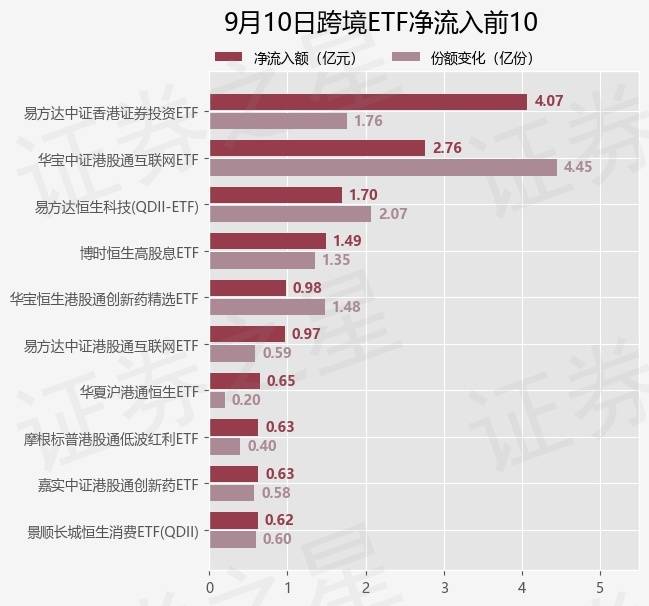
Summary of Key Points Core Viewpoint - On September 10, the total net inflow of cross-border ETFs reached 1.654 billion yuan, with a cumulative net inflow of 12.134 billion yuan over the past five trading days, indicating strong investor interest in these funds [1]. Fund Inflows - A total of 34 cross-border ETFs experienced net inflows on September 10, with the E Fund CSI Hong Kong Securities Investment ETF (513090) leading the inflow, increasing by 17.5 million shares and a net inflow of 407 million yuan [1][3]. - Other notable ETFs with significant inflows include: - Hua Bao CSI Hong Kong Stock Connect Internet ETF (513770) with a net inflow of 276 million yuan [3]. - E Fund Hang Seng Technology (QDII-ETF) (513010) with a net inflow of 170 million yuan [3]. Fund Outflows - On the same day, 17 cross-border ETFs recorded net outflows, with the Huatai-PB Korea Semiconductor ETF (QDII) (513310) showing the largest outflow, decreasing by 22 million shares and a net outflow of 42.67 million yuan [1][4]. - Other ETFs with notable outflows include: - Hua An Hang Seng Stock Connect Technology Theme ETF with a net outflow of 26 million yuan [5]. - Penghua CSI Hong Kong Stock Connect Medical and Health Comprehensive Trading ETF with a net outflow of 11 million yuan [5]. Performance Overview - The performance of the top inflow ETF, E Fund CSI Hong Kong Securities Investment ETF, showed a 1.00% increase, while the top outflow ETF, Huatai-PB Korea Semiconductor ETF, increased by 2.54% despite the outflow [3][5]. - The overall trend indicates a mixed performance among the ETFs, with some gaining traction while others faced withdrawals [1][4].