博时纳斯达克100ETF(513390)

Search documents
美股小幅上涨,关注本周FOMC会议
Xin Lang Cai Jing· 2025-12-11 09:09
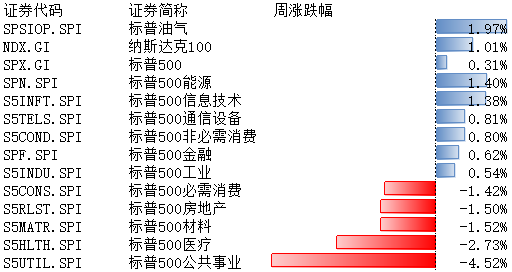
Macroeconomic Overview - The US PCE price index for September remained high, with a year-on-year increase of 2.8%, matching expectations and higher than the previous value of 2.7% [1] - The month-on-month PCE price index for September increased by 0.3%, consistent with expectations and the previous value [1] - The core PCE price index for September rose by 2.8% year-on-year, in line with expectations but lower than the previous value of 2.9% [1] - The month-on-month core PCE price index for September increased by 0.2%, matching expectations and the previous value [1] - Personal consumption expenditures in September rose by 0.3% month-on-month, in line with expectations but lower than the previous value of 0.5% [1] - Actual personal consumption expenditures for September showed no growth, falling short of the expected 0.1% and the previous value of 0.2% [1] Employment and Consumer Confidence - The US manufacturing sector continued to contract in November, while the service sector accelerated its expansion [1] - The ISM manufacturing index for November recorded 48.2, below the expected 49 and the previous value of 48.7 [1] - The ISM services index for November recorded 52.6, exceeding the expected 52 and the previous value of 52.4 [1] - The ADP employment report for November showed a decrease of 32,000 jobs, significantly below the expected decrease of 10,000 and the previous decrease of 42,000 [1] - Consumer confidence improved significantly in December, with the Michigan University consumer confidence index initial value at 52.3, better than the expected 52 and the previous value of 51 [2][1] - The one-year inflation expectation from Michigan University for December was 4.1%, lower than both the expected and previous value of 4.5% [2] - The five-year inflation expectation from Michigan University for December was 3.2%, lower than both the expected and previous value of 3.4% [2] Market Performance - The S&P Oil & Gas index rose by 1.97% over the week from December 1 to 5, while the Nasdaq 100 index increased by 1.01% and the S&P 500 index rose by 0.31% [3][16] - Among the 11 sectors covered by the S&P 500, 6 sectors saw gains, with the S&P 500 Energy sector leading at 1.40%, while the S&P 500 Utilities sector lagged with a decline of 4.52% [3][16] - The market is observing stable expectations for interest rate cuts in December, following disappointing employment data [16]

美股观察|特朗普关税威胁再触发避险交易,美股下跌
Xin Lang Cai Jing· 2025-10-14 10:16
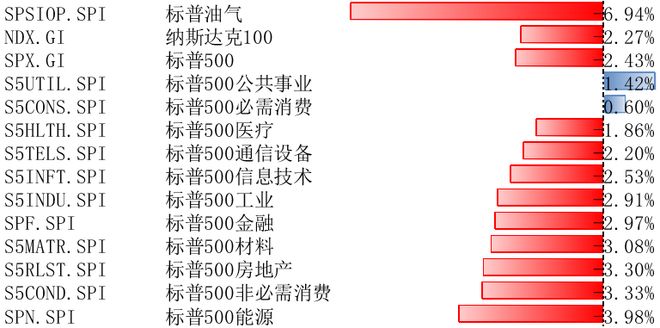
Group 1: US Macroeconomic Data - The US government has been shut down since October 1, 2025, due to the failure to pass a temporary funding bill, leading to heightened US-China trade tensions [1] - The University of Michigan's consumer confidence index for October recorded at 55, slightly above the expected 54 but below the previous value of 55.1 [1] - The one-year inflation expectation for October is at 4.6, slightly lower than the expected 4.7 and the previous 4.7, while the five-year inflation expectation remains stable at 3.7 [1] Group 2: Major Index Performance - For the week of October 6-10, the S&P Oil & Gas Index fell by 6.94%, the Nasdaq 100 Index decreased by 2.27%, and the S&P 500 Index dropped by 2.43%, with only two of the eleven sectors showing gains [1] Group 3: Market Outlook and Investment Direction - The threat of tariffs from Trump has triggered risk-averse trading, leading to declines in US stocks and a rise in gold prices [3] - The impact of the tariffs on US-China trade and economy is considered less significant compared to April, with market reactions being more desensitized [3] - There are ongoing discussions within the Federal Reserve regarding future interest rate paths, indicating a divergence of opinions [3]
美股观察|美联储仍有望在9月开启降息,宽松环境或能延续
Xin Lang Cai Jing· 2025-09-02 11:14
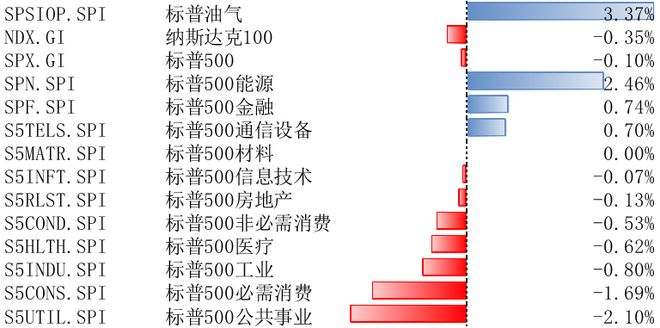
Group 1: US Macroeconomic Data - The US July PCE did not exceed expectations but remains at a high level, with service prices driving core inflation. The July PCE increased by 2.6% year-on-year, consistent with expectations and previous values; month-on-month, it rose by 0.2%, matching expectations but lower than the previous 0.3% [1] - In July, US durable goods orders continued to decline, but core durable goods orders rebounded strongly, with the difference attributed to fluctuations in aircraft orders. Durable goods orders fell by 2.8% month-on-month, better than the expected decline of 3.8% and previous decline of 9.4%; excluding transportation, orders rose by 1.1%, exceeding expectations of 0.2% and previous 0.3% [1] - New home sales in the US saw a significant drop compared to the previous month. July new home sales decreased by 0.6% month-on-month, falling short of the expected 0.5% and previous 4.1%; total sales reached 652,000 units, better than the expected 630,000 units but lower than the previous 656,000 units [1] Group 2: Major Index Performance - For the week of August 25-29, the S&P Oil & Gas Index rose by 3.37%, while the Nasdaq 100 Index fell by 0.35%, and the S&P 500 Index decreased by 0.10%. Among the 11 sectors covered by the S&P 500, 3 sectors saw gains, with energy leading at 2.46% and utilities lagging at -2.10% [2] Group 3: Investment Direction - The US Q2 GDP revision was upwardly adjusted due to strong business investment, indicating economic resilience. The Federal Reserve is expected to initiate interest rate cuts, catalyzing a recovery trade. Concerns arose regarding the independence of the Federal Reserve following Trump's dismissal of a board member, leading to a decline in the dollar and US Treasury yields, while gold prices increased [4] - Market expectations for interest rate cuts have slightly increased compared to the previous week, with a current probability of 86.6% for a rate cut starting in September. Recent inflation data shows a relatively mild impact from tariffs, with the burden primarily on net exporters, and CPI pressure expected to concentrate in Q4 [4]