卤化物电解质

Search documents
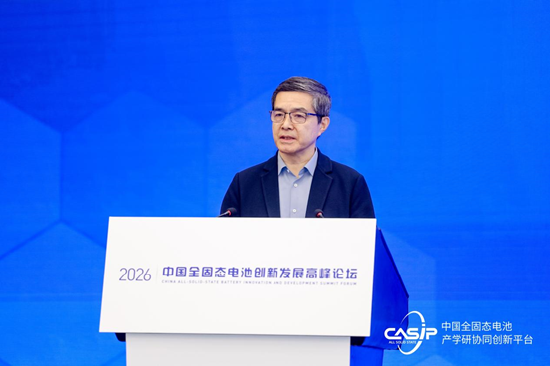
聚力攻坚|第三届全固态电池创新发展高峰论坛召开
Xin Lang Cai Jing· 2026-02-13 03:32
Core Insights - The third China All-Solid-State Battery Innovation Development Summit Forum was successfully held in Beijing, focusing on key issues in the all-solid-state battery industry and providing systematic support for technological breakthroughs and high-quality development [1][16]. Group 1: Strategic Direction and Collaboration - The Chinese battery industry is experiencing rapid growth and technological iteration, with applications expanding from vehicles and energy storage to robotics and low-altitude aircraft [2][17]. - The All-Solid-State Battery Collaborative Innovation Platform aims to address common industry challenges and promote interdisciplinary collaboration [2][17]. Group 2: Research and Breakthroughs - The demand for batteries is surging under carbon neutrality goals, with solid-state batteries facing challenges such as electrolyte performance and solid-solid interface compatibility [4][19]. - Innovations in interface design and molecular engineering have led to breakthroughs in reducing interface resistance and enhancing electrolyte performance [4][19]. Group 3: Material Innovations - Key materials research is focused on high-capacity, high-voltage cathodes, stable anodes, and electrolytes with high ionic conductivity [6][21]. - Various teams are exploring advanced materials and strategies to improve the performance and stability of solid-state batteries [22][23]. Group 4: Manufacturing and Standardization - The manufacturing of all-solid-state batteries faces challenges related to material systems and solid-solid interface science, requiring breakthroughs in engineering processes and cost-effectiveness [11][27]. - A comprehensive standard system for solid-state batteries is being developed to guide industry management and technological advancement [12][28]. Group 5: Safety and Interface Design - Achieving stable interfaces in solid-state batteries relies on multidimensional collaborative design, with a focus on balancing performance gains and stability risks [29][14]. - The safety risks and failure mechanisms of solid-state batteries differ significantly from liquid systems, necessitating collaborative efforts from academia and industry [29][14]. Group 6: Forum Outcomes - The forum identified key scientific and technological challenges, facilitating efficient collaboration between academia and industry to support the all-solid-state battery sector's development [15][30].

容百科技以多技术路线布局全固态电池 2027年规模化商用或锁定先机
Zheng Quan Shi Bao Wang· 2025-11-15 08:33
Group 1 - The core focus of Rongbai Technology is on advancing solid-state battery technology and industrialization, with a comprehensive R&D and production path established since 2018 [1] - The company has achieved significant breakthroughs in solid-state cathode materials, with 10 tons of 8-series high-nickel solid-state cathode materials shipped and ton-level shipments of 9-series materials recognized in the market [2] - In the solid-state electrolyte sector, Rongbai Technology has developed a sulfide solid electrolyte with uniform particle size distribution, leading to major breakthroughs in energy density [2][3] Group 2 - The company plans to achieve large-scale commercial application of solid-state battery cathode materials by 2027, targeting the next generation of smart mobility [4] - A clear production roadmap is in place, with plans to complete B-sample verification this year and initiate C-sample testing next year, aiming for pilot line completion in 2026 and large-scale production in 2027 [4] - Rongbai Technology is transitioning from a single ternary enterprise to a platform provider of comprehensive cathode material solutions, leveraging technology integration and a global supply chain [4]

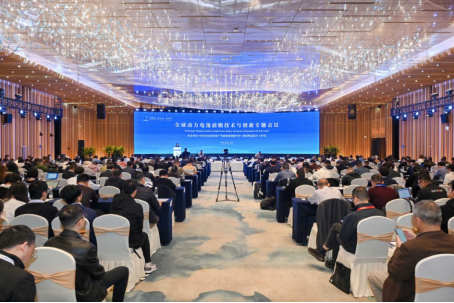
前沿技术风向标|全球动力电池前瞻技术与创新论坛共探产业未来
Xin Lang Cai Jing· 2025-11-15 05:57
Core Insights - The global advanced technology forum on power batteries was successfully held in Yibin, focusing on cutting-edge technological breakthroughs and key challenges in the power battery sector, recognized as a "technical barometer" for global power battery development [1] - The forum attracted over 600 experts and representatives from various sectors, including battery manufacturing, automotive, materials, and research institutions, facilitating in-depth discussions on the latest technological advancements and core issues in next-generation batteries [1] Industry Trends - The competition in the battery industry is shifting from "engineering optimization" to "deep water of technological innovation," with core challenges now centered on breakthroughs in energy density, safety, fast charging performance, and resource constraints [5] - The lithium iron phosphate battery is expected to capture 80% of the market share by 2025, with the penetration rate of new energy vehicles nearing 50% [7] - The demand for batteries is projected to grow fourfold by 2030 and twelvefold by 2035, indicating significant growth potential in the industry [7] Technological Innovations - The oCVD/iCVD technology presented at the forum enhances the structural stability and electrochemical performance of high-nickel ternary battery materials through polymer coating [9] - The development of halide electrolytes shows better compatibility with cathodes compared to sulfides and oxides, but faces challenges in ionic conductivity, cost control, and electrode interface stability [10] - A new approach for solid-state battery interface issues involves "dynamic interface repair with dual ionic conductors," providing a pathway for low-pressure operation [10] Standardization and Engineering Challenges - The solid-state battery technology is becoming a new focus of global industrial competition, yet it still faces multiple challenges in materials, interfaces, and engineering [10] - Engineering challenges for sulfide solid-state batteries include material compatibility, electrolyte film formation, and interface design, necessitating a deep integration of materials, processes, and equipment innovation [11] Knowledge Sharing and Collaboration - A significant report on "Global Patent Analysis and Strategy for Solid-State Batteries" was released, focusing on the role of intellectual property in the development of next-generation batteries [13] - The forum served as a high-end communication platform, promoting deep connections between technological viewpoints and practical experiences, supporting the high-quality development of China's new energy industry [13]
容百科技发布全固态电池产业化路径 预计2027年实现规模化商用
Zhong Zheng Wang· 2025-11-14 06:26
Core Viewpoint - Rongbai Technology has disclosed its comprehensive research and development layout and technology commercialization timeline for all-solid-state battery materials, aiming for mass commercialization of its positive materials by 2027 [1][2] Group 1: All-Solid-State Battery Development - The all-solid-state battery is considered the ideal form of next-generation battery technology due to its high safety and comprehensive performance, with a projected global market size exceeding 156 GWh by 2030 [1] - The industrialization of sulfide all-solid-state batteries faces three core challenges: interface stability, cost, and manufacturing processes [1] - Industry efforts are focused on interface modification and multi-scale characterization technologies to guide structural optimization, with expectations that the cost of sulfide all-solid-state batteries could drop below 0.4 yuan/Wh by 2035 as production capacity expands and processes iterate [1] Group 2: Positive Material Strategy - Rongbai adopts a dual strategy of "ultra-high nickel" and "lithium-rich manganese-based" in the positive material sector, achieving 10-ton level shipments for 8-series high nickel and ton-level shipments for 9-series high nickel [2] - The lithium-rich manganese-based positive material has been recognized by leading cell manufacturers for its high capacity output under high voltage through structural adjustments [2] Group 3: Solid Electrolyte and Supply Chain - The company is advancing both sulfide and halide routes for solid electrolytes, with LPSC electrolytes showing uniform particle size distribution and air stability, suitable for high nickel positive materials to achieve energy density breakthroughs [2] - Halide electrolytes maintain a stable capacity retention rate after 1000 cycles and exhibit industry-leading ionic conductivity [2] - Key auxiliary materials such as binders and lithium sulfide have achieved independent mass production, ensuring supply chain support for industrialization [2] Group 4: Strategic Transformation and Innovation - Rongbai Technology has transformed from a single ternary material company to a platform provider of comprehensive positive material solutions, leveraging a "technology-process-market" closed-loop strategy [2] - The company is rapidly entering new markets such as sodium batteries, manganese iron phosphate, and lithium iron phosphate through continuous acquisitions and independent research and development [2] - In supply chain management, the company employs long-term procurement agreements and AI to optimize inventory, while also establishing a battery recycling system to create a resource recycling value chain [2] - The company emphasizes accelerating material design through a digital platform and strengthening collaborative innovation with global customers [2]
嘉宾预告丨有研广东院 教授级高工 赵昌泰将在2025起点固态电池行业年会发表主题演讲
起点锂电· 2025-10-28 09:15
Core Insights - The 2025 Solid-State Battery Industry Annual Conference and the Golden Ding Award Ceremony will be held on November 8, 2025, in Guangzhou, focusing on new technologies and ecosystem building [2] - The event will feature a keynote speech by Professor Zhao Changtai from the Guangdong Academy of New Materials Technology, discussing the research progress of halide all-solid-state batteries [2] Company Overview - The Guangdong Academy of New Materials Technology, established on June 30, 2021, is a provincial-level research institution co-built by China Research, Guangdong Provincial Science and Technology Department, and local governments [7] - The academy focuses on the integration of technology research and development, public services, and industrial incubation, particularly in the fields of new energy materials and advanced electronic materials [7] Key Products - The main products include halide electrolytes, halide all-solid-state batteries, low-pressure all-solid-state batteries, and dry electrode technology [8] Strategic Advantages - The Guangdong Academy is in the process of establishing a large-scale production line for low-cost, high-ion-conductivity halide electrolytes and aims to achieve continuous production of solid-state dry electrodes [10] - The 20Ah halide all-solid-state battery has passed safety verification tests, and the low-pressure all-solid-state battery can operate normally at a charge and discharge rate of 0.5 C under atmospheric pressure [10]

有研广东院参选2025中国固态电池行业金鼎奖
起点锂电· 2025-10-18 10:18
Core Viewpoint - The article discusses the 2025 China Solid-State Battery Industry Golden Award, aimed at encouraging innovation and recognizing outstanding contributions in the solid-state battery sector [3][13]. Group 1: Award Overview - The Golden Award is organized by Qidian Solid-State Battery and Qidian Research Institute SPIR, involving over 100 industry experts, entrepreneurs, research institutions, and media [13]. - The award aims to honor leading and innovative companies in the solid-state battery industry [13]. - The evaluation process includes self-nomination, candidate data review, committee voting, public announcement of results, and an award ceremony [13]. Group 2: Application Details - The application period for the award is from July 28, 2025, to September 20, 2025 [14]. - Data review will take place from September 21, 2025, to September 30, 2025, followed by expert evaluation from October 11, 2025, to October 20, 2025 [14]. - The award ceremony is scheduled for November 8, 2025, in Guangzhou [14]. Group 3: Participating Company - The Guangdong Institute of New Materials Technology (referred to as Youyan Guangdong Institute) is a participant in the award, focusing on solid-state battery material technology innovation [3][5]. - Established on June 30, 2021, the institute is a collaborative effort between China Youyan, Guangdong Provincial Science and Technology Department, and local governments [5]. - The institute aims to integrate innovation and industry development, focusing on new energy materials and advanced electronic materials [5]. Group 4: Product and Technological Advancements - The main products of Youyan Guangdong Institute include halide electrolytes, halide all-solid-state batteries, low-pressure all-solid-state batteries, and dry-process electrodes [6]. - The institute is in the process of establishing a large-scale production line for low-cost, high-ion-conductivity halide electrolytes and aims for continuous preparation of solid-state dry-process electrodes [12]. - The 20Ah halide all-solid-state battery has passed safety validations, and the low-pressure all-solid-state battery can achieve normal charging and discharging at 0.5 C under atmospheric pressure [12].

中金 | 固态电池系列报告一:锂电皇冠上的明珠,产业化浪潮将至
中金点睛· 2025-09-04 23:42
Core Viewpoint - Solid-state batteries are expected to become the next generation of lithium battery technology due to their high safety and energy density, with significant investment opportunities arising from technological breakthroughs and industrial transformation [2][4]. Group 1: Market Demand and Projections - The commercialization of solid-state batteries is accelerating due to policy support, market demand, and technological breakthroughs, with a projected global shipment of 808 GWh by 2030 [4][10]. - By 2030, the demand for semi-solid-state batteries is expected to exceed 650 GWh, with specific demands from power, energy storage, EVTOL, and consumer electronics at 466 GWh, 90 GWh, 60 GWh, and 36 GWh respectively [10]. - Full solid-state batteries are anticipated to achieve small-scale production by 2027 and commercial production by 2030, with a demand forecast of over 150 GWh [10]. Group 2: Material Innovations - The solid-state battery technology is converging towards the sulfide electrolyte route, which currently has high costs but significant cost reduction potential with scale [5][12]. - The long-term focus for anode materials is shifting towards lithium metal due to its high capacity and low electrode potential, with ongoing advancements in production methods [25][27]. - The cathode materials are expected to transition from high-nickel ternary materials to lithium-rich manganese-based materials, which offer high capacity and lower costs [23]. Group 3: Equipment and Manufacturing Processes - The value of equipment for solid-state batteries is significantly increasing due to the introduction of new processes and equipment in both the front and mid-stages of production [6][29]. - The front-end production requires dry electrode processes that are more compatible with sulfide electrolytes, enhancing production efficiency and reducing costs [30][32]. - The mid-stage production will replace winding with stacking processes, necessitating new equipment such as glue frame printing and isostatic pressing to ensure tight contact between solid electrolyte and electrodes [31][39]. Group 4: Competitive Landscape - Various companies are advancing their production capabilities for solid-state battery components, including sulfide and halide electrolytes, with significant investments in R&D and production lines [22][20]. - Companies like Ganfeng Lithium and Tianqi Lithium are focusing on lithium metal anodes, while others are developing advanced manufacturing techniques for solid-state batteries [27][26]. - The industry is witnessing a shift towards more efficient and cost-effective production methods, with several firms already implementing dry processing technologies [36][41].

重视固态电池材料等成长板块
GOLDEN SUN SECURITIES· 2025-08-10 13:18
Investment Rating - The report maintains a "Buy" rating for key stocks in the basic chemical sector, including Dongyangguang, Jingtai Holdings, Zhongyan Dadi, and Weixing Chemical [4]. Core Insights - The basic chemical sector is experiencing a configuration opportunity, with the index declining from a peak of 9565.18 points in September 2021 to a low of 3876.11 points in February 2024, representing a cumulative drop of 59.5% [1]. - The construction project growth rate in the chemical industry has been continuously declining, with a forecasted negative growth rate of -7.3% by Q1 2025 [1]. - The basic chemical index saw a cumulative increase of 5.9% from July 11 to August 8, 2024, while the petroleum and petrochemical index increased by 2.5% during the same period [1]. - Institutional holdings in the basic chemical sector peaked in Q3 2021 at 6.69%, but have since declined to 3.72% by Q2 2025 [1]. Summary by Sections Solid-State Battery Materials - Solid-state batteries are expected to significantly enhance energy density, with potential to exceed 500 Wh/kg, compared to traditional lithium-ion batteries which struggle to surpass 300 Wh/kg [2]. - The report highlights the importance of solid-state battery materials, including polymer, oxide, and sulfide types, with a focus on sulfide materials for future full solid-state batteries [2]. - Companies to watch in this sector include Daoshi Technology and Changyang Technology, as they are positioned to benefit from the anticipated industrialization of solid-state batteries starting in 2026 [2]. AI4S and AI Materials Investment Opportunities - AI4S is rapidly penetrating the pharmaceutical and chemical industries, with significant growth in innovative drug licensing transactions reaching 41 deals worth $36.929 billion in Q1 2025 [3]. - AI technologies are expected to replace traditional drug development processes, enhancing efficiency and reducing costs [3]. - The report identifies key players in AI4S, including Jingtai Holdings and Zhizhi New Materials, as well as suppliers of AI-specific hardware and materials [3].