可转债主题基金

Search documents
债市接连下跌 什么情况?
Zheng Quan Shi Bao· 2025-12-09 00:17
Group 1 - The bond market has experienced significant volatility and downward pressure this year, leading to a decline in the net value of bond funds and increased redemption pressure [1] - The 30-year treasury futures have seen a cumulative decline of over 8% since their peak in February, with other maturities also experiencing price drops, albeit to a lesser extent [2] - The recent downturn in the bond market is attributed to year-end profit-taking by institutions and a lack of clear positive catalysts, resulting in strong selling pressure [2][3] Group 2 - Over 200 bond funds have reported negative annual returns, with 13 funds showing returns below -5% and 215 funds below -1% [4] - The performance of convertible bond funds and mixed equity-bond funds has been relatively strong, benefiting from the performance of the equity and convertible bond markets [4] - The current market conditions suggest that the bond market may face continued downward pressure, with a lack of willingness among major institutional investors to take a bullish stance [4][5]
债市接连下跌,什么情况?
Zheng Quan Shi Bao· 2025-12-08 13:53
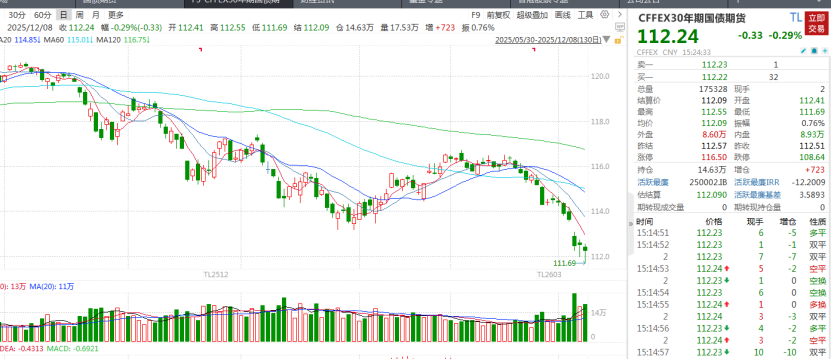
Core Viewpoint - The bond market has experienced significant volatility and downward pressure in 2023, leading to declines in bond fund net values and increased redemption pressures for investors [1] Group 1: Market Performance - The 30-year government bond futures have seen a cumulative decline of over 8% since their peak in February, with other maturities also experiencing price drops, albeit to a lesser extent [2] - As of December 5, nearly 800 bond funds reported negative annual returns, with 13 funds showing returns below -5% and 215 funds below -1% [6] Group 2: Market Influences - The recent downturn in the bond market is attributed to year-end profit-taking by institutions and a lack of clear positive catalysts, leading to increased selling pressure [4] - The stock market's weakness has also contributed to selling pressure in the bond market, which has not exhibited the typical "stock-bond seesaw" behavior, particularly in the long-end bonds [4] Group 3: Regulatory and Policy Impact - The "anti-involution" policy has led to an increase in bond yields, with new regulatory proposals adding to market uncertainty and prompting institutions to sell off bonds to avoid volatility [5] - The central bank's actions regarding government bonds are seen as more symbolic than substantive, with expectations of increased cooperation in the new year as fiscal measures are anticipated [7] Group 4: Future Outlook - Analysts suggest that the bond market's downward trend may continue due to a lack of willingness among major institutional investors to take a bullish stance [7] - There is a recommendation for investors to focus on short- and medium-term bond funds that are more sensitive to liquidity, while maintaining a cautious approach towards longer-term bonds until market trends become clearer [7]


债市接连下跌,什么情况?
证券时报· 2025-12-08 13:31
Core Viewpoint - The bond market has experienced significant volatility and downward pressure in 2023, leading to net value declines for bond funds and increased redemption pressures for investors [1][5]. Group 1: Market Performance - Since the beginning of the year, the bond market has shown frequent fluctuations, with the 30-year treasury futures price retreating over 8% from its peak in February [2][3]. - As of December 5, nearly 800 bond funds reported negative annual returns, with 215 funds yielding less than -1% [7][8]. Group 2: Causes of Market Decline - The recent decline in the bond market is attributed to year-end profit-taking by institutions, a lack of clear positive catalysts, and selling pressure from the stock market affecting bond prices [5][6]. - The bond market has not exhibited the typical "stock-bond seesaw" behavior, particularly in the long-duration bonds, which have shown significant interest rate increases [5][6]. Group 3: Future Outlook - Analysts suggest that the bond market may face continued downward pressure due to a lack of willingness among major institutional investors to take a bullish stance [9]. - Despite the current challenges, there is potential for a rebound in the bond market after year-end adjustments, as institutions may still have a demand for increased allocations [9][10].


持续调整!年内上千只债基负收益 30年期国债期货回撤超5%
Zheng Quan Shi Bao Wang· 2025-09-10 10:17
Core Viewpoint - The bond market has experienced significant adjustments since July, leading to negative returns for over a thousand bond funds, while the equity market has seen a rise in investor confidence due to supportive policies [1][4]. Group 1: Bond Market Performance - Since July, the 30-year government bond futures have retraced over 5%, with other maturities also showing declines, indicating a broad adjustment in the bond market [2][3]. - As of September 9, over a thousand bond funds reported negative year-to-date returns, with 50 funds showing returns below -2% and 181 funds below -1% [4]. - The bond market's downturn is attributed to changing market expectations, driven by macroeconomic policies aimed at stabilizing growth and a strong equity market performance [3][4]. Group 2: Fund Dynamics - The adjustment in the bond market has led to significant redemption pressures on bond funds, with nearly 20 funds experiencing large redemptions in the past month [4]. - Convertible bond funds and mixed equity-bond funds have performed relatively well, with some convertible bond funds achieving returns exceeding 20% [4]. - Recent regulatory changes regarding public fund fees have raised concerns among investors, potentially impacting the bond market's attractiveness [5]. Group 3: Market Outlook - The current environment suggests that the bond market may continue to face disturbances due to rising risk appetite and the strong performance of the equity market [6]. - Despite the challenges, there remains fundamental support for the domestic bond market, with expectations of a stable liquidity environment and ongoing growth policies [6]. - Analysts suggest that while a trend of recovery in the bond market may take time, there could be structural opportunities as market sentiment stabilizes [6].