吉利中国星系列

Search documents
传统燃油车的挣扎还是回春?
3 6 Ke· 2026-02-27 03:13
Core Viewpoint - The relationship between fuel vehicles and electric vehicles is shifting from a competitive replacement to a parallel coexistence, with fuel vehicles finding a new positioning in the market [1][9]. Group 1: Industry Trends - Stellantis Group has written down €22.2 billion in assets due to overestimating the speed of electrification, leading to an expected operating loss of over €20 billion in the second half of the year [1]. - Ford has acknowledged a $19.5 billion accounting loss from terminating multiple electric vehicle projects, while General Motors has withdrawn some electrification investments and recorded a $6 billion charge [1]. - The combined asset impairment of approximately $55 billion from these three major automakers, along with slowing electric vehicle demand in the U.S., subsidy reductions in Europe, and price wars in China, has made the calibration of electrification a core industry topic [1]. Group 2: Market Dynamics - In the U.S. market, demand for fuel and hybrid vehicles is returning due to a significant drop in demand following a surge before the expiration of a $7,500 tax credit in 2025, compounded by high-interest rates and tightened credit [3]. - In Europe, the slow construction of charging infrastructure and fluctuating electricity prices have hindered consumer acceptance of electric vehicles, leading to a resurgence in demand for plug-in hybrids and hybrid models [3]. - In China, while the penetration rate of new energy vehicles approaches 50%, many brands are struggling with profitability, indicating a complex market landscape [3]. Group 3: Technological Developments - Major automakers are investing in upgrading fuel vehicle technology to bridge the gap with electric vehicles, addressing previous issues such as power supply, heat dissipation, and response delays [2]. - Companies like Mercedes-Benz and Volkswagen are reallocating investment budgets to enhance fuel vehicle platforms rather than focusing solely on electric platforms, recognizing the ongoing demand for fuel vehicles [4]. - The transition to intelligent fuel vehicles is being facilitated by advancements in technology, with companies like Bosch and Geely implementing smart driving systems in their fuel models [7][8]. Group 4: Policy Environment - The EU's new carbon emission regulations for new vehicles from 2025 to 2027 provide a transitional mechanism for automakers, allowing them to adjust their strategies [5]. - In China, the focus has shifted from accelerating electrification to stabilizing fuel vehicle consumption, reflecting a recognition of the complexity of the automotive industry [6].


燃油车市场会局部“回春”吗?
Jing Ji Guan Cha Bao· 2026-02-25 09:16
Group 1 - Stellantis Group, the world's fourth-largest automotive group, has recognized an overestimation of the speed of electrification, leading to a one-time asset impairment of €22.2 billion, resulting in an expected operating loss of over €20 billion for the second half of the year [2] - Ford has acknowledged a book loss of $19.5 billion due to the termination of multiple electric vehicle projects, while General Motors has withdrawn some electrification investments and recorded a $6 billion charge [2] - The combined impairment impact of approximately $55 billion from these three multinational automotive giants, alongside a slowdown in electric vehicle demand in the U.S., a reduction in European subsidies, and a price war in the Chinese market, has shifted the discussion on the pace of electrification to a core industry topic [2] Group 2 - The global fuel vehicle market is showing signs of potential recovery, with many automakers upgrading fuel vehicles to bridge the intelligence gap with electric vehicles [3] - Major multinational automakers had previously set timelines for phasing out fuel vehicles and focused on electric platforms, but recent changes in the market environment have led to a reassessment of this strategy [4] - In the U.S. market, demand for fuel and hybrid vehicles is returning due to a significant drop in demand following a tax credit expiration, while in Europe, the slow construction of charging infrastructure and fluctuating electricity prices have hindered the acceptance of pure electric vehicles [4] Group 3 - Starting in 2024, several multinational automakers have resumed substantial investments in fuel vehicle technology, with Mercedes-Benz postponing its target for electric vehicle sales to 50% by 2025 by five years and allocating 50% of its investment budget to upgrading fuel vehicle platforms [5][6] - This renewed investment in fuel vehicle technology reflects a recognition of the diverse demand in the market, acknowledging that the global fleet of over 1 billion fuel vehicles cannot be replaced within a decade [6] - The policy environment is also changing, with the EU's new car emissions regulations providing a transitional mechanism for automakers, allowing them to adjust their strategies [6] Group 4 - By the end of 2025, China's fuel vehicle ownership is expected to exceed 320 million, accounting for 88% of total vehicle ownership, which is crucial for employment and market value in the automotive parts sector [7] - The shift in policy language from "accelerating electrification" to "stabilizing fuel vehicle consumption" indicates a recognition of the complexity of the industry rather than a reversal of direction [7] Group 5 - The concept of "oil-electric intelligence" addresses the technological capabilities of fuel vehicles, overcoming previous challenges related to electronic architecture and power supply systems [8] - With advancements in technology, fuel vehicles are now capable of integrating intelligent features that were once exclusive to electric vehicles, indicating a shift in the competitive landscape [9] - Bosch predicts that by 2026, the market share of pure electric, hybrid, and fuel vehicles will stabilize at a ratio of 4:4:2, suggesting that fuel vehicles will not disappear but will be concentrated in specific scenarios and replacement needs [9][10]


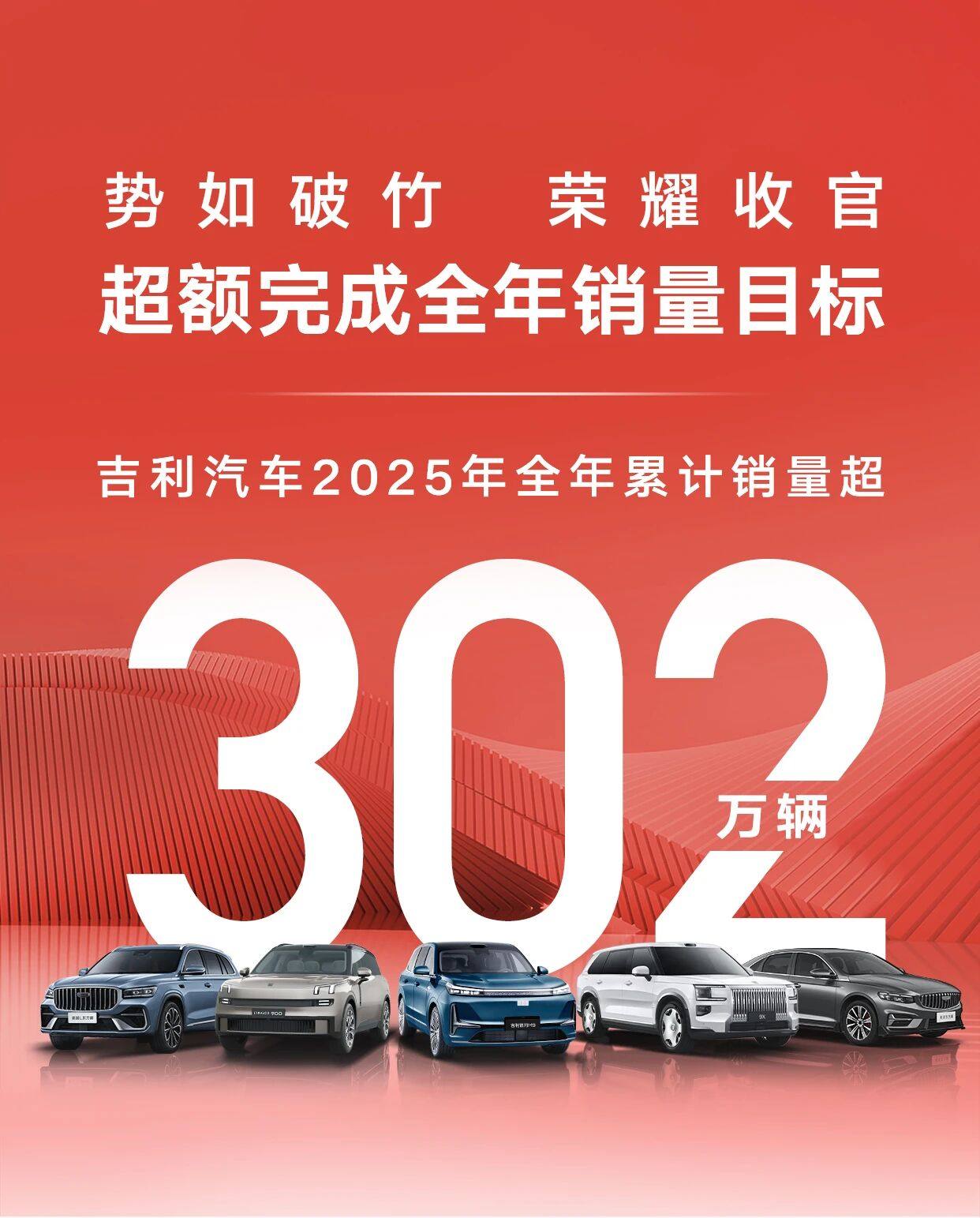
吉利汽车2025年全年累计销量超302万辆 2026年冲击总销量345万辆!
Zhi Tong Cai Jing· 2026-01-01 11:23
Core Insights - Geely Automobile achieved a total vehicle sales of 3,024,567 units in 2025, representing a year-on-year growth of approximately 39% and exceeding the annual sales target of 3,000,000 units [1][4][10] - The company recorded a significant increase in new energy vehicle sales, reaching 1,687,800 units, which is a remarkable 90% year-on-year growth, setting a new record [1][4][7] - The Geely brand led the sales with 2,449,939 units, while the "China Star" series achieved sales of 1,214,100 units, surpassing the "one million China Star" target [1][11] Sales Performance - Total vehicle sales for Geely in 2025 were 3,024,567 units, a 39% increase from the previous year [1][4] - New energy vehicle sales reached 1,687,800 units, marking a 90% increase year-on-year [1][4][7] - The Geely brand's sales were 2,449,939 units, while the Lynk & Co brand sold 350,495 units, a 23% increase [4][17] - Zeekr brand sales totaled 224,133 units, with December 2025 deliveries reaching 30,267 units, a record high [21] Brand Performance - The "China Star" series achieved sales of 1,214,100 units, exceeding the target of one million [1][11] - The Galaxy brand saw a 150% increase in sales, reaching 235,807 units, and achieved the "one million Galaxy" sales target in just 29 months [13][14] - Lynk & Co's new energy family accounted for 65% of its total sales, with a 36% year-on-year growth [18][20] - Zeekr's new models, including the Zeekr 9 series, have strengthened its position in the luxury new energy market [21] International Expansion - Geely's overseas sales reached 420,097 units in 2025, successfully meeting its export sales target [23] - The company expanded into 13 new markets, including the UK, Italy, Brazil, and South Africa [23][26] - Lynk & Co has accelerated its global presence, establishing over 860 stores in more than 50 countries [24][26] - Zeekr has also entered over 50 countries, showcasing strong competitiveness in various international markets [25][26]