
吉利神盾金砖电池

Search documents
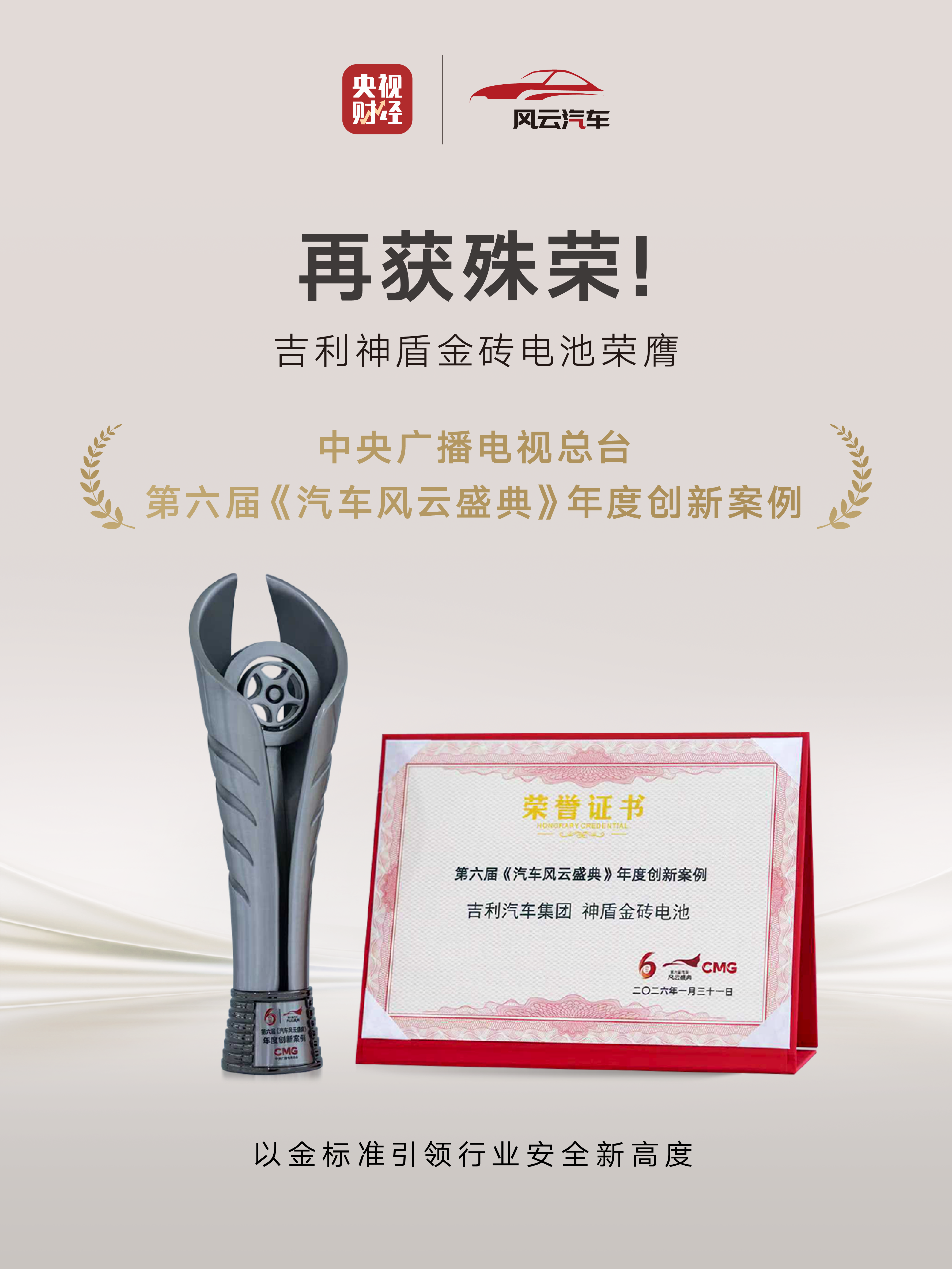
央视认可!神盾金砖电池获年度创新大奖
Xin Lang Cai Jing· 2026-02-26 10:23
Core Viewpoint - Geely's Shield Gold Brick Battery has been recognized as an innovative case at the 6th "Automobile Wind and Cloud Ceremony" by China Central Television, showcasing its leading technological innovation and extreme safety performance [1][24]. Group 1: Awards and Recognition - The Geely Shield Gold Brick Battery has won the first prize of the "Science and Technology Progress Award" from the China Society of Automotive Engineers, highlighting its four core advantages: ultra-safety, ultra-fast charging, high discharge rate, and ultra-durability [1][24]. Group 2: Key Advantages - The battery is defined by four hard-core advantages: - **Ultra-Safety**: Successfully passed extreme tests, including simultaneous penetration by eight steel needles and a live ammunition test without smoke, fire, or explosion, maintaining a voltage above 3.2V [8][32]. - **High Discharge Rate**: Achieves a maximum discharge rate of 21.02C, utilizing self-developed multi-particle composite technology to balance power, lifespan, and energy density [39][41]. - **Ultra-Durability**: Capable of maintaining performance over a million kilometers, featuring a unique self-repairing SEI membrane technology to ensure structural stability [20][42]. - **Ultra-Fast Charging**: Designed to prevent lithium plating during initial charging, ensuring efficient energy transfer [12][36]. Group 3: Industry Contribution - Geely is opening its battery safety patents to the entire industry, promoting safety standards and sharing systematic solutions for battery safety design and technology verification, aimed at enhancing user safety in extreme scenarios [43].


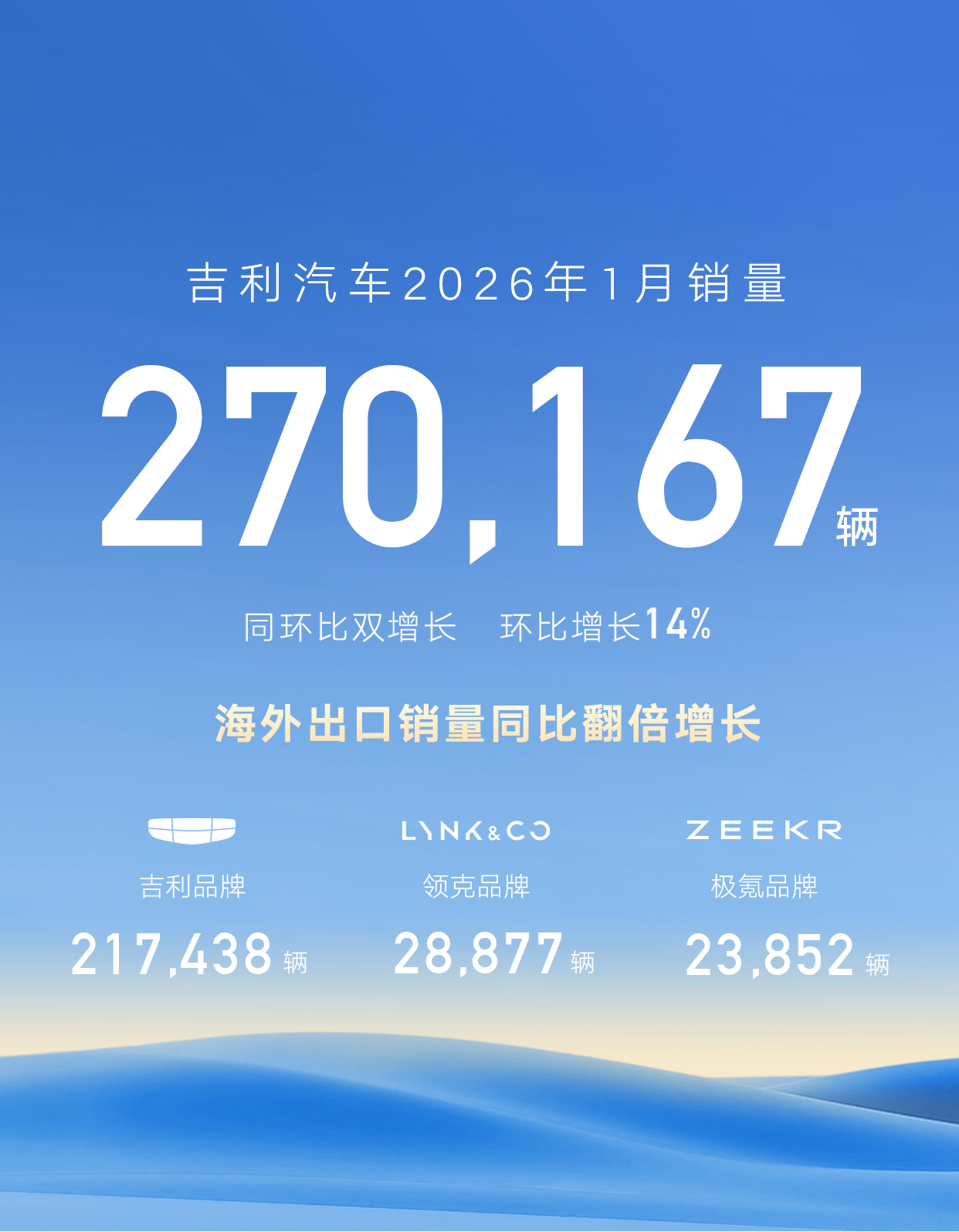
“一个吉利”聚势向上,吉利汽车1月销量27万辆,海外销量翻倍增长
Jin Rong Jie· 2026-02-02 10:00
Core Insights - Geely Automobile Holdings Limited reported a total passenger car sales of 270,167 units in January 2026, marking a year-on-year increase of 1% and a month-on-month increase of 14% [1][2] - The company aims to achieve a sales target of 3.45 million units for the year 2026, with plans to launch 1-2 new models each quarter, including hybrid and hydrogen energy vehicles [1][20] Sales Performance - In January 2026, Geely's new energy vehicle sales reached 124,252 units, reflecting a year-on-year growth of approximately 3% [1] - The sales of Geely's premium brand Zeekr reached 23,852 units, doubling year-on-year [1][3] - Overseas exports amounted to 60,506 units, representing a significant year-on-year increase of 121% [1][20] Brand Development - Geely is focusing on product premiumization, with a clear brand matrix established post-integration [3][12] - The luxury brand Zeekr's sales in January were 23,852 units, with the Zeekr 9X and Zeekr 009 leading in their respective segments [3] - Lynk & Co sold 28,877 units in January, with 17,410 units being new energy vehicles, accounting for 60% of its total sales [5] Technological Advancements - Geely is advancing its AI technology with the launch of the WAM (World Action Model) at CES 2026, enhancing the integration of AI across vehicle systems [13][15] - The new generation assisted driving system, 千里浩瀚G-ASD, aims to provide superior user experience and will gradually introduce advanced driving features [15][16] - In the battery sector, Geely plans to launch a new lithium iron phosphate battery system in 2026, aiming for a 15% increase in energy density [17] Global Expansion Strategy - Geely's global strategy emphasizes regional deepening and global collaboration, with a target of 640,000 export units in 2026, representing over 50% growth [20][22] - The company is establishing a comprehensive industrial park in Malaysia to serve as a hub for Southeast Asia, aiming for an annual production capacity of 500,000 units [22] - Geely is also focusing on high-end market penetration in developed regions, leveraging partnerships with Volvo and Renault [22]
吉利汽车1月销量超27万辆,全年冲刺345万辆目标
Bei Ke Cai Jing· 2026-02-02 09:15
Group 1 - The core viewpoint of the article highlights Geely Automobile's strong performance in January 2026, with a total passenger car sales of 270,167 units, marking a 1% year-on-year increase and a 14% month-on-month increase, as the company aims for an annual sales target of 3.45 million units [1] - In the new energy sector, Geely's sales reached 124,252 units in January 2026, reflecting a year-on-year growth of approximately 3%, with Zeekr's sales doubling to 23,852 units [1] - Geely's overseas export sales in January 2026 reached 60,506 units, showing a significant year-on-year increase of 121%, with a target of 640,000 units for the year, representing over 50% growth [1] Group 2 - Geely plans to gradually introduce Level 3 autonomous driving features on highways and Level 4 in urban areas in 2026, alongside the launch of Robotaxi trial operations [2] - The company will introduce a new manganese iron phosphate battery system, aiming for a 15% increase in energy density, and will complete the first pack of solid-state batteries in 2026 [2] - Geely's four major brands—Zeekr, Lynk & Co, Geely Galaxy, and Geely China Star—will share resources and collaborate to support the high-end product development and accelerate the AI technology transformation [3]
更聪明 更安全 更开放——从智博会看智能网联新能源汽车新趋势
Xin Hua Wang· 2025-09-06 11:12
Core Insights - The automotive industry is rapidly evolving with the integration of AI technologies, enhanced safety measures, and cross-industry collaborations showcased at the 2025 World Intelligent Industry Expo in Chongqing [1][2][3] Group 1: AI Empowerment - AI large models are enabling smarter vehicle interactions, allowing cars to respond to user commands for adjusting settings like air conditioning and seat massage [2] - The introduction of multimodal large model technology is giving vehicles emotional perception capabilities, enabling real-time monitoring of driver emotions and automatic adjustments to the car's environment [2] - The penetration rate of L2 and above assisted driving functions in China's new energy passenger vehicles reached 82.6% in the first half of the year [2] Group 2: Safety Enhancements - New battery collision monitoring systems are being developed to provide precise damage assessment and warnings, addressing safety concerns related to battery fires and explosions [5] - The release of mandatory national standards for electric vehicle battery safety has upgraded safety requirements, with innovations from various automakers to enhance battery safety [5][6] - Privacy protection measures are being implemented in vehicles, including local processing of biometric data and user control over data sharing [6] Group 3: Open Ecosystem - The "Human-Car-Home" ecosystem is moving towards large-scale implementation, allowing users to control home devices from their vehicles [3] - The automotive industry is focusing on the deep integration of AI with terminal devices, particularly in smart cockpits [3] - The introduction of innovative technologies like transparent photovoltaic car bodies demonstrates the industry's commitment to breaking traditional barriers and fostering collaborative innovation [9] Group 4: Intelligent Transportation - The integration of smart traffic systems with autonomous vehicles is being piloted in 20 cities, enhancing traffic management and safety [10] - The future vision includes vehicles as integral components of smart cities, contributing to mobile computing and energy storage [10]

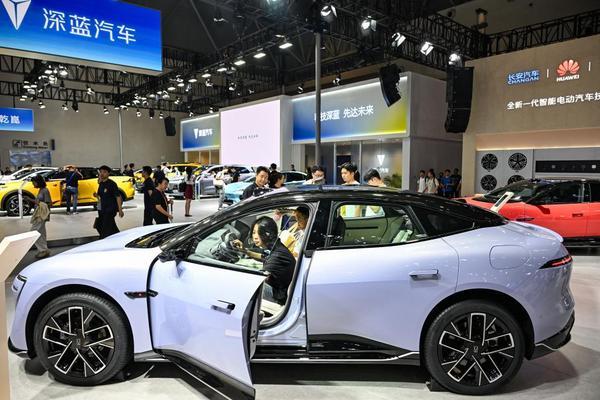
财经聚焦丨更聪明 更安全 更开放——从智博会看智能网联新能源汽车新趋势
Xin Hua Wang· 2025-09-06 10:53
Core Insights - The automotive industry is evolving with smarter, safer, and more open technologies showcased at the 2025 World Intelligent Industry Expo in Chongqing [1] Group 1: Smarter Technologies - AI large models are enhancing smart interactions in vehicles, allowing for personalized responses to user commands [3] - The integration of multimodal large model technology enables vehicles to develop "emotional perception" capabilities, adjusting settings based on the driver's emotional state [3] - The penetration rate of L2 and above assisted driving functions in new energy passenger vehicles in China reached 82.6% in the first half of the year [3] Group 2: Safety Enhancements - New battery collision monitoring systems provide real-time damage assessment, addressing safety concerns related to battery fires and explosions [7] - The introduction of mandatory national standards for electric vehicle battery safety has been implemented, enhancing safety requirements [7] - Various automakers are innovating battery technologies to prevent fires and improve safety, such as the "Golden Shield" battery technology from Changan [7][8] Group 3: Open Ecosystem - The development of a "new transparent photovoltaic body" technology allows vehicles to generate energy while driving, showcasing the integration of AI, materials, and energy technologies [9] - The automotive industry is shifting from a focus on individual technologies to a competitive landscape centered around ecosystem collaboration and collective strength [10] - The implementation of vehicle-road-cloud integration is being piloted in 20 cities, enhancing traffic management and safety through real-time data sharing [10][11]

财经聚焦|更聪明 更安全 更开放——从智博会看智能网联新能源汽车新趋势
Xin Hua She· 2025-09-06 10:51
Group 1: Smart Integration in Vehicles - The integration of AI large models into vehicles enhances intelligent interaction, allowing cars to respond to user needs more humanely, such as adjusting air conditioning and playing music based on voice commands [1] - The adoption of multi-modal large model technology enables vehicles to develop "emotional perception" capabilities, monitoring driver emotions and adjusting the environment accordingly [1] - The penetration rate of L2 and above assisted driving functions in China's new energy passenger vehicles reached 82.6% in the first half of the year [1] Group 2: Safety Enhancements - New battery collision monitoring systems provide precise damage assessment and warnings, enhancing battery safety [2] - The introduction of national standards for electric vehicle battery safety has been implemented, addressing concerns over battery fires and explosions [3] - Various automakers are innovating battery technologies to ensure safety, such as the ability to withstand punctures without igniting [3] Group 3: Open Ecosystem Development - The automotive industry is evolving through cross-industry collaboration, integrating AI, materials, and energy technologies to create innovative solutions like transparent photovoltaic car bodies that can generate energy while driving [5] - The development of a "car-road-cloud" integrated system is underway, with pilot projects in 20 cities to enhance traffic management and safety [6] - The automotive sector is shifting from a focus on individual technologies to a competitive landscape centered around ecosystem collaboration and collective strength [5][6]