
商保创新药

Search documents
28省份明确商保创新药“进院”参照“国谈药”,细则仍待确定
Di Yi Cai Jing· 2026-01-08 12:34
Core Insights - The commercial insurance innovative drug directory has been officially implemented since January 1, with the inclusion of drugs like Daratumumab β injection, but outpatient incentives for these drugs remain in a policy vacuum [1][2] - The "three exclusions" policy is seen as a significant but challenging measure to facilitate the entry of commercial insurance innovative drugs into hospitals [1][3] - There is a lack of clarity regarding the implementation details for the entry of commercial insurance innovative drugs into hospitals, which limits the ability of medical institutions to stock a wider variety of these drugs [4][5] Group 1 - The first version of the commercial insurance innovative drug directory was launched on January 1, and it includes specific drugs that can be reimbursed separately from the bundled payment system [1] - As of January 8, at least 28 provinces have mandated local medical institutions to hold pharmacy meetings by the end of February to discuss the integration of commercial insurance innovative drugs [2] - The "three exclusions" policy aims to allow innovative drugs to be used in hospitals without affecting the bundled payment system, but its practical implementation remains uncertain [3][7] Group 2 - The entry of commercial insurance innovative drugs into hospitals can either be through inclusion in special drug directories or by facilitating their hospital entry pathways [3] - Recent data shows that from January 1 to 6, over 15 medical institutions recorded sales of commercial insurance innovative drugs, although most of these were pre-configured before the directory's release [3][4] - The sales of commercial insurance innovative drugs are highly concentrated in a few products, particularly those used for Alzheimer's treatment [3] Group 3 - There are currently no specific assessment indicators for the hospital configuration of commercial insurance innovative drugs, unlike the established metrics for national negotiated drugs [4] - Some provinces have clarified that the use of national negotiated drugs will not be included in certain performance assessment metrics for public medical institutions, but it is unclear if this applies to commercial insurance innovative drugs [5] - The transition from hospital entry to patient medication involves prescription and payment processes, which currently face significant bottlenecks, especially in outpatient settings [6] Group 4 - The "three exclusions" policy is expected to be crucial for expanding the hospital sales of commercial insurance innovative drugs, but balancing interests among stakeholders is necessary for effective implementation [7] - A common approach to support the use of innovative drugs in hospitals is to open a "special case negotiation" green channel, but the limited application quota raises concerns about accessibility for commercial insurance innovative drugs [8] - The implementation of "exclusion payment" mechanisms is seen as a more definitive incentive for hospitals to use innovative drugs, but current policies primarily favor national negotiated drugs [9] Group 5 - The commercial insurance innovative drug directory's initial week saw sales primarily occurring in medical institutions, but the market potential remains limited due to the nature of the drugs included [11] - There is a push for retail pharmacies to stock commercial insurance innovative drugs, but concerns about prescription practices and reimbursement processes persist [12] - Future efforts should focus on aligning the commercial insurance innovative drug directory with the national insurance system to enhance confidence in the use of these drugs in hospitals [12]
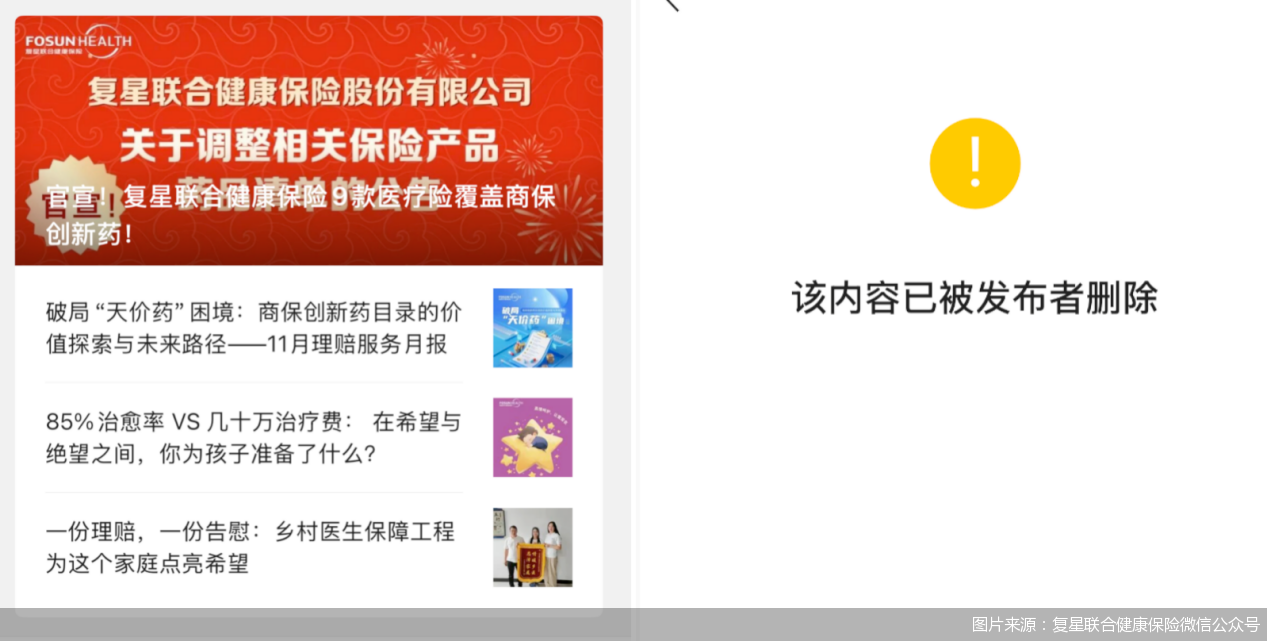
官宣9款医疗险覆盖商保创新药后又撤销,复星联合健康保险缘何“悔棋”
Bei Jing Shang Bao· 2025-12-18 12:50
Core Viewpoint - The announcement by Fosun United Health Insurance regarding the inclusion of nine medical insurance products in the commercial health insurance innovative drug directory was retracted shortly after its release, raising questions about the internal decision-making process and the implications for the health insurance market [3][4][6]. Group 1: Announcement and Withdrawal - The initial announcement highlighted that Fosun United Health Insurance would cover nine innovative drugs in its medical insurance products, generating excitement in the industry [3][5]. - The announcement was later deleted from the company's official WeChat account, indicating a lack of finalized discussions regarding the products [4][5]. - The company stated that the adjustment to the drug list would take effect from January 1, 2026, for specific insurance products [5]. Group 2: Market Implications - The release of the first commercial health insurance innovative drug directory, which includes 19 high-value drugs, is seen as a potential opportunity to enhance the purchasing rate of commercial insurance [7]. - The directory aims to address the challenges of high-priced innovative drugs and improve the collaboration between insurance companies and pharmaceutical firms [7][8]. - Experts believe that integrating innovative drugs into medical insurance can significantly reduce patients' financial burdens and enhance the competitiveness of insurance products [6][7]. Group 3: Challenges and Considerations - The main challenges for insurance companies include high drug prices leading to increased claims costs and the lack of historical data for accurate pricing [8][9]. - Companies are encouraged to develop specialized products and collaborate with pharmaceutical companies to create data-sharing and risk-sharing mechanisms [8][9]. - The success of integrating innovative drugs into insurance offerings depends on effective risk management and sustainable business practices [7][9]. Group 4: Company Background and Financial Performance - Fosun United Health Insurance, established in January 2017, is the sixth approved professional health insurance company in China, with major shareholders including Fosun Pharma and the International Finance Corporation [10][14]. - The company has shown a clear upward trend in profitability since 2021, with net profits of 0.20 billion, 0.63 billion, 0.23 billion, and 0.42 billion from 2021 to 2024 [12][13]. - Recent capital increases have been approved, enhancing the company's capital strength and solvency, which is crucial for covering innovative drugs and supporting business expansion [13][14].

如何支持真创新?国家医保局详解“双目录”
2 1 Shi Ji Jing Ji Bao Dao· 2025-12-10 05:33
Core Insights - The National Healthcare Security Administration (NHSA) has introduced 114 new drugs to the basic medical insurance catalog for 2025, with a significant focus on innovative treatments and a record number of new drugs added [1][5][6] Summary by Sections New Drug Additions - A total of 114 drugs were added to the basic medical insurance catalog, including 105 through negotiation, 7 through competitive bidding, and 2 directly from national procurement [1] - Among the new additions, 111 are new products launched within the last five years, representing nearly 98% of the total, with 50 classified as Category 1 new drugs, marking a historical high in both proportion and quantity [1][5] Therapeutic Areas - The newly added drugs cover critical therapeutic areas such as oncology, anti-infection, chronic diseases, rare diseases, and mental health, addressing diverse clinical needs [1][5][6] Directory Adjustment Process - The adjustment process involved four main stages: application, review, negotiation/bidding, and results. A total of 718 applications were received, with 535 passing the initial review, resulting in an 85% approval rate [3] - In the expert review phase, 311 drugs were evaluated, with 129 passing, leading to a 41.48% approval rate [3][4] Negotiation Success Rates - The negotiation and bidding phase saw 127 drugs participate, with 112 successfully negotiated, achieving a success rate of 88.19%, the highest since 2018 [4][5] Commercial Insurance Innovation - The first commercial insurance innovative drug catalog was released alongside the basic insurance adjustments, featuring 19 innovative drugs from 18 companies, with 9 being Category 1 new drugs [2][7] - The commercial insurance catalog aims to complement the basic insurance, providing additional support for high-cost innovative drugs while ensuring basic medication needs are met [2][8] Future Considerations - The NHSA emphasizes the importance of a multi-layered medical insurance system, encouraging the integration of commercial health insurance and innovative drug catalogs to enhance patient access to diverse treatment options [8][10] - Key challenges include aligning the different execution cycles of basic insurance and commercial products, as well as improving communication between insurance companies and pharmaceutical firms [9][10]
黄心宇:商保创新药目录内药品需具有“适保性”
Bei Jing Shang Bao· 2025-12-09 13:12
Core Insights - The National Healthcare Security Administration (NHSA) announced that 19 innovative drugs have been included in the commercial insurance innovative drug directory after a review process involving 141 drug applications, with 121 passing the formal review [1] Group 1: Drug Approval Process - A total of 141 drug applications were submitted for the commercial insurance innovative drug directory [1] - Out of these, 121 drugs passed the formal review stage [1] - Ultimately, 19 drugs were selected to be included in the directory [1] Group 2: Criteria for Inclusion - The drugs included in the commercial insurance innovative drug directory must meet four key criteria: 1. High level of innovation 2. Significant clinical value 3. Not substitutable by drugs in the basic medical insurance directory 4. Suitability for commercial insurance use (referred to as "suitability") [1]
每年万亿医保基金如何支持创新药?国家医保局详解
第一财经· 2025-12-09 08:16
Core Viewpoint - The article emphasizes the importance of the National Medical Insurance Fund in supporting innovative pharmaceuticals in China, highlighting a stable funding source for the industry and the introduction of new drug listings in the medical insurance catalog [3][5]. Group 1: Medical Insurance Fund and Innovation - The National Medical Insurance Fund spends over 1 trillion yuan annually on pharmaceuticals, which is crucial for supporting medical innovation [3]. - During the 2025 Innovation Drug High-Quality Development Conference, it was stated that the cumulative expenditure of the National Medical Insurance Fund during the 14th Five-Year Plan period is approximately 13 trillion yuan, with an annual growth rate exceeding 10% [3][5]. - The National Medical Insurance Bureau announced the addition of 114 new drugs to the 2025 National Medical Insurance Drug List, including 50 innovative drugs, achieving an overall success rate of 88% [3][5]. Group 2: Commercial Insurance and Drug Listings - The introduction of the commercial insurance innovative drug catalog is seen as a significant step towards the collaborative development of basic medical insurance and commercial insurance [7][8]. - The first edition of the commercial insurance innovative drug catalog includes 19 drugs, focusing on high clinical value and significant patient benefits, which are beyond the scope of basic medical insurance [8]. - The commercial health insurance sector has seen substantial growth, with premium income reaching 977.4 billion yuan in 2024, indicating a shift towards more diverse medical insurance products [8]. Group 3: Drug Coverage and Market Dynamics - The basic medical insurance has covered 44% of innovative drug payments, while commercial insurance accounts for 7%, indicating that basic medical insurance remains the primary payer for innovative drugs [6]. - Over the past eight years, the basic medical insurance drug list has seen a 40% increase in the number of drugs compared to before the establishment of the National Medical Insurance Bureau in 2018 [6]. - The collaboration between basic medical insurance and commercial insurance is essential, as basic insurance focuses on fundamental coverage while commercial insurance can address personalized needs and preferences [9].

新华时评:民生药箱“保基本”还要更多元
Xin Hua She· 2025-12-09 03:22
Core Insights - The release of the 2025 National Medical Insurance Drug List and the first version of the Commercial Insurance Innovative Drug List marks a significant step in the construction of a multi-tiered medical security system, enhancing the accessibility of essential medications while diversifying options for patients [1] Group 1: National Medical Insurance Drug List - The updated National Medical Insurance Drug List includes 114 new drugs, significantly improving coverage for key areas such as cancer, chronic diseases, mental health, rare diseases, and pediatric medications [1] - The approach of combining basic medical insurance with commercial insurance reflects the government's commitment to improving drug accessibility for the public and addressing diverse medication needs [1] Group 2: Commercial Insurance Innovative Drug List - The first version of the Commercial Insurance Innovative Drug List includes 19 drugs, primarily those with high innovation and clinical value [1] - The dual-list system aims to balance the principles of basic insurance coverage while providing a pathway for high-value innovative drugs, thus encouraging pharmaceutical companies to invest in research and development [1] Group 3: Benefits of the Dual-List System - The implementation of the dual-list system is expected to create a win-win situation for multiple stakeholders, allowing patients to reduce their economic burden through commercial insurance reimbursement for certain medical expenses [1] - Drugs included in the Commercial Insurance Innovative Drug List can benefit from support policies for hospitalization, while commercial insurance can increase enrollment rates by including these innovative drugs [1] Group 4: Future Considerations - Future efforts are needed to break down data barriers between basic medical insurance and commercial insurance, establishing a one-stop settlement system to better leverage the roles of basic insurance and commercial insurance [2]
2025医保药品目录公布,新增114种药品
21世纪经济报道· 2025-12-07 01:25
Core Viewpoint - The 2025 National Medical Insurance Drug List has successfully added 114 new drugs, including 50 innovative Class I drugs, with an overall success rate of 88%, significantly higher than the 76% in 2024 [1][5]. Group 1 - The 2025 National Medical Insurance Drug List includes drugs that fill gaps in basic medical insurance coverage, such as treatments for triple-negative breast cancer, pancreatic cancer, and lung cancer [5]. - The list also incorporates medications for rare diseases like Langerhans cell histiocytosis and thalassemia, as well as chronic diseases such as diabetes and autoimmune diseases [5]. - The total number of drugs in the National Medical Insurance Drug List has increased to 3,253, with 1,857 Western medicines and 1,396 traditional Chinese medicines, enhancing coverage in key areas like cancer, chronic diseases, mental health, rare diseases, and pediatric medications [5]. Group 2 - The first version of the commercial insurance innovative drug list includes 19 drugs, featuring CAR-T therapies for cancer treatment, medications for neuroblastoma and Gaucher disease, and treatments for Alzheimer's disease [5].

120家企业参与2025年药品目录谈判协商
Xin Hua Wang· 2025-11-05 09:28
Core Insights - The National Healthcare Security Administration (NHSA) has initiated negotiations for the 2025 National Basic Medical Insurance (BMI) drug list and the commercial insurance innovative drug list from October 30 to November 3, with participation from 120 domestic and foreign enterprises [1] - This year marks a significant change as the commercial insurance innovative drug list has been added to the directory adjustment process, running concurrently with the basic medical insurance directory work [1] - The new basic medical insurance drug list and the first version of the commercial insurance innovative drug list are expected to be released online and offline in Guangzhou on the first weekend of December, with implementation set for January 1, 2026 [1] Summary by Categories Negotiation and Participation - A total of 127 drugs outside the directory participated in the BMI drug list negotiations, while 24 drugs were involved in the price negotiations for the commercial insurance innovative drug list [1] Changes in Drug Listing Process - The inclusion of the commercial insurance innovative drug list in the directory adjustment process represents a new approach compared to previous years, indicating a shift towards integrating commercial insurance with basic medical insurance [1] Timeline for Implementation - The NHSA plans to complete the necessary technical, administrative, and legal procedures before the release of the new drug lists, which will be officially implemented starting January 1, 2026 [1]
新版医保药品目录调整“上新” 满足群众多层次、多元化用药需求
Yang Shi Wang· 2025-11-05 07:55
Core Points - The new basic medical insurance drug catalog and the first version of the commercial insurance innovative drug catalog are set to be released in Guangzhou on the first weekend of December, with implementation starting on January 1, 2024 [1] - The recent negotiations involved 120 domestic and foreign enterprises, with 127 drugs outside the basic medical insurance catalog participating in the negotiations, and 24 drugs involved in price negotiations for the commercial insurance innovative drug catalog [3] - The commercial insurance innovative drug catalog was organized by the National Medical Insurance Administration, allowing companies to apply for inclusion in either the basic medical insurance catalog or the commercial insurance innovative drug catalog, or both [5] Industry Insights - The addition of the commercial insurance innovative drug catalog aims to better meet the diverse medication needs of the population, with 1.326 billion people covered by basic medical insurance in 2024, maintaining a coverage rate of 95% [6] - Total expenditure for the basic medical insurance fund is projected to reach 2.97 trillion yuan in 2024, providing solid support for healthcare access [6] - The commercial health insurance market is experiencing rapid growth, with premium income reaching 977.3 billion yuan in 2024, an increase of 8.2% year-on-year, although there remains significant room for improvement in coverage levels compared to basic medical insurance [6] - Challenges exist in synchronizing medical insurance and commercial insurance settlements across provinces, but initiatives like the "commercial insurance + medical insurance" one-stop settlement payment platforms have been launched in various regions [6]
国家医保局:2025年药品目录谈判协商顺利结束
Xin Jing Bao· 2025-11-04 10:25
Core Insights - The National Healthcare Security Administration (NHSA) is organizing negotiations for the 2025 National Basic Medical Insurance (BMI) drug list and the commercial insurance innovative drug list from October 30 to November 3, with participation from 120 domestic and foreign companies [1] - A total of 127 drugs outside the current BMI list are involved in the negotiations, while 24 drugs are participating in the price negotiations for the commercial insurance innovative drug list [1] - The new BMI drug list and the first commercial insurance innovative drug list are expected to be released online and offline in Guangzhou during the first weekend of December, with implementation starting on January 1 of the following year [1]