
嘉实中证软件服务ETF

Search documents
热门板块进入高波区间 场外产品跟踪指数“受阻”
Zhong Guo Zheng Quan Bao· 2026-02-04 20:29
Core Insights - The A-share commercial aerospace and non-ferrous metals sectors have entered a phase of wide fluctuations, with related index funds experiencing significant tracking errors and volatility [1][3] - Fund managers have taken measures to suspend large subscriptions over 1 million yuan for certain thematic index funds due to the challenges posed by rapid market movements [4][7] Fund Performance and Flows - In January, the Southern CSI Shenwan Non-ferrous Metals ETF saw net inflows exceeding 18 billion yuan, with several other thematic ETFs attracting over 10 billion yuan each [2] - By the end of January, multiple thematic ETFs, including the Southern CSI Non-ferrous Metals ETF and the Guotai CSI Semiconductor Materials and Equipment ETF, surpassed 20 billion yuan in scale [2] Market Volatility and Management Challenges - The recent volatility in popular sectors has led to significant fluctuations in fund net values, with some satellite-themed index funds rising over 8% on January 23, only to drop over 7% by January 26 [3] - Tracking errors for certain index funds have increased, with some exceeding 1% in January, compared to less than 0.5% in the previous month [3][4] Operational Strategies - Fund managers are advised to implement refined operations and disciplined execution to manage tracking errors effectively, especially during periods of high volatility [5][6] - Strategies include phased investments, algorithmic trading, and prioritizing high liquidity core assets to mitigate impact costs [6] Recommendations for Fund Management - It is suggested to adopt a "core + satellite" sampling replication method to ensure high liquidity and weight in core assets while adjusting cash reserves dynamically based on market conditions [6] - Establishing a multi-dimensional prevention and response mechanism is crucial for managing fund flows and tracking accuracy [6]
金融市场流动性与监管动态周报:规模指数ETF净流出,融资买入额占两市交易额比例回落-20260120
CMS· 2026-01-20 13:34
Group 1: Market Liquidity and ETF Flows - Recent outflows from stock ETFs indicate a cooling market, with broad-based index ETFs being the main contributors to these outflows, while thematic and sector-specific ETFs continue to attract net inflows [1][3][8] - The CSI 300 ETF experienced significant net outflows, while the CSI 2000 ETF, representing small-cap stocks, saw net inflows, indicating a shift in investor preference towards less pressured assets [11][12] - On January 19, financing funds recorded a net outflow of 8.5 billion yuan, marking the first net outflow of the year, as uncertainty around annual performance forecasts increases [3][11] Group 2: Monetary Policy and Interest Rates - The central bank conducted a net injection of 1,112.8 billion yuan in the open market during the week of January 12-16, with a focus on maintaining reasonable liquidity in the banking system [15] - Money market rates have declined, with the R007 and DR007 rates decreasing by 0.2 basis points and 3.0 basis points respectively, while the yield on 1-year and 10-year government bonds also fell [15][16] Group 3: Sector Preferences and Fund Flows - In terms of sector preferences, the computer, non-ferrous metals, and media sectors attracted significant net inflows, while sectors like electronics, power equipment, and banking faced substantial outflows [46][47] - The net inflow for the computer sector was 87.9 billion yuan, while the non-ferrous metals sector saw 61.7 billion yuan, indicating strong investor interest in these areas [47] Group 4: Market Sentiment and Trading Activity - Market sentiment has weakened, with the financing buy amount for the week of January 12-16 being 1,934.3 billion yuan, accounting for 12.6% of the total A-share trading volume, a decrease from previous levels [37] - The VIX index increased, reflecting a decline in market risk appetite, as the Nasdaq and S&P 500 indices also experienced slight declines [39]
ETF周报2026年1月第1期:宽基ETF净流出超2000亿-20260119
East Money Securities· 2026-01-19 13:07
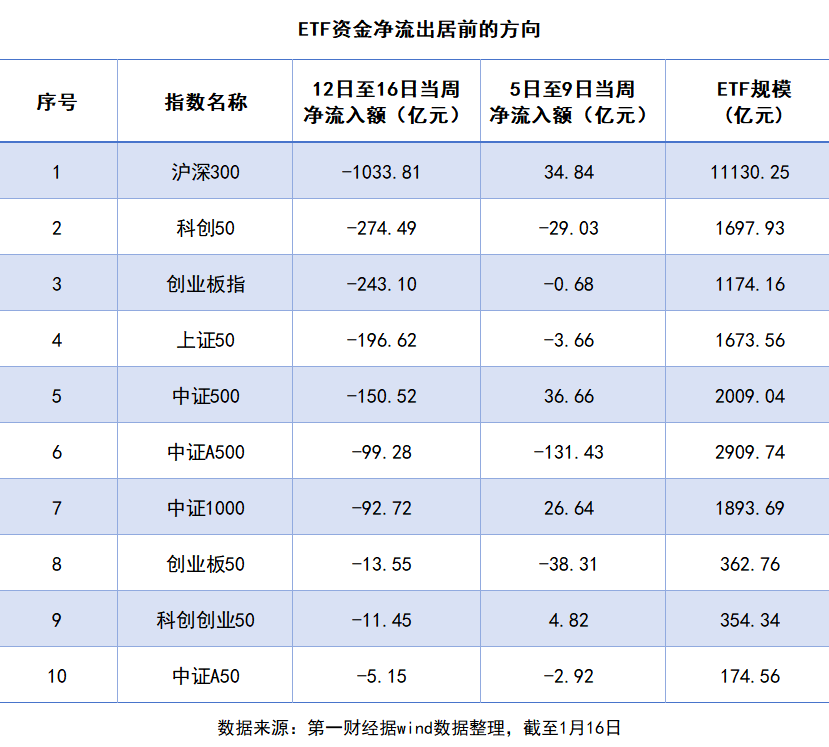
Group 1: Overall ETF Fund Flow Situation - The overall net outflow of the stock ETFs (excluding cross-border) from January 12 to 16, 2026, reached 1412.8 billion, a change of -1436.2 billion compared to the previous week, with a significant outflow of 1545.6 billion occurring on January 15 and 16 alone [12][15] - Money market ETFs have seen continuous net outflows in recent weeks, while A-share industry and thematic ETFs recorded a net inflow of nearly 700 billion in a single week, indicating that individual investors are actively entering the market [15][17] - Hong Kong stock ETFs experienced a net inflow of over 10 billion, continuing the inflow trend, while cross-border industry and thematic ETFs had a net inflow of 104.2 billion, slightly decreasing by 31.6 billion from the previous week [17][21] Group 2: Wide-based/Style/Industry/Sub-sector ETF Fund Flow Analysis - The total net outflow of wide-based ETFs reached 2126.2 billion, with those linked to the CSI 300 index seeing a net outflow of over 1000 billion, while the CSI 500, CSI A500, and other wide-based ETFs also experienced varying degrees of outflow [21][22] - In terms of Smart Beta and major industries, there was a notable inflow in dividend ETFs, particularly in the latter half of the week, while technology and cyclical sectors remain the hottest directions [21][24] - From January 12 to 16, the inflow in the non-ferrous metals sector showed strong sustainability, with software, artificial intelligence, media, and military industries also seeing significant net inflows, although some divergence was observed in the latter half of the week [24][26] Group 3: Representative ETF Fund Flow Overview - The top five ETFs with the highest net inflows from January 12 to 16 were: - Harvest CSI Software Service ETF (75.4 billion) - Southern CSI Shenwan Non-ferrous Metals ETF (63.7 billion) - GF CSI Media ETF (62.7 billion) - Yongying National Satellite ETF (58.0 billion) - Huaxia CSI Electric Grid Equipment Thematic ETF (38.9 billion) - The ETFs with the highest net outflows during the same period included: - Huatai-PB CSI 300 ETF (-475.2 billion) - Huaxia CSI 300 ETF (-269.7 billion) - E Fund Shanghai Stock Sci-Tech 50 ETF (-249.1 billion) - E Fund ChiNext ETF (-239.0 billion) - Huaxia Shanghai Stock 50 ETF (-191.1 billion) [30]
ETF周成交超1.28万亿,资金加速“弃宽基追主题”
Di Yi Cai Jing· 2026-01-18 11:23
Core Viewpoint - A significant shift in the A-share ETF market has occurred, with over 200 billion yuan withdrawn from core broad-based ETFs and nearly 70 billion yuan flowing into thematic industry ETFs, indicating a potential turning point in market trends [1][2][7]. Group 1: ETF Market Dynamics - From January 12 to 16, over 2 trillion yuan was withdrawn from broad-based ETFs, marking a 15-fold increase compared to the previous week and setting a record for weekly net outflows [2][3]. - The core broad-based ETFs, including the CSI 300 and STAR 50, were the main targets for fund withdrawals, with the CSI 300 ETF alone experiencing a net outflow of over 1 trillion yuan [2][3]. - The total trading volume of stock ETFs reached 1.28 trillion yuan during the same week, the highest in five years, reflecting intense trading activity and rapid fund turnover [7]. Group 2: Thematic ETF Inflows - In contrast to the broad-based ETFs, thematic ETFs saw a net inflow of nearly 70 billion yuan, with 117 products receiving over 1 billion yuan in net subscriptions [3][4]. - Key sectors attracting investment included software, media, and semiconductors, with specific products like the Harvest CSI Software Service ETF receiving a net inflow of 75.43 billion yuan, reaching a record size of 146 billion yuan [3][6]. - The satellite internet sector emerged as a focal point for investment, with six satellite-themed ETFs attracting 74.71 billion yuan in net inflows, highlighting a growing interest in this area [3][4]. Group 3: Market Sentiment and Future Outlook - Analysts suggest that the significant outflows from broad-based ETFs and inflows into thematic ETFs may indicate a healthy market adjustment rather than a downturn, as investors seek more flexible and growth-oriented investment opportunities [7][8]. - The recent regulatory environment is seen as a corrective measure to excessive market speculation, with expectations that market sentiment will improve within a couple of weeks [8]. - The ongoing trend of reallocating funds from broad-based to thematic ETFs reflects a broader shift in investor strategy, moving towards long-term asset allocation rather than short-term trading [9].

融资盘突发降温!部分赛道恐短期承压,要不要撤?
Sou Hu Cai Jing· 2026-01-15 08:40
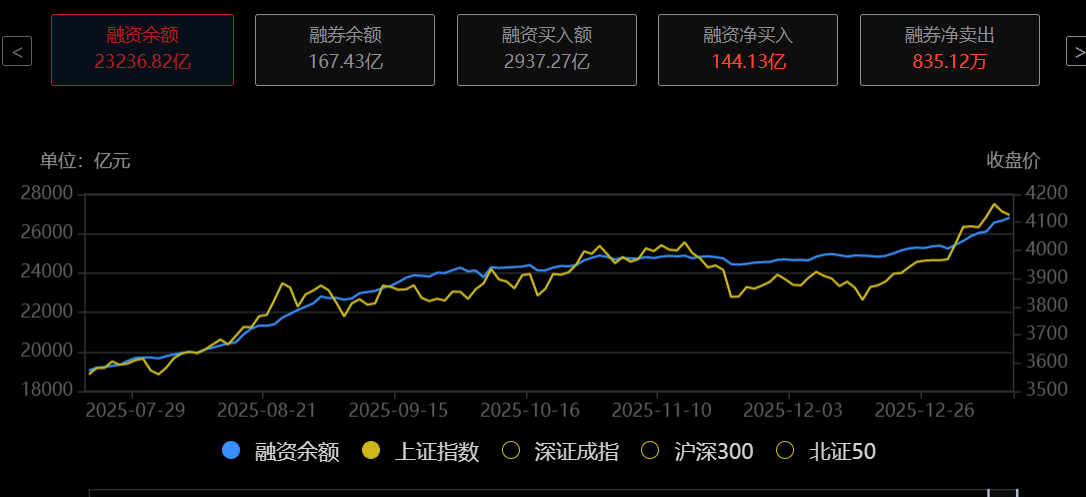
Market Overview - On January 14, a sudden announcement from three major exchanges raised the minimum margin requirement for financing from 80% to 100%, effective immediately, leading to a significant market downturn after an initial rally [1] - The A-share market's margin balance reached a historical high of 2.67 trillion yuan, with net financing inflow nearing 140 billion yuan in just the first seven trading days of 2026 [1][4] - Trading activity has been notably high, with daily transaction volumes exceeding 3 trillion yuan on multiple occasions, indicating elevated market sentiment [1] Impact of Margin Requirement Adjustment - Historical data suggests that previous increases in margin requirements in November 2015 and May 2017 resulted in a decrease of 6.3% and 4.1% in margin balances within a week, with the Shanghai Composite Index experiencing declines of 5% to 8% [4] - On January 14, the most affected sectors included TMT (Technology, Media, and Telecommunications) and non-bank financials, with the CSI 2000 index dropping by 4.6% and the number of stocks hitting the daily limit increase from 3 to 58 [4] - Northbound capital also reacted negatively, with a net outflow of 6.2 billion yuan, marking the largest single-day outflow in January [4] Sector Analysis - High Beta sectors such as TMT and non-bank financials, which have high financing balances and volatility, are expected to face immediate pressure due to the margin increase [4] - Key industries like electronics, power equipment, and computing, which are significant players in margin financing, may see a slowdown in capital inflow in the short term [4] - Despite the margin increase, existing investors are not required to add additional margin, which helps maintain stability in the over 2 trillion yuan of existing margin balances [4] ETF Market Insights - Certain ETFs, such as the Hai Fu Tong CSI Short Bond ETF and the Bosera Convertible Bond ETF, have seen active margin trading, although their overall contribution to total margin trading remains limited due to their large scale [6] - ETFs with high margin trading ratios, like the Hang Seng Technology ETF and the Huaxia Hang Seng Internet Technology ETF, should be approached with caution as forced liquidations could lead to significant price drops [6] Long-term Outlook - The adjustment of margin requirements is viewed as a "counter-cyclical fine-tuning," primarily affecting new contracts while leaving existing ones intact, suggesting limited long-term impact on market dynamics [10] - Historical patterns indicate that after initial emotional reactions, funds will likely return to selecting stocks based on fundamentals and valuations, minimizing the long-term effects of margin adjustments [10] - Despite short-term pressures, sectors such as AI applications and commercial aerospace continue to attract significant capital, indicating ongoing interest in certain growth areas [10] Future Projections - Analysts expect continued structural differentiation in the A-share market, driven by technological innovation and concentrated corporate performance, with a projected net profit growth rate for the CSI 300 index of 7.2% and 8.4% for 2026 and 2027, respectively [12][13]
303只ETF获融资净买入 嘉实中证软件服务ETF居首
Zheng Quan Shi Bao Wang· 2026-01-15 02:35
Core Viewpoint - As of January 14, the total margin balance for ETFs in the Shanghai and Shenzhen markets is 122.525 billion yuan, showing a decrease of 1.29 billion yuan from the previous trading day [1] Group 1: ETF Financing and Margin Data - The ETF financing balance is 114.788 billion yuan, down by 1.15 billion yuan from the previous trading day [1] - The ETF margin trading balance is 7.737 billion yuan, which is a decrease of 0.14 billion yuan compared to the previous trading day [1] Group 2: Net Inflows in ETFs - On January 14, 303 ETFs experienced net financing inflows, with the largest net inflow recorded in the Jiashi CSI Software Service ETF, amounting to 94.7039 million yuan [1] - Other ETFs with significant net financing inflows include the Southern CSI 500 ETF, Huatai-PB CSI 300 ETF, Fortune CSI Satellite Industry ETF, Guotai CSI All-Index Software ETF, and Huitianfu CSI Major Consumption ETF [1]
ETF规模速报 | 传媒ETF净流入超41亿元,沪深300ETF华泰柏瑞净流出超16亿元
Sou Hu Cai Jing· 2026-01-14 01:13
Market Overview - The A-share market experienced a collective adjustment, with the Shenzhen Component Index falling over 1% and the ChiNext Index dropping nearly 2% [1] - AI application concepts rose against the trend, while sectors like commercial aerospace and controllable nuclear fusion saw significant declines [1] ETF Market Activity - On January 13, the non-monetary ETF market saw significant inflows, with the GF CSI Media ETF increasing by 3.12 billion shares and a net inflow of 4.122 billion yuan [1] - The Yongying National Satellite Communication Industry ETF also saw an increase of 894 million shares with a net inflow of 1.886 billion yuan [1] - The Harvest CSI Software Service ETF had an increase of 1.439 billion shares and a net inflow of 1.507 billion yuan [1] Fund Performance - The top-performing ETFs by net inflow for the month include: - GF CSI Media ETF with a net inflow of 7.321 billion yuan and a total fund size of 10.767 billion yuan [4] - Yongying National Satellite Communication Industry ETF with a net inflow of 6.765 billion yuan and a total fund size of 15.592 billion yuan [4] - Southern CSI Nonferrous Metals ETF with a net inflow of 5.941 billion yuan and a total fund size of 29.006 billion yuan [4] Overall ETF Market Statistics - As of January 13, the total ETF shares in the market reached 33,788.87 billion shares, with a total scale of 62,409.89 billion yuan [4] - The consumer sector saw the largest increase in shares, with 10 funds tracking it, while the CSI Media Index had the largest increase in shares with 2 funds tracking it [4]

308只ETF获融资净买入 富国中债7—10年政策性金融债ETF居首
Zheng Quan Shi Bao Wang· 2026-01-13 02:04
Core Viewpoint - As of January 12, the total margin balance for ETFs in the Shanghai and Shenzhen markets reached 122.95 billion yuan, reflecting an increase of 3.51 billion yuan from the previous trading day [1] Group 1: ETF Financing and Margin Balances - The ETF financing balance stood at 114.98 billion yuan, up by 3.24 billion yuan compared to the previous trading day [1] - The ETF margin short balance was recorded at 7.97 billion yuan, which is an increase of 0.27 billion yuan from the previous trading day [1] Group 2: Top Performing ETFs - On January 12, a total of 308 ETFs experienced net financing inflows, with the top performer being the Fortune China Bond 7-10 Year Policy Financial Bond ETF, which saw a net inflow of 681 million yuan [1] - Other ETFs with significant net financing inflows included the GF CSI Media ETF, Hai Fu Tong CSI Short-term Bond ETF, Southern CSI 500 ETF, Yongying National Standard Commercial Satellite Communication Industry ETF, Southern CSI 1000 ETF, and Harvest CSI Software Service ETF [1]
开年火爆的脑机接口怎么“跟”?这些ETF或能锁定板块行情
Xin Lang Cai Jing· 2026-01-12 08:55
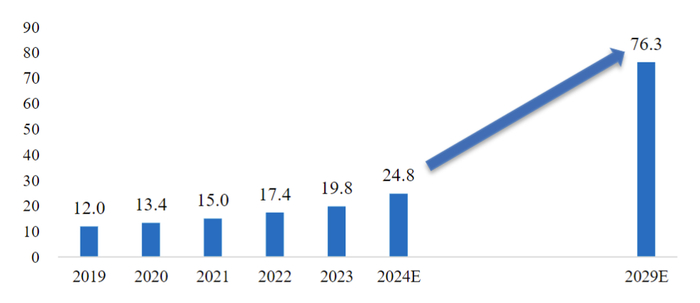
Core Insights - The brain-computer interface (BCI) market is gaining significant attention following Elon Musk's announcement of large-scale production plans for his company Neuralink starting in 2026, shifting perceptions from skepticism to optimism about commercialization [1] - Current applications of BCI technology are still in clinical trial phases, facing ethical and social acceptance challenges, leading to varied growth forecasts from different institutions [1] - Grand View Research reports that the BCI market size grew from $1.2 billion in 2019 to nearly $2 billion in 2023, with a compound annual growth rate (CAGR) exceeding 13%, and is expected to reach $7.63 billion by 2029 with a CAGR of 25.2% from 2024 to 2029 [1] Market Overview - The domestic BCI industry in China has advanced from a "follower" to a "co-runner and partial leader" position globally, with the market size increasing from approximately 1 billion RMB in 2020 to about 1.73 billion RMB in 2023, capturing 12.5% of the global market [3][5] - The CAGR for China's BCI market is reported at 20%, significantly higher than the global average of 14% [3] Drivers of Growth - Policy support includes the inclusion of brain science in China's 14th Five-Year Plan and local subsidies reaching up to 30 million RMB, alongside the development of national standards for BCI expected by 2025 [5] - Capital investment in the domestic BCI sector exceeded 6.5 billion RMB from 2021 to 2023, accounting for 28% of global financing, with notable single-round financing records [5] - Technological advancements include breakthroughs in electrode channel counts by Chinese universities and significant reductions in power consumption and costs for non-invasive BCI technologies [6] Application and Market Segmentation - Medical rehabilitation remains the largest segment, accounting for approximately 65% of the current market, with the average price of domestic "brain-controlled robotic arms" decreasing from 1.2 million RMB in 2019 to 450,000 RMB in 2023 [6] - Consumer applications in education, entertainment, and industrial safety are emerging, with the consumer segment's market share increasing to 18% in 2023 and expected to exceed 30% by 2026 [6] Future Projections - The Chinese BCI market is projected to reach approximately 5 billion RMB by 2026 and aim for 20 billion RMB by 2030, potentially capturing 25% of the global market [7] - China is expected to not only expand its market but also to set standards and solutions, positioning itself as a "second pole" in the global BCI industry [7] Investment Opportunities - The BCI sector's complexity suggests that investing in ETFs could be a strategic approach to capture the full spectrum of opportunities across the value chain, including software algorithms and medical technology [8] - The software segment, which translates neural signals into machine language, is critical for BCI commercialization, with 15% of the CSI Software Service Index now associated with BCI [8] - The medical technology segment is highlighted as the most immediate commercial application for BCI, with significant representation in the CSI Medical Device Index, which includes leading companies in the field [11]
276只ETF获融资净买入 华泰柏瑞恒生科技ETF居首
Zheng Quan Shi Bao Wang· 2025-12-04 02:53
Group 1 - The core point of the article highlights that as of December 3, the total margin balance for ETFs in the Shanghai and Shenzhen markets reached 118.509 billion yuan, an increase of 248 million yuan from the previous trading day [1] - The ETF financing balance was reported at 110.539 billion yuan, which is an increase of 363 million yuan compared to the previous trading day [1] - The ETF margin trading balance showed a decrease in the short selling balance, which stood at 7.97 billion yuan, down by 115 million yuan from the previous trading day [1] Group 2 - On December 3, a total of 276 ETFs experienced net financing inflows, with the Huatai-PineBridge Hang Seng Tech ETF leading the net inflow at 136 million yuan [1] - Other ETFs with significant net financing inflows included the Huaxia Hang Seng Internet Technology ETF, Huaxia SSE STAR 50 ETF, Harvest CSI Software Service ETF, Pengyang 30-Year Treasury Bond ETF, and Huaxia NASDAQ 100 ETF [1]