
国泰中证全指证券公司ETF

Search documents
金融产品每周见:金融地产行业基金:从投资能力分析到基金经理画像-20260306
Shenwan Hongyuan Securities· 2026-03-06 02:27
1. Report Industry Investment Rating No relevant content provided. 2. Core Viewpoints of the Report - Based on fund holdings, financial and real estate industry funds can be classified into three categories: "Finance and Real Estate + Satellite", "Sub - sector Tracks", and "Sector Rotation". Most fund managers adopt the "Sub - sector Tracks" strategy [4]. - Three aspects of the overall investment ability analysis of financial and real estate industry funds: 1) Compared with the sector index, financial and real estate industry funds perform slightly weaker, which is related to the low differentiation within the financial and real estate sectors; 2) The relatively good - at industries are banking and non - bank finance, while the relatively weak - at industry is real estate; 3) Fund managers of financial and real estate industry funds have stronger stock - picking abilities for financial and real estate stocks compared to those of all - industry funds [4]. - Seven dimensions to compare financial and real estate industry funds with different style characteristics: 1) There is a negative correlation between turnover rate and performance; 2) High - performing financial and real estate theme products pay more attention to ROE; 3) The market - value style of financial and real estate funds' stock holdings is generally large - cap; 4) The left - and right - side investment positions of financial and real estate funds are at the median level of the market; 5) Find fund managers with high - confidence stock - picking abilities through the skewness and kurtosis coefficients of stock - picking return distribution; 6) Characterize fund managers' environmental adaptability through finding similar funds and analyzing their performance in favorable and unfavorable environments; 7) The performance distribution of sub - sector rotation is scattered. There are no obvious similarities in the stock holdings of high - performing products in the past year, and the performance of each product in each quarter varies greatly [4]. - How to screen the observation list of financial and real estate industry funds: Screen with reference to the following quantitative indicators: 1) Excess performance momentum; 2) Performance in favorable and unfavorable environments; 3) Stock - picking ability; 4) Left - and right - side investment ability; 5) Other considerations: The tenure of the fund manager should be as long as possible, and the fund size should not be too large or too small [4]. 3. Summary According to Relevant Catalogs 3.1 Financial and Real Estate Industry Fund Classification - **Classification Methods**: Classify based on the allocation and rotation ratios of funds in the primary and secondary industries of the financial and real estate sectors in the past three years, including "Finance and Real Estate + Satellite" (average allocation ratio between 60% - 70%), "Sector Rotation" (average allocation ratio below 60%), "Sub - sector Tracks" (average allocation ratio of sub - sectors > 50% and the latest allocation ratio > 60%), "Financial and Real Estate Rotation" (average unilateral annualized turnover rate of primary industries within the financial and real estate sectors > 60%), and "Financial and Real Estate Equilibrium" (other financial and real estate industry funds) [12]. - **Classification Results and Representative Funds**: Financial and real estate industry funds mainly adopt the "Sub - sector Tracks" strategy, with prominent scale and quantity. Most of these funds are concentrated in large - finance and banking. There are also a small number of "Finance and Real Estate + Satellite" and "Sector Rotation" products. Currently, there are few products focusing on sub - sectors such as real estate, securities, and insurance [19]. - **Overall Situation of Financial and Real Estate Index Funds**: In the past year, the scale of financial and real estate index funds has been much larger than that of financial and real estate active equity funds. In 2025, the scale of financial and real estate index funds increased significantly, especially in Q3 of 2025. Most of the large - scale financial and real estate index funds are ETF products, and many of them track the securities company index, while some also track non - bank - related or Hong Kong - related financial indices [20][24]. - **Overview of All Tracked Indices of Financial and Real Estate Index Funds**: The report lists various indices tracked by financial and real estate index funds, including the scale, number of tracking funds, and the largest - scale tracking fund for each index [25]. 3.2 Holding Characteristics: Can Financial and Real Estate Industry Funds Create Positive Excess Returns? - **Overall Performance vs. Passive Index**: As a whole, financial and real estate industry funds cannot outperform passive indices. This is because the financial and real estate sectors have performed well since 2024, and the low differentiation within the sectors makes it difficult for industry funds to create higher Alpha in an upward environment [30]. - **Excess Returns at the Industry Level**: Financial and real estate industry funds are relatively good at banking and non - bank finance but relatively weak at real estate [31]. - **Stock - picking Ability for Financial and Real Estate Stocks**: Fund managers of financial and real estate industry funds have stronger stock - picking abilities for financial and real estate stocks compared to those of all - industry funds. The weaker performance of the funds compared to the index is mainly due to insufficient positions [35]. - **Holding Characteristics Compared with Balanced Funds**: Financial and real estate industry funds and balanced funds tend to have similar preferences for sub - sectors, but financial and real estate industry funds focus on banking and insurance earlier. In terms of individual stock allocation, financial and real estate industry funds and balanced funds focus on the same key stocks, but financial and real estate industry funds currently focus more on banking, while balanced funds also have relatively high allocations in some real estate and diversified finance stocks [41]. - **Cluster Analysis of Financial and Real Estate Industry Funds**: Through cluster analysis, financial and real estate industry funds can be roughly divided into five types, including those with rotation styles, real - estate - chain theme funds, large - finance theme funds with different港股 allocation ratios, etc. [45]. 3.3 Comparison of Financial and Real Estate Funds with Different Style Characteristics - **Turnover and Trading Dimension**: There is a negative correlation between turnover rate and performance. In the past year, high - performing products generally adopted low - turnover investment strategies. In the past two years, there are high - performing products in both moderate - turnover and low - turnover categories [48]. - **Stock - holding Style Dimension**: High - performing financial and real estate theme products pay more attention to ROE. The market - value style of financial and real estate funds' stock holdings is generally large - cap, and most high - performing products in the past two years are of large - cap or medium - large - cap styles [52][56]. - **Stock - holding Popularity Dimension**: The proportion of the financial and real estate sector in the market - preferred stocks has increased significantly since 2024, and the structure has changed significantly. Most high - performing products focused on market - preferred stocks in 25H1 [60]. - **Left - and Right - side Dimension**: The left - side buying coefficients of financial and real estate funds are at the median level of active equities. There are high - performing products in both left - side and right - side investment strategies [63]. - **Stock - picking Ability Dimension**: By calculating the stock - picking return distribution of financial and real estate funds, products with moderately right - skewed, moderately peaked, and high mean/standard - deviation values are selected. Funds such as E Fund Financial Industry A, BOC Financial and Real Estate A, and Fullgoal Financial and Real Estate Industry A have more suitable stock - picking ability indicators [69]. - **Favorable and Unfavorable Environment Dimension**: Different types of products show different market - environment adaptability results. Most financial and real estate theme funds perform better in favorable environments than in unfavorable environments, and there are also some products with balanced performance in both environments [72]. - **Sub - sector Rotation Dimension**: The sector - rotation performance of financial and real estate theme funds is highly polarized. There are actively rotating products, products that淡化 rotation, and products that rotate moderately [75]. - **High - performing Products in the Past Year**: The top - ten high - performing financial and real estate theme products in the past year mostly had a performance of over 15%, and some leading products achieved a return of over 20%. There are no significant similarities in the stock holdings of these products, and their performance in each quarter also varies greatly [79]. - **QDII Active Financial and Real Estate Funds**: There are currently three QDII active equity funds focusing on global real - estate investment opportunities, with different investment characteristics in terms of investment regions and stock - holding concentration [83]. 3.4 Financial and Real Estate Theme Fund Observation List - **Selection Criteria**: Select products based on quantitative indicators such as excess performance momentum, performance in favorable and unfavorable environments, stock - picking ability, left - and right - side investment ability, and also consider factors such as the tenure of the fund manager and fund size. For new fund managers, the time - length and size requirements can be appropriately relaxed [88]. - **Observation List and Data Summary**: The report lists the observation list of financial and real estate funds, including information such as fund classification, code, manager, scale, and performance indicators [89]. - **Short - term Supplementary List**: Considering products that have shifted towards the financial and real estate sectors in the short term, a supplementary list is added, which focuses more on the one - year performance of the funds [90].
两市ETF两融余额减少94.83亿元丨ETF融资融券日报
2 1 Shi Ji Jing Ji Bao Dao· 2026-02-24 02:45
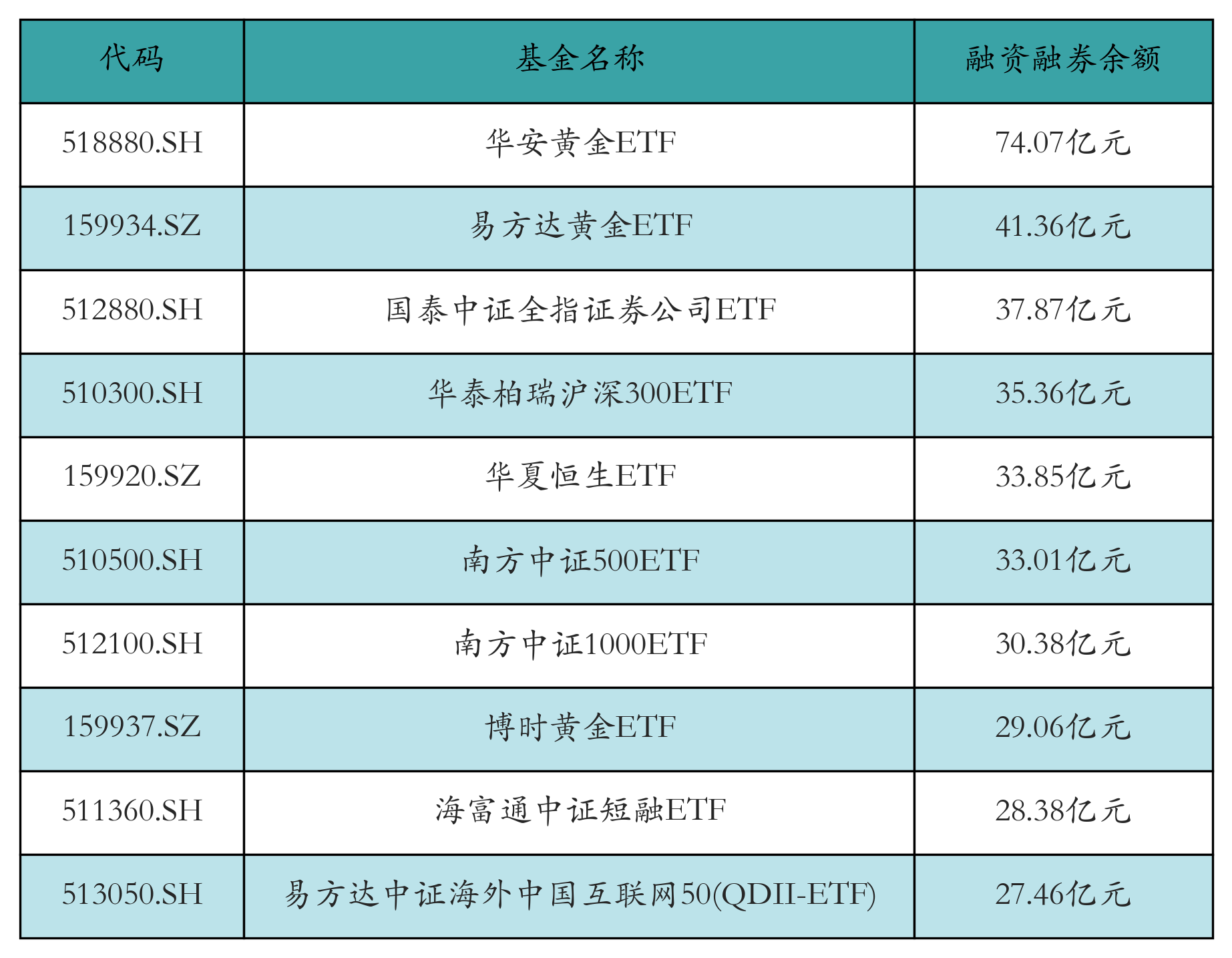
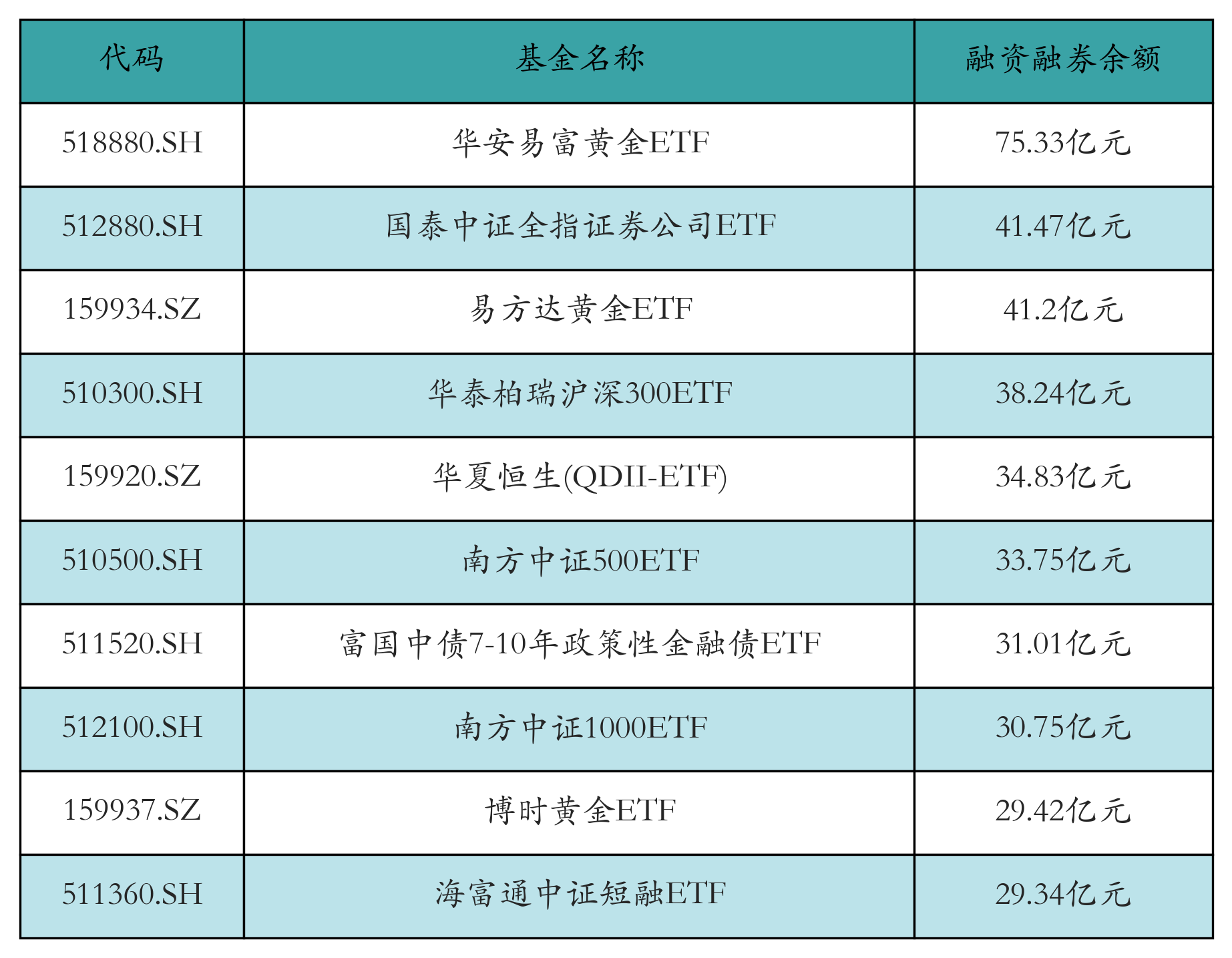
Market Overview - On February 13, the total ETF margin balance in the two markets was 115.864 billion yuan, a decrease of 9.483 billion yuan from the previous trading day [1] - The financing balance was 108.367 billion yuan, down by 9.454 billion yuan, while the securities lending balance was 7.497 billion yuan, a decrease of 29.625 million yuan [1] - In the Shanghai market, the ETF margin balance was 80.922 billion yuan, a decrease of 8.662 billion yuan, with a financing balance of 74.354 billion yuan, down by 8.657 billion yuan [1] - In the Shenzhen market, the ETF margin balance was 34.942 billion yuan, a decrease of 0.822 billion yuan, with a financing balance of 34.013 billion yuan, down by 0.796 billion yuan [1] ETF Margin Financing and Securities Lending - The top three ETF margin balances on February 13 were: Huaan Gold ETF (7.407 billion yuan), E Fund Gold ETF (4.136 billion yuan), and Guotai CSI All-Share Securities Company ETF (3.787 billion yuan) [2] - The top three ETF financing buy amounts were: Hai Futong CSI Short Bond ETF (1.683 billion yuan), Hang Seng Technology ETF (909 million yuan), and Bosera Convertible Bond ETF (874 million yuan) [4] - The top three ETF financing net buy amounts were: Dachen Hang Seng Technology ETF (31.3105 million yuan), Huaan Gold ETF (30.3682 million yuan), and Huatai-PB CSI 300 ETF (27.6497 million yuan) [5] ETF Securities Lending - The top three ETF securities lending sell amounts were: Southern CSI 500 ETF (1.27 billion yuan), Southern CSI 1000 ETF (283.781 million yuan), and Bosera Convertible Bond ETF (229.007 million yuan) [7]

两市ETF两融余额增加45.31亿元丨ETF融资融券日报
2 1 Shi Ji Jing Ji Bao Dao· 2026-02-13 02:55
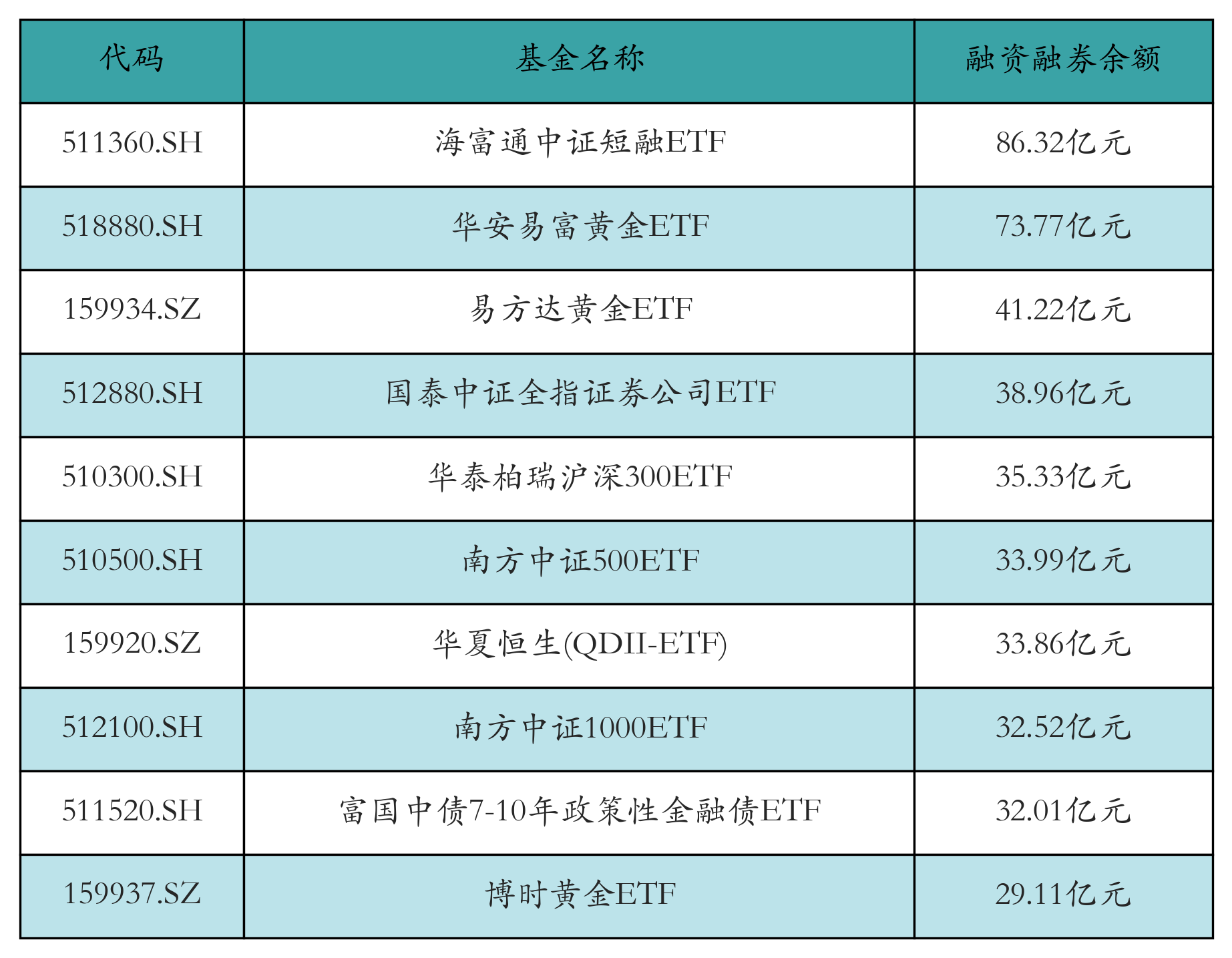
Market Overview - As of February 12, the total ETF margin balance in the two markets reached 125.347 billion yuan, an increase of 4.531 billion yuan from the previous trading day [1] - The financing balance was 117.82 billion yuan, up by 4.536 billion yuan, while the securities lending balance decreased by 4.2073 million yuan to 7.527 billion yuan [1] - In the Shanghai market, the ETF margin balance was 89.583 billion yuan, increasing by 4.501 billion yuan, with a financing balance of 83.011 billion yuan, up by 4.506 billion yuan [1] - The Shenzhen market's ETF margin balance was 35.764 billion yuan, increasing by 30.4641 million yuan, with a financing balance of 34.809 billion yuan, up by 29.959 million yuan [1] ETF Margin Balances - The top three ETFs by margin balance on February 12 were: - Hai Fu Tong Zhong Zheng Short Bond ETF (8.632 billion yuan) - Hua An Yi Fu Gold ETF (7.377 billion yuan) - Yi Fang Da Gold ETF (4.122 billion yuan) [2][3] ETF Financing Buy Amounts - The top three ETFs by financing buy amounts on February 12 were: - Hai Fu Tong Zhong Zheng Short Bond ETF (7.6 billion yuan) - Hua Tai Bai Rui Nan Fang Dong Ying Hang Seng Technology Index (QDII-ETF) (1.012 billion yuan) - Bo Shi Zhong Zheng Convertible Bonds and Exchangeable Bonds ETF (681 million yuan) [4][5] ETF Financing Net Buy Amounts - The top three ETFs by financing net buy amounts on February 12 were: - Hai Fu Tong Zhong Zheng Short Bond ETF (4.49 billion yuan) - Hua Tai Bai Rui Nan Fang Dong Ying Hang Seng Technology Index (QDII-ETF) (271 million yuan) - Hua Xia Hang Seng Technology (QDII-ETF) (144 million yuan) [6][7] ETF Securities Lending Sell Amounts - The top three ETFs by securities lending sell amounts on February 12 were: - Nan Fang Zhong Zheng 1000 ETF (1.02265 million yuan) - Nan Fang Zhong Zheng 500 ETF (537.15 thousand yuan) - Hua Xia Shang Zheng Ke Chuang Ban 50 Component ETF (391.57 thousand yuan) [8][9]
绝对收益产品及策略周报(260202-260206):上周161只固收+基金创新高-20260211
GUOTAI HAITONG SECURITIES· 2026-02-11 08:35
Group 1 - The report indicates that the stock side employs a small-cap value portfolio combined with a non-timing stock-bond monthly rebalancing strategy of 10/90 and 20/80, with cumulative returns of 1.36% and 2.53% by 2026 [1][4] - As of February 6, 2026, the total market size of fixed income + funds reached 23,568.03 billion, with 1,166 products, and 161 of them reached historical net value highs last week [2][10] - The performance median of various fund types showed divergence, with mixed bond type I at 0.07%, type II at -0.15%, and flexible allocation type at -0.19% [2][14] Group 2 - The macro environment forecast for Q1 2026 indicates a slowdown, with the CSI 300 index, the total wealth index of government bonds, and the AU9999 contract showing returns of -1.33%, 0.18%, and -6.91% respectively [3] - Recommended industry ETFs for February 2026 include the Guotai CSI All-Share Securities Company ETF, Guotai CSI Coal ETF, Guotai CSI Steel ETF, and Southern CSI Shenwan Nonferrous Metals ETF, with a combined return of -2.94% last week [3][4] - The absolute return strategy performance showed that the macro-timing driven stock-bond 20/80 rebalancing strategy had a return of -0.42% last week, while the stock-bond risk parity strategy returned -0.12% [4][16] Group 3 - The small-cap value style performed the best in the stock-bond 20/80 combination with a year-to-date return of 2.53%, while PB earnings, high dividend, and small-cap growth strategies yielded 1.04%, 0.97%, and 1.69% respectively [4][16] - The report highlights that the absolute return products have a total of 1,166 funds, with a focus on those with a minimum equity position not exceeding 40% over the last eight quarters [10][11] - The performance median for conservative, balanced, and aggressive funds was 0.04%, -0.17%, and -0.27% respectively, indicating a mixed performance across risk levels [14][15]
华鑫股份股价连续4天下跌累计跌幅5.41%,国泰基金旗下1只基金持1370.6万股,浮亏损失1302.07万元
Xin Lang Cai Jing· 2026-02-11 07:18
Group 1 - The core point of the news is that Huaxin Co., Ltd. has experienced a decline in stock price, falling 0.36% to 16.60 CNY per share, with a total market value of 17.611 billion CNY and a cumulative drop of 5.41% over the past four days [1] - Huaxin Co., Ltd. was established on November 5, 1992, and listed on December 2, 1992. The company is primarily engaged in property leasing, property management, and securities services [1] - The revenue composition of Huaxin Co., Ltd. includes: Other businesses 44.80%, Brokerage business 39.48%, Investment banking 8.08%, Asset management 7.43%, Credit business 5.50%, and Futures business 3.33% [1] Group 2 - From the perspective of the top ten circulating shareholders, Guotai Fund's ETF has increased its holdings by 5.5068 million shares, totaling 13.706 million shares, which represents 1.29% of the circulating shares [2] - The Guotai CSI All-Share Securities Company ETF (512880) has a current scale of 57.029 billion CNY and has reported a loss of 1.45% this year, ranking 5445 out of 5569 in its category [2] - The fund manager of Guotai CSI All-Share Securities Company ETF is Ai Xiaojun, who has a total fund asset scale of 188.936 billion CNY and has achieved a best fund return of 329.78% during his tenure [3]

两市ETF两融余额减少10.85亿元丨ETF融资融券日报
2 1 Shi Ji Jing Ji Bao Dao· 2026-02-11 04:32
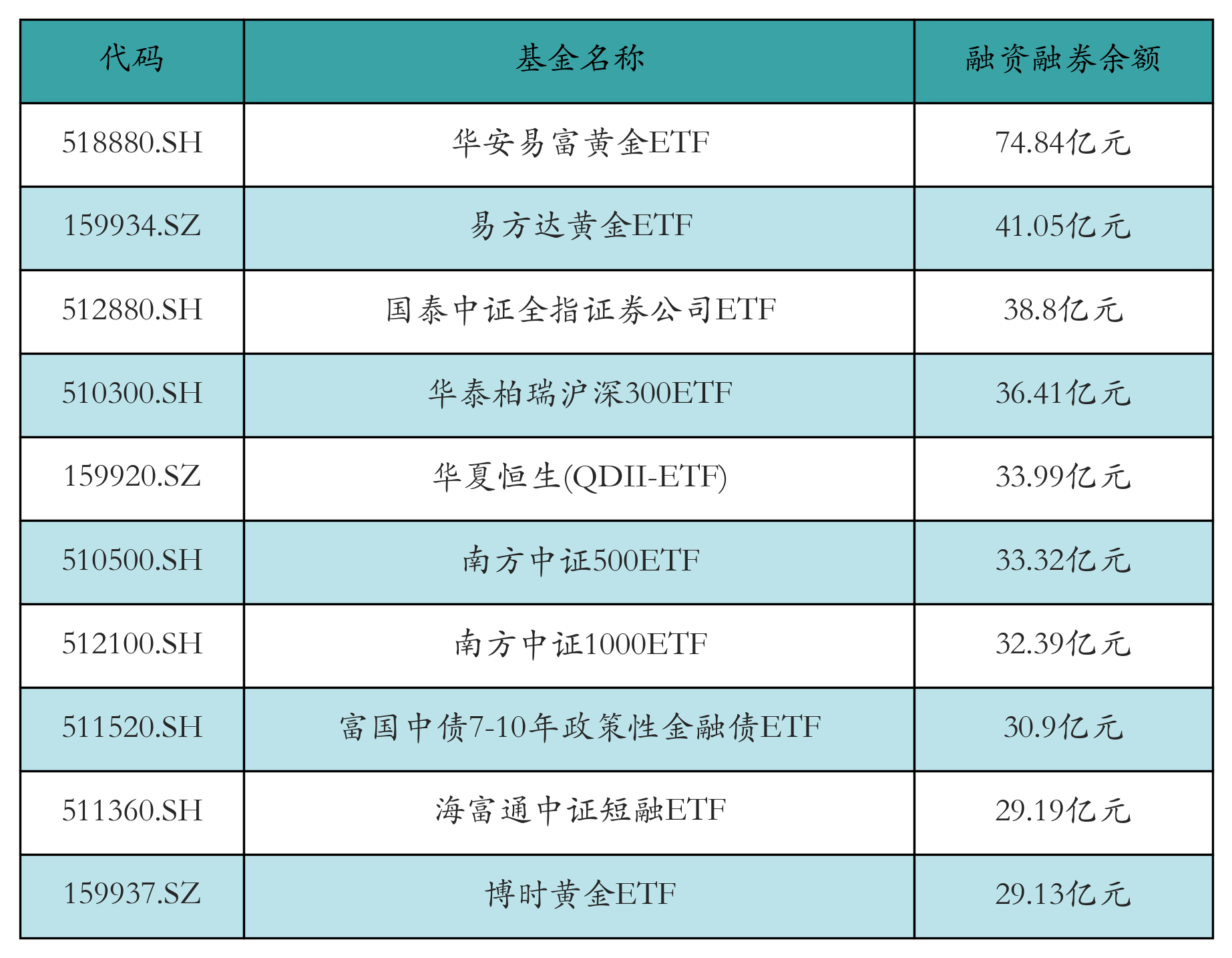
Market Overview - As of February 10, the total ETF margin balance in the two markets is 1200.01 billion yuan, a decrease of 10.85 billion yuan from the previous trading day [1] - The financing balance is 1124.56 billion yuan, down by 10.86 billion yuan, while the margin short balance is 75.45 billion yuan, which increased by 141.45 million yuan [1] - In the Shanghai market, the ETF margin balance is 843.29 billion yuan, a decrease of 8.95 billion yuan, with a financing balance of 777.49 billion yuan, down by 9.08 billion yuan [1] - In the Shenzhen market, the ETF margin balance is 356.72 billion yuan, a decrease of 1.89 billion yuan, with a financing balance of 347.07 billion yuan, down by 1.78 billion yuan [1] ETF Margin Balances - The top three ETF margin balances as of February 10 are: 1. Huaan Yifu Gold ETF (74.84 billion yuan) 2. E Fund Gold ETF (41.05 billion yuan) 3. Guotai CSI All-Share Securities Company ETF (38.8 billion yuan) [2] ETF Financing Buy Amounts - The top three ETF financing buy amounts on February 10 are: 1. Hai Fudong CSI Short Bond ETF (1.242 billion yuan) 2. Bosera CSI Convertible Bonds and Exchangeable Bonds ETF (1.049 billion yuan) 3. Huatai-PineBridge Southern Eastern Hong Kong Technology Index (QDII-ETF) (718 million yuan) [4] ETF Financing Net Buy Amounts - The top three ETF financing net buy amounts on February 10 are: 1. Huabao CSI Medical ETF (754.137 million yuan) 2. Guangfa CSI Media ETF (610.08 million yuan) 3. E Fund CSI Overseas China Internet 50 (QDII-ETF) (568.384 million yuan) [5] ETF Margin Sell Amounts - The top three ETF margin sell amounts on February 10 are: 1. Southern CSI 1000 ETF (256.052 million yuan) 2. Huatai-PineBridge CSI 300 ETF (88.673 million yuan) 3. Huaxia SSE 50 ETF (51.573 million yuan) [6]
中银证券股价连续5天上涨累计涨幅5.46%,国泰基金旗下1只基金持4306.19万股,浮盈赚取3143.52万元
Xin Lang Ji Jin· 2026-02-09 07:09
Group 1 - The core point of the news is that Zhongyin Securities has seen a continuous increase in its stock price, rising 0.43% to 14.10 yuan per share, with a total market capitalization of 39.17 billion yuan and a cumulative increase of 5.46% over the past five days [1] - Zhongyin Securities was established on February 28, 2002, and listed on February 26, 2020. Its main business includes investment banking, securities brokerage, asset management, proprietary trading, private equity investment, futures, and other services [1] - The revenue composition of Zhongyin Securities is as follows: securities brokerage 64.12%, asset management 16.46%, investment banking 6.48%, futures 5.60%, proprietary trading 4.30%, other 1.74%, and private equity investment 1.30% [1] Group 2 - From the perspective of the top ten circulating shareholders, Guotai Fund's ETF has increased its holdings in Zhongyin Securities by 17.34 million shares, now holding 43.06 million shares, which accounts for 1.55% of the circulating shares [2] - The Guotai CSI All-Share Securities Company ETF (512880) has a current scale of 57.03 billion yuan and has experienced a loss of 2.3% this year, ranking 5342 out of 5580 in its category [2] - The fund manager of Guotai CSI All-Share Securities Company ETF, Ai Xiaojun, has a total fund asset scale of 188.94 billion yuan, with the best fund return during his tenure being 348.34% and the worst being -46.54% [2]

两市ETF两融余额减少2.47亿元丨ETF融资融券日报
2 1 Shi Ji Jing Ji Bao Dao· 2026-02-06 04:37
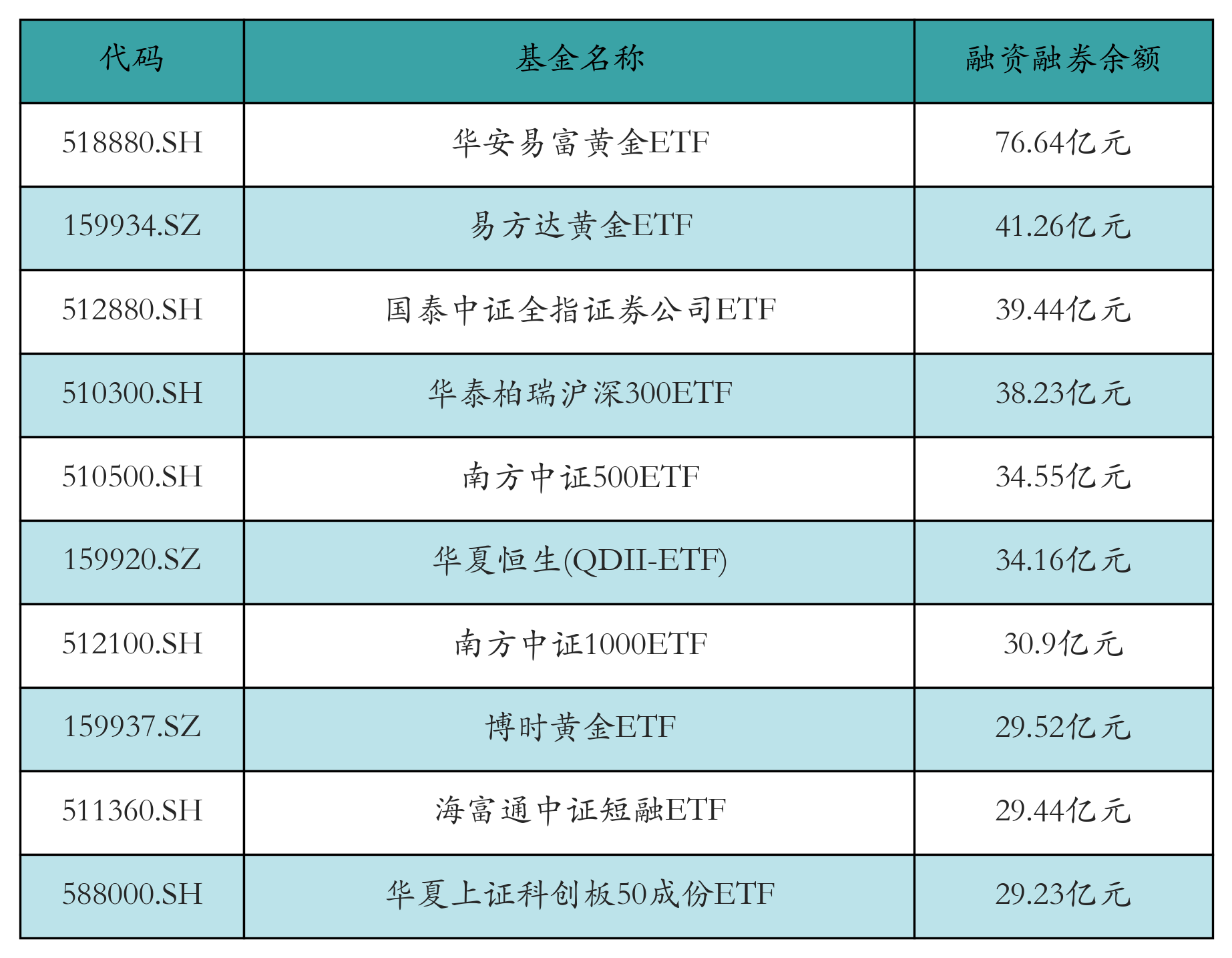
Market Overview - As of February 5, the total ETF margin balance in the two markets is 121.606 billion yuan, a decrease of 247 million yuan from the previous trading day [1] - The financing balance is 113.984 billion yuan, down by 200 million yuan, while the securities lending balance is 7.622 billion yuan, a decrease of 46.735 million yuan [1] - In the Shanghai market, the ETF margin balance is 85.489 billion yuan, a decrease of 83.627 million yuan, with a financing balance of 78.839 billion yuan, down by 36.391 million yuan [1] - In the Shenzhen market, the ETF margin balance is 36.116 billion yuan, a decrease of 1.63 billion yuan, with a financing balance of 35.144 billion yuan, also down by 1.63 billion yuan [1] ETF Margin Balances - The top three ETFs by margin balance on February 5 are: - Huaan Yifu Gold ETF (7.664 billion yuan) - E Fund Gold ETF (4.126 billion yuan) - Guotai CSI All-Share Securities Company ETF (3.944 billion yuan) [2] ETF Financing Buy Amounts - The top three ETFs by financing buy amounts on February 5 are: - Hai Futong CSI Short Bond ETF (1.78 billion yuan) - Bosera CSI Convertible Bonds and Exchangeable Bonds ETF (1.569 billion yuan) - Huaan Yifu Gold ETF (1.426 billion yuan) [4] ETF Financing Net Buy Amounts - The top three ETFs by financing net buy amounts on February 5 are: - Huaxia Shanghai Stock Exchange Sci-Tech Innovation Board 50 ETF (159 million yuan) - GF CSI Hong Kong Innovative Medicines (QDII-ETF) (151 million yuan) - Huaan Yifu Gold ETF (110 million yuan) [6] ETF Securities Lending Sell Amounts - The top three ETFs by securities lending sell amounts on February 5 are: - Southern CSI 500 ETF (92.5785 million yuan) - Southern CSI 1000 ETF (69.2863 million yuan) - Huaxia CSI 1000 ETF (20.042 million yuan) [8]
两市ETF两融余额较前一交易日减少2.58亿元丨ETF融资融券日报
2 1 Shi Ji Jing Ji Bao Dao· 2026-02-04 02:57
Market Overview - As of February 3, the total ETF margin balance in the two markets is 122.589 billion yuan, a decrease of 0.258 billion yuan from the previous trading day [1] - The financing balance is 115.104 billion yuan, down by 0.226 billion yuan, while the securities lending balance is 7.485 billion yuan, a decrease of 31.623 million yuan [1] - In the Shanghai market, the ETF margin balance is 85.858 billion yuan, a decrease of 0.482 billion yuan, with a financing balance of 79.301 billion yuan, down by 0.451 billion yuan [1] - In the Shenzhen market, the ETF margin balance is 36.731 billion yuan, an increase of 0.224 billion yuan, with a financing balance of 35.803 billion yuan, up by 0.225 billion yuan [1] ETF Margin Financing Balances - The top three ETF margin financing balances as of February 3 are: - Huaan Yifu Gold ETF (7.533 billion yuan) - Guotai CSI All-Share Securities Company ETF (4.147 billion yuan) - E Fund Gold ETF (4.12 billion yuan) [2] ETF Financing Buy Amounts - The top three ETF financing buy amounts on February 3 are: - Hai Futong CSI Short Bond ETF (5.537 billion yuan) - Bosera CSI Convertible Bonds and Exchangeable Bonds ETF (1.671 billion yuan) - Huaan Yifu Gold ETF (1.228 billion yuan) [4] ETF Financing Net Buy Amounts - The top three ETF financing net buy amounts as of February 3 are: - Guotai CSI All-Share Securities Company ETF (0.145 billion yuan) - Bosera CSI Convertible Bonds and Exchangeable Bonds ETF (0.124 billion yuan) - Jiashi CSI 500 ETF (0.123 billion yuan) [6] ETF Securities Lending Sell Amounts - The top three ETF securities lending sell amounts on February 3 are: - Huatai-PB CSI 300 ETF (45.3476 million yuan) - Southern CSI 1000 ETF (16.6351 million yuan) - Southern CSI 500 ETF (11.5041 million yuan) [8]
绝对收益产品及策略周报(260126-260130):上周108只固收+基金创新高
GUOTAI HAITONG SECURITIES· 2026-02-04 02:30
Investment Rating - The report does not explicitly provide an investment rating for the industry or products discussed [1]. Core Insights - The total scale of the fixed income + funds market reached 23,558.32 billion, with 1,164 products, and 108 of these reached historical net value highs last week [2][20]. - The performance of various fund types showed divergence, with median returns for mixed bond funds (primary and secondary) at -0.08%, and flexible allocation funds at -0.03%, while bond FOFs and mixed FOFs had median returns of 0.26% and 0.35% respectively [2][13]. - The macro environment forecast for Q1 2026 indicates a slowdown, with the CSI 300 index and other indices showing returns of 1.65% and 0.39% respectively as of January 31, 2026 [3][23]. Summary by Sections 1. Fixed Income + Product Performance Tracking - As of January 30, 2026, the total number of fixed income + funds was 1,164, with a total scale of 23,558.32 billion [10]. - Last week, 6 new products were launched, and the median performance of various fund types was as follows: mixed bond type primary (-0.08%), secondary (-0.08%), and flexible allocation (-0.03%) [13][14]. - The conservative, stable, and aggressive fund median returns were 0.01%, -0.12%, and -0.12% respectively [13]. 2. Major Asset Allocation and Industry ETF Rotation Strategy Tracking - The macro environment forecast for Q1 2026 is a slowdown, with the CSI 300 index yielding 1.65% and the total wealth index of government bonds yielding 0.39% [3][23]. - The recommended industry ETFs for January 2026 include coal, steel, securities companies, and banking ETFs, with a combined return of 0.88% last week [3]. 3. Absolute Return Strategy Performance Tracking - The stock-bond 20/80 rebalancing strategy yielded 0.05% last week, while the stock-bond risk parity strategy yielded 0.04% [4]. - The small-cap value strategy showed the highest performance with a year-to-date return of 2.60%, while the combined strategy with macro momentum yielded a cumulative return of 3.82% [4].