
华夏恒生互联网科技业ETF

Search documents
公募积极布局港股 科技与周期品种仍是投资主线
Zhong Guo Zheng Quan Bao· 2026-02-25 20:55
Core Viewpoint - The Hong Kong stock market has shown volatility post-Spring Festival, with public funds actively positioning themselves to seize future opportunities, particularly in technology and cyclical sectors [1][2]. Market Performance - As of February 25, the Hang Seng Index has increased by 0.22%, while the Hang Seng Technology Index has decreased by nearly 2%. Various sectors have shown mixed performance, with telecommunications, energy, industrials, and materials rising, while consumer staples, conglomerates, and healthcare sectors have faced adjustments [2]. - Notable individual stock performances include significant increases for companies like Dachen Microline Group and Jiu Yuan Group, while Tencent Holdings and Alibaba have seen declines [2]. Fund Positioning - Multiple fund institutions maintain a positive outlook on Hong Kong stocks, with significant inflows into ETFs focused on this market. For instance, the Huatai-PB Hang Seng Technology ETF saw an increase of 13.436 billion shares, while several other ETFs also reported substantial share increases [2]. - Active funds are also adjusting their portfolios to include major Hong Kong internet stocks, indicating a strategic focus on these companies [3]. Long-term Investment Outlook - According to Huaxia Fund, the current market conditions may present a valuable investment window for Hong Kong stocks, driven by attractive valuations and expectations of improved liquidity. The market is experiencing a convergence of factors such as low historical valuations and continued inflows from southbound capital [4]. - Fund managers from various institutions express optimism about the potential for valuation recovery in Hong Kong stocks, supported by improving corporate performance and favorable macroeconomic conditions, including a potential decline in U.S. interest rates [4]. Sector Focus - The technology sector remains a primary focus for investment, with expectations of explosive growth in AI-related capital expenditures. Major domestic internet companies are anticipated to maintain stable growth, enhancing both earnings and valuations [5][6]. - The ongoing economic transformation and industrial upgrades in China are expected to provide significant support for the valuation of Hong Kong's technology sector, despite short-term fluctuations in interest rate expectations [5].
公募积极布局港股科技与周期品种仍是投资主线
Zhong Guo Zheng Quan Bao· 2026-02-25 20:22
Market Overview - The Hong Kong stock market has shown volatility after the Spring Festival, with mixed performance across sectors. Public funds are actively positioning themselves in the market to seize future opportunities, particularly in technology and cyclical sectors [1][2]. Fund Flows - As of February 24, half of the top ten ETFs with increased shares this year are cross-border ETFs investing in the Hong Kong market. Notably, the Huatai-PB Hang Seng Technology ETF saw an increase of 13.436 billion shares, while several other ETFs also reported significant increases [2]. - Active funds are also adjusting their portfolios to include Hong Kong stocks, with notable holdings in major internet companies like Tencent, Alibaba, Meituan, and Xiaomi [2]. Long-term Investment Outlook - According to Huaxia Fund, the Hong Kong market may present a noteworthy investment window in 2026, driven by attractive valuations and expectations of improved liquidity. The current valuations are at historically low levels, providing a safety margin for investors [2]. - The market is experiencing a resurgence of foreign capital inflows, which is expected to support the Hong Kong stock market [2]. Sector Focus - The technology and cyclical sectors are identified as the main investment themes in the Hong Kong market, with a focus on the AI industry, which is anticipated to see explosive capital expenditure growth [3][4]. - The ongoing economic transformation and industrial upgrades in China are providing significant support for the valuation of the technology sector in Hong Kong [4]. Investment Sentiment - Fund managers express optimism about the Hong Kong market, citing the potential for valuation recovery linked to corporate performance and favorable macroeconomic conditions, including a potential decline in U.S. interest rates [3][4]. - The perception of AI is shifting towards a more rational assessment of return on investment, which is expected to reduce bubble risks and enhance long-term opportunities in the technology sector [4].
【海外策略】恒生科技:战略配置区间已至,逆势布局正当时——港股策略观点更新(付天姿/张宇生)
光大证券研究· 2026-02-10 23:07
Core Viewpoint - The Hong Kong stock market is currently in a phase of volatility and correction, with the Hang Seng Technology Index experiencing significant declines, indicating a potential investment opportunity as the market shows signs of bottoming out [4][5]. Group 1: Market Overview - The Hang Seng Technology Index has dropped from a peak of around 6000 points in mid-January to 5346.2 points as of February 6, marking a weekly decline of 6.51%, the largest weekly drop recently [4]. - The overall Hang Seng Index fell by 3.02% to 26559.95 points, while the Hang Seng China Enterprises Index decreased by 3.07% to 9031.38 points, indicating a synchronized pullback across major indices [4]. - The decline in the technology sector is attributed to profit-taking pressures rather than fundamental deterioration, suggesting a potential for recovery as the market stabilizes [4]. Group 2: Capital Flow and Market Behavior - Southbound capital has shown a "buy the dip" strategy, with a net inflow of 560.7 billion HKD in the week of February 6, the highest weekly net inflow in three months, reflecting strong confidence in the technology sector [5][6]. - The inflow into technology-focused ETFs has been significant, with major funds like Huatai-PB Hang Seng Technology ETF and Huaxia Hang Seng Internet Technology ETF seeing net inflows of 38.84 billion HKD and 27.28 billion HKD respectively, indicating a shift towards quality core assets [5]. - Overall, net inflows from various capital sources exceeded 400 billion HKD, providing strong internal support against selling pressures, which suggests that the downward momentum in the market is weakening [6].


资金加仓恒生科技等赛道 宽基核心资产受关注
Zhong Guo Zheng Quan Bao· 2026-02-08 21:55
Group 1 - The consumer and photovoltaic sectors saw significant gains last week, with several related ETFs rising over 3% [1][2] - The A-share market's broad-based products experienced active trading, with ETFs tracking the CSI A500 index exceeding a total transaction volume of 250 billion yuan [1][2] - The market outlook for February suggests a continuation of the upward trend, driven by concentrated earnings forecasts and the recovery of leading companies' performance [1][4] Group 2 - The Hong Kong consumer sector performed strongly, with ETFs such as the Hang Seng Consumer ETF leading the gains [2] - Gold-related ETFs faced a downturn, with an average decline of over 5% across 14 commodity gold ETFs, and some gold stock ETFs dropping more than 13% [2] - The technology sector attracted significant capital inflow, with the Huatai-PineBridge Hang Seng Technology ETF seeing a net inflow of over 3.8 billion yuan last week [3] Group 3 - Several asset management institutions have released macro outlooks for China's equity market in 2026, highlighting diverse growth paths driven by the 14th Five-Year Plan [4][5] - Key investment areas identified include technology, manufacturing, renewable energy, healthcare, and emerging consumer sectors [4][5] - The market is expected to maintain a structural trend in February, with a focus on core growth assets that are currently at historical median valuation levels [5]
资金加仓恒生科技等赛道宽基核心资产受关注
Zhong Guo Zheng Quan Bao· 2026-02-08 20:22
Group 1 - The consumer and photovoltaic sectors saw significant gains, with several related ETFs rising over 3% last week, while gold and artificial intelligence sectors experienced declines, with some ETFs dropping over 9% [1][2] - A-shares market showed active trading in broad-based products, with ETFs tracking the CSI 500 index exceeding a total trading volume of 250 billion yuan, and those tracking the Sci-Tech 50 index surpassing 30 billion yuan [1][2] - The market outlook for February suggests a continuation of the upward trend, driven by concentrated earnings forecasts and the recovery of leading companies' performance, benefiting core assets [1][4] Group 2 - The Hong Kong consumer sector performed strongly, with ETFs such as the Hang Seng Consumer ETF leading the gains, while the photovoltaic sector also showed positive performance [1] - The gold sector underperformed, with commodity gold ETFs declining over 5%, and gold stock ETFs experiencing even greater declines, with some dropping over 13% [2] - The technology sector attracted significant capital inflow, with the Hang Seng Technology ETFs seeing substantial net inflows, particularly the Huatai-PineBridge Hang Seng Technology ETF, which had a net inflow of over 3.8 billion yuan last week [2] Group 3 - The satellite communication sector also experienced notable capital inflow, with the Yongying National Commercial Satellite Communication Industry ETF seeing a net inflow of over 1.8 billion yuan [3] - Several ETFs, including the Huazhong Gold ETF and the Southern CSI Nonferrous Metals ETF, reported net inflows exceeding 10 billion yuan this year [3] - Investment firms are focusing on five key areas for the Chinese equity market by 2026: technology, manufacturing, renewable energy, healthcare, and emerging experiential consumption [3] Group 4 - The market is expected to stabilize in February, with a shift in focus from January's credit and liquidity performance to macro and industry clues [4] - The "14th Five-Year Plan" is anticipated to provide a clearer framework for high-quality development and new growth drivers, stabilizing market perceptions of future growth [4] - Core assets are recommended for continued attention, as their valuations are at historical median levels, with stable profit expectations and increasing foreign capital inflow [4]
超130亿元,“跑了”!
Zhong Guo Ji Jin Bao· 2026-02-03 06:49
Group 1 - The stock ETF market experienced a significant net outflow of 790 billion yuan in January, with broad-based ETFs being the main contributors to this outflow [2] - On February 2, the first trading day of the month, stock ETFs saw a net outflow of 13.771 billion yuan, influenced by a sharp decline in the three major stock indices [2] - Broad-based ETFs and the metals sector were the largest "bloodletting" categories, while sector-specific ETFs like semiconductors and pharmaceuticals attracted significant inflows [2][3] Group 2 - As of February 2, the total scale of 1,321 stock ETFs (including cross-border ETFs) was 4.09 trillion yuan, showing a notable decrease due to the market downturn [3] - Sector-specific ETFs and Hong Kong stock ETFs saw substantial inflows, with 3.715 billion yuan and 3.346 billion yuan respectively on the previous trading day [3] - The semiconductor sector had a remarkable net inflow of 2.61 billion yuan on February 2, with the Guolian An CSI All-Share Semiconductor ETF leading with a net inflow of 903 million yuan [3] Group 3 - Over the past five days, the SGE Gold 9999 index saw inflows exceeding 13.9 billion yuan, while the specialized chemical index attracted over 7 billion yuan [4] - Leading institutions like E Fund reported a total ETF scale of 642.71 billion yuan, with a net inflow of 800 million yuan on the previous day [4] - Notable single product inflows included 526 million yuan for the ChiNext ETF and 352 million yuan for the Hang Seng Technology ETF [4] Group 4 - Broad-based ETFs continued to experience significant outflows, with a net outflow of 23.778 billion yuan on the previous day, leading to a scale decrease of 68.672 billion yuan [5] - The CSI 500 ETF had the largest single-day outflow of 13.02 billion yuan, followed by the CSI 300 ETF with 7.2 billion yuan [5] Group 5 - The metals sector also faced notable outflows, with a net outflow of 4.39 billion yuan, influenced by expectations surrounding the Federal Reserve's monetary policy and profit-taking sentiments [6] - Despite short-term volatility, the long-term investment logic for the metals sector remains solid, supported by global manufacturing cycles and energy transition demands [6] Group 6 - Current market adjustments are viewed as providing better valuation windows for long-term investments, with a stable long-term market outlook supported by policy measures and improving economic fundamentals [7] - Key factors include ongoing policy support, marginal improvements in economic indicators, and a favorable funding environment with increasing allocations to A-shares from various institutional investors [7]
241只ETF获融资净买入 易方达中证香港证券投资主题ETF居首
Zhong Guo Jing Ji Wang· 2026-02-02 01:49
Group 1 - The total margin balance of ETFs in the Shanghai and Shenzhen markets as of January 30 is 120.251 billion yuan, a decrease of 2.896 billion yuan from the previous trading day [1] - The financing balance of ETFs is 112.88 billion yuan, down by 2.767 billion yuan, while the margin balance for securities lending is 7.371 billion yuan, a decrease of 0.129 billion yuan [1] - On January 30, 241 ETFs experienced net financing inflows, with the E Fund CSI Hong Kong Securities Investment Theme ETF leading with a net inflow of 84.1736 million yuan [1] Group 2 - Other ETFs with significant net financing inflows include the Huaxia Hang Seng Internet Technology ETF, the FTSE China A50 ETF, the Huabao CSI Medical ETF, the Bosera Gold ETF, and the Huaan Gold ETF [1]
竞逐科技与高端制造,公募ETF发行大爆发
Huan Qiu Wang· 2026-01-19 06:28
Core Viewpoint - The A-share market has entered a new round of structural trends in 2026, with sectors like commercial aerospace, new energy, and artificial intelligence (AI) applications showing strong performance, leading to a significant increase in the issuance of thematic ETFs and their net asset values [1] Group 1: Thematic ETF Performance - The Satellite ETF managed by Yongying Fund has achieved a return of 17.92% year-to-date and a 99.10% increase over the past six months, with its scale rising from 2.4 billion to 17 billion yuan, making it the first satellite-themed ETF to exceed 10 billion yuan in size [1] - The Huaan Gold ETF has surpassed 100 billion yuan in scale, becoming the first gold ETF in China to enter the "billion club" due to rising gold and silver prices [1] Group 2: Fund Company Activities - Multiple fund companies are actively launching thematic ETFs focused on "pan-technology + high-end manufacturing," targeting investment directions such as electric utilities, sub-sectors of the Sci-Tech Innovation Board, and battery themes that are not yet overcrowded [2] - The Invesco Great Wall Fund's electric utility ETF raised 1.667 billion yuan in just 7 days, indicating strong investor interest in the electric sector [2] - The Tianhong Fund's chip design thematic ETF raised 607 million yuan in 8 days, while the Southern Fund's AI ETF raised 514 million yuan in only 6 days [2] Group 3: New Energy and Resource ETFs - In the new energy sector, battery-themed ETFs are experiencing "same-topic competition," with the Dacheng Fund's battery ETF raising 442 million yuan in just 4 days, the shortest subscription period in the market [4] - Several fund companies have reported new ETFs focused on industrial metals, indicating a strong interest in upstream resource sectors [4] Group 4: ETF Issuance Trends - The number of new ETFs issued has surged from 281 in 2021 to 363 in 2025, with technology, new energy, and pharmaceutical thematic ETFs showing remarkable performance [5] - The Huaxia Hang Seng Internet Technology ETF's shares have increased from 7.555 billion at issuance to 66.869 billion, an expansion of nearly 8 times [5] - However, there is a notable trend of divergence within thematic ETFs, with some products experiencing a rapid decline in scale, highlighting the importance of long-term sector attractiveness and product differentiation [5] Group 5: Market Outlook - Analysts suggest that the recent surge in thematic ETF issuance is closely linked to the structural trends in the A-share market in 2026, with institutional investors quickly positioning themselves in popular sectors [6] - If the related industries maintain their growth, these ETFs may become a significant direction for capital inflow, but fund companies must focus on lifecycle management and market demand to avoid resource wastage [6]
融资盘突发降温!部分赛道恐短期承压,要不要撤?
Sou Hu Cai Jing· 2026-01-15 08:40
Market Overview - On January 14, a sudden announcement from three major exchanges raised the minimum margin requirement for financing from 80% to 100%, effective immediately, leading to a significant market downturn after an initial rally [1] - The A-share market's margin balance reached a historical high of 2.67 trillion yuan, with net financing inflow nearing 140 billion yuan in just the first seven trading days of 2026 [1][4] - Trading activity has been notably high, with daily transaction volumes exceeding 3 trillion yuan on multiple occasions, indicating elevated market sentiment [1] Impact of Margin Requirement Adjustment - Historical data suggests that previous increases in margin requirements in November 2015 and May 2017 resulted in a decrease of 6.3% and 4.1% in margin balances within a week, with the Shanghai Composite Index experiencing declines of 5% to 8% [4] - On January 14, the most affected sectors included TMT (Technology, Media, and Telecommunications) and non-bank financials, with the CSI 2000 index dropping by 4.6% and the number of stocks hitting the daily limit increase from 3 to 58 [4] - Northbound capital also reacted negatively, with a net outflow of 6.2 billion yuan, marking the largest single-day outflow in January [4] Sector Analysis - High Beta sectors such as TMT and non-bank financials, which have high financing balances and volatility, are expected to face immediate pressure due to the margin increase [4] - Key industries like electronics, power equipment, and computing, which are significant players in margin financing, may see a slowdown in capital inflow in the short term [4] - Despite the margin increase, existing investors are not required to add additional margin, which helps maintain stability in the over 2 trillion yuan of existing margin balances [4] ETF Market Insights - Certain ETFs, such as the Hai Fu Tong CSI Short Bond ETF and the Bosera Convertible Bond ETF, have seen active margin trading, although their overall contribution to total margin trading remains limited due to their large scale [6] - ETFs with high margin trading ratios, like the Hang Seng Technology ETF and the Huaxia Hang Seng Internet Technology ETF, should be approached with caution as forced liquidations could lead to significant price drops [6] Long-term Outlook - The adjustment of margin requirements is viewed as a "counter-cyclical fine-tuning," primarily affecting new contracts while leaving existing ones intact, suggesting limited long-term impact on market dynamics [10] - Historical patterns indicate that after initial emotional reactions, funds will likely return to selecting stocks based on fundamentals and valuations, minimizing the long-term effects of margin adjustments [10] - Despite short-term pressures, sectors such as AI applications and commercial aerospace continue to attract significant capital, indicating ongoing interest in certain growth areas [10] Future Projections - Analysts expect continued structural differentiation in the A-share market, driven by technological innovation and concentrated corporate performance, with a projected net profit growth rate for the CSI 300 index of 7.2% and 8.4% for 2026 and 2027, respectively [12][13]
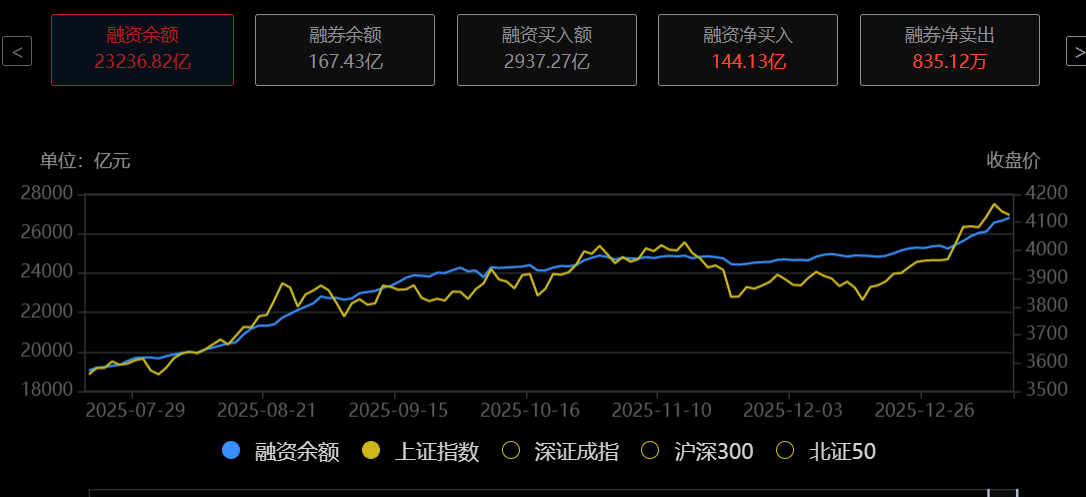
247只ETF获融资净买入 华泰柏瑞恒生科技ETF居首
Zheng Quan Shi Bao Wang· 2026-01-08 02:00
Core Viewpoint - As of January 7, the total margin balance for ETFs in the Shanghai and Shenzhen markets is 119.315 billion yuan, showing a decrease of 0.58 billion yuan from the previous trading day [1] Group 1: ETF Financing and Margin Data - The ETF financing balance is 111.663 billion yuan, down by 0.567 billion yuan from the previous trading day [1] - The ETF margin short balance is 7.652 billion yuan, decreasing by 0.013 billion yuan from the previous trading day [1] Group 2: Net Inflows in ETFs - On January 7, 247 ETFs experienced net financing inflows, with the Huatai-PB Hang Seng Technology ETF leading with a net inflow of 0.162 billion yuan [1] - Other ETFs with significant net inflows include the Huaxia Hang Seng Technology ETF, Guotai Junan CSI All Share Securities Companies ETF, Huaxia Hang Seng Internet Technology ETF, Guotai Junan CSI Semiconductor Materials and Equipment Theme ETF, Pengyang 30-Year Treasury Bond ETF, and Southern CSI 500 ETF [1]