
华宝券商ETF

Search documents
千亿女将“清仓”离场,谁将扛起华宝基金指数大旗?
Xin Lang Cai Jing· 2026-02-24 11:46
Core Viewpoint - The sudden resignation of Hu Jie, the index investment director of Huabao Fund, who managed assets worth 101.36 billion yuan, raises concerns about the future of the company's passive investment strategy and highlights the contrasting performance between its ETF and active equity funds [1][19][20]. Group 1: Hu Jie's Departure - Hu Jie has served nearly 20 years at Huabao Fund, with over 13 years as a fund manager, and her departure is significant due to her management of 16 index funds totaling 101.36 billion yuan, which is over half of the company's index fund assets [1][3][19]. - Despite her contributions to the rapid expansion of the ETF scale, her funds underperformed, with a one-year return of 9.33%, significantly lagging behind the 20.4% increase of the CSI 300 index [19][24]. - Hu Jie's exit has exposed the long-standing structural issues within Huabao Fund's equity funds, where the passive investment segment has thrived while active equity funds have struggled [19][20]. Group 2: Performance of Funds - The non-cash ETF scale reached 127.88 billion yuan by the end of 2025, marking a 56.38% year-on-year growth, nearly doubling in two years [19][28]. - In contrast, the active equity fund management scale has remained below 20 billion yuan for the past two years, with several products being liquidated due to insufficient scale [20][31]. - Huabao Fund's ETF products have been successful, with 34 new funds launched since 2025, including 26 ETFs, covering various market hotspots [28][30]. Group 3: Management Changes - Huabao Fund has undergone significant management changes, including the resignation of its chairman and several executives, which may impact the company's strategic direction [14][33][36]. - The new leadership aims to strengthen passive equity funds while potentially sidelining active equity strategies, raising questions about how the company will fill the void left by Hu Jie [36][37]. - The overall fund management scale of Huabao Fund reached 416.53 billion yuan by the end of 2025, with the non-cash ETF contributing significantly to this growth [36].


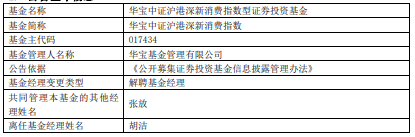
胡洁离任华宝基金旗下15只基金
Zhong Guo Jing Ji Wang· 2026-02-24 08:03
Core Viewpoint - Hu Jie has resigned from multiple funds managed by Huabao Fund Management Co., Ltd., including the Huabao CSI Hong Kong-Shenzhen New Consumption Index and Huabao CSI Sci-Tech Innovation 50 ETF [1][5][9]. Fund Performance Summary - **Huabao CSI Hong Kong-Shenzhen New Consumption Index A/C**: Established on April 11, 2023, with a year-to-date return of -0.14% and a cumulative net value of 1.3040 yuan [1]. - **Huabao CSI Sci-Tech Innovation 50 ETF**: Established on August 25, 2021, with a year-to-date return of 0.84% and a cumulative net value of 1.0850 yuan [1]. - **Huabao Securities ETF**: Established on August 30, 2016, with a year-to-date return of -3.28% and a cumulative net value of 1.1206 yuan [2]. - **Huabao Medical ETF**: Established on May 21, 2015, with a year-to-date return of 3.68% and a cumulative net value of 0.4702 yuan [2]. - **Huabao Military Industry ETF**: Established on August 5, 2016, with a year-to-date return of 7.88% and a cumulative net value of 1.7146 yuan [2]. - **Huabao Consumer Leader ETF**: Established on September 28, 2021, with a year-to-date return of -0.95% and a cumulative net value of 0.7753 yuan [3]. - **Huabao Technology Leader ETF**: Established on July 22, 2019, with a year-to-date return of 3.85% and a cumulative net value of 2.0646 yuan [3]. - **Huabao Bank ETF**: Established on July 18, 2017, with a year-to-date return of -5.42% and a cumulative net value of 1.5586 yuan [4]. - **Huabao Technology ETF**: Established on August 30, 2019, with a year-to-date return of 3.61% and a cumulative net value of 1.7809 yuan [4]. Fund Manager Changes - Hu Jie has been replaced as the fund manager for several funds, including the Huabao CSI Hong Kong-Shenzhen New Consumption Index and Huabao CSI Sci-Tech Innovation 50 ETF, with new managers appointed [5][6][9][10].
A股券商板块年内大幅跑输市场,证券ETF、香港证券ETF、券商ETF下半年强势吸金
Ge Long Hui· 2025-12-09 08:11
Group 1 - The A-share brokerage sector has significantly underperformed the market this year, with the CSI All Share Securities Companies Index rising only 1.8% compared to the over 25% increase in the Wind All A Index [1] - The Hong Kong Securities ETF has surged over 41% this year, while the A-share Securities ETF has only increased by 5% [2] - The net profit of listed brokerages is expected to grow by 62.4% year-on-year in the first three quarters of 2025, indicating a divergence between performance and stock price [2] Group 2 - The brokerage sector is entering a configuration window with quantitative signals and capital resonance, suggesting a potential upward trend as main funds show significant inflow [3] - The sector is currently in a neutral to weak oscillation pattern, with limited downside risk and a potential for upward breakout if positive catalysts emerge [3] - The turnover rate in the brokerage sector has dropped to a historical low, indicating low trading willingness and a stable chip structure [3] Group 3 - Central Huijin's long-term stable allocation provides strong support for the sector, with no evidence of reduction in holdings and an increase in positions in key brokerages [4] - The brokerage sector's price-to-book (PB) ratio is only 1.36 times, indicating a significant undervaluation despite a surge in performance [4] - The securities industry has ample room for incremental business growth, with leading brokerages expected to strengthen through mergers and acquisitions [4]
【ETF观察】12月1日行业主题ETF净流出22.17亿元
Sou Hu Cai Jing· 2025-12-01 22:30
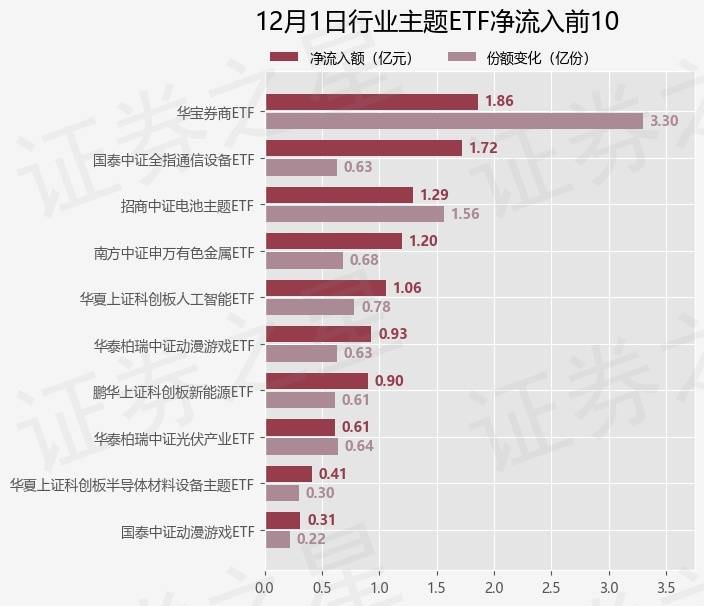
Summary of Key Points Core Viewpoint - On December 1, the industry-themed ETF funds experienced a net outflow of 2.217 billion yuan, with a cumulative net outflow of 21.43 billion yuan over the past five trading days, indicating a trend of capital withdrawal from these funds [1]. Fund Performance - A total of 66 industry-themed ETFs saw net inflows on December 1, with the Huabao Securities ETF (512000) leading the inflow, increasing by 330 million shares and a net inflow of 186 million yuan [1][3]. - Conversely, 141 industry-themed ETFs experienced net outflows, with the Guotai Zhongzheng All-Index Securities Company ETF (512880) having the largest outflow, decreasing by 501 million shares and a net outflow of 592 million yuan [1][4]. Top ETFs by Net Inflow - The top ETFs by net inflow on December 1 included: - Huabao Securities ETF (512000): 1.86 billion yuan net inflow, 701.77 million shares [3]. - Guotai Zhongzheng All-Index Communication Equipment ETF (515880): 1.72 billion yuan net inflow, 42.93 million shares [3]. - Other notable inflows included the China Merchants Zhongzheng Battery Theme ETF (561910) and the Southern Zhongzheng Shenwan Nonferrous Metals ETF (512400) [3]. Top ETFs by Net Outflow - The top ETFs by net outflow on December 1 included: - Guotai Zhongzheng All-Index Securities Company ETF (512880): 5.92 billion yuan net outflow, 499.03 million shares [4][5]. - Huabao Zhongzheng Bank ETF (512800): 4.35 billion yuan net outflow, 213.76 million shares [5]. - Other significant outflows were seen in the Guolian An Zhongzheng Semiconductor ETF (512480) and the Yongying Zhongzheng Hong Kong Gold Industry ETF (517520) [5].
【ETF观察】11月28日行业主题ETF净流出24.94亿元
Sou Hu Cai Jing· 2025-11-28 22:37
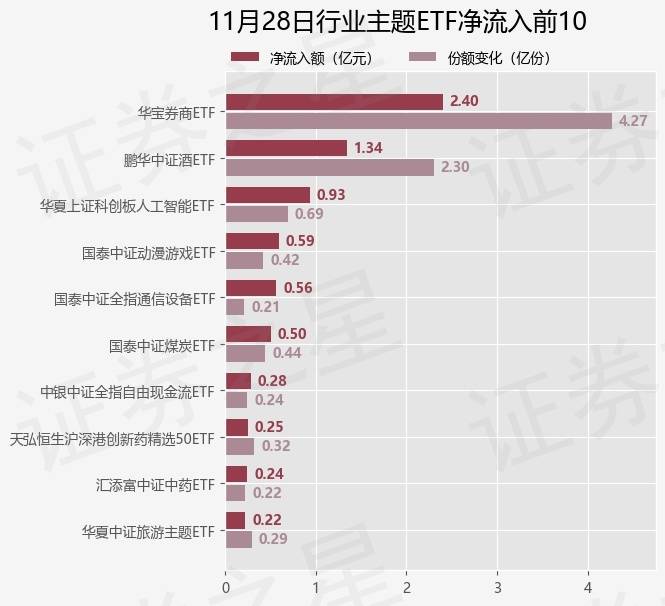
Core Insights - On November 28, industry-themed ETF funds experienced a net outflow of 2.494 billion yuan, with a cumulative net outflow of 20.054 billion yuan over the past five trading days [1] - A total of 48 industry-themed ETFs saw net inflows, with the Huabao Securities ETF (512000) leading with an increase of 427 million shares and a net inflow of 240 million yuan [1][3] - Conversely, 151 industry-themed ETFs recorded net outflows, with the Guotai Zhongzheng All-Index Securities Company ETF (512880) experiencing the largest outflow of 654 million yuan and a reduction of 556 million shares [1][4] Summary by Category Net Inflows - The Huabao Securities ETF (512000) had a net inflow of 240 million yuan, with a share increase of 427 million, bringing its total shares to 698.47 million [3][5] - Other ETFs with net inflows include: - Penghua Zhongzheng Wine ETF (512690) with a net inflow of 134 million yuan and a share increase of 230 million [3] - Huaxia Shanghai Stock Exchange Science and Technology Innovation Board Artificial Intelligence ETF (589010) with a net inflow of 93 million yuan and a share increase of 69 million [3] Net Outflows - The Guotai Zhongzheng All-Index Securities Company ETF (512880) had the highest net outflow of 654 million yuan, with a share decrease of 556 million, resulting in a total of 504.04 million shares [4][5] - Other ETFs with significant net outflows include: - Huabao Zhongzheng Bank ETF (512800) with a net outflow of 428 million yuan and a share decrease of 512 million [4] - Huaxia Zhongzheng Robot ETF (562500) with a net outflow of 163 million yuan and a share decrease of 173 million [5]
四季度以来近2000亿元资金涌入权益类ETF
Sou Hu Cai Jing· 2025-11-26 06:59
Group 1 - The pace of capital inflow into equity ETFs has significantly accelerated, with a total net subscription amount reaching 196.48 billion yuan as of November 21 [1] - On November 21, the single-day net subscription amount for equity ETFs exceeded 40 billion yuan, marking the highest net inflow in over seven months [1] - The capital flow is directed towards three main categories: broker-themed ETFs and dividend-themed ETFs, technology growth-themed ETFs, and Hong Kong stock-themed ETFs [1] Group 2 - Morgan Asset Management states that despite recent market adjustments, liquidity shocks are nearing full pricing, and the overall market trend has not fundamentally changed [2] - The Chinese AI industry is still in its early development stage, avoiding the excessive capital expenditure issues seen in the U.S., with a solid foundation for technological innovation and self-sufficiency [2]
凸显看好态度 多路资金竞相加码权益资产
Shang Hai Zheng Quan Bao· 2025-11-09 15:26
Group 1 - Multiple funds are increasing their investments in Chinese equity assets, with several newly launched equity funds raising over 3 billion yuan, indicating strong market interest [1][2] - The recent surge in equity fund issuance has led to a notable increase in the number of funds exceeding 3 billion yuan in size, with several funds selling out on the first day of issuance [2][3] - The performance of the A-share market has improved, enhancing investor sentiment and leading to a shift in household investment preferences towards public funds [3] Group 2 - Existing funds are also attracting significant inflows, with over 100 billion yuan flowing into ETFs, prompting some high-performing funds to impose purchase limits [4][5] - The net subscription amount for equity ETFs reached approximately 118.4 billion yuan since October, reflecting investor optimism about the market [4][5] - Notable inflows into securities-themed ETFs indicate a positive outlook among investors, with specific ETFs attracting substantial net subscriptions [5][6]
四季度以来权益类ETF吸金超千亿元
Sou Hu Cai Jing· 2025-11-05 00:36
Core Insights - The net subscription amount for equity ETFs in October reached 100.894 billion yuan, with a significant inflow of over 25 billion yuan on October 31 during a market adjustment [1] Fund Flows - The net subscription amount for Guotai Junan Securities ETF was 7.549 billion yuan, while other ETFs such as Huabao Bank ETF, Huabao Securities ETF, and Jiashi Science and Technology Chip ETF each had net subscriptions exceeding 3.5 billion yuan [1] - Hong Kong-themed ETFs, including Huaxia Hang Seng Technology ETF, Huatai-PB Hang Seng Technology ETF, Tianhong Hang Seng Technology ETF, and Dacheng Hang Seng Technology ETF, also saw net subscriptions above 3 billion yuan [1]
近半资金撤离!高位ETF止盈潮涌,什么情况?
券商中国· 2025-10-15 12:00
Core Viewpoint - A significant amount of capital is fleeing high-position ETFs, indicating a structural shift in market behavior where funds are moving from high-performing sectors to those that have underperformed [1][3][4]. Market Dynamics - Recent market volatility has intensified, with a clear "high-cut low" structural characteristic. Funds are withdrawing from previously high-performing sectors while reallocating to those with lower gains. This rotation is expected to be a prolonged process with multiple reversals [2][4]. - Year-to-date, there is a stark divergence in industry performance, with sectors like non-ferrous metals, communications, electronics, and power equipment seeing gains over 40%, while sectors such as food and beverage, coal, and transportation have not seen positive returns [4]. ETF Performance - High-performing ETFs are experiencing significant capital outflows, with the STAR Market 50 ETF being the most affected, seeing a net outflow of nearly 50 billion yuan this year, reducing its share size by almost half [5]. - Other ETFs, such as the ChiNext ETF, have also faced substantial outflows, with over 20 billion yuan leaving since September [5]. - Conversely, underperforming ETFs, particularly in the brokerage sector, have attracted over 10 billion yuan in net inflows, indicating a shift in investor sentiment towards these lagging assets [8]. Investment Trends - The trend of "selling high and buying low" is evident, with funds increasingly favoring ETFs that have not performed well this year. For instance, the brokerage sector ETFs have seen a significant increase in share size, with the Huabao Brokerage ETF's circulation nearly tripling since the beginning of the year [8]. - The market is witnessing a rotation towards assets with strong balance sheets and robust operational patterns, which are expected to benefit from market volatility [12]. Future Outlook - The ongoing trend of capital moving from high-return sectors to those with lower valuations is anticipated to continue, with the potential for prolonged market reversals. Investors are advised to focus on assets with resilience and long-term value creation potential [10][12].

高位ETF频遭资金止盈 反脆弱资产溢价预期升温
Zheng Quan Shi Bao· 2025-10-12 22:07
Market Trends - Recent market volatility has led to a significant "high cut low" structural characteristic, with funds withdrawing from previously high-performing sectors while reallocating to underperforming ones [1] - The market rotation is expected to be prolonged, with multiple reversals likely occurring during this transition [1] ETF Performance - The Shanghai Composite Index has been fluctuating above 3800 points, with high-position sectors showing weak growth and funds displaying divergence [2] - Year-to-date, sectors such as non-ferrous metals, communications, electronics, and power equipment have seen gains exceeding 40%, while sectors like food and beverage, coal, oil and petrochemicals, and transportation have not turned positive [2] - The disparity in performance between the best and worst indices exceeds 80 percentage points, indicating that market opportunities are primarily driven by sector-specific catalysts [2] Fund Flows - ETFs with high growth attributes, such as the STAR Market 50 ETF, have experienced significant outflows, with over 50 billion yuan withdrawn this year, marking it as the ETF with the largest net outflow [3] - The ChiNext ETF, which has also seen nearly 50% growth, ranks second in terms of net outflows, with over 20 billion yuan exiting [3] - Other growth-oriented ETFs, including those focused on healthcare, semiconductors, and AI, have similarly faced substantial sell-offs since September [3] Inflows into Underperforming ETFs - In contrast, some underperforming ETFs have attracted significant inflows, with three broker-themed ETFs receiving over 10 billion yuan each this year [4] - The Huabao Broker ETF has seen its circulating shares triple since the beginning of the year, reflecting a growing interest in the sector despite its relatively modest performance [4] - Other underperforming ETFs, such as those focused on coal and liquor, have also garnered over 8 billion yuan in net inflows this year [4] Balanced Investment Strategies - The CSI A500 series ETFs have been among the few to receive increased investment, with over 3.8 billion yuan net inflow since September, positioning it as a leading product in its category [5] - The A500 index is viewed as a balanced investment option, suitable for the current market dynamics characterized by significant sector performance disparities [5] Asset Resilience - The capital market has seen a surge in technology-related sectors, while traditional sectors like utilities and real estate have lagged [6] - Despite high returns from certain thematic funds, investors are beginning to take profits and shift towards lower-priced funds, indicating a cautious approach to market volatility [6] - The transition from high-performing to underperforming sectors is expected to be gradual, with ongoing fluctuations in market conditions [6] Investment Outlook - Assets with anti-fragile characteristics, such as gold, coal, and oil transportation, are anticipated to gain premium valuations due to their robust balance sheets and operational resilience [7] - These assets are expected to benefit from market fluctuations and underlying factors such as state-owned enterprise reforms driving shareholder returns [7]