
城市更新专项贷款

Search documents
发放城市更新领域贷款 达7863亿元
Jin Rong Shi Bao· 2026-02-26 02:32
Core Viewpoint - The National Development Bank (NDB) has issued loans totaling 786.3 billion yuan in 2025 to support urban renewal projects, focusing on the renovation of old residential areas, streets, factories, and urban villages, as well as infrastructure improvements and cultural heritage preservation [1] Group 1: Loan Issuance and Focus Areas - In 2025, NDB issued loans of 786.3 billion yuan specifically for urban renewal, emphasizing the renovation of old residential communities, streets, factories, and urban villages [1] - The bank's efforts are aimed at optimizing urban structure, enhancing functionality, preserving cultural heritage, and improving urban quality [1] Group 2: Policy Implementation and Support - NDB is implementing the directives from the Central Urban Work Conference and the State Council's opinions on urban renewal, focusing on its core responsibilities and increasing medium to long-term financing support [1] - The bank has established a special loan for urban renewal and is developing a credit policy and institutional framework that aligns with high-quality urban development [1] Group 3: Innovative Financing Models - NDB is exploring market-oriented financing models to address funding balance issues in urban renewal projects, such as promoting comprehensive development models in cities like Jingdezhen and Huanggang [2] - The bank is also researching support for old housing renovations through self-renewal and original reconstruction models in cities like Beijing [2] Group 4: Future Plans and Contributions - NDB plans to strengthen communication with relevant ministries and local governments, actively participate in the "14th Five-Year" urban renewal planning, and enhance project development reserves [2] - The bank aims to leverage its role as a policy financial institution to contribute positively to improving livelihoods and expanding domestic demand through high-quality urban renewal initiatives [2]
2025年中国国开行向城市更新领域发放贷款7863亿元
Xin Lang Cai Jing· 2026-02-24 11:04
Core Viewpoint - The China Development Bank (CDB) plans to issue loans amounting to 786.3 billion RMB for urban renewal projects by 2025, focusing on the renovation of old residential areas, streets, factories, and urban villages, as well as infrastructure improvements [1] Group 1: Loan Allocation and Focus Areas - CDB will primarily support the renovation of old residential communities, old streets, old factories, and urban villages, along with urban infrastructure construction [1] - The bank has established a special loan for urban renewal under the guidance of relevant ministries and financial regulatory bodies, emphasizing support for demonstration cities and economically significant provinces [1] Group 2: Financial Strategies and Models - CDB is exploring market-oriented financing models to address funding balance issues in urban renewal projects, such as promoting comprehensive development models in cities like Jingdezhen and Huanggang [1] - The bank is implementing diverse financial products, including policy-based financial tools and fixed asset support loans, to provide compliant and efficient financial services [1] Group 3: Future Plans and Collaboration - CDB aims to enhance communication and coordination with relevant ministries and local governments, actively participating in the formulation of the national and local "14th Five-Year" urban renewal plans [2] - The bank will focus on building a project database and increasing project development reserves [2]
国开行2025年向城市更新领域发放贷款7863亿元
Xin Hua Wang· 2026-02-21 06:51
Core Viewpoint - The National Development Bank (NDB) plans to issue loans amounting to 786.3 billion yuan in 2025 for urban renewal projects, focusing on the renovation of old residential areas, streets, factories, and villages, as well as infrastructure improvement and ecological restoration [1] Group 1: Loan Allocation and Focus Areas - NDB's loans will primarily support the renovation of old residential communities, urban infrastructure, ecological system restoration, and the preservation of historical and cultural heritage [1] - The bank has established a special loan program for urban renewal, creating a credit policy and system that aligns with high-quality urban development [1] Group 2: Strategic Implementation - NDB aims to enhance its support for demonstration cities and economically significant provinces while respecting urban development laws and addressing pressing local issues [1] - The bank is exploring market-oriented financing models to address funding balance challenges in urban renewal projects [1] Group 3: Project Development and Future Plans - The bank plans to increase project development reserves and leverage its role as a policy financial institution to contribute positively to urban renewal and improve living standards [2]
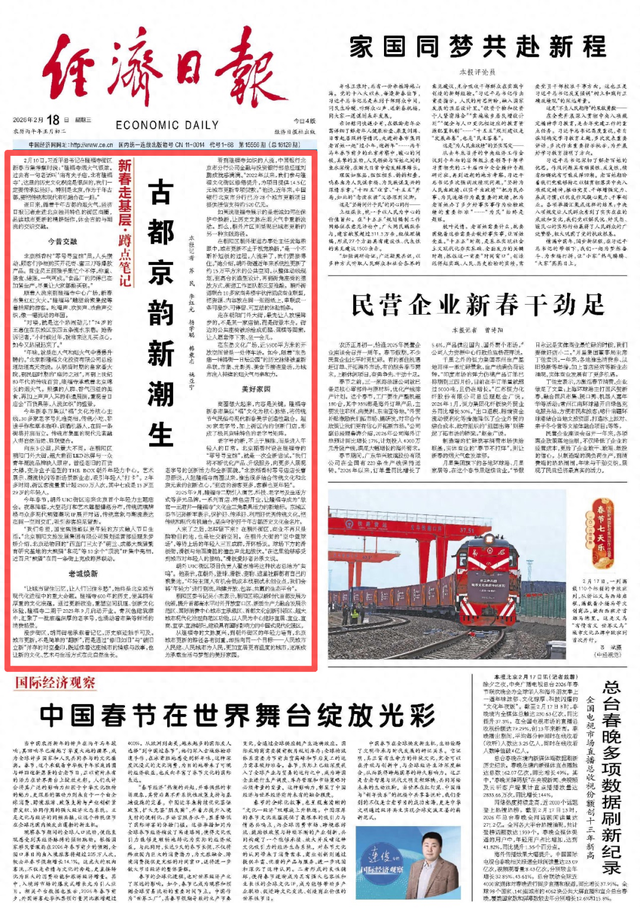
“谁懂啊,在北京过了个潮年!”
Xin Lang Cai Jing· 2026-02-18 11:08
Core Insights - The article emphasizes the importance of integrating traditional culture with modern elements in Beijing's urban renewal efforts, particularly in the context of the Longfu Temple area and the Chaoyang district [1][22]. Group 1: Longfu Temple Area - Xi Jinping highlighted the historical significance of Longfu Temple, comparing it to the Confucius Temple in the south, and stressed the need to preserve and promote its cultural heritage [1]. - The Longfu Temple area is experiencing a vibrant revival, with a New Year market featuring over 30 traditional brands, blending traditional snacks with modern innovations like herbal coffee and cocktail robots [9][18]. - The Longfu Temple's historical significance spans 600 years, and its ongoing renovation aims to create a space that honors its past while introducing new cultural experiences [13][20]. Group 2: Chaoyang District - The Chaoyang district showcases a different approach to urban renewal, focusing on creating interactive public spaces that attract younger demographics, with over 25 million visitors in two years, 70% of whom are aged 15 to 29 [11][14]. - The district has transformed old shopping centers into modern hubs, such as THE BOX, which features art displays and trendy pop-up shops, appealing to the youth culture [11][14]. - The first youth-themed temple fair in the Chaoyang district combines traditional elements with contemporary attractions, including large-scale art installations and popular cultural icons like pandas [11][22]. Group 3: Economic Impact and Investment - The Bank of China has provided 1.45 billion yuan in loans for the renovation of the Longfu cultural district, part of a broader commitment to support urban renewal projects totaling approximately 52 billion yuan [14]. - The integration of traditional and modern elements in both Longfu Temple and Chaoyang district aims to create a more livable and engaging urban environment, enhancing the overall quality of life for residents [22].

重庆市《关于加强金融支持城市更新工作的通知》,公布金融支持城市更新十大服务方向
Sou Hu Cai Jing· 2025-12-07 04:29
Core Viewpoint - The article emphasizes the need for financial institutions to actively participate in urban renewal projects in Chongqing, aiming to establish a diversified financing system and enhance collaboration among government, finance, and enterprises to support sustainable urban development [3][4]. Group 1: Overall Requirements - The initiative aims to implement the central government's directives on urban work, focusing on modernizing urban infrastructure and services through innovative financial products and services [4]. - Financial institutions are encouraged to strengthen medium- and long-term credit supply to meet the financing needs of urban renewal projects [4]. Group 2: Key Support Areas - Financial institutions are to focus on urban area renewal, renovation of old residential communities, and enhancement of urban infrastructure, including digital and green space updates [5]. - The initiative also emphasizes the importance of preserving historical and cultural aspects of urban environments during the renewal process [5]. Group 3: Financial Support Measures - A specialized team should be established within financial institutions to enhance urban renewal financial services and ensure effective policy implementation [6]. - Financial institutions are encouraged to innovate financial products tailored to urban renewal needs, such as specialized loans, funds, and asset-backed securities [6][7]. - Collaboration between financial and fiscal sectors is essential to increase support for urban renewal projects through special bonds and market-driven funds [7]. Group 4: Mechanism Guarantees - A collaborative mechanism among financial management, housing, and construction departments is necessary to address challenges in urban renewal financing [8]. - Financial institutions should develop performance evaluation systems to assess the effectiveness of their urban renewal financial services [8]. - Successful case studies in urban renewal should be promoted to share best practices and encourage further innovation in financing solutions [8].

重庆发布支持城市更新“金融十条”
Zheng Quan Shi Bao Wang· 2025-10-29 12:16
Core Viewpoint - The Chongqing Financial Regulatory Bureau, in collaboration with other local authorities, has introduced ten measures to enhance financial support for urban renewal, focusing on spatial restructuring, functional optimization, industrial upgrading, and ecological restoration [1][2]. Group 1: Spatial Restructuring - The measures emphasize the role of policy financial tools to address capital shortfalls and attract more social funds for urban renewal, particularly in the renovation of old residential areas, enhancement of public spaces, and improvement of infrastructure [1]. - The goal is to revitalize old buildings and streets, bringing new life to these areas [1]. Group 2: Functional Optimization - Increased financial support for public facilities such as road networks is highlighted, aiming to promote smart urban system upgrades and improve the 15-minute convenient living circle [1]. - The measures also support the protection of historical and cultural districts, ensuring the continuity of urban cultural heritage [1]. Group 3: Industrial Upgrading - Financial resources will be directed towards industrial upgrades, facilitating the transformation of inefficient factories and parks into new industries such as technology innovation and health care [1]. Group 4: Ecological Restoration - The focus is on green and low-carbon transformations, supporting projects like low-carbon communities and sponge cities through green finance tools such as green loans and bonds [1]. Group 5: Financial Mechanism and Environment - The measures aim to create a more organized and effective financial support system for urban renewal, establishing a dedicated financial working group to enhance collaboration among government, financial institutions, and enterprises [2]. - There is an emphasis on innovative financial products, including specialized loans for urban renewal, to ensure precise and long-term resource allocation [2]. - The initiative seeks to foster a stable and sustainable financial service environment, encouraging financial institutions to balance development and safety while addressing project financing challenges [2].
重庆金融监管局孙晓明:推动开发城市更新专项贷款等产品
2 1 Shi Ji Jing Ji Bao Dao· 2025-10-29 05:45
Core Viewpoint - Financial empowerment is identified as a key variable in promoting urban renewal and activating urban development dynamics, with the Chongqing Financial Regulatory Bureau collaborating with various local authorities to enhance financial support for urban renewal initiatives [1][2]. Group 1: Financial Support Mechanisms - The establishment of a dedicated financial working group for urban renewal aims to enhance the coordination between government, financial institutions, and enterprises, transitioning from a reactive to a proactive approach in urban planning [2]. - The introduction of specialized financial products, such as urban renewal loans, is intended to create a comprehensive financial product system that supports sustainable development [2]. - Financial institutions are encouraged to balance development and safety, exploring mechanisms to alleviate project financing bottlenecks and fostering a supportive lending environment [2]. Group 2: Key Focus Areas for Financial Services - The first focus area is spatial reshaping, which involves visible updates to urban areas, such as the renovation of old neighborhoods and public spaces, leveraging policy financial tools to attract more social capital [5]. - The second focus area is functional optimization, which aims to enhance public facilities and promote smart urban systems, ensuring efficient and convenient urban living [5]. - The third focus area is industrial enhancement, directing financial resources towards upgrading industries and transforming underutilized spaces into new economic drivers [5]. - The fourth focus area is ecological restoration, focusing on green and low-carbon projects, utilizing green finance tools to support sustainable urban development [5].
