
基本公共服务

Search documents
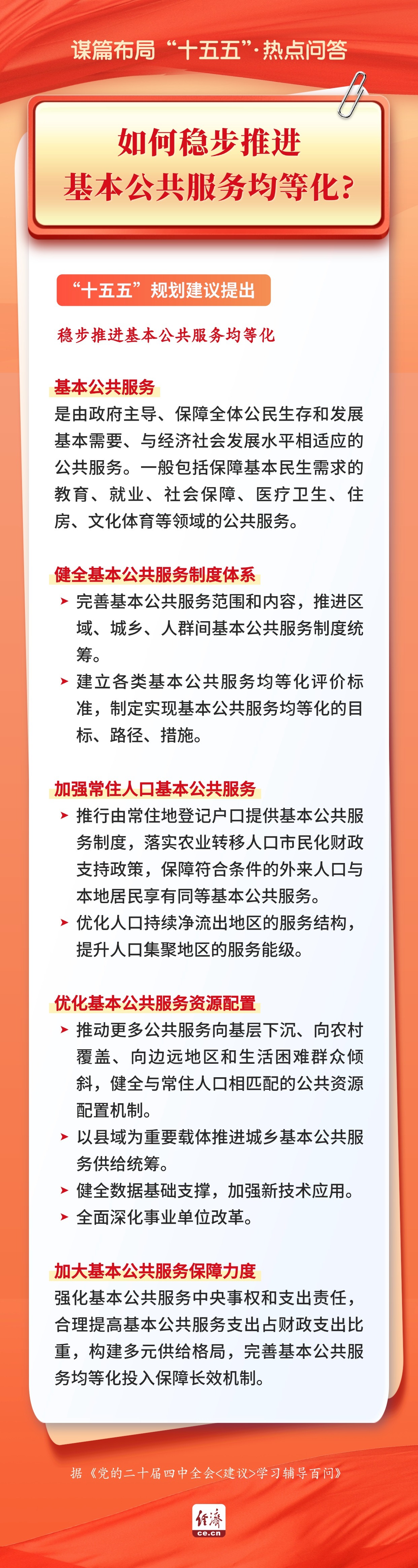
谋篇布局“十五五”·热点问答|如何稳步推进基本公共服务均等化?
Zhong Guo Jing Ji Wang· 2025-12-06 12:06
Group 1 - The core viewpoint of the article emphasizes the need to steadily promote the equalization of basic public services, which are essential for the survival and development of all citizens and should align with the level of economic and social development [2][6] - Basic public services include education, employment, social security, healthcare, housing, and cultural sports, all of which are government-led initiatives [2][6] - The article suggests optimizing the allocation of basic public service resources by enhancing coverage in rural areas, remote regions, and among disadvantaged populations [5][6] Group 2 - It is important to establish a comprehensive system for basic public services, including evaluation standards and clear goals for achieving equalization [6][8] - The article highlights the need for a matching public resource allocation mechanism that corresponds with the resident population [7] - There is a call to increase the financial support for basic public services, ensuring that the expenditure on these services constitutes a reasonable proportion of total fiscal spending [8][9]

加大保障和改善民生力度(学习贯彻党的二十届四中全会精神)
Ren Min Ri Bao· 2025-11-17 22:20
Core Points - The core message emphasizes the importance of improving and safeguarding people's livelihoods as a fundamental aspect of China's modernization efforts [1][4]. Group 1: Leadership and Development Philosophy - The leadership of the Communist Party of China is highlighted as a key characteristic of socialism with Chinese characteristics, emphasizing the need to respect public opinion and improve people's livelihoods [3]. - The development philosophy is centered around the people, with the goal of achieving a better life for the populace being the ultimate aim of modernization [3][4]. Group 2: Achievements in Livelihood Improvement - Significant progress has been made in enhancing the quality of life, with the establishment of the world's largest education, social security, healthcare, and urban housing systems [5]. - Employment has remained stable, with over 12 million new urban jobs created annually since the 14th Five-Year Plan, and the urban unemployment rate kept below expected targets [5]. - The per capita disposable income of residents increased from 35,100 yuan in 2021 to 41,300 yuan in 2024, with the urban-rural income ratio narrowing to 2.34:1 [5]. - The education system has seen improvements, with gross enrollment rates for preschool and high school education reaching 92% by 2024 [5]. - The social security system has expanded, with over 1 billion people covered by basic pension insurance and 1.327 billion by basic medical insurance by the end of 2024 [5]. - Housing security has improved, with over 11 million units of various types of affordable housing constructed during the 14th Five-Year Plan [5]. - Health services have improved, with the number of practicing (assistant) physicians and registered nurses per 1,000 people reaching 3.61 and 4.16, respectively, by 2024 [5][6]. Group 3: Key Tasks for Livelihood Improvement - The focus is on promoting high-quality and full employment as a fundamental aspect of people's livelihoods, with strategies to enhance employment support and public service systems [8]. - The income distribution system is to be improved to promote common prosperity, with mechanisms to ensure fair compensation based on contributions [9]. - Education is prioritized, with plans to enhance resource allocation and expand free education [10]. - The social security system is to be refined, ensuring comprehensive coverage and sustainability [11]. - Real estate development is to be guided towards high quality, addressing housing needs through various measures [12]. - Health initiatives are to be accelerated, focusing on equitable access to healthcare services [13]. - Population development strategies are to be implemented, addressing aging and promoting a supportive environment for families [14]. - Public service equalization is to be advanced, ensuring services reach rural and underserved areas [15].
「经济发展」刘世锦:扩消费稳增长稳预期与结构性改革
Sou Hu Cai Jing· 2025-11-06 02:46
Economic Development - The article discusses the stages of income growth for China, aiming to reach a per capita income of $14,000 to become a high-income country, $20,000 to enter the developed country category, and $35,000 to achieve a moderately developed status [4][5][6] - As of 2021, China's per capita GDP was approximately $12,500, close to the World Bank's high-income threshold, which is projected to be $14,005 in 2024 [4][6] - The article highlights the challenges faced by countries transitioning from middle-income to high-income status, noting that many have fallen into the "middle-income trap" due to factors like insufficient innovation, income inequality, and external shocks [5][6] Growth Trends - China's economic growth has shifted from high-speed to medium-speed, with expectations of maintaining a growth rate of 4-5% over the next 5-10 years [7][9] - The article compares China's current economic situation to Japan's past, emphasizing that while both faced similar challenges, Japan had already surpassed the high-income threshold and had a more developed social security system [9][10] Consumption and Demand - The article identifies insufficient consumer demand as a significant issue, with China's final consumption as a percentage of GDP being about 20% lower than the global average [10][11] - It discusses the structural bias in consumption, where survival-type consumption is stable, but development-type consumption, which includes services like education and healthcare, is lacking [11][12] - The article points out that the urbanization rate in China is currently at 67%, lower than that of developed economies, which hampers service consumption and public service accessibility [14][15] Income Disparity - The article notes that income inequality remains a challenge, with a significant portion of the population in low-income brackets, which limits overall consumption potential [16][17] - It highlights that the government sector holds a substantial share of national wealth, which affects the distribution of income and consumption patterns [17][20] Policy Recommendations - The article suggests that improving public services and addressing the needs of low-income groups, particularly migrant workers, is crucial for boosting consumption [29][30] - It advocates for structural reforms to enhance the flow of resources between urban and rural areas, aiming to increase the size of the middle-income group [34][35] - The article emphasizes the need for a shift from an investment-driven economy to one focused on innovation and consumption, which could provide sustainable growth [35][36]
中办 国办发布进一步保障和改善民生 着力解决群众急难愁盼的意见(全文)
Xin Hua She· 2025-06-09 09:05
Group 1: Social Security and Support for Low-Income Groups - The government aims to enhance the fairness of social security by expanding coverage, particularly for flexible workers, migrant workers, and new employment forms, while removing household registration restrictions for social insurance participation [1][2] - A dynamic monitoring and early warning system will be established to identify low-income individuals and families, ensuring timely inclusion in social assistance programs [2] - The minimum living guarantee standards will be adjusted in relation to urban and rural residents' average consumption expenditures to ensure basic living needs are met [2] Group 2: Public Services and Accessibility - The plan emphasizes improving the quality and efficiency of basic public services, with a focus on aligning service supply with population changes and optimizing resource allocation [3][4] - Basic public services will be provided based on the principle of residence, ensuring that migrant populations receive equal rights to services as local residents [4] - The government will promote the integration of digital technology in public services to enhance accessibility and efficiency [3] Group 3: Education and Healthcare Improvements - A five-year action plan will be implemented to enhance the quality of basic education, including the construction of over 1,000 high-quality high schools and the standardization of education facilities [6] - The healthcare system will be strengthened by promoting the sharing of high-quality medical resources and enhancing the capabilities of grassroots healthcare institutions [7] Group 4: Elderly and Child Services - The government will expand low-cost facilities and services for the elderly and children, ensuring quality and sustainable operations in these sectors [8] - A focus will be placed on developing community-based services that cater to the needs of the elderly and children, including support for family-based care [9] Group 5: Inclusive Development and Policy Implementation - Policies will be designed to prioritize children's welfare and support youth development, ensuring that public services are inclusive and accessible [10][11] - The government will enhance coordination among departments to effectively implement policies aimed at improving living standards and social equity [12]