外汇对冲工具

Search documents
美联储降息,中国有三重机遇,对老百姓的钱袋子有何影响?
Sou Hu Cai Jing· 2025-10-06 08:01
Core Viewpoint - The Federal Reserve's decision to lower the federal funds rate by 25 basis points to 4.00%-4.25% in September 2025 marks the first rate cut since December 2024, with expectations of two more cuts within the year, totaling a 75 basis point reduction, reshaping global capital flows and diminishing the influence of the dollar tide [1][4]. Group 1: Monetary Policy and Capital Flow - The high-interest era in the U.S. attracted global capital, creating a financial leverage model that maintained U.S. financial resilience but also led to significant market bubbles. The onset of the rate cut cycle is causing a decline in the attractiveness of dollar assets, prompting institutions to liquidate assets to avoid future yield shrinkage, thus redistributing global liquidity [4][6]. - The current complex global geopolitical environment is driving capital towards markets with higher safety margins, with China emerging as a key alternative due to its stable development environment and undervalued asset prices. The "Belt and Road" initiative is guiding foreign investment into the real economy, making it harder for short-term dollar flows to withdraw easily [6][19]. Group 2: Impact on Currency and Asset Pricing - The increase in dollar supply is weakening its exchange rate, with the RMB/USD exchange rate surpassing 7.1 in September 2025 and maintaining at 7.1195 on October 3. This appreciation reduces import costs and enhances the international pricing of domestic assets, with gold prices rising over 40% this year, reflecting a reassessment of dollar credit and increased attractiveness of RMB assets [9][12]. - Foreign capital is accelerating its investment in the Chinese market, despite short-term fluctuations in the bond market. The improvement in the interest rate differential between China and the U.S. is expected to attract more foreign investment in Chinese bonds [10][12]. Group 3: Market Dynamics and Challenges - The A-share and Hong Kong markets are showing upward trends, with a favorable financing environment for quality enterprises, particularly in coastal economic zones and "Belt and Road" regions, creating new wealth opportunities. However, the current monetary circulation shows a high multiplier effect, leading to cash flow challenges for businesses and individuals [12][14]. - Short-term speculative capital may disrupt local markets and inflate asset bubbles, while the real economy still faces financing disparities, particularly for small and medium-sized enterprises. The uncertainty surrounding the Fed's rate cut pace could complicate capital flows further [14][15]. Group 4: Strategic Opportunities and Recommendations - China's monetary policy needs to balance "stabilizing growth" and "preventing risks." The focus should remain on targeted monetary easing without large-scale loosening, with 10-year government bond yields expected to fluctuate between 1.70% and 1.90% [15][17]. - Key indicators to monitor include the Fed's rate cut schedule and domestic monetary policy actions, which will directly influence market expectations. Companies should optimize debt structures and reduce reliance on short-term borrowing, while individuals should manage leverage and prioritize emergency fund reserves [17][20].


美元、美股“双杀” 外国投资者急寻外汇对冲保护
智通财经网· 2025-04-28 06:49
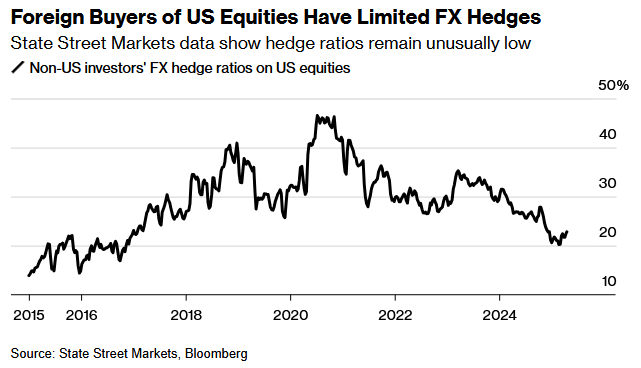
Core Viewpoint - The long-standing strategy of foreign investors buying US dollars and investing in the S&P 500 and Nasdaq indices has faced significant challenges due to the recent trade war initiated by the Trump administration, leading to substantial losses in both stock and currency investments [1] Group 1: Market Performance - The S&P 500 index has declined by 6% this year, while returns for investors using euros and yen have dropped by 14% [1] - The rapid deterioration of this trading strategy has caused anxiety among foreign investors who previously viewed the US as a safe haven for returns [1] Group 2: Currency Hedging - Many foreign investors are now eager to increase currency hedging in their US stock portfolios, with current foreign investment assets in the US stock market amounting to approximately $18 trillion, nearly one-fifth of the total market capitalization [1][5] - The overall currency hedging ratio for foreign investors in US stocks is currently at 23%, significantly lower than the nearly 50% level seen in 2020 [5] Group 3: Hedging Costs and Strategies - The cost of hedging for investors based on currencies like the Swiss franc or yen is approximately 4% annualized for three-month hedges, while for euro-based investors, it exceeds 2% [6] - The demand for options trading as a hedging method has surged, with the trading volume of euro-dollar options reaching new highs, although increased volatility has also raised hedging costs by about 15% this year [7] Group 4: Market Outlook - Despite the current challenges, some market participants remain cautious about predicting the dollar's future movements, citing unpredictability in exchange rate fluctuations [11] - Analysts suggest that even a small outflow of international investment from the US could lead to significant market impacts, given that international investors hold approximately $28 trillion in US assets [11]