大切诺基

Search documents
重大战略失误!全球第四大汽车集团闪崩
汽车商业评论· 2026-02-08 23:06
Core Viewpoint - Stellantis announced a significant impairment charge of approximately $26.5 billion, primarily due to misjudging the pace of the transition to electric vehicles and drastically lowering its electrification targets, leading to a sharp decline in stock prices [4][5][18]. Group 1: Impairment and Financial Impact - The impairment charge is unprecedented in the automotive industry, surpassing the company's current market value, with stock prices plummeting by 30% at one point [4][5]. - Analysts noted that while the market anticipated some impairment, the scale and cash expenditure ratio were critical negative factors affecting the company's performance [4]. - Stellantis's revenue heavily relies on high-margin Jeep and Ram trucks, which are particularly vulnerable in the weak U.S. electric vehicle market [5]. Group 2: Industry Context and Challenges - The automotive industry is facing a crisis, with traditional Western automakers struggling to balance investments between electric and combustion engine vehicles while contending with rising competition from Chinese manufacturers and increasing international trade barriers [5]. - In 2025, electric vehicle sales in Europe are projected to account for 19.5% of total sales, a nearly 30% year-over-year increase, but still below market expectations; in the U.S., the share is only 7.7% [5]. Group 3: Strategic Adjustments and Leadership Changes - Under the leadership of new CEO Antonio Filosa, Stellantis is adjusting its strategy to focus on consumer demand rather than aggressive electrification targets, which were deemed overly optimistic by the previous CEO Carlos Tavares [7][16]. - The company plans to invest in both electric and combustion engine options, reflecting a shift towards a "power choice" strategy that allows consumers to select their preferred powertrain [16]. Group 4: Product Quality and Market Response - Stellantis is addressing product quality issues, with a reported decline in early-month defect complaints by over 50% in North America and over 30% in Europe [12]. - The company is introducing new and updated models, including the Jeep Cherokee and Dodge Challenger, to enhance product appeal and drive sales [12]. Group 5: Future Projections and Financial Outlook - Stellantis expects its revenue for the second half of 2025 to reach between $92.2 billion and $94.6 billion, but anticipates a net loss of $22.4 billion to $24.8 billion during the same period [17]. - The company has decided to suspend its dividend for 2026 and plans to issue up to $5.9 billion in corporate bonds to manage its financial situation [17].


知名车企,破产
Zhong Guo Ji Jin Bao· 2025-07-08 13:52
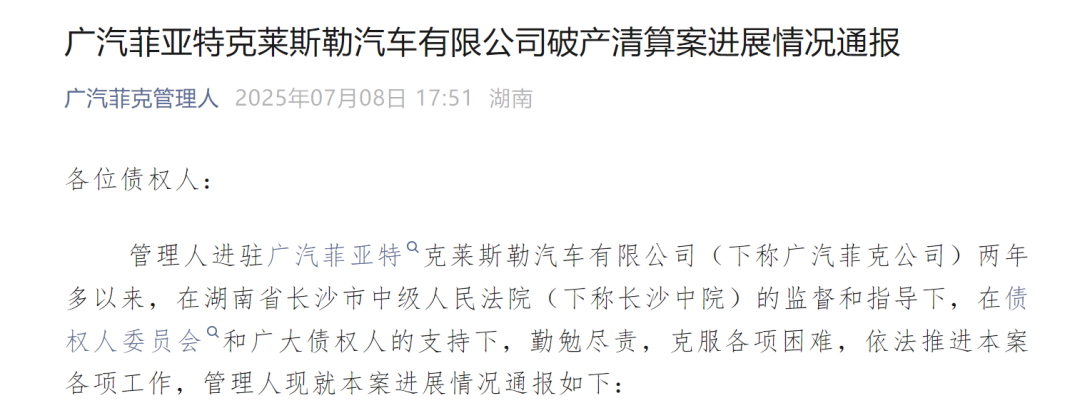
Core Points - GAC Fiat Chrysler (广汽菲克) has declared bankruptcy due to its inability to repay debts and insufficient assets to cover liabilities [1][4] - The company had been approved to file for bankruptcy as early as October 2022, with its Guangzhou factory taken over by GAC Aion for electric vehicle production [4] - The Changsha factory has undergone five failed auction attempts, with the starting price dropping from 19.15 billion yuan to approximately 9.92 billion yuan, nearly a 50% reduction [4] Company Background - GAC Fiat Chrysler, established in 2010, was known for brands like Fiat, Chrysler, and Jeep, and was renamed in 2015 after Fiat acquired Chrysler [8] - Jeep was introduced to the Chinese market in 2007, gaining popularity with models like the Grand Cherokee and Commander, leading to a peak sales year in 2017 with over 200,000 units sold [9] - However, Jeep's sales declined significantly from 2018 onwards, with annual sales dropping from 125,000 units in 2018 to just 2,040 units in 2021, resulting in a net asset of only 200,000 yuan by that year [9]
车圈南橘北枳记
汽车商业评论· 2025-06-10 02:50
Core Viewpoint - The Chinese automotive market is undergoing a significant structural adjustment, with domestic brands increasing their market share at the expense of foreign brands, which now hold less than 35% of the market [4]. Group 1: Domestic Brand Growth - In 2024, domestic passenger car sales are projected to reach 17.97 million units, accounting for 65.2% of total passenger car sales, an increase of 9.2 percentage points year-on-year [4]. - In April 2025, domestic brands achieved retail sales of 1.15 million units, a year-on-year increase of 31%, with a market share of 65.5%, up 8 percentage points [4]. - From January to April 2025, domestic brands held a retail market share of 64%, an increase of 7.9 percentage points compared to the previous year, particularly gaining in the new energy and export markets [4]. Group 2: Challenges Faced by Foreign Brands - Kia is struggling in the Chinese market due to a lack of clarity in positioning and slow progress in electrification, with only 21.5% of global sales being electric models in 2024 [6]. - Skoda's sales in China fell by 23.1% year-on-year to 17,500 units in 2024, as it is squeezed by both the Volkswagen brand's price cuts and the competitive offerings from domestic brands [9][10]. - Jeep's focus on SUVs has led to a disconnect with Chinese consumer preferences, resulting in a decline in brand presence and market share [11]. Group 3: Global Performance of Foreign Brands - Despite challenges in China, Kia remains strong in its home market and is expanding in North America and Europe, achieving over 3 million global sales in 2024 [20]. - Skoda's global sales reached 926,600 units in 2024, with strong performance in Europe, particularly in Germany, the Czech Republic, and the UK [21]. - Jeep's brand recognition and performance in North America remain robust, with 90% of its global sales coming from this market, totaling 587,800 units in 2024 [23]. Group 4: Lessons Learned - The struggles of foreign brands in China highlight the importance of understanding local consumer preferences and adapting product strategies accordingly [28]. - Successful global strategies require a deep understanding of localization, which encompasses product definition, technology routes, brand communication, and supply chain management [29]. - Brands must recognize their positioning and strengths, focusing on markets that align with their core competencies rather than pursuing broad-scale expansion [29].