
天池512超节点

Search documents
百度分拆昆仑芯IPO上市:参股昆仑芯的A股上市公司或受益(附表格)
Xin Lang Cai Jing· 2026-01-04 09:54
Core Viewpoint - Baidu's subsidiary Kunlun Chip has submitted an application for an independent IPO on the Hong Kong Stock Exchange, leading to significant stock price increases for Baidu [1][2][17]. Group 1: IPO Announcement and Market Reaction - On January 2, 2026, Baidu announced the plan to spin off Kunlun Chip, resulting in a 9.35% increase in Baidu's Hong Kong stock price and a 15.03% increase in its NASDAQ stock price, both reaching two-year highs [1][2][17]. - The IPO process for Kunlun Chip is seen as a strategic move to enhance its market valuation and attract investors focused on AI computing chips and related systems [4][16]. Group 2: Business and Financial Background - Kunlun Chip, a leading AI computing chip supplier, was established from Baidu's smart chip division, with its self-developed chip projects dating back to 2011 [4][16]. - The company completed its first round of financing in April 2021, achieving a valuation of approximately 13 billion yuan (about 1.9 billion USD) [4][16]. - By 2025, Kunlun Chip had completed multiple financing rounds, attracting investments from major firms like BYD and CITIC Capital [4][16]. Group 3: Product Development and Market Position - Kunlun Chip has secured significant contracts, including a 1 billion yuan deal with China Mobile for AI computing devices, achieving a leading market share in several procurement categories [5][18]. - The company plans to launch new products annually over the next five years, with the Kunlun M100 and M300 chips set for release in 2026 and 2027, respectively [5][18]. - IDC reported that Kunlun Chip's shipment volume reached 69,000 units, significantly surpassing competitors like Cambricon [6][18]. Group 4: Industry Context and Competitive Landscape - The IPO of Kunlun Chip is part of a broader trend of domestic semiconductor companies entering the capital market, with several other firms like Moore Threads and Muxi also recently listed [20][21]. - The Chinese AI chip market is undergoing a significant transformation, moving towards a model of "multiple strong coexistence and scene segmentation," with Kunlun Chip positioned as a foundational player in AI computing [21][22]. Group 5: Valuation and Investment Implications - Goldman Sachs estimates that if Kunlun Chip achieves a valuation similar to Cambricon's (40x sales), Baidu's 59% stake could be valued at 22 billion USD, representing 45% of Baidu's current market capitalization [9][22]. - Companies holding stakes in Kunlun Chip, such as Chuling Information and Zhongxin Group, are expected to benefit from this IPO, with potential upward price elasticity in their stocks [10][23].

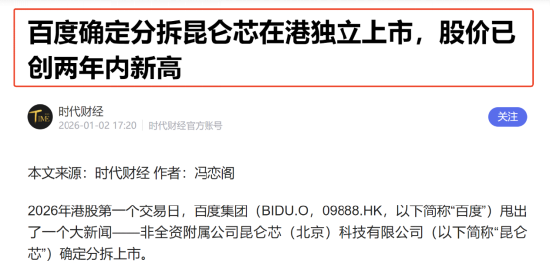
市场估值或达1000亿港元,已提交上市申请!
Sou Hu Cai Jing· 2026-01-03 15:39
Core Viewpoint - Baidu's subsidiary Kunlun Chip has submitted a listing application to the Hong Kong Stock Exchange, aiming for a separate public listing while remaining a Baidu subsidiary. The details regarding the split, global offering scale, and Baidu's share reduction in Kunlun Chip are yet to be finalized [2][4]. Group 1: Listing and Corporate Structure - Kunlun Chip submitted its listing application on January 1, with the aim to enhance operational and financial transparency [2][4]. - Baidu currently holds a 59.45% stake in Kunlun Chip, making it the largest shareholder [4]. - The company underwent a name change and increased its registered capital from approximately 21.28 million RMB to 400 million RMB [4]. Group 2: Business Performance and Market Position - Kunlun Chip was initially a project within Baidu, established in 2012, and achieved independent financing in April 2021 with an initial valuation of around 13 billion RMB [4]. - The latest financing round is expected to be completed by July 2025, with investors including BYD and CITIC Capital [4]. - In November 2025, Kunlun Chip's revenue surpassed 1 billion RMB, exceeding competitors like Moore Threads and Cambricon [6]. Group 3: Product Development and Future Plans - Baidu announced the launch of new Kunlun Chip products, including the M100 and M300, designed for large-scale inference and multimodal model training, set to be released in 2026 and 2027 respectively [5]. - A five-year roadmap was revealed, with plans for the Tianchi super nodes and Kunlun N series products to be launched between 2028 and 2030 [5].

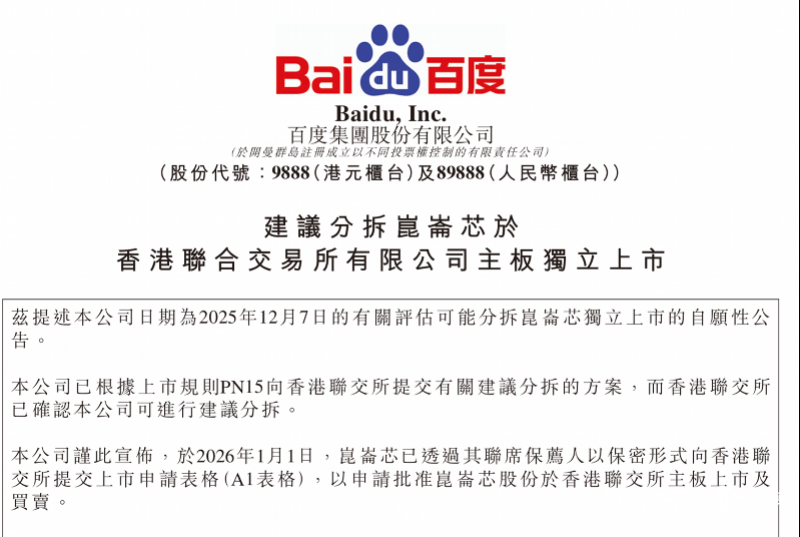
百度旗下昆仑芯已秘密赴港IPO
Nan Fang Du Shi Bao· 2026-01-02 23:14
Core Viewpoint - Baidu's Kunlun Chip is moving towards independent listing, having submitted a confidential application to the Hong Kong Stock Exchange, aiming for a main board listing by January 1, 2026 [2][3]. Group 1: Company Structure and Strategy - Kunlun Chip, an AI chip company, was previously part of Baidu's Intelligent Chip and Architecture Department and became an independent entity in April 2021, led by CEO Ouyang Jian [3]. - Following the planned spin-off, Kunlun Chip will remain a subsidiary of Baidu, allowing for better reflection of its value and enhancing operational and financial transparency [3]. - The spin-off is expected to improve Kunlun Chip's image among customers, suppliers, and potential strategic partners, benefiting Baidu through its shareholding in Kunlun Chip [3]. Group 2: Financial Performance and Projections - Kunlun Chip has reportedly completed a new financing round exceeding 2 billion yuan, achieving a valuation of 21 billion yuan [4]. - Revenue for Kunlun Chip is projected to exceed 3.5 billion yuan in 2025, with expectations of reaching breakeven [4]. Group 3: Product Development and Market Position - Kunlun Chip plans to launch the M100 chip in early 2026, optimized for large-scale inference scenarios, followed by the M300 chip in early 2027 for ultra-large-scale multimodal model training and inference [4]. - In 2026, Baidu will introduce the "Tianchi 256 Super Node" and "Tianchi 512 Super Node," utilizing the Kunlun P800 chip, supporting up to 256 and 512 interconnected cards, respectively [5]. - Starting in the second half of 2027, Kunlun Chip will release super nodes supporting 1,000 and 4,000 cards, with a focus on domestic production of core components [5].

百度分拆昆仑芯独立上市,股价创两年内新高
凤凰网财经· 2026-01-02 13:42
Core Viewpoint - Baidu announced the spin-off of its non-wholly owned subsidiary Kunlun Chip (Kunlun) for an IPO on the Hong Kong Stock Exchange, aiming to enhance its valuation and attract specialized investors in AI computing chips and related systems [3][4][7]. Group 1: Spin-off Details - Kunlun submitted its listing application to the Hong Kong Stock Exchange on January 1, 2026, with the proposal confirmed by the exchange [3][4]. - The global offering will include a public offering in Hong Kong and allocations to institutional and professional investors [5]. - Post-spin-off, Kunlun is expected to remain a subsidiary of Baidu, although details regarding the shareholding reduction and offering scale are yet to be finalized [6]. Group 2: Reasons for Spin-off - The spin-off will allow for a more accurate reflection of Kunlun's value based on its strengths, enabling independent assessment by investors [7]. - The business nature of Kunlun is expected to attract investors focused on AI computing chips and related hardware and software systems [7]. - The company believes that Kunlun's scale justifies its pursuit of a public listing, which could enhance its reputation among clients and partners, leading to business growth [7]. Group 3: Kunlun's Background and Performance - Kunlun, a supplier of AI computing chips and integrated systems, has its roots in Baidu's smart chip and architecture department, with self-developed chip projects dating back to 2011 [8]. - In 2021, Kunlun completed independent financing, achieving a valuation of approximately 13 billion yuan, and has since attracted significant investment from various firms [9]. - Kunlun secured a major contract in August 2022, ranking first in market share for AI server products in a procurement project by China Mobile [9]. Group 4: Future Product Launches - The next-generation Kunlun products, including Kunlun M100 and M300 chips, are set to launch in 2026 and 2027, respectively, targeting large-scale inference and high-performance training needs [13][14]. - Baidu's executive vice president emphasized a long-term investment strategy in infrastructure, with annual product launches planned for the next five years [15]. Group 5: Market Position and Stock Performance - IDC reported that Kunlun's shipment volume reached 69,000 units, significantly outperforming competitors [16]. - Analysts have noted that Kunlun has achieved or surpassed many leading companies in various aspects, particularly in CUDA compatibility [17]. - Following the announcement of the spin-off, Baidu's stock price rose to a two-year high, closing at 143.8 HKD per share, an increase of 9.35% [19].

百度计划分拆昆仑芯在港股上市,市场估值或达1000亿港元
Sou Hu Cai Jing· 2026-01-02 07:09
Core Viewpoint - Baidu's subsidiary Kunlun Core has submitted a listing application to the Hong Kong Stock Exchange, aiming for a separate public listing while remaining a subsidiary of Baidu [1][4]. Group 1: Listing Details - Kunlun Core submitted its listing application on January 1, 2025, through its joint sponsors in a confidential manner [1]. - The specifics regarding the spin-off, global offering scale and structure, and Baidu's reduction in shareholding in Kunlun Core have not yet been finalized [1]. - Baidu currently holds a 59.45% stake in Kunlun Core, making it the largest shareholder [4]. Group 2: Business and Financial Insights - The spin-off is intended to better reflect Kunlun Core's value based on its strengths and enhance operational and financial transparency [4]. - Kunlun Core, which originated from an internal chip project at Baidu in 2012, completed independent financing in April 2021 with an initial valuation of approximately 13 billion yuan [4]. - The latest financing round is expected to be completed by July 2025, with investors including BYD and CITIC Capital [4]. - As of November 2025, Kunlun Core's revenue is reported to have exceeded 1 billion yuan, surpassing competitors like Moore Threads and Cambricon [5]. Group 3: Product Development - Baidu announced the launch of the next-generation Kunlun Core products at the Baidu World Conference in November 2025, with the Kunlun Core M100 and M300 set to be released in 2026 and 2027, respectively [5]. - The products are designed to provide cost-effective AI computing power for Chinese enterprises [5]. - A five-year roadmap for Kunlun Core's future products has been established, with significant milestones planned through 2030 [5].
百度官宣:昆仑芯已赴港IPO
Feng Huang Wang· 2026-01-02 06:09
Core Viewpoint - Baidu's Kunlun Chip has submitted a listing application to the Hong Kong Stock Exchange, aiming for a public offering while remaining a subsidiary of Baidu after the spin-off [1] Group 1: Company Developments - Kunlun Chip, previously Baidu's intelligent chip and architecture department, completed its first round of independent financing in April 2021, with an initial valuation of approximately 13 billion RMB [1] - As of December 16, 2025, Kunlun Chip transitioned to a joint-stock company, increasing its registered capital from about 21.28 million RMB to 400 million RMB, a growth of approximately 1780% [1] - The new generation of Kunlun Chips, M100 and M300, was announced at the Baidu World Conference, with M100 designed for large-scale inference scenarios set to launch in 2026, and M300 for ultra-large multimodal model training and inference tasks expected in 2027 [1] Group 2: Market Position and Financial Insights - Goldman Sachs estimates the value of Baidu's 59% stake in Kunlun Chip to be between 3 billion to 11 billion USD, while Macquarie Securities values it at approximately 16.5 billion USD, accounting for 30% of Baidu's target valuation [2] - Morgan Stanley predicts that revenue from Baidu's self-developed AI chips will surge from 1.3 billion RMB in 2025 to 8.3 billion RMB in 2026, a sixfold increase, which will double Baidu's GPU computing revenue in 2026 [2] Group 3: Industry Trends - There is a wave of IPOs in the AI chip sector, with domestic GPU companies like Muxi and Moer Thread listing on the Sci-Tech Innovation Board in December 2025, experiencing significant stock price increases on their debut [3] - Wall Street analysts suggest that the current market environment is favorable for AI narratives, positioning Kunlun Chip to capitalize on this trend and move beyond the perception of being solely for internal use by large companies [4] Group 4: Competitive Landscape - According to IDC's 2024 report, Nvidia holds a 70% market share in accelerated computing chip shipments, with over 1.9 million units shipped. Among domestic AI chip manufacturers, Huawei's Ascend leads with 640,000 units, followed by Kunlun Chip with 69,000 units [5]
百度官宣:昆仑芯已赴港IPO
财联社· 2026-01-02 05:43
Core Viewpoint - Baidu's Kunlun Chip has submitted a listing application to the Hong Kong Stock Exchange, aiming for a public offering while remaining a subsidiary of Baidu after the spin-off [4]. Group 1: Company Developments - Kunlun Chip, previously part of Baidu's intelligent chip and architecture department, completed independent financing in April 2021 with an initial valuation of approximately 13 billion RMB [4]. - As of December 16, 2025, Kunlun Chip transformed into a joint-stock company, increasing its registered capital from about 2.128 million RMB to 400 million RMB, a growth of approximately 1780% [5]. - The new generation of Kunlun Chips, M100 and M300, is set to be launched in 2026 and 2027, respectively, targeting large-scale inference and multimodal model training tasks [5]. Group 2: Market Position and Valuation - Goldman Sachs estimates the value of Baidu's 59% stake in Kunlun Chip to be between 3 billion to 11 billion USD, while Macquarie Securities values it at approximately 16.5 billion USD, accounting for 30% of Baidu's target valuation [6]. - Morgan Stanley predicts that revenue from Baidu's self-developed AI chips will surge from 1.3 billion RMB in 2025 to 8.3 billion RMB in 2026, a sixfold increase, which will also double Baidu's GPU computing revenue in 2026 [6]. Group 3: Industry Trends - There is a wave of IPOs in the AI chip sector, with domestic GPU companies like Muxi and Moole Technology recently listing on the STAR Market, experiencing significant stock price increases on their debut [7]. - Wall Street analysts suggest that the current period is an optimal time for AI narratives, positioning Kunlun Chip favorably to capitalize on market trends and shed the perception of being solely for internal use by large companies [9]. - According to IDC's 2024 report, Nvidia holds a 70% market share in accelerated computing chip shipments, with Kunlun Chip ranking among the top domestic AI chip manufacturers, having shipped 69,000 units [10].

刚刚!百度官宣:昆仑芯赴港IPO
Sou Hu Cai Jing· 2026-01-02 03:24
Group 1 - Baidu announced that Kunlun Chip has submitted a listing application to the Hong Kong Stock Exchange for approval to list and trade its shares on the main board [3] - The proposed spin-off will involve a global offering of Kunlun Chip shares, including a public offering in Hong Kong and a placement to institutional and professional investors [3] - As of the announcement date, Kunlun Chip is a non-wholly owned subsidiary of Baidu, and it is expected to remain a subsidiary after the spin-off [3] Group 2 - Kunlun Chip, formerly Baidu's Intelligent Chip and Architecture Department, completed its first round of independent financing in April 2021, with an initial valuation of approximately 13 billion [5] - As of July 2025, Kunlun Chip has undergone a D round of financing, with investors including various capital firms and funds [5] - Baidu holds a 59.45% stake in Kunlun Chip, while other partners hold smaller percentages [5] Group 3 - The new generation of Kunlun Chips, M100 and M300, was announced at the Baidu World Conference, with M100 designed for large-scale inference and expected to launch in 2026, while M300 targets ultra-large multimodal model training and inference tasks, expected in 2027 [5] - Baidu has already deployed a cluster of 30,000 Kunlun Chips, capable of supporting multiple trillion-parameter model trainings, with plans to expand to a million-chip scale [5] Group 4 - Morgan Stanley predicts that Kunlun Chip's revenue could reach 8.3 billion by 2026, representing a sixfold increase compared to the expected revenue in 2025 [6] - The AI chip industry is currently experiencing a wave of IPOs, indicating a growing interest and investment in this sector [7] Group 5 - Suiyuan Technology, one of the domestic GPU companies, has appointed CICC as its advisory institution for its listing process, indicating a strategic move based on market conditions [10] - Suiyuan Technology focuses on AI cloud computing products and has a registered capital of 387 million [10] - Hanbo Semiconductor, established in December 2018, specializes in high-end GPU chips and has a strong R&D team with over 500 members, many of whom have extensive experience from leading companies like AMD and NVIDIA [13]
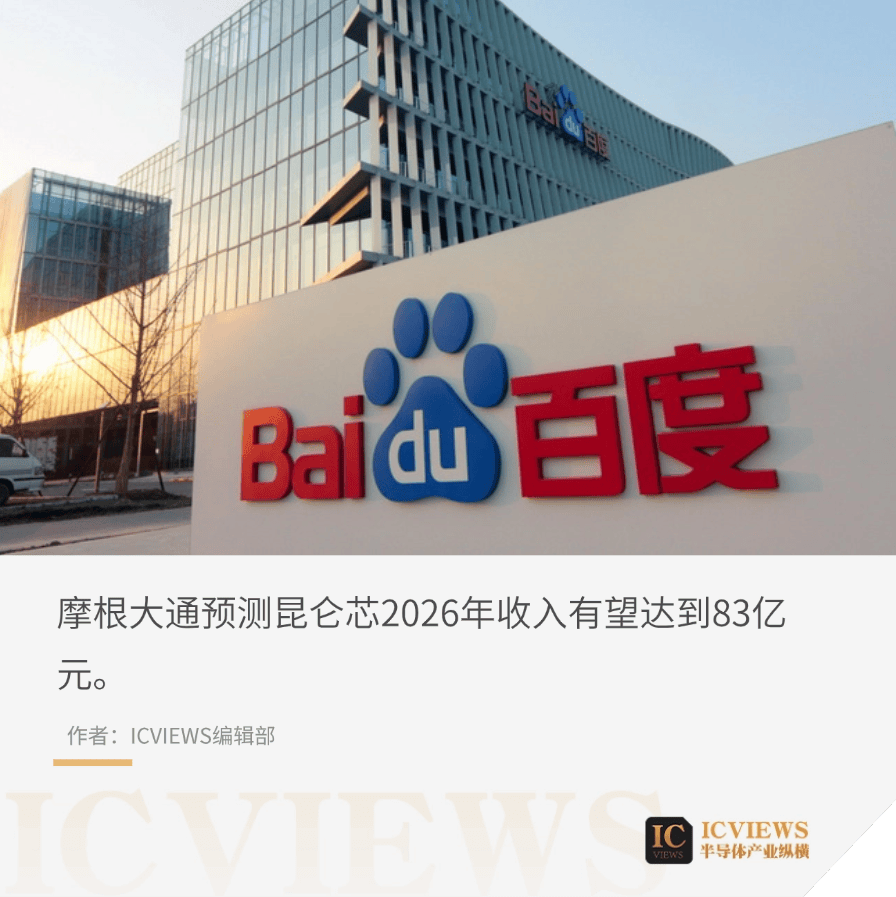
百度旗下昆仑芯已向港交所秘密提交IPO申请
Sou Hu Cai Jing· 2026-01-02 02:08
Group 1 - Baidu's Kunlun Chip has submitted a listing application to the Hong Kong Stock Exchange, aiming for an independent IPO by January 1, 2026 [1] - Kunlun Chip, an AI chip company, was previously part of Baidu's Intelligent Chip and Architecture Department and became an independent entity in April 2021 [1] - The spin-off is expected to enhance Kunlun Chip's operational and financial transparency, allowing investors to independently assess its performance and potential [1] Group 2 - Reports of Kunlun Chip's IPO plans surfaced in December 2025, with a target to complete the IPO by early 2027, and a recent funding round raised over 2 billion yuan, valuing the company at 21 billion yuan [2] - Kunlun Chip is projected to achieve over 3.5 billion yuan in revenue by 2025 and reach breakeven [2] - Baidu plans to launch the M100 chip in early 2026 and the M300 chip in early 2027, targeting large-scale inference and multimodal model training needs [2] Group 3 - Baidu is set to release the "Tianchi 256 Super Node" and "Tianchi 512 Super Node" in the first and second halves of 2026, respectively, featuring the Kunlun Chip P800 [4] - The super node products will support up to 256 and 512 interconnected cards, with plans for thousand-card and four-thousand-card nodes starting in the second half of 2027 [4] - The decision to disclose the AI chip roadmap is influenced by competitive pressures and the upcoming IPO of Kunlun Chip [4]
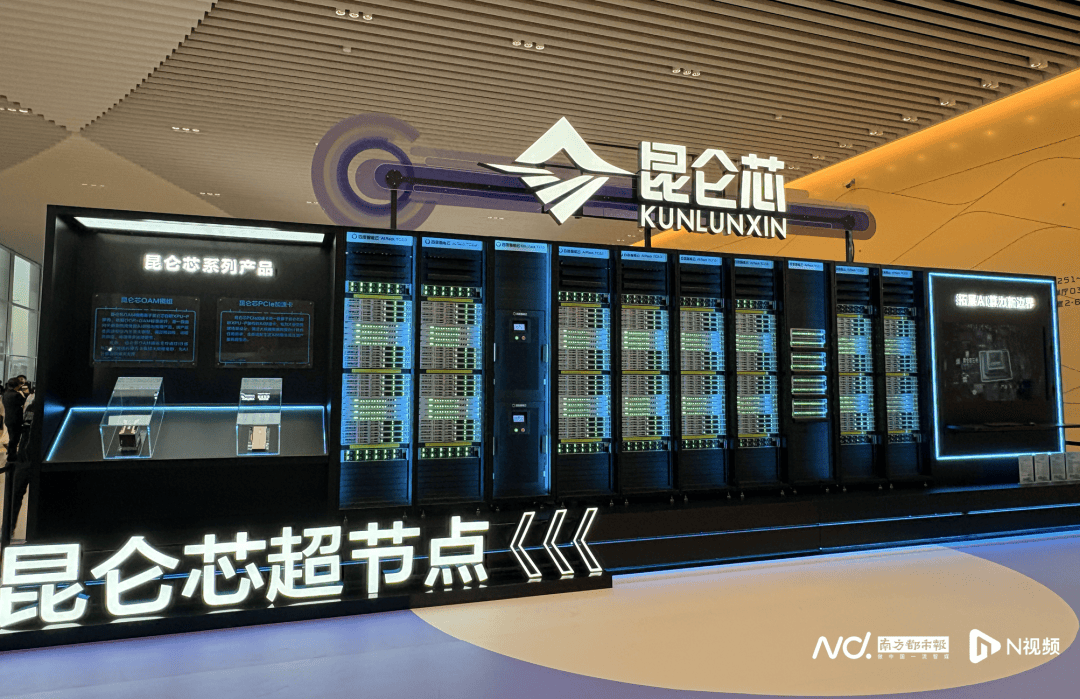
又一AI芯片企业启动IPO?
3 6 Ke· 2025-12-17 02:18
Core Viewpoint - Kunlun Core is reportedly nearing the completion of its share reform, accelerating its efforts towards an IPO [2] Group 1: Company Developments - Kunlun Core, originally part of Baidu's intelligent chip and architecture division, completed its independent financing in April 2021 with an initial valuation of approximately 13 billion [2] - As of July 2025, Kunlun Core is expected to have undergone its D-round financing, with investors including Shanghe Momentum Capital, Shanzheng Investment, and others [2] - Baidu holds a controlling stake in Kunlun Core at 59.45%, while Beijing Kunlun Legend Technology Partnership and Tianjin Jiuzhang Kunlun Enterprise Management Partnership hold approximately 4.61% and 3.57%, respectively [2] Group 2: Product Launches - At the Baidu World Conference in November, the next-generation Kunlun chips M100 and M300 were announced, with M100 designed for large-scale inference scenarios set to launch in 2026, and M300 aimed at ultra-large multimodal model training and inference tasks expected in 2027 [2] - The Tianchi 256 and Tianchi 512 super nodes will officially launch next year, with the Tianchi 512 capable of training trillion-parameter models [3] - Kunlun Core has completed deployments of tens of thousands of chips, with Baidu lighting up a 30,000-chip cluster this year to support multiple hundred-billion-parameter model trainings [3] Group 3: Market Context - The AI chip sector is currently experiencing a wave of IPOs, with companies like Moole Thread already listed and raising nearly 8 billion, achieving a peak stock price increase of 723.5% [4] - Other AI chip companies, such as Muxi and Suyuan Technology, are also preparing for their listings, indicating a favorable market environment for Kunlun Core to pursue its IPO [4] - According to IDC's 2024 report, Kunlun Core ranks among the top domestic chip manufacturers, with a shipment volume of 69,000 units, following Huawei's Ascend at 640,000 units [4]