
完全成本保险

Search documents
发展农业保险筑牢风险屏障
Jing Ji Ri Bao· 2026-02-11 21:58
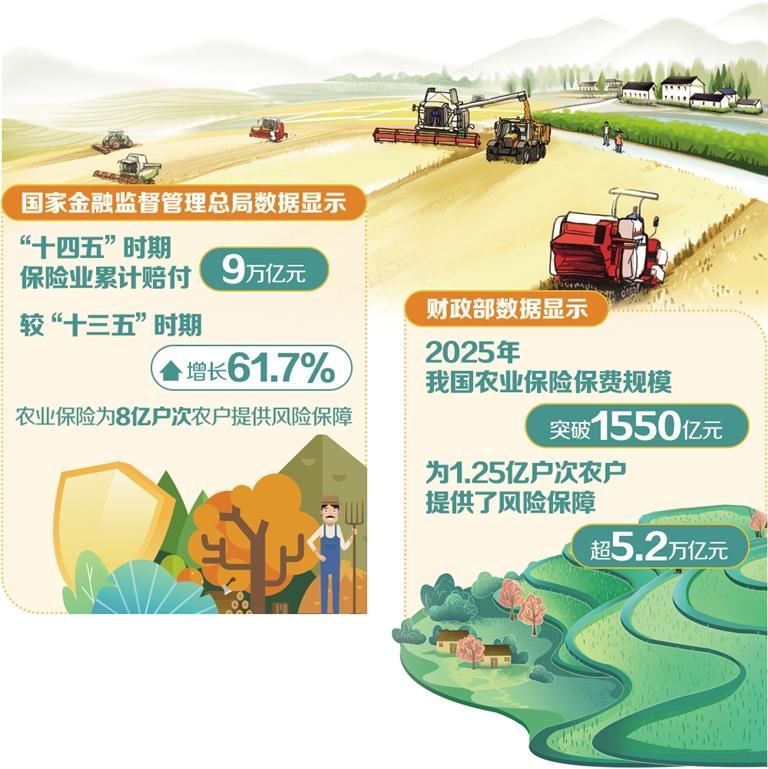
Core Viewpoint - Agricultural insurance is a crucial mechanism for modern agricultural risk management, significantly stabilizing agricultural production and ensuring farmers' income, with a projected premium scale exceeding 155 billion yuan by 2025, providing risk coverage for over 520 billion yuan for 125 million farming households [1] Group 1: Importance of Agricultural Insurance - Agricultural insurance serves as a risk management tool for agricultural producers and rural residents, providing economic compensation for various risks during agricultural production [2] - It effectively mitigates systemic risks in agriculture, such as extreme weather and market fluctuations, thereby stabilizing farmers' planting intentions and enhancing agricultural resilience [2] Group 2: Financial Mechanism and Policy Support - Agricultural insurance addresses the limitations of traditional direct subsidy models by leveraging government premium subsidies, which can significantly increase risk coverage with minimal fiscal input [3] - The government’s support through premium subsidies, such as a 30% subsidy, amplifies the total premium and enhances the effectiveness of financial resources in agricultural risk management [3] Group 3: Development History of Agricultural Insurance - The development of agricultural insurance in China has evolved through several phases, starting from pilot programs in the early 1980s to the establishment of a policy-based agricultural insurance system post-2004 [4][5] - By 2018, agricultural insurance premiums increased from 5.18 billion yuan to 57.27 billion yuan, with the number of insured households rising from 49.81 million to 195 million [7] Group 4: Recent Developments and Innovations - In 2020, China’s agricultural insurance premium income ranked first globally, with policies for major crops being implemented nationwide, enhancing the insurance coverage level [8] - The establishment of the China Agricultural Reinsurance Company in 2020 aimed to disperse agricultural disaster risks and manage a national agricultural insurance disaster risk fund [8] Group 5: Challenges Facing Agricultural Insurance - The agricultural insurance sector faces structural challenges, including increased risks from extreme weather and the need for products that cater to new agricultural business models like family farms and cooperatives [12][14] - The lack of effective risk-sharing mechanisms during major disasters poses a threat to the operational stability of insurance companies [15] Group 6: Future Directions for Agricultural Insurance - To enhance the quality of agricultural insurance, there is a need to optimize policy design, improve service capabilities, and develop a comprehensive insurance system [16] - The focus should be on expanding the product range, enhancing coverage for local specialty products, and transitioning from cost coverage to income and profit protection [16][17] - Building a multi-layered disaster risk dispersion mechanism and improving infrastructure for agricultural insurance services are essential for future growth [18][19]
农险扩面提质结硕果
Jing Ji Ri Bao· 2026-01-25 22:17
Core Insights - The central economic and rural work meetings in 2025 have systematically deployed strategies for "three rural issues," emphasizing the importance of agricultural insurance in supporting rural revitalization and food security [2] - Agricultural insurance premiums in China have steadily increased, with a total payout of 9 trillion yuan during the 14th Five-Year Plan, marking a 61.7% increase compared to the previous plan [2] - The agricultural insurance sector is evolving from cost coverage to income protection, addressing significant disaster risks associated with agricultural production [4] Agricultural Insurance Development - The planting areas of rice, wheat, and corn account for over 80% of China's total grain area, with these crops being the main focus of agricultural insurance policies [3] - The development of agricultural insurance has progressed in stages every 5 to 6 years, with the introduction of basic insurance in 2007 and the expansion of comprehensive cost and income insurance starting in 2018 [3] - In 2023, agricultural insurance payouts exceeded 2.6 billion yuan due to adverse weather conditions affecting wheat crops, demonstrating the critical role of insurance in mitigating farmers' losses [3] Expansion of Coverage - The scope of comprehensive cost and income insurance is expanding, with new policies for sugarcane and soybeans set to cover more regions by 2026 [4] - The establishment of a disaster model for major crops aims to assess risks from various natural disasters, enhancing the insurance framework [4] Specialized Agricultural Products - Agricultural insurance in China is categorized into central government-subsidized products and local specialty products, with a focus on expanding coverage and improving product offerings [5] - Insurance products tailored for geographical indication agricultural products have been developed, providing significant risk coverage for specific crops [5] Technological Integration - The insurance sector is increasingly adopting digital transformation to enhance efficiency in underwriting and claims processing, with a focus on a comprehensive risk management service model [7] - The use of advanced technologies such as drones and AI is being encouraged to improve the accuracy and timeliness of insurance services [10] Future Outlook - By 2025, agricultural insurance premiums are projected to exceed 155 billion yuan, providing risk coverage for over 1.25 billion farmers [11] - The Ministry of Finance plans to continue enhancing the quality and efficiency of agricultural insurance, with a guiding document expected in 2026 to support high-quality development [11]

“三农”新使命 保险新作为 从中央农村工作会议看保险业服务“三农”新要求
Jin Rong Shi Bao· 2026-01-14 02:05
Core Insights - The central theme of the news is the strategic deployment of agricultural policies and insurance to enhance food security and support rural development in China, particularly in the context of the 14th Five-Year Plan and the upcoming 15th Five-Year Plan [1][2]. Group 1: Agricultural Policy and Strategic Focus - The Central Rural Work Conference has outlined key tasks for 2026, including enhancing grain production capacity, improving disaster prevention capabilities, and establishing mechanisms to prevent poverty [1]. - The insurance industry is expected to play a crucial role in supporting these agricultural initiatives, reflecting a significant shift in its responsibilities [1]. Group 2: Role of Agricultural Insurance - Agricultural insurance has become an essential part of China's modern agricultural risk management system, providing risk coverage to 800 million households during the 14th Five-Year Plan [2]. - The implementation of comprehensive cost insurance for major grains has achieved nationwide coverage, significantly increasing the average insurance amount per acre [2]. Group 3: Technological Integration in Agricultural Insurance - The integration of technology, such as AI, big data, and blockchain, is transforming agricultural insurance services and risk management, enhancing efficiency and transparency [4][5]. - Innovative products like weather index insurance and high-standard farmland quality insurance are being developed to address various agricultural risks [3][4]. Group 4: Challenges and Recommendations for Agricultural Insurance - Despite progress, agricultural insurance faces challenges such as imprecise premium rates and a lack of standardized regulations, which hinder its effectiveness [7][8]. - Recommendations include establishing a robust service network for agricultural insurance and developing unified technical standards for underwriting and claims processes [8].
首单制种保险赔付落地 农业保险向精准化转型发展
Jin Rong Shi Bao· 2025-12-17 04:41
Core Insights - The article highlights the completion of China's first crop (rice) seed insurance payout by Taiping Property Insurance, amounting to approximately 757,900 yuan, reflecting the shift in agricultural insurance from traditional cost and yield protection to quality and key process protection [1] - The development of agricultural insurance is increasingly vital for ensuring national food security, promoting modern agricultural development, and supporting rural revitalization [2] Group 1: Agricultural Insurance Development - Agricultural insurance has provided coverage for 800 million farming households during the 14th Five-Year Plan period, with the average insurance amount per mu increasing by 72% [2] - The insurance sector is expanding its product offerings, including weather index insurance, price insurance, and high-standard farmland insurance, to create a diversified product system covering the entire agricultural value chain [2][3] Group 2: Innovation in Insurance Products - Taiping Property Insurance has introduced a seed insurance product focused on "rice seed setting rate" as a core compensation indicator, addressing the high risks in the seed production process, especially under extreme weather conditions [3] - In 2024, Taiping Property Insurance plans to cover complete cost insurance and planting income insurance for rice, wheat, and corn, providing risk coverage of 321 billion yuan for over 31 million farming households [3] Group 3: Challenges and Future Directions - Current agricultural insurance faces challenges such as product homogeneity and inadequate precision in risk management for diverse agricultural operations [4][5] - Experts suggest that future agricultural insurance should focus on precision, aligning products with industry needs and enhancing the accuracy of underwriting and claims processes [6][7] Group 4: Technological Empowerment - The use of big data analytics is recommended to create targeted insurance products and improve risk assessment, enabling a more personalized approach to insurance coverage [7] - The insurance industry is encouraged to expand the range of agricultural insurance products and explore innovative options like meteorological index insurance and price insurance to meet diverse regional needs [7]

农业保险“防护网”护好农民“钱袋子” 财政补贴近八成,前三季度为4.9万户次提供风险保障39.4亿元
Zhen Jiang Ri Bao· 2025-11-13 23:49
Core Insights - The article highlights the effectiveness of the agricultural insurance system in mitigating risks for farmers, particularly in the face of natural disasters and market fluctuations [1][2][5] Group 1: Agricultural Insurance System - The agricultural insurance system has been enhanced to provide comprehensive coverage and efficient service, offering a safety net for farmers [1][2] - As of Q3 2025, the policy-based agricultural insurance premium scale reached 121 million yuan, with government subsidies accounting for nearly 80% [2] - The insurance has provided risk protection amounting to 3.94 billion yuan for 49,000 farming households, with a year-on-year increase in coverage level of 2.68% [2] Group 2: Innovative Insurance Products - New insurance products have been developed to meet the specific needs of farmers, such as the meteorological index insurance for wheat and rice, which provides timely compensation based on objective weather data [3] - The wheat meteorological index insurance has covered 235,800 acres, providing 87.37 million yuan in risk protection, while the rice insurance has covered 44,600 acres with 14.28 million yuan in protection [3] - The introduction of commercial agricultural insurance products aims to reduce operational risks for farmers, particularly during critical harvesting periods [3] Group 3: Service Improvement and Technology Integration - The agricultural insurance service has been upgraded to ensure quick response and efficient claims processing, with a focus on using technology such as drones for damage assessment [4] - By the end of Q3, the total compensation paid out by the agricultural insurance reached 80.71 million yuan, benefiting 5,800 farming households [4] - The integration of technology has improved the efficiency and accuracy of underwriting, damage assessment, and claims processing, ensuring timely and adequate compensation for farmers [4]
人保财险新疆分公司 打造多层次保险体系
Zheng Quan Ri Bao Zhi Sheng· 2025-10-25 16:39
Core Insights - The company has developed a diversified agricultural insurance system to support the agricultural industry in Xinjiang, enhancing risk protection and contributing to national food security [1][2] Group 1: Agricultural Insurance Products - The company offers 13 central policy insurance products, including coverage for cotton, wheat, corn, rice, and livestock, along with 80 additional local and commercial agricultural insurance products [1][2] - The introduction of innovative products such as the three major grain climate index insurance aims to internalize disaster reduction services into insurance terms, helping farmers mitigate secondary costs [2] Group 2: Service Innovations - The company has improved the insurance application process through the "Yun Zhi Bao" app, simplifying the procedure for farmers and enhancing service efficiency [2] - The company has established a risk-sharing mechanism that extends insurance coverage from traditional farming to the entire agricultural supply chain, promoting income growth for farmers [2] Group 3: Financial Impact and Coverage - Over the past decade, the company has insured 37.97 million acres of crops and 128 million livestock, providing risk protection worth 476.997 billion yuan to 24.19 million farming households [3] - The company has paid out 24.476 billion yuan in claims to 7.41 million farmers, with an average payout of 3,302.97 yuan per household, addressing farmers' concerns regarding agricultural risks [3]
以金融“活水”滋润“三农”沃土 浇灌出乡村振兴新气象
Yang Shi Wang· 2025-09-27 01:48
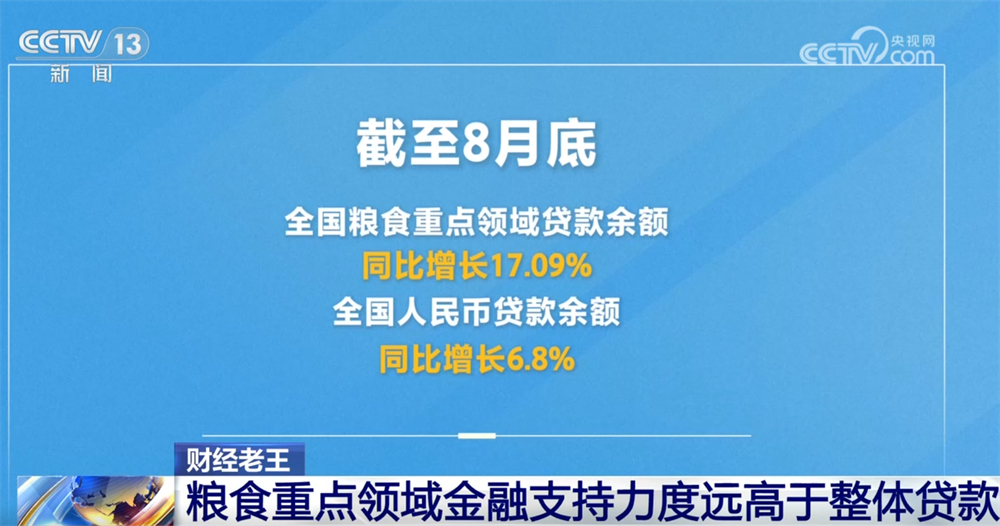
Financial Support for Agriculture - As of the end of August, the loan balance in key agricultural sectors increased by 17.09% year-on-year, significantly higher than the overall growth of 6.8% in RMB loans [1] - Financial support for agriculture includes various tailored loan products such as "Smart Grain Warehouse Loan," "Marine Ranch Loan," and "Fruit Farmer Loan," with over half of the agricultural loans requiring no collateral or guarantees [3][5] Insurance Developments - Comprehensive insurance products for major crops like rice, wheat, and corn are now available nationwide, providing better coverage compared to previous years [5] - The cost of insurance has decreased, with farmers able to secure around 1000 yuan in coverage for a premium of just over 10 yuan, thanks to substantial government subsidies [5][7] Impact on Farmers - Farmers have reported easier access to loans with lower interest rates and better disaster protection, leading to increased confidence in agricultural activities [9]
手里有粮 心里不慌,种粮有钱 丰收有底
Yang Shi Xin Wen· 2025-09-27 00:17
Financial Support for Agriculture - As of the end of August, the loan balance in key agricultural sectors increased by 17.09% year-on-year, significantly higher than the overall growth of 6.8% in RMB loans [4] - Farmers previously faced challenges in obtaining loans due to lack of collateral, but now over half of the operating loans do not require collateral or guarantees, relying solely on credit [7] - Various tailored loan products have emerged, including loans for specific agricultural activities such as "Smart Grain Warehouse Loan," "Marine Ranch Loan," and "Apple Flow E-Loan" [10] Insurance Developments - Agricultural insurance has improved significantly, with comprehensive cost insurance and income insurance for major crops like rice, wheat, and corn now available nationwide [12] - The cost of insurance has become more affordable, with farmers able to secure around 1000 yuan in coverage for a premium of about 10 yuan, largely subsidized by the government [12] - Specialty agricultural insurance products have also been developed to cover various types of farming, ensuring that farmers are protected based on what they grow [15] Policy and Economic Context - The current year is critical for consolidating poverty alleviation achievements, with stable summer grain production and increasing early rice yields [18] - The combination of supportive policies, financial empowerment, and effective insurance has created a robust safety net for farmers, enhancing their confidence in agricultural production [18]
完全成本保险:为西藏主粮作物上“全险”
Jin Rong Shi Bao· 2025-08-27 01:56
Core Viewpoint - The introduction of comprehensive cost insurance by China Life Property & Casualty Insurance in Tibet significantly enhances the risk management capabilities of local farmers, allowing them to better cope with natural disasters and market fluctuations [1][2]. Group 1: Insurance Product Development - China Life Property & Casualty Insurance has launched comprehensive cost insurance in Tibet, expanding coverage to include land costs and labor expenses, which were previously excluded [1]. - The insurance coverage for key crops has increased significantly, with barley and rice coverage rising from 380 yuan per mu to 800 yuan per mu, wheat from 350 yuan to 750 yuan, and corn from 380 yuan to 900 yuan [2]. Group 2: Financial Support and Affordability - The financial burden on farmers has been alleviated through a multi-tiered subsidy mechanism, where the local government covers 80% of the insurance premium, leaving farmers with minimal out-of-pocket costs [2]. - For example, a farmer with 20 mu of barley only pays approximately 26 yuan in premiums, while the maximum compensation can increase from 7,600 yuan to 16,000 yuan in case of severe crop failure [2]. Group 3: Impact on Agricultural Practices - The implementation of comprehensive cost insurance is transforming agricultural practices in Tibet, encouraging farmers to expand planting areas, adopt high-quality varieties, and increase agricultural investments [2]. - Modern agricultural techniques such as mechanized sowing and scientific fertilization are becoming more prevalent, alongside the emergence of new business models like cooperatives and family farms [2]. Group 4: Future Plans - China Life Property & Casualty Insurance plans to expand the coverage area of comprehensive cost insurance and explore the "insurance + futures" model to further support farmers and enhance the modern agricultural system in Tibet [3].
防灾减损 农户能用这些保险(信息服务台)
Ren Min Ri Bao· 2025-08-14 21:50
Core Viewpoint - Recent heavy rainfall has caused significant damage to farmland and agricultural equipment, prompting discussions on how insurance can provide support to affected farmers and improve claims processing efficiency [1] Group 1: Current Compensation Situation - Financial regulatory authorities are guiding insurance companies to conduct timely assessments and optimize claims processes during the critical flood prevention period, ensuring quick and reasonable compensation [2] - In Inner Mongolia, insurance coverage for major crops has been expanded, with compensation amounts increased from 300-600 yuan per mu to 900-1200 yuan per mu, resulting in 389 million yuan paid to 147,300 farmers [2] - In Beijing, agricultural insurance coverage reached 820 million yuan from January to May, with 7,085 claims reported due to heavy rainfall, of which 191 have been compensated [2] Group 2: Insurance Products for Farmers - The implementation plan for high-quality development in the banking and insurance sectors emphasizes the development of localized agricultural insurance products, including farmland, housing, and machinery insurance [4] - Central government continues to subsidize insurance premiums for major agricultural products, while local governments are introducing region-specific insurance products [4] - Various insurance products are being developed, including agricultural machinery insurance and specialized insurance for farm employers and short-term personal accident insurance for farmers [5] Group 3: Challenges in Agricultural Insurance - Agricultural insurance has positively impacted farmers' income security, but issues such as delayed payments and average compensation persist [6] - The application of new technologies like remote sensing and big data in agricultural insurance is increasing, but there is a lack of standards leading to doubts about the accuracy of damage assessments [6][7] - Regulatory bodies are encouraged to establish data-sharing mechanisms to enhance the precision and efficiency of claims processing, while ensuring that government interventions do not disrupt the insurance ecosystem [7]