富国天惠LOF

Search documents
需求萎缩规模停滞,新规下的LOF基金该“何去何从”?
Sou Hu Cai Jing· 2026-01-07 09:08
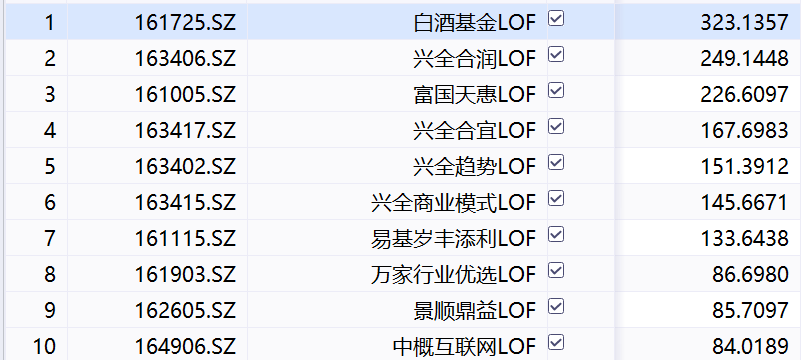
Core Insights - The article highlights the decline of Listed Open-Ended Funds (LOFs) in contrast to the growth of Exchange-Traded Funds (ETFs), with LOFs struggling to maintain relevance in the market [1][3]. Group 1: Market Performance - As of January 6, 2026, only 7 LOF products have surpassed a scale of 10 billion, primarily consisting of established funds like the Baijiu LOF and others [2]. - Since 2022, the number of newly established LOFs has drastically decreased, with only 1 new LOF expected in 2025 and none in 2024, while over 30 LOFs have been liquidated [3][4]. Group 2: Comparison with ETFs - LOFs initially offered a dual trading mechanism, allowing for both on-market trading and off-market subscriptions, but have since lost their appeal due to poor performance and liquidity issues [3][5]. - ETFs benefit from a more efficient redemption mechanism and transparent pricing, which has contributed to their growing dominance over LOFs [5][6]. Group 3: Regulatory Impact - The introduction of new public fund sales regulations effective January 1, 2026, has further diminished the attractiveness of LOFs by lowering subscription fees while maintaining high redemption fees, eroding their competitive edge [6][7]. - The new regulations treat LOFs similarly to other fund types, removing their unique advantages in trading flexibility and cost efficiency [8]. Group 4: Future Outlook - The article suggests that LOFs may still have niche opportunities, particularly in cross-border and commodity LOFs, which can leverage T+0 trading and complex asset management [9]. - There is a call for the public fund industry to explore integrating active management with ETF-like mechanisms to enhance transparency and competitiveness [9].

朱少醒2025年三季度表现,富国天惠LOF基金季度涨幅17.45%
Sou Hu Cai Jing· 2025-10-27 15:58
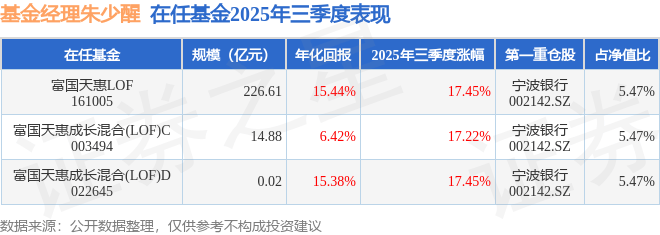
Core Insights - The best-performing fund managed by manager Zhu Shaoxing is the FuGuo TianHui LOF (161005), which achieved a quarterly net value increase of 17.45% as of the end of Q3 2025 [1][2]. Fund Performance - Zhu Shaoxing manages a total of three funds, with the FuGuo TianHui LOF having an annualized return of 15.44% and a total fund size of 226.61 billion [2]. - The FuGuo TianHui Growth Mixed (LOF) C and D funds also performed well, with quarterly increases of 17.22% and 17.45%, respectively [2]. Investment Strategy - During Zhu Shaoxing's tenure as the manager of FuGuo TianHui Growth Mixed (LOF) A (161005), the cumulative return reached 1654.7%, with an average annualized return of 15.44% [2]. - The fund made 158 adjustments to its heavy stock positions, achieving a success rate of 60.76% with 96 profitable trades [2]. Key Holdings - The top holding for the FuGuo TianHui LOF is Ningbo Bank, which constitutes 5.47% of the net value [2]. - Notable stock adjustments include significant gains from stocks like Guoci Materials, which yielded an estimated return of 570.91% during its holding period [3][4]. Case Studies of Stock Adjustments - Guoci Materials was held for over 7 years, with a revenue growth of 744.76% during that period [4]. - In contrast, Wei Er Shares experienced a loss of 50.86% during its holding period, reflecting a revenue decline of 16.7% [5].
部分顶流基金经理光环褪去
2 1 Shi Ji Jing Ji Bao Dao· 2025-08-08 05:11
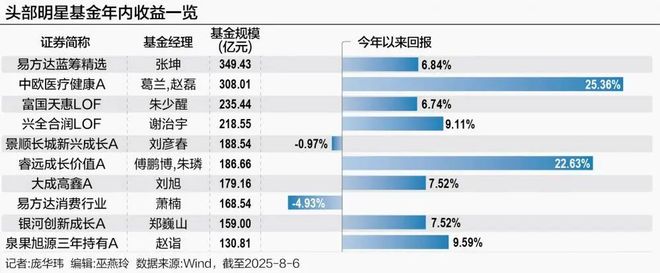
Core Viewpoint - After three years of underperforming the market, actively managed equity funds have experienced a significant rebound this year [1][5]. Group 1: Performance of Active Equity Funds - The "Wande Equity Mixed Fund Index," representing actively managed equity funds, showed a performance of -21.03% in 2022, -13.52% in 2023, and 3.45% in 2024, all underperforming the Shanghai Composite Index [5]. - As of August 6, 2024, the Wande Equity Mixed Fund Index has increased by 16.67%, outperforming the Shanghai Composite Index, which rose by 8.42% [5][6]. - Year-to-date, actively managed funds have outperformed the Shanghai Composite Index by over 8 percentage points and the CSI 300 Index by over 12 percentage points [6]. Group 2: Performance of Star Fund Managers - A significant number of star fund managers have shown varied performance this year, with some excelling, particularly in the healthcare sector, while others have struggled [2][3]. - Among the top-performing funds, the "China Europe Medical Innovation" fund managed by Ge Lan has achieved a return of 68.97%, while the "China Europe Medical Health" fund has returned 25.36% [10][11]. - Conversely, some star fund managers, such as Zheng Chengran and Liu Yanchun, have seen their funds underperform, primarily due to heavy investments in sectors like liquor and new energy [16]. Group 3: Sector Performance and Investment Strategies - The healthcare sector has seen a resurgence, with funds heavily invested in innovative drugs, especially those with significant exposure to Hong Kong stocks, outperforming others [12][15]. - Funds managed by star managers focusing on growth sectors, such as technology and new energy, have also performed well, with notable returns from funds like "Xingquan Social Value" and "Xingquan Harmony" [13][14]. - The performance disparity among star fund managers is attributed to their investment strategies not adapting to the rapidly changing market conditions, particularly in sectors like AI and innovative drugs [16].