
LOF基金

Search documents
不确定的世界:低风险投资指南
集思录· 2026-03-19 14:05AI Processing
7.失意时苦练内功,得意时更要低调。失意时心情低落好理解,但是很多时候得意时很容易 飘,好像马上都可以辞职投资了,但是好好想想一年的支出,工作带来的收益,在能兼顾工 作和投资的时候万万不要冲动。我一直都认为工作是基石,走投资走的是活棋,但是如果把 工作丢了,投资就是死棋。 我一直遵循的低风险投资的核心理念: 1.找到机会就要尽自己最大的融资能力,2020年10月开始低风险投资,记得第一次做的好多 钱都是借来的,当看到很多人发现机会借钱上的时候会有共鸣。后来开口跟家里借钱我也没 有羞涩,得益于多年家人的信任还是全力支持我。 2.超强的行动力,发现机会以后最好的方式是小单试错,而不是一直在岸边观望不下水练习。 试错以后就要敢于大单上。看到有些人知道机会但是迟迟犹豫有时候挺惋惜,因为机会稍纵 即逝。 3.不要困在原地,不断突破舒适圈。低风险投资的难在于市场的有效性一直在变强,那么今天 的机会可能明天就没有了,所以需要自己不断学习不断迭代,想留在原地就要努力从60做到 90分,要不就寻找新赛道。 4.完善自己的细节力。当大家都知道一个赛道,能不能继续赚钱就需要不断完善细节。一般说 一个LOF基金我大概知道是哪家基金公 ...


LOF基金有“双轨”交易机制 留心资源类LOF的溢价风险|经济周刊·理财
Guang Zhou Ri Bao· 2026-02-13 03:10
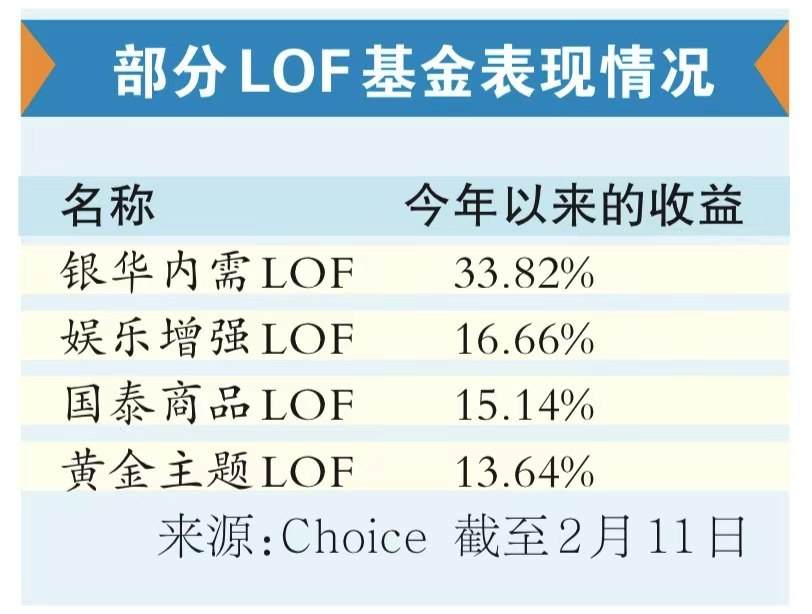
Core Viewpoint - The recent performance of LOF (Listed Open-end Fund) has been volatile, with significant losses reported after a sharp decline in silver prices and adjustments in net asset value calculation standards, leading to investor concerns about the risks associated with these funds [1]. Summary by Sections LOF Fund Overview - LOF funds are characterized by their flexibility in investment targets, including both index and actively managed products, allowing investors to buy and sell through various channels like fund companies and banks [1]. - As of February 11, over 400 LOF funds are available in the market, with a performance disparity exceeding 40% among them, particularly those focused on commodities like gold, oil, and silver [1]. Performance of Specific LOF Funds - Notable LOF funds and their year-to-date returns include: - Yinhua Domestic Demand LOF: 33.82% - Entertainment Enhanced LOF: 16.66% - Guotai Commodity LOF: 15.14% - Gold Theme LOF: 13.64% [2]. Investment Suitability - LOF funds are deemed more suitable for investors with trading experience who understand premium and discount risks, while ordinary investors are advised to participate cautiously [2]. - The dual trading mechanism of LOF allows for arbitrage opportunities, but the relatively small scale of these funds and the time required for conversions between on-market and off-market transactions pose risks [3]. Risk Considerations - Investors are cautioned about resource-based LOFs, as their underlying asset prices can be highly volatile due to geopolitical factors and supply-demand dynamics, which may lead to significant losses during market corrections [4]. - Funds that are more balanced, such as broad-based index or mixed equity-debt LOFs, are considered to have relatively stable risks, with better liquidity and price stability [4].
一文看懂2026年基金行业市场研究报告:行业马太效应进一步凸显
Xin Lang Cai Jing· 2026-02-09 10:21
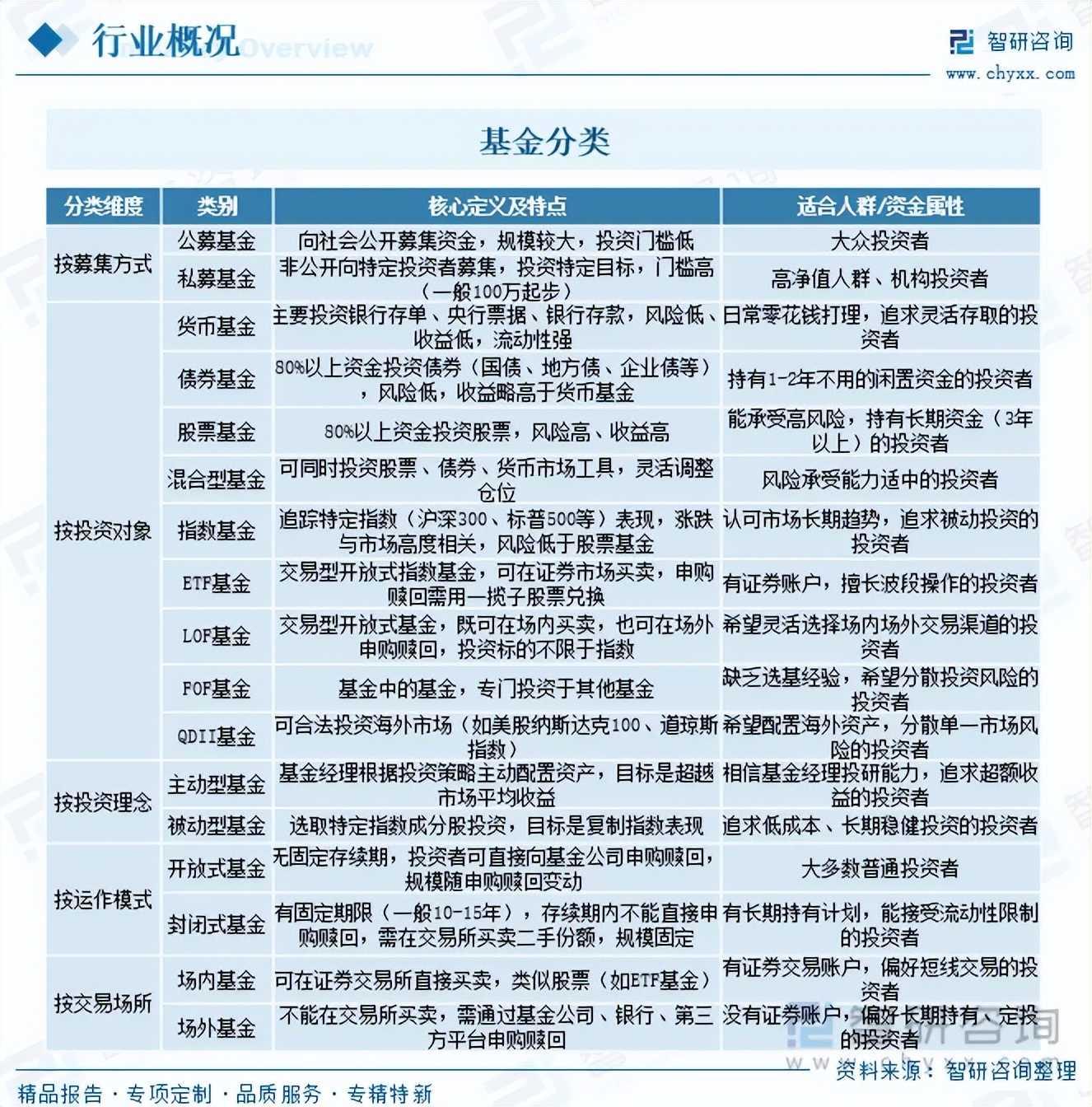
Core Insights - The real estate industry is transitioning to a stable development phase, leading to a shift in public investment needs from mere preservation to diversified value growth [1][15] - There is a significant adjustment in national asset allocation, with funds moving from traditional savings and real estate to standardized equity and fixed-income fund products [1][15] - The fund industry in China is expected to see substantial growth, with a projected total of 151,286 funds by October 2025, including 13,381 public funds and 137,905 private funds, with a total scale of 590,112.3 billion yuan [1][15] Overview of the Fund Industry - Funds, or securities investment funds, pool capital from multiple investors to create an independent asset managed by professional fund managers, allowing for diversified investment and risk sharing [2][16] - The benefits of funds include lower investment thresholds for ordinary investors, risk diversification, and professional management, although they still carry inherent market risks [2][16] Fund Classification - Funds can be categorized based on various criteria, including: - **By fundraising method**: Public funds (open to the public) and private funds (targeted at specific investors) [3][17] - **By investment object**: Money market funds, bond funds, stock funds, mixed funds, index funds, ETF funds, LOF funds, FOF funds, and QDII funds [3][17] - **By investment philosophy**: Active funds (managed to outperform the market) and passive funds (aiming to replicate market indices) [3][17] - **By operation mode**: Open-end funds (allowing continuous buying and selling) and closed-end funds (fixed size, traded on exchanges) [3][17] - **By trading venue**: On-exchange funds (traded like stocks) and off-exchange funds (purchased through fund companies or banks) [3][17] Development History - The development of China's fund industry has evolved through five key phases: pilot exploration, regulatory initiation, rapid expansion, transformation and adjustment, and high-quality development [6][20] - Recent trends indicate a shift towards professionalization, diversification, and internationalization, with innovative products like public REITs and ESG-themed funds emerging [6][20] Market Policies - The Chinese government emphasizes the importance of the fund industry for the stability of the capital market and the support of the real economy, implementing various policies to encourage and regulate its development [8][22] - Key policies include initiatives for green finance, support for technology enterprises, and measures to enhance financial services for housing rental markets [8][22] Current Market Status - The fund industry is experiencing a migration of capital from traditional savings and real estate to standardized equity and fixed-income products, indicating a broadening of investment strategies among the public [1][15] - The multi-layered fund product system in China is now capable of meeting diverse wealth management needs, with significant growth potential in the coming years [1][15]
年轻投资者“坐过山车”实录:要把控制风险放在第一位
Zhong Guo Zheng Quan Bao· 2026-02-05 22:28
Market Overview - The market has experienced a significant downturn, with international gold and silver prices dropping sharply, leading to a deep correction in precious metals and technology sectors, causing many funds to retract significantly [1][2] - Investors who previously enjoyed profits in January are now facing losses, with many expressing that losing money feels faster than making it [1] Investor Sentiment - Many young investors initially found joy in trading, with the market's upward trend providing a sense of achievement and recognition [2] - The sudden market decline has led to emotional distress among investors, with significant losses occurring in a single day, contrasting sharply with their previous gains [3] Investment Strategies - Young investors are learning and refining their investment strategies amidst market volatility, with some adopting diversified approaches and maintaining discipline [4][5] - A focus on absolute returns rather than comparisons to indices is noted, with some investors satisfied with modest annual returns in the current low-interest-rate environment [4] Risk Management - The importance of risk control is emphasized, with investors recognizing the need to understand their risk tolerance and avoid over-leveraging during market highs [6] - Experienced investors highlight the distinction between investing and speculating, stressing the necessity of understanding the companies behind investments [6]
要把控制风险放在第一位
Zhong Guo Zheng Quan Bao· 2026-02-05 20:27
Market Sentiment - The market has experienced a significant downturn, with international gold and silver prices dropping, leading to a deep correction in precious metals and technology sectors, causing many funds to retract sharply [1][2] - Investors who previously enjoyed profits in January are now facing losses, with some expressing that losing money feels faster than making it [1][2] Investor Behavior - Young investors are experiencing a shift in their investment mindset, with some feeling a strong emotional attachment to market movements, leading to a sense of loss when the market declines [2][3] - Different strategies are being adopted by young investors, with some focusing on diversified investments and others engaging in frequent trading based on market fluctuations [3][4] Investment Strategies - Some investors are employing disciplined strategies, such as observing market trends and setting clear buy and sell signals, aiming for absolute returns rather than comparing with indices [3] - A focus on balanced and diversified investments, particularly in index funds, is seen as a more suitable approach for ordinary investors, as opposed to chasing individual stocks [4] Risk Management - The recent market volatility has highlighted the importance of understanding personal risk tolerance and maintaining a clear investment strategy [5] - Investors are advised to prioritize risk control and avoid using funds beyond their risk capacity, especially during market highs [5]
金十数据全球财经早餐 | 2026年2月2日
Jin Shi Shu Ju· 2026-02-01 23:09
Group 1 - The U.S. government has entered a technical and partial "shutdown" state due to budget issues, with the House Speaker expressing confidence in resolving the situation soon [2][13] - The Federal Reserve's officials believe that there is currently no need for interest rate cuts, with some suggesting a more patient approach to monetary policy [10][11] - The CME has raised margin requirements for gold, silver, platinum, and palladium futures, indicating increased volatility in these markets [12] Group 2 - Gold prices experienced a significant drop, with spot gold falling by 9.19% to $4,883.45 per ounce, marking the largest single-day decline since 1983 [3][7] - Silver saw an even steeper decline, plummeting 26.37% to $85.01 per ounce, which is the largest recorded single-day drop [3][7] - Oil prices remained stable near six-month highs, with WTI crude oil closing at $65.78 per barrel, up 0.35% [3][7] Group 3 - U.S. stock indices closed lower, with the Dow Jones down 0.36%, S&P 500 down 0.43%, and Nasdaq down 0.94% [4][7] - European stock indices showed positive performance, with Germany's DAX30 up 0.94% and the Euro Stoxx 50 up 0.95% [4][7] - Hong Kong's Hang Seng Index fell by 2.08%, with significant declines in gold and precious metals stocks [4][7] Group 4 - A-shares showed mixed performance, with the Shanghai Composite Index down 0.96% and the ChiNext Index up 1.27%, indicating a rebound trend [5][8] - Key sectors such as optical fiber and agriculture saw gains, while gold stocks faced significant sell-offs [5][8]

【财富周刊】多家银行再度抬高积存金准入门槛,多只LOF基金暂停大额申购
Xin Lang Cai Jing· 2026-02-01 13:49
Group 1 - Several banks have raised the entry threshold for gold accumulation business due to rising gold prices, with major state-owned banks like ICBC and ABC tightening access since early 2026 [1] - On February 1, ICBC issued a risk warning regarding significant fluctuations in domestic and international precious metal prices, advising investors to assess their risk tolerance and maintain a rational investment mindset [2] - The total scale of ETFs in the market has decreased to 5.46 trillion yuan, with a net outflow of over 400 billion yuan in broad-based ETFs in the past week [2] Group 2 - Multiple LOF funds have suspended large purchases, with some products limiting daily subscriptions to as low as 2 yuan, due to an influx of speculative funds during market downturns [3] - The Guotou Silver LOF fund announced its resumption of trading on February 2, 2026, with a price fluctuation limit of 10% [4] - In January, the net outflow from broad-based index ETFs reached 1.01 trillion yuan, while industry-themed ETFs saw a net inflow of 211.7 billion yuan [5]
今日财经要闻TOP10|2026年1月31日
Xin Lang Cai Jing· 2026-01-31 11:37
Group 1: Geopolitical Developments - President Trump warned that a large fleet is heading towards Iran, larger than the one deployed near Venezuela, while expressing openness to reaching an agreement with Tehran [1][5] Group 2: Commodity Market Changes - CME announced an increase in margin requirements for gold and silver futures amid a price drop, raising non-high-risk account margins for gold from 6% to 8% and for silver from 11% to 15% [2] - Multiple commodity-related LOF funds announced limits on large subscriptions, with some products having a daily subscription cap as low as 2 yuan, to prevent damage to investor interests during market volatility [9] Group 3: Corporate Developments - Nvidia's proposed $100 billion collaboration with OpenAI has stalled due to internal doubts, despite initial plans for rapid negotiations and significant investment in computing power [6][16]
LOF基金2026年开年再掀溢价潮
Mei Ri Jing Ji Xin Wen· 2026-01-08 23:56
Core Viewpoint - The LOF (Listed Open-Ended Fund) has gained significant attention in the market, particularly with the surge in silver futures, leading to a wave of speculative trading and subsequent warnings about premium risks from fund companies [1][2]. Group 1: Market Activity and Performance - At the beginning of 2026, multiple LOF funds, including Guotou Silver LOF, issued premium risk warnings due to significant price premiums in the secondary market, indicating high speculative interest [2][5]. - In 2025, the average return of all 407 LOF funds reached 24.06%, with three funds achieving over 100% returns, highlighting the potential profitability of these products [3]. Group 2: Historical Context and Challenges - LOF funds were introduced in 2004 to address inefficiencies in traditional fund trading, allowing for both on-exchange and off-exchange transactions [4]. - Despite initial growth, the establishment of new LOF funds has declined significantly, with no new funds launched in 2024 and only two in 2025, resulting in a total market size of less than 700 billion yuan by the end of 2025 [5]. Group 3: Future Outlook and Strategic Positioning - The future of LOF funds may involve focusing on niche markets and optimizing mechanisms to improve trading efficiency and liquidity, while complementing rather than competing with ETFs [8]. - Industry experts suggest that LOF funds can still provide unique value by catering to specific asset classes and offering flexible trading options, despite facing challenges in efficiency and cost competitiveness compared to ETFs [7][8].
LOF基金2026年开年再掀溢价潮,多只产品提示风险
Mei Ri Jing Ji Xin Wen· 2026-01-08 13:37
Core Viewpoint - The LOF (Listed Open-Ended Fund) has gained significant attention in the market, particularly with the surge in silver futures, leading to a wave of speculative trading and subsequent warnings about premium risks from fund companies [1][2]. Group 1: Market Activity and Performance - At the beginning of 2026, multiple LOF funds, including Guotou Silver LOF, issued premium risk warnings due to significant price premiums in the secondary market, indicating high speculative interest [2] - In 2025, the average return of all 407 LOF funds was 24.06%, with three funds achieving over 100% returns, highlighting the potential for high returns despite the risks involved [3] Group 2: Historical Context and Challenges - LOF funds were introduced in 2004 to address inefficiencies in traditional fund trading, allowing for both on-exchange and off-exchange transactions [4] - The establishment of new LOF funds has declined significantly, with no new funds launched in 2024 and only two in 2025, indicating a stagnation in growth compared to other fund types [5] Group 3: Future Outlook and Strategic Positioning - Despite the recent surge in interest, LOF funds still have considerable room for growth in terms of scale and public awareness, remaining a niche product in the investment landscape [7] - Industry experts suggest that LOF funds can provide unique value by accommodating special assets and offering flexible trading options, but they face challenges in efficiency and cost competitiveness compared to ETFs [8]