
富马酸丙酚替诺福韦片

Search documents
主动撤回药物上市申请导致计提减值,凯因科技:2025年利润将减1.1亿元
Shen Zhen Shang Bao· 2026-01-21 11:37
Core Viewpoint - The company, Kaiyin Technology, has voluntarily withdrawn its drug registration application for Pegylated Interferon α-2 Injection, which was intended for use in treating chronic hepatitis B in adults, due to the National Medical Products Administration's latest review recommendations [1][3]. Group 1: Drug Registration Withdrawal - The decision to withdraw the drug registration application was made after careful consideration and aims to further supplement clinical case studies before potentially resubmitting the application [3]. - The withdrawal will result in a full impairment provision for the related development expenses, reducing the company's profit for 2025 by 110 million yuan [3]. Group 2: Financial Impact - The withdrawal of the drug registration application is not expected to affect the sales of the company's existing products but will impact the operating performance for 2025 [3]. - Following the announcement, the company's stock price fell by 13.23%, closing at 22.76 yuan per share on January 21 [4]. Group 3: Company Financial Performance - In the first three quarters of 2025, the company reported revenues of 927 million yuan, a year-on-year decrease of 8.3%, and a net profit attributable to shareholders of 103 million yuan, down 5.1% [7]. - The operating cash flow for the same period was 38.01 million yuan, reflecting a year-on-year increase of 16.0% [7]. - As of the end of the third quarter, the company's total assets were 2.868 billion yuan, an increase of 9.6% compared to the end of the previous year, while the net assets attributable to shareholders decreased by 2.6% to 1.796 billion yuan [7].


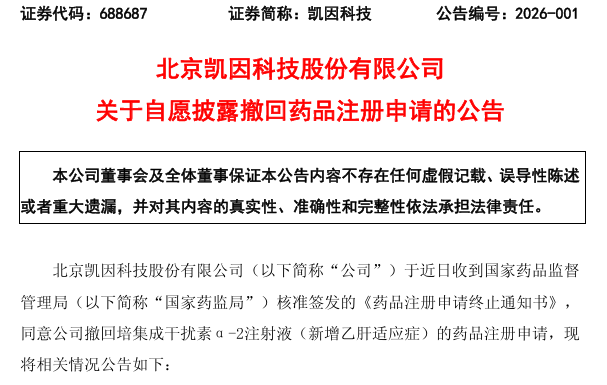
主动撤回药物上市申请,这家公司成今日上午A股跌幅最大企业
Di Yi Cai Jing Zi Xun· 2026-01-21 04:44
Core Viewpoint - The company Kain Technology (688687.SH) has voluntarily withdrawn its drug registration application for a hepatitis B treatment, leading to a significant drop in its stock price by 11.78% on January 21, making it the largest decline in the A-share market that day [2][3]. Group 1: Drug Development and Regulatory Actions - Kain Technology received a termination notice from the National Medical Products Administration (NMPA) regarding its application for the drug Peginterferon α-2 Injection for a new hepatitis B indication [2]. - The drug Peginterferon α-2 Injection was initially approved in 2018 for treating chronic hepatitis C and was being studied for its efficacy in treating chronic hepatitis B, with clinical trials showing potential for functional cure [3]. - The company plans to supplement clinical case studies as per NMPA's requirements and intends to resubmit the registration application in the future, although no specific timeline has been provided [4]. Group 2: Financial Implications and Market Reaction - The withdrawal of the drug application has led the company to fully provision for asset impairment related to the development costs of the hepatitis B indication, which is expected to reduce the company's profit by 111 million yuan in 2025 [4]. - This decision has raised concerns among investors about the future of the drug's development in the hepatitis B space, although the company clarified that it has not abandoned the project and is acting out of caution [4].

主动撤回药物上市申请,这家公司成今日上午A股跌幅最大企业
第一财经· 2026-01-21 04:39
Core Viewpoint - The company, Kaiyin Technology, has voluntarily withdrawn its drug registration application for Pegylated Interferon α-2 Injection for the treatment of chronic hepatitis B, leading to a significant drop in its stock price by 11.78% on January 21, making it the largest decline in the A-share market that morning [3][6]. Group 1: Drug Development and Market Impact - Pegylated Interferon α-2 Injection is a novel long-acting interferon developed by the company, initially approved in 2018 for chronic hepatitis C treatment [3]. - The new application aimed to expand its use to chronic hepatitis B, with clinical research showing potential for functional cure, including over 20% of patients achieving HBsAg clearance [4][5]. - The withdrawal was based on the latest review suggestions from the National Medical Products Administration, and the company plans to supplement clinical case studies before resubmitting the application [5][6]. Group 2: Financial Implications - The company has fully recognized impairment losses related to the development expenses of the withdrawn application, reducing its profit by 111 million yuan for the fiscal year 2025 [6]. - This decision raised concerns among investors about the future of the drug's development in hepatitis B, although the company clarified that it has not abandoned the project and is acting cautiously [6].

今日上午A股跌幅最大企业,主动撤回乙肝药上市申请
Di Yi Cai Jing· 2026-01-21 04:05
Core Viewpoint - The company has withdrawn its drug registration application for the hepatitis B treatment, leading to a significant drop in its stock price, indicating investor concerns about the future of its drug development pipeline [1][2][3] Group 1: Drug Development and Regulatory Actions - The drug in question, Peginterferon α-2a injection, was the fastest progressing hepatitis B drug in the company's pipeline and had recently reached the application stage for market approval [1] - The company received a termination notice from the National Medical Products Administration, agreeing to the withdrawal of the drug registration application for the hepatitis B indication [1][2] - The company plans to supplement clinical case studies as per regulatory requirements and may resubmit the registration application in the future [2][3] Group 2: Financial Impact and Market Reaction - The withdrawal of the registration application resulted in an 11.78% drop in the company's stock price, making it the largest decline in the A-share market on that day [1] - The company has fully recognized impairment losses related to the development expenses of the Peginterferon α-2a injection project, which will reduce its profit by 111 million yuan in 2025 [3] - This decision has raised concerns among investors about the viability of the drug's development for hepatitis B, although the company maintains that it has not abandoned the project [3] Group 3: Industry Context - Hepatitis B virus infection is a significant global public health issue, with chronic hepatitis B potentially leading to severe complications like cirrhosis and liver cancer if not properly managed [2] - The company has previously achieved a high cure rate for hepatitis C with its all-oral drug series, but faces increasing competition in the hepatitis C market, prompting a shift towards innovative hepatitis B treatments [2]
海南海药(000566) - 2025年5月24日投资者关系活动记录表
2025-05-25 08:30
Group 1: Clinical Trials and Results - The company is conducting Phase IIa clinical trials for the drug Paiengabin, with 12 subjects enrolled in the first dose group, showing a 25.47% reduction in seizure frequency over 28 days compared to baseline [5] - In Phase I clinical studies, Paiengabin demonstrated linear pharmacokinetics across doses of 2.5-25 mg, with no serious adverse events reported [3][4] - The Phase IIa trial results are still blinded, and final efficacy data will be available post-unblinding [5] Group 2: Drug Characteristics and Comparison - Paiengabin is a KCNQ potassium channel agonist, designed to overcome the limitations of the previously marketed drug Retigabine, which was withdrawn due to safety concerns [6] - Non-clinical studies indicate that Paiengabin has superior chemical stability and better distribution in the brain compared to Retigabine, enhancing its efficacy against epilepsy [7] Group 3: Future Development and Market Strategy - The company plans to explore expanding Paiengabin's indications based on Phase II clinical outcomes and market demand, potentially including severe depression caused by KCNQ mutations [9] - The patent for Paiengabin is held by the Shanghai Institute of Materia Medica, with exclusive rights for clinical development and commercialization in mainland China [9] - The company is considering international rights transfer for Paiengabin, depending on the outcomes of the Phase II trials [9] Group 4: Fluorofenone Clinical Trials - Fluorofenone's Phase I clinical trials have shown good safety and tolerability in healthy subjects, with adverse events primarily mild to moderate [10] - The Phase II mid-analysis for Fluorofenone included 156 subjects, with a 55.6% reduction in Ishak fibrosis scores after 48 weeks [11] - The company anticipates entering Phase III clinical trials for Fluorofenone in the second half of 2025, with the drug included in the list of breakthrough therapies by the National Medical Products Administration [11]

广生堂: 2025年度向特定对象发行A股股票募集说明书(申报稿)
Zheng Quan Zhi Xing· 2025-05-23 13:25
Group 1 - The company, Fujian Cosunter Pharmaceutical Co., Ltd., plans to issue A-shares to specific investors, with the proposal approved by the board and shareholders [2][3] - The issuance will target no more than 35 specific investors, including qualified institutional investors and individuals, with all subscriptions to be made in cash [3][4] - The pricing for the shares will be based on the average trading price over the 20 trading days prior to the pricing date, set at no less than 80% of that average [4] Group 2 - The total number of shares to be issued will not exceed 47,780,100, representing no more than 30% of the company's total share capital prior to the issuance [5] - The company aims to raise up to 976.87 million yuan, with funds allocated primarily for innovative drug research and development, traditional Chinese medicine industrialization, and working capital [5] - The company will initially use self-raised funds for projects until the raised funds are available, and if the actual net amount raised is less than planned, adjustments will be made based on project priorities [5] Group 3 - After the issuance, the shares subscribed by investors will be subject to a six-month lock-up period [6] - The issuance will not change the controlling shareholder or the actual controller of the company, nor will it affect the distribution of shares in a way that violates listing conditions [6] - The company has committed to measures to compensate for any dilution of immediate returns resulting from the issuance [6] Group 4 - The company has experienced continuous losses, with net profits of -132.18 million yuan, -354.23 million yuan, -199.54 million yuan, and -30.42 million yuan in recent periods, primarily due to increased R&D investments and price declines from centralized procurement policies [10][11] - The company is focusing on innovative drug development, which typically involves high costs and long timelines, and faces risks related to market acceptance and competition [9][10] - The company has established itself as a well-known player in the antiviral drug market, particularly in hepatitis B treatment, with a product portfolio that includes generics and innovative drugs [14]
