
小偃6号

Search documents
“种质”就是“种子”吗?这里有权威答案!
Nan Fang Nong Cun Bao· 2026-02-11 04:06
Group 1 - The core issue is the distinction between wild ginkgo, which is endangered, and landscape ginkgo, which lacks genetic diversity despite being common in cities [1] - Germplasm resources are crucial for agricultural innovation and food security, encompassing a wide range of biological materials beyond just seeds [2] - Since the implementation of the "Seed Industry Revitalization Action Plan" in 2021, China's seed security has improved, with over 95% of crop varieties being independently bred [3] Group 2 - China is a major germplasm resource country but still faces challenges in precise identification and utilization of these resources [3] - The focus on improving germplasm resource identification and enhancement is essential for advancing the seed industry and addressing agricultural development needs [3] - The integration of biotechnology and artificial intelligence in breeding innovation is necessary to create new breeding scenarios and enhance productivity [4]
银杏濒危?保护种质资源不止是保护种子
Ren Min Ri Bao· 2025-12-28 04:31
Group 1 - The core issue is the distinction between wild ginkgo, which is endangered, and landscape ginkgo, which lacks genetic diversity despite being common in cities [1] - Germplasm resources are crucial for agriculture, encompassing not just seeds but also various plant parts and genetic materials, highlighting their broader significance [1] - The importance of germplasm resources is underscored as they are foundational to agricultural innovation and food security [2] Group 2 - China is a major germplasm resource country but still faces challenges in precise identification and the development of breakthrough varieties [3] - Current phenotypic identification of germplasm resources in China is only 35%, with a target of 60% by 2030, indicating a significant gap [3] - The integration of artificial intelligence in breeding innovation is essential for enhancing the breeding system and accelerating the development of new varieties [3]
这个西北小城何以走出28位院士(科技视点)
Ren Min Ri Bao· 2025-10-12 22:10
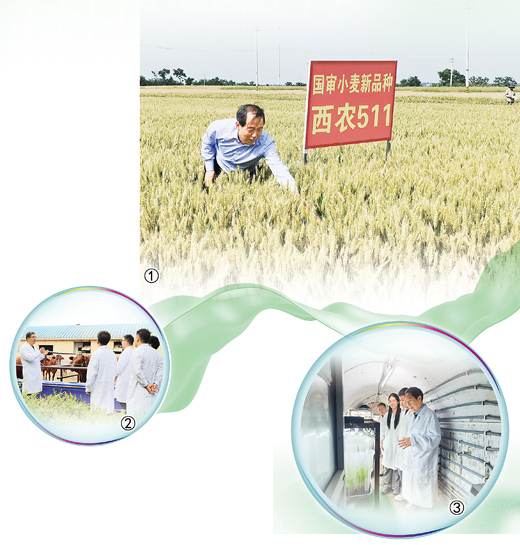
Core Insights - The article emphasizes the integration of education, technology, and talent as foundational elements for China's modernization, particularly in the agricultural sector [2][12] - Yangling, as the first national-level agricultural high-tech industrial demonstration zone, showcases significant advancements in agricultural research and innovation [3][4] Group 1: Agricultural Research and Development - Yangling is home to key educational institutions like Northwest A&F University and has over 100 provincial and ministerial research platforms, contributing to a robust agricultural research environment [3][4] - The region has produced impactful agricultural technologies, such as the "Xinan 511" wheat variety, which has been promoted over 40 million acres since its approval in 2018 [5] - The "Three Rui" apple varieties have been cultivated and promoted across more than 1 million acres, demonstrating successful agricultural innovation [6][7] Group 2: Integration of Education and Industry - The collaboration between educational institutions and local enterprises is highlighted as a driving force for innovation, with faculty members taking on roles in companies to enhance practical research applications [13][14] - The establishment of agricultural technology innovation centers and joint research platforms has led to significant advancements in crop breeding and agricultural practices [13][14] Group 3: Future Directions and Innovations - The future agricultural research institute aims to become a center for new agricultural productivity, focusing on drought-resistant crops and integrating artificial intelligence into agricultural practices [15] - Yangling plans to establish 50 demonstration bases for agricultural technology transfer by the end of 2024, enhancing the commercialization of research outcomes [14]

植物如何影响我们的生活?专家解读植物奥秘与科学家精神
Xin Jing Bao· 2025-06-04 00:54
Group 1 - The event on May 30th celebrated the contributions of scientists, particularly focusing on the relationship between plants and human life, as part of a series aimed at promoting the spirit of scientists by 2025 [1][5] - Professor Gu Hongya emphasized the importance of plants in human civilization, discussing their role in food sources and the process of domestication versus breeding [2][4] - The introduction of various plants throughout history, such as grapes and potatoes, illustrates the evolution of human civilization and the significance of plant resources [2][3] Group 2 - Gu highlighted the strategic importance of wild plant resources, noting that even non-endangered species like wild soybeans are crucial for food security due to their unique genetic traits [3] - The lecture showcased the dedication of scientists like Yuan Longping and Tu Youyou, who made significant contributions to agriculture and health, respectively, demonstrating the spirit of perseverance and innovation [4][5] - The event aimed to foster a scientific atmosphere and enhance public scientific literacy, aligning with national goals for technological advancement and national rejuvenation [5]