小米大家电(空调

Search documents
小米17系列正面迎战苹果,雷军谈小米如何“逆天改命”
Sou Hu Cai Jing· 2025-09-28 08:15
Core Insights - Xiaomi has undergone a significant transformation over the past five years, evolving from an internet company to a player in smart manufacturing, focusing on a comprehensive ecosystem of "people, vehicles, and homes" [1][11] - The launch of the Xiaomi 17 series smartphones marks a pivotal moment, showcasing advancements in battery life, imaging technology, and display quality, positioning the products to compete directly with Apple's iPhone [2][15] - The company has made substantial investments in research and development, with a commitment of over 100 billion yuan in core technologies over five years, leading to breakthroughs in self-developed chips and electric vehicles [13][16] Product Launch and Performance - The Xiaomi 17 series includes three models, with starting prices of 4499 yuan for the standard version, 4999 yuan for the Pro version, and 5999 yuan for the Pro Max version, achieving record sales within minutes of launch [1][10] - The Xiaomi 17 Pro Max has reportedly captured over 50% of the sales within the series, breaking records for first-day sales in the domestic market [1][10] Technological Advancements - The Xiaomi 17 standard version features a 7000mAh battery, nearly double that of the iPhone 17, showcasing significant advancements in battery technology [2] - The imaging system in the Xiaomi 17 Pro series is highlighted as a leader in mobile photography, utilizing advanced technologies to enhance image quality [2][3] - The introduction of the "super pixel" technology in the display of the Xiaomi 17 Pro Max improves clarity and reduces power consumption by 26% [3] Strategic Direction - Xiaomi's shift towards high-end products is characterized by a focus on user insights and technological breakthroughs rather than mere specifications [15] - The company aims to redefine the automotive space with its electric vehicles, emphasizing a combination of technology and ecosystem integration [9][17] Financial Performance - In the first half of 2025, Xiaomi reported total revenue of 227.2 billion yuan, a year-on-year increase of 38.2%, with net profit reaching 22.83 billion yuan, a significant growth of 146% [10] Long-term Vision - Xiaomi's commitment to long-term investment in technology and innovation is evident, with plans to continue expanding its capabilities in both the automotive and semiconductor sectors [8][14] - The company aims to establish itself as a leading force in global technology, moving beyond traditional competitors and setting new benchmarks for innovation [19]
985管培生吐槽每天拧螺丝12小时,车间实习长达半年,五菱回应;曝理想未经授权用歼-20战机做宣传海报;小米大家电登陆欧洲市场
雷峰网· 2025-09-25 00:31
Key Points - The article discusses various industry news and events, highlighting significant developments in companies and sectors such as automotive, technology, and AI [2][4][7][8][10][15][26][29]. Group 1: Automotive Industry - A significant number of management trainees at SAIC-GM-Wuling reported dissatisfaction with their roles, which involve extensive manual labor, contradicting initial job expectations [4][5]. - BYD's executive vice president stated that the company has backup plans in case of a supply disruption from NVIDIA, emphasizing their self-research capabilities [8][9]. - Li Auto faced controversy for unauthorized use of military aircraft images in promotional materials, leading to a formal complaint from Aviation Industry Corporation of China [10]. Group 2: Technology and AI - Zhou Hongyi emphasized that larger AI models are not necessarily better, advocating for the importance of specialization and local knowledge in AI applications [7]. - Lei Jun of Xiaomi highlighted the importance of benchmarking against industry leaders to achieve competitive advantage [8]. - Alibaba announced a significant investment in AI infrastructure, aiming to enhance its capabilities and expand its global data center network [15][21]. Group 3: Market Developments - Tesla reported a surge in vehicle registrations in China, indicating a strong recovery in the market, particularly for the Model Y [16][17]. - Intel is seeking investment from Apple to revitalize its business, while also exploring partnerships with other companies [23][24]. - Google and Qualcomm are collaborating on a new product that merges the functionalities of PCs and smartphones, hinting at innovative developments in computing technology [24].

未来五年增长确定性最高的中国科技公司,小米提前预定了
Feng Huang Wang· 2025-08-22 08:24
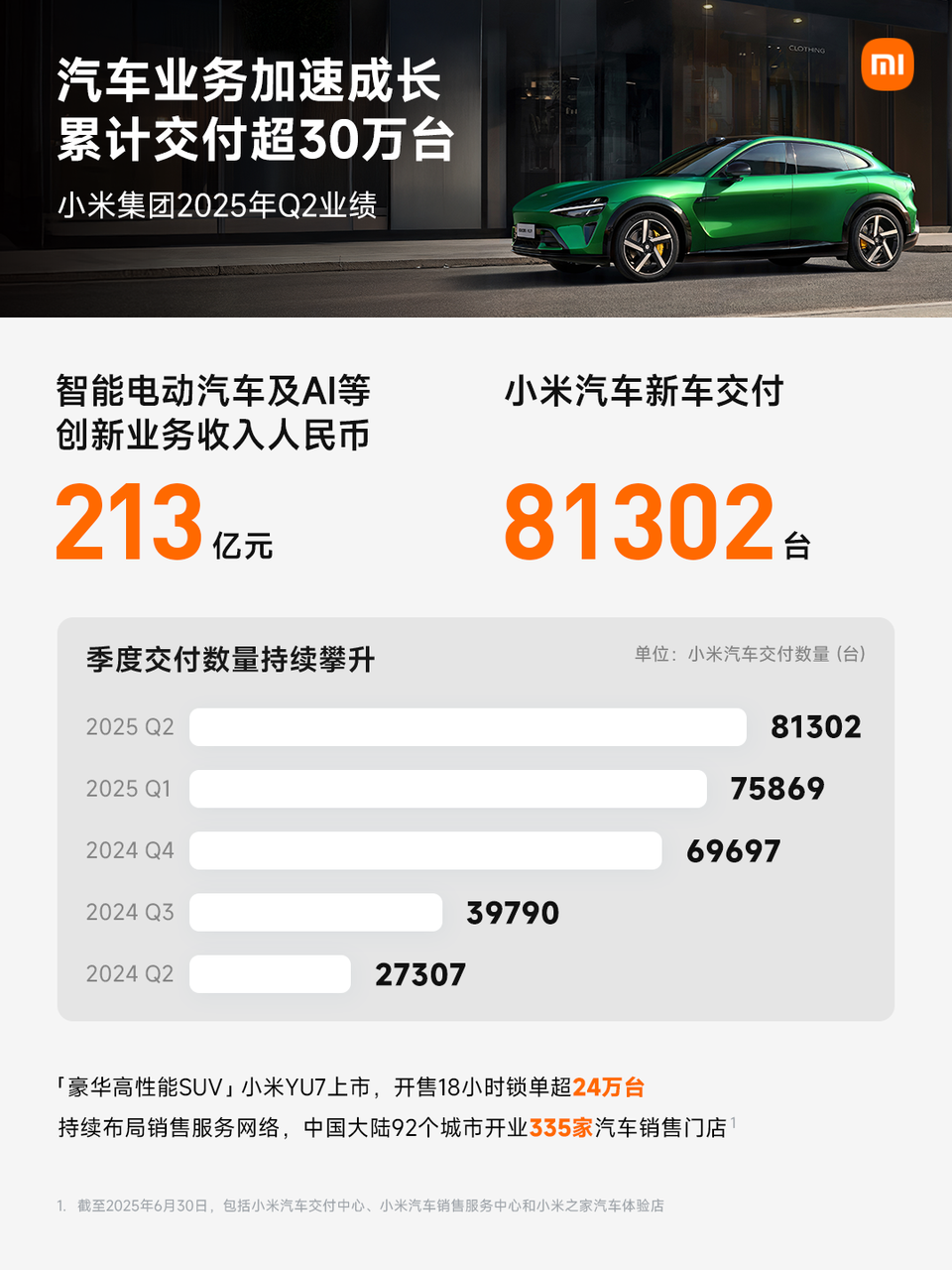
Core Insights - Xiaomi has achieved a remarkable Q2 2025 financial performance with total revenue of 116 billion yuan and a year-on-year growth of 30.5%, marking a historical high amidst a challenging industry environment [1][2][17] - The company's growth is attributed to its "human-vehicle-home ecosystem" strategy, which is not only supporting current financial performance but also establishing growth certainty for the next 3 to 5 years [1][11][17] Financial Performance - Xiaomi's Q2 2025 revenue of 116 billion yuan includes contributions from multiple business lines, with smart electric vehicles and innovative businesses contributing 21.3 billion yuan [2] - The automotive segment generated 20.6 billion yuan in revenue with a record delivery of 81,302 vehicles in a single quarter, indicating a strong position in the domestic new energy vehicle market [2][4] Automotive Business - Despite the YU7 model not yet being delivered, Xiaomi's automotive division delivered a total of 157,000 vehicles in the first half of the year, achieving an average tax-inclusive price of 280,000 yuan [4] - Xiaomi's strategy emphasizes product strength over price competition, with plans to enter the European electric vehicle market by 2027 [4][11] Smartphone and AIoT Performance - In Q2 2025, Xiaomi's global smartphone shipments reached 43 million units, maintaining a market share of 14.7% and ranking among the top three globally for 20 consecutive quarters [5] - The high-end smartphone strategy is showing results, with a 27.6% market share in the high-end segment in China, and significant growth in the 4,000-6,000 yuan price range [5] - The AIoT segment, particularly large home appliances, saw a 66.2% year-on-year revenue growth, with air conditioning units achieving both volume and price growth [5] Ecosystem Strategy - Xiaomi's "human-vehicle-home ecosystem" is a unified strategy that integrates smartphones, vehicles, and home appliances, creating a seamless user experience [9][11] - The company has established itself as a leader in this ecosystem, with other industry players beginning to adopt similar strategies, indicating a broader industry trend [11][12] Competitive Advantages - Xiaomi's competitive edge lies in its technological integration, scale, R&D investment, and strong brand loyalty, which collectively create a robust barrier to entry for competitors [15][16] - The company has invested 102 billion yuan in R&D over the past five years, with a current R&D expenditure of 7.8 billion yuan in Q2 2025, representing 6.7% of its revenue [16] Future Outlook - The automotive business is expected to continue its growth trajectory, potentially becoming a significant profit driver as new models are launched and supply chains are optimized [17] - Xiaomi aims to transition from hardware sales to a model focused on subscription services and data monetization, enhancing its profit margins [17]
大利好!创新高
Zhong Guo Ji Jin Bao· 2025-05-27 11:57
Core Insights - Xiaomi Group achieved record highs in quarterly revenue and adjusted net profit for Q1 2025 [1][3] Financial Performance - Total revenue for Q1 2025 reached over 100 billion yuan for the second consecutive quarter, marking a strong growth trend over six quarters [3] - Adjusted net profit exceeded 10 billion yuan for the first time [3] - Overall gross margin reached 22.8%, an increase of 0.5 percentage points year-on-year, also a record high [3] Market Position - Xiaomi regained the top position in smartphone shipments in mainland China after ten years, with a market share increase of 4.7 percentage points to 18.8% [3] - The shipment growth rate was 40%, significantly outpacing the mainland smartphone market's growth of 4.6% [3] - Globally, Xiaomi maintained a position among the top three smartphone manufacturers for 19 consecutive quarters, with a market share of 14.1% [3] Business Segments - The smart electric vehicle and AI innovation segment generated total revenue of 18.6 billion yuan, with an operating loss of 500 million yuan [2][4] - The home appliance business saw revenue double, with air conditioner shipments exceeding 1.1 million units, a year-on-year increase of over 65% [4] - The washing machine and refrigerator shipments also reached historical highs, with washing machine shipments more than doubling year-on-year [4] Electric Vehicle Performance - The Xiaomi SU7 series achieved high delivery levels, with 75,869 units delivered in Q1 2025, maintaining over 20,000 units delivered monthly for six consecutive months [5] - Cumulative deliveries of the SU7 series exceeded 258,000 units as of May 21, 2025 [5] - Xiaomi aims to expand production capacity to achieve a target of 350,000 units delivered for the entire year of 2025 [5] Stock Market Information - As of May 27, 2025, Xiaomi's stock closed at 51.55 HKD, with a market capitalization of 1.34 trillion HKD [6]