
小米电动汽车

Search documents
小米集团-W(01810):等待基本面拐点,AI战略图景显化:小米集团-W(01810):
Shenwan Hongyuan Securities· 2026-03-26 10:30
Investment Rating - The investment rating for the company is "Buy" (maintained) [1] Core Views - The report highlights the need to wait for a fundamental turning point, with a clearer picture of the AI strategy emerging [6] - The company has adjusted its profit forecasts for 2026 and 2027, maintaining a "Buy" rating despite the downward revisions [8] Financial Data and Earnings Forecast - Revenue projections for the company are as follows: - 2024: 365.9 billion RMB - 2025: 457.3 billion RMB - 2026E: 504.8 billion RMB - 2027E: 593.0 billion RMB - 2028E: 698.0 billion RMB - Year-on-year growth rates are projected at 35% for 2024, 25% for 2025, 10% for 2026, 17% for 2027, and 18% for 2028 [7] - Adjusted net profit forecasts are: - 2024: 27.3 billion RMB - 2025: 39.2 billion RMB - 2026E: 33.4 billion RMB - 2027E: 41.4 billion RMB - 2028E: 51.4 billion RMB - The report indicates a decrease in adjusted net profit for 2026 and 2027 compared to previous estimates [8][11] Business Segments - Smartphone segment: - Revenue for 2025 is projected at 186.4 billion RMB, with a year-on-year decrease of 3% - The average selling price (ASP) is expected to increase by 5% in 2026, reaching 1,185 RMB per unit [8] - IoT segment: - Revenue for 2025 is projected at 123.2 billion RMB, with a year-on-year growth of 18% - The report notes that the slowdown in growth is due to national subsidies and increased competition [8] - Internet services: - Revenue for 2025 is projected at 37.4 billion RMB, with a year-on-year growth of 10% [8] - Electric vehicles: - The company aims to deliver 550,000 vehicles in 2026, with a target of 410,000 deliveries in 2025 [8] Valuation - Based on a sum-of-the-parts (SOTP) valuation, the target valuation for the company is 986.7 billion RMB, indicating a potential upside of 33% from the current market value [15]

纽约时报:我刚从中国回来,美国赢不了
美股IPO· 2026-02-12 04:03
Core Viewpoint - The article argues that the United States is not winning in its competition with China, particularly in manufacturing, artificial intelligence, and drug development, and emphasizes the need for internal reform in the U.S. to address these challenges [3][4]. Group 1: Manufacturing and Trade - China remains the world's largest exporter, with a trade surplus reaching $1.2 trillion last year, indicating that many Chinese goods still reach the U.S. despite tariffs [5]. - The article highlights advancements in China's electric vehicle industry, showcasing companies like Xiaomi, which has entered the EV market, and emphasizes the impressive manufacturing capabilities observed during a visit to a factory [5]. - In 2024, the number of industrial robots installed in China is projected to be nearly nine times that of the U.S., reflecting China's significant progress in automation and robotics [5]. Group 2: Technology and Innovation - China has made remarkable strides in artificial intelligence, with its power generation capacity being more than double that of the U.S., allowing for cost-effective data center operations [4]. - The success of Chinese AI products, such as Manus, which was sold to Meta for over $2 billion, illustrates the rapid development in this sector [4]. - In drug development, China has surpassed the number of drug authorizations it receives from other countries, indicating a shift towards becoming a leader in pharmaceutical innovation [6]. Group 3: Policy and Economic Strategy - The article calls for a reevaluation of U.S. industrial policy to support strategic industries, particularly in technology, rather than focusing solely on traditional manufacturing [7]. - It emphasizes the need for the U.S. to reverse cuts to scientific and technological investments made during the Trump administration, advocating for a more balanced approach to resource allocation [7]. - The article suggests that overcoming China's competitive edge requires domestic economic reform and a shift in focus towards future industries, rather than relying on tariffs or trade negotiations [7].


福特CEO自述拆解特斯拉及中国电动车后“自愧不如”,“发现的东西令人震惊”
Huan Qiu Wang· 2025-11-12 09:01
Core Insights - Ford's CEO Jim Farley expressed shock after analyzing Tesla and Chinese electric vehicle (EV) brands, realizing they are significantly ahead in the market, prompting a comprehensive reform within Ford [1][3] Group 1: Competitive Analysis - Disassembling competitors' products is a common practice in the automotive industry, and Ford's analysis of the Tesla Model 3 and Chinese vehicles revealed surprising findings [3] - Ford's Mustang Mach-E has approximately 1.6 kilometers more wiring than Tesla vehicles, which increases weight and necessitates larger, more expensive batteries [3] Group 2: Market Dynamics - Chinese automakers are surpassing most Western competitors by launching a range of technologically advanced and affordable electric vehicle models, rapidly capturing market share in Europe and other emerging markets [3] - The electric vehicle market in China is experiencing explosive growth, with Farley stating that Ford will not abandon its electric vehicle initiatives [3] Group 3: Perception of Chinese EVs - Farley has previously acknowledged the rise of Chinese EV companies as a "threat" to Western manufacturers but has also shown admiration for their products, having driven a Xiaomi electric vehicle for six months [3] - In June, Farley stated that Chinese electric vehicles are "far superior" to their Western counterparts, and in October, he noted that Chinese brands are "completely dominating" the global electric vehicle market landscape [3]



大摩:小米新款手机销量料强劲 汽车定制服务将成重要竞争优势
Ge Long Hui· 2025-09-26 01:25
Core Viewpoint - Morgan Stanley believes that the Xiaomi 17 series will see strong sales due to its quality and high cost-performance ratio, which will help accelerate Xiaomi's market share growth in the high-end smartphone sector [1] Group 1: Smartphone Business - Analysts, including Andy Meng, indicate that Xiaomi's strong sales in the Xiaomi 17 series will enhance its position in the high-end smartphone market [1] - The report emphasizes the importance of quality and cost-effectiveness in driving sales for the Xiaomi 17 series [1] Group 2: Electric Vehicle Business - Xiaomi has initiated a dedicated customization service in its electric vehicle business, which is expected to become a core competitive advantage [1] - Although the initial monthly production is only 40 vehicles, there is confidence that this service will scale as the utilization rate of the new electric vehicle factory increases [1] - The customization model is anticipated to be extended to most vehicle models, aiding Xiaomi in maintaining a steady flow of new orders [1] Group 3: Investment Rating - The report maintains an overweight rating for Xiaomi, reflecting confidence in its growth prospects in both the smartphone and electric vehicle sectors [1]
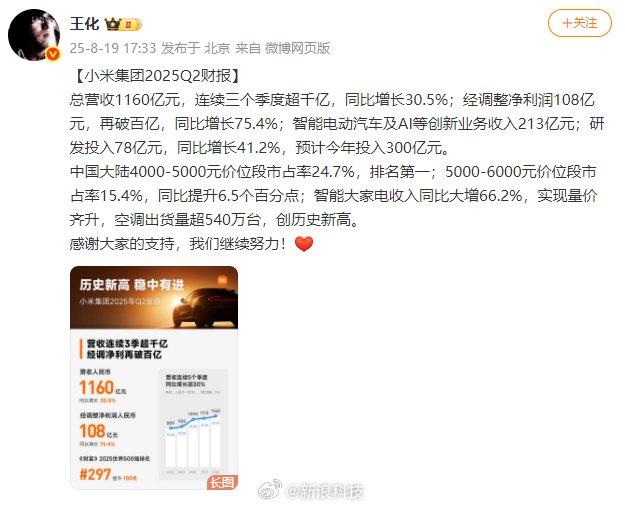
小米第二季度交付新车超8万辆,电动汽车收入206亿元
Xin Lang Ke Ji· 2025-08-19 10:17
Core Insights - Xiaomi reported delivering over 80,000 new vehicles in the second quarter [1] - The revenue from electric vehicles in the second quarter reached 20.6 billion yuan [1] Summary by Categories Company Performance - Xiaomi's second quarter vehicle deliveries exceeded 80,000 units [1] - The electric vehicle revenue for the second quarter was 20.6 billion yuan [1] Market Response - Wang Hua expressed gratitude for the support received and emphasized the company's continued efforts [1]
财联社汽车早报【8月14日】
Xin Lang Cai Jing· 2025-08-14 00:41
Regulatory Developments - The State Administration for Market Regulation and the Ministry of Industry and Information Technology are drafting a notice to strengthen the recall and supervision of intelligent connected new energy vehicles, emphasizing that companies must not mislead consumers regarding the capabilities of driving assistance systems [1] - The notice aims to prevent exaggerated marketing claims that could lead to consumer misuse of vehicles, with increased oversight on advertising practices [1] Market Performance - From August 1 to 10, the retail sales of passenger vehicles in China reached 452,000 units, a year-on-year decrease of 4%, but a month-on-month increase of 6% [3] - Cumulatively, retail sales for the year have reached 13.198 million units, reflecting a 10% year-on-year growth [3] - In the same period, new energy vehicle sales were 262,000 units, marking a 6% year-on-year increase and a 6% month-on-month increase, with a cumulative total of 6.717 million units sold this year, up 28% year-on-year [3] - The penetration rate for new energy vehicles in retail sales was 57.9%, while the wholesale penetration rate was 56.8% [3] Corporate Actions - GAC Group approved a capital increase of 600 million yuan for GAC Aion to acquire a 71.43% stake in Huawei's automotive subsidiary, Huawang Automotive [4] - GAC Group has launched a city recruitment plan for Huawang Automotive, focusing on major cities such as Beijing, Shanghai, and Shenzhen, adhering to a "few dealers, many stores" principle [6] Competitive Landscape - Morgan Stanley predicts that if Xiaomi's electric vehicle deliveries significantly increase, its stock price could rise by 15% to 20% in the next 3 to 4 months, with expectations of monthly deliveries reaching 40,000 units by the fourth quarter [8] - Nissan reported a July sales figure of 52,655 units in China, a year-on-year increase of 19.4%, indicating a need for the company to accelerate adjustments to enhance market share in a competitive environment [9][10] Product Launches - The 2026 model of the Deep Blue L07 has been launched with a starting price of 135,900 yuan, featuring advanced driving assistance systems and a maximum range of 1,500 km in range-extended mode [11] - The vehicle is noted for being the only model in its price range to feature Huawei's advanced driving technology across all variants [12] Financial Outlook - Porsche has revised its adjusted net profit forecast for 2025 to between 1.6 billion and 3.6 billion euros, down from a previous estimate of 2.4 billion to 4.4 billion euros, citing current market dynamics as a reason for the adjustment [12]
摩根大通:如果小米电动汽车交付量显著增长 其股价有望上涨 15-20%
Jin Rong Jie· 2025-08-13 05:00
Core Viewpoint - Morgan Stanley indicates that Xiaomi's stock price could rise by 15% to 20% in the next 3 to 4 months if there is a significant increase in electric vehicle deliveries following a recent decline due to profit downgrade concerns [1] Group 1: Electric Vehicle Deliveries - Analysts, including Gokul Hariharan, have placed Xiaomi's stock on a "positive catalyst watch list," anticipating that monthly electric vehicle deliveries will reach 40,000 units at some point in the fourth quarter [1] - Xiaomi's electric vehicle delivery volume has been hovering around 30,000 units for several months, and any increase would support the valuation of its electric vehicle business [1] Group 2: Stock Performance and Market Sentiment - Over the past month, Xiaomi's stock has underperformed compared to the benchmark index, as investors expect a slowdown in profits from its core smartphone and IoT businesses in the second half of the year [1] - Morgan Stanley maintains a "neutral" rating on Xiaomi's stock with a target price of HKD 60 [1]
“十四五”数字彰显中国优势
Sou Hu Cai Jing· 2025-07-19 02:32
Group 1 - China's consumer market remains the second largest globally, with a projected retail sales total of over 50 trillion RMB in 2023, reflecting an average annual growth of 5.5% over the past four years [3][4] - The contribution of consumption to China's economic growth has reached approximately 60%, highlighting the shift towards a domestic demand-driven growth model [3][4] - China's foreign trade has shown resilience, with goods trade expected to reach 6.16 trillion USD by 2024, marking a 32.4% increase from the end of the 13th Five-Year Plan in 2020 [4][5] Group 2 - The structure of China's exports has shifted, with high-tech products accounting for 18.2% of total goods trade by 2024, indicating an upgrade in technological capabilities [5] - The trade relationship with the US remains stable despite challenges, with bilateral trade expected to reach 688.3 billion USD in goods and 155.8 billion USD in services by 2024, reflecting growth since 2017 [6] - China's trade partnerships have diversified, with ASEAN remaining the largest trading partner for five consecutive years, and trade with Belt and Road Initiative countries exceeding 50% [5][6] Group 3 - The recent approval of NVIDIA's H20 chip sales to China marks a shift in US export control strategy, indicating a potential thaw in technology-related tensions [7] - Chinese officials emphasize the importance of foreign investment and the attractiveness of the Chinese market for multinational companies, particularly in the AI sector [7] - The resilience of China's economy against tariffs has exceeded many analysts' expectations, although challenges in imports and domestic demand persist [8][9]


小米集团-W:升目标价至70港元,重申“买入”评级-20250528
Daiwa Securities· 2025-05-28 09:40
Investment Rating - The report maintains a "Buy" rating for Xiaomi Group-W (01810) [1] Core Insights - Daiwa Securities raised the target price for Xiaomi from HKD 65 to HKD 70, an increase of 7.7%, based on a 38x P/E ratio for 2025-26 and a 4.4x P/S ratio for the electric vehicle business [1] - Xiaomi's Q1 2025 performance exceeded market expectations by 13% in adjusted net profit, with gross profit margins for IoT and electric vehicles surprising positively, exceeding market expectations by 4 percentage points and 2 percentage points respectively [1] - The upcoming investor day on June 3 and the listing of YU7 in July are expected to serve as short-term catalysts for the stock [1] - Based on the revised gross profit margin forecasts for electric vehicles and IoT, the report has increased the earnings per share estimates for 2025-27 by 8-19% [1]
德银:维持小米买入评级 上调目标价
news flash· 2025-05-06 04:51
Core Viewpoint - Deutsche Bank maintains a buy rating on Xiaomi and raises the target price from HKD 71.50 to HKD 74.00 [1] Group 1: Electric Vehicle Business - Xiaomi's electric vehicle business saw a month-on-month decline in new orders in April [1] - The reduction in advertising for autonomous driving may have contributed to the pressure on new orders [1] - The second electric vehicle factory is expected to commence production in the second half of 2025, with an anticipated support for sales of 50,000 to 150,000 vehicles this year [1] Group 2: Profitability Expectations - Deutsche Bank forecasts that the gross margin for Xiaomi's electric vehicle business may further increase to approximately 22% in the first quarter [1] - The annual gross margin is expected to rise to 24.7% [1]