
小鹏Mona 03

Search documents
汽车及汽车零部件行业研究:智驾行业2026年投资策略:从辅助驾驶走向物理AI
SINOLINK SECURITIES· 2026-03-02 05:13
观点一:智驾平权 2.0,支撑智驾赛道全年高景气度。 展望 2026 年整车行业面临补贴退坡、原材料涨价等多重压力,市场担心主机厂对智能驾驶功能是否会减配。我们研 究发现 26 年智驾平权趋势非但不会放缓,而是会进入 2.0 阶段,城市 NOA(领航辅助驾驶功能)开始走向千家万户, 背后的原因在于:1)过去 2-3 年智驾景气度的本质来源是新能源车内卷背景下的主机厂增配,这一强大的供给端驱 动力在 2026 年依然存在并且增强。2)小鹏 Mona 已经证明 10-20w 低价格带消费者对优质智驾功能同样具有需求。在 供给和需求双重驱动力下,我们测算 2026 年城市 NOA 硬件配置渗透率有望从 2025 年 16%提升至 25%,全年搭载城市 NOA 功能硬件配置销量有望达到 545 万,同比增速超过 50%。 观点二:L2 进入强监管政策周期,L3/L4 法规体系逐步建立。 1)L2 强监管政策周期下检测类机构充分受益:L2 强标是强监管政策落地最重要的执行依据,目前已进入报批阶段。 此次我国 L2 强覆盖范围广、所涉及检测车型多;同时由于测试严格程度强、检测项目多,预计单次检测价值量较高; 因此我们预计 ...






多地暂停汽车国补
Nan Fang Du Shi Bao· 2025-09-30 15:24
Core Viewpoint - The recent suspension of the "old-for-new" vehicle subsidy across multiple regions in China is a strategic adjustment by local governments to manage the annual subsidy budget effectively, rather than a reduction in support for the automotive industry [1][2][7]. Group 1: Policy Changes - Various regions, including Jiangsu and Zhejiang, have announced the suspension of their vehicle "replacement and update" subsidies, with specific deadlines set for different areas [2][3]. - The Guangzhou government has also adjusted its vehicle "replacement and update" policy, with a deadline for subsidy applications set for September 30, 2025 [3]. Group 2: Financial Support - The National Development and Reform Commission (NDRC) has allocated a total of 300 billion yuan in special bonds to support the "old-for-new" vehicle program, with the latest batch of 69 billion yuan recently distributed to local governments [4][7]. - The total number of applications for the "old-for-new" vehicle program reached 8.3 million as of September 10, 2025, indicating strong consumer interest [7]. Group 3: Market Impact - Automotive dealers express concerns that the suspension of subsidies may negatively impact sales, particularly for certain models that consumers are currently considering [8]. - The suspension of the subsidy may lead to a decline in sales, as some sales may have been anticipated based on the availability of these subsidies [8].

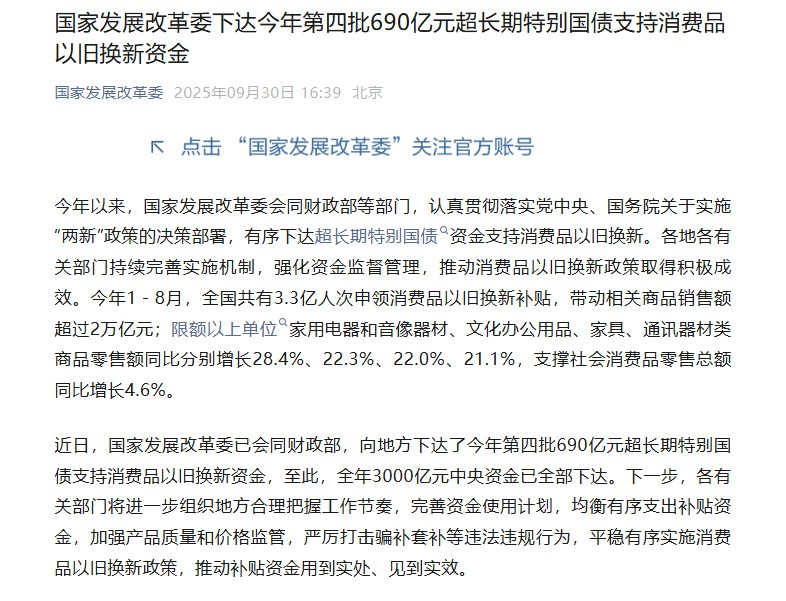
多地汽车国补暂停?发改委:第四批消费品以旧换新资金已下达
Nan Fang Du Shi Bao· 2025-09-30 12:13
Core Viewpoint - The recent suspension of the "old-for-new" vehicle subsidy across multiple regions in China is a strategic adjustment by local governments to ensure the smooth and orderly use of annual subsidy funds, rather than a reduction in support for the automotive industry [1][2][8]. Group 1: Policy Changes - Various regions, including Jiangsu and Zhejiang, have announced the suspension of their vehicle "replacement and update" subsidies, with specific deadlines set for October 2025 [2][3]. - The Guangzhou Municipal Bureau of Commerce has also adjusted its vehicle "replacement and update" policy, with applications for subsidies ending on September 30, 2025 [3][5]. - The Guangdong Provincial Automobile Circulation Association indicated that the end dates for subsidies vary by city, depending on the actual usage of subsidy funds [5]. Group 2: Financial Support - The National Development and Reform Commission (NDRC) announced the allocation of 69 billion yuan in special bonds to support the "old-for-new" vehicle program, completing the annual allocation of 300 billion yuan [6][8]. - As of September 10, 2025, the number of applications for the "old-for-new" vehicle program reached 8.3 million, indicating strong consumer interest [8]. Group 3: Market Impact - The suspension of subsidies may impact vehicle sales, as some dealers express concerns about the potential decline in demand for certain models due to the lack of available subsidies [8]. - The automotive industry analyst noted that the adjustment in subsidy policies is a form of refined regulatory control rather than a decrease in national support [8]. Group 4: Consumer Guidance - Consumers are advised to distinguish between "scrapping" and "replacement" subsidies, as many regions continue to implement scrapping subsidies while suspending replacement subsidies [9]. - It is important for consumers to stay updated on local subsidy policies, as adjustments may occur based on funding availability, and to be aware of application deadlines to avoid missing out on potential benefits [9].
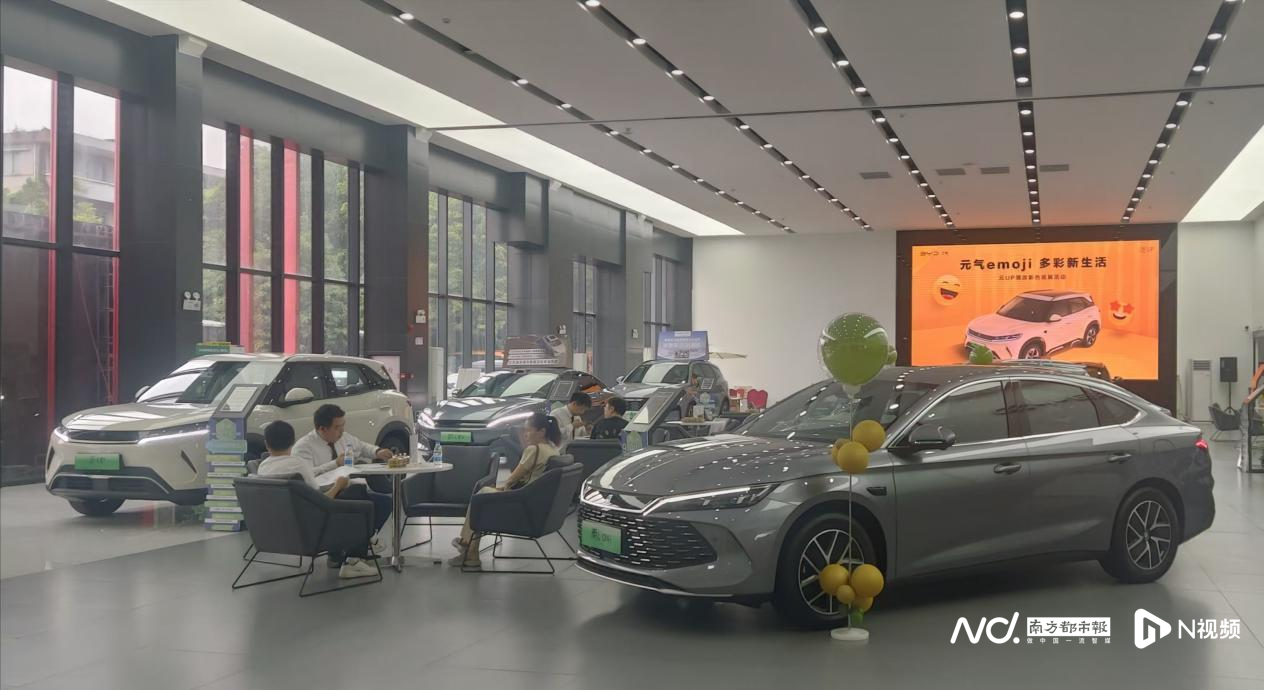
乘用车研究框架:聚焦“顺周期“供给,寻找整车的阿尔法
2025-08-21 15:05
Summary of Key Points from the Conference Call Industry Overview - The automotive industry investment opportunities should consider fundamentals (industry cycle and economic cycle), market conditions, and the impact of policies such as purchase tax incentives on the sector's performance [1][4][6] Core Insights and Arguments - The industry cycle is driven by technological iterations (e.g., electric vehicles) and changes in consumer demand (e.g., family car needs), leading to structural market changes such as the rise of SUVs and electric vehicles, which generate excess returns [1][5] - Economic cycles and policy rhythms jointly influence automotive demand, with government incentives like purchase tax reductions stimulating consumption and guiding consumption structure, particularly increasing the penetration rate of electric vehicles [1][6] - Optimal investment timing in the automotive sector typically occurs during periods of economic improvement coinciding with industry trends, such as the SUV boom from 2009-2010 and the electric vehicle surge from 2020-2021 [1][7] Investment Alpha - Investment alpha in the automotive sector is reflected in new product supply and pricing systems. New product supply must align with industry cycles, exemplified by BYD's DMI 4.0 hybrid technology. A strong pricing system indicates competitive strength, with stable prices suggesting robust competitiveness [1][9][10] - Tracking price changes within narrow price bands can help assess the competitiveness and growth potential of automakers. Long-term price stability indicates strong competitiveness, while price reductions to maintain sales suggest weakening competitiveness [10][11] Development Opportunities - Future development opportunities in the automotive industry include internationalization and exports, as well as the high-end pure electric vehicle cycle. Companies that can quickly localize manufacturing and export on a large scale will find significant opportunities [2][17][20] - The high-end pure electric vehicle market is expected to grow as early electric vehicles enter the replacement phase, with improvements in product cost-performance ratios and infrastructure [19] Historical Context - Historical periods of significant investment opportunities in the automotive sector include the SUV peak from 2016-2017 and the full-scale launch of electric vehicles in 2020-2021, where favorable economic conditions and strong industry trends led to substantial excess returns [7][8] Consumer Demand and Technology - Adapting to changes in consumer demand and technological upgrades is crucial for automakers' sustained growth. For instance, companies like Li Auto design products targeting family needs, while BYD addresses high hybrid system costs with innovative technology [12][13] Market Dynamics - The cyclical trends in the automotive industry significantly impact automakers' stock prices and fundamentals, with qualitative assessments shifting from skepticism to optimism based on successful product launches, followed by quantitative evaluations as sales and profitability improve [14][18] Identifying Core Investment Points - Core investment points in the automotive sector include early positioning during initial market phases and following trends as they solidify. For example, investing in companies like XPeng during product improvements can yield high returns [15][16] Conclusion - The automotive industry is poised for growth driven by technological advancements, changing consumer preferences, and favorable economic conditions. Companies that effectively navigate these dynamics and capitalize on emerging trends will likely achieve significant success in the evolving market landscape [17][20]
蔚来的加时赛,和中国车企的循环赛
乱翻书· 2025-03-19 07:57
上周五做了场直播,聊蔚来的加时赛和中国汽车的循环赛。加时赛这个词是从上周一36氪那篇蔚来变革文章里面李斌说的, " 别家孩子已经考上大学,我 们还在复读。 " 用联赛循环赛替代王兴提的那个杯赛淘汰赛模型,是因为老编辑觉得之前王兴提的"四大分组(央企、地方国企、民企、新势力)进淘汰赛"模型需要修 正,汽车行业的"淘汰赛"更像联赛而非真正淘汰,不同梯队企业将长期共存。 "未来将是一个联赛而非淘汰赛,大约有7-8家甚至10家主要玩家,会有进有出。"出现比较严重治理危机的这些大集团及其旗下孵化的一些新 能源品牌,他们一旦出现问题之后,还是会给这些新势力让出一部分市场份额的。大家熬到淘汰赛,可能不是通过'我战胜了小米、华为',而 是'我熬死了魅族、乐视'。 老编辑 嘉宾是王洪浩、蟹老板、还有阑夕和老编辑,其中老编辑是在直播的最后环节才加入的,因为那会他是真的刚下飞机,在机场候机楼跟我们连麦。 小鹏汽车新车发布会后,有人拿李斌复读这个观点问何小鹏,何小鹏说,如果蔚来李斌是在复读,"我也在复读",暗示整个行业都面临挑战。他进一步表 示,小鹏当前不是从"ICU到KTV",而是从"ICU的病床到ICU的门口","目前没有任何一 ...