
开源AI模型

Search documents
英伟达联手韩国:可不能让全球对中国技术上瘾
Guan Cha Zhe Wang· 2026-03-17 03:27
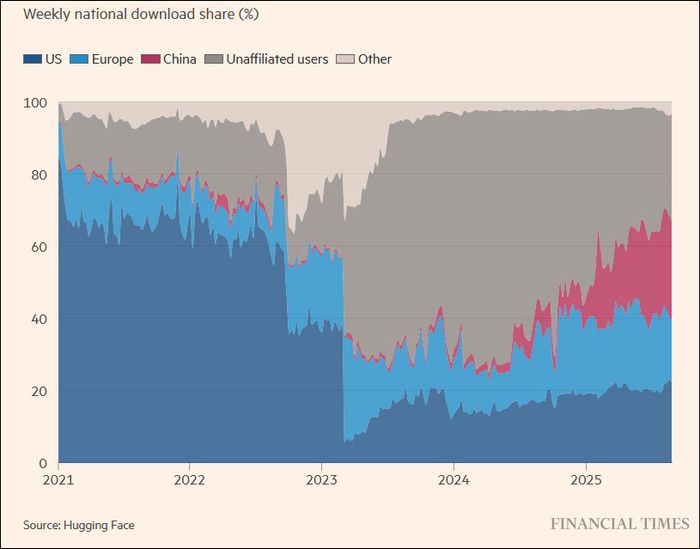
Group 1 - Reflection AI, a US-based AI startup backed by Nvidia, is collaborating with South Korea's Shinsegae Group to build one of the largest AI computing data centers in Korea, with a power consumption of 250 megawatts, equivalent to that of a small US city [1] - The total investment for this project is reported to be in the billions, with specific amounts not disclosed, and the data center will require thousands of chips supplied entirely by Nvidia [1] - Reflection AI aims to develop customized models for the Korean language and culture to support local enterprises and government agencies, contributing to Korea's AI technology autonomy [1] Group 2 - The collaboration highlights the Trump administration's strategy of using AI chips and models as diplomatic leverage to strengthen ties with allies, with similar agreements already established with the UAE and Saudi Arabia [2] - The urgency behind the US's technological initiatives stems from concerns over China's rapid advancements in AI, particularly with the emergence of open-source AI models from Chinese companies gaining global attention [2] - Reflection AI's CEO emphasized the importance of preventing reliance on Chinese technological infrastructure, referring to open-source models as a "Trojan horse" that encompasses chips, software, and applications [2] Group 3 - Reflection AI and Shinsegae Group have strong political ties to the Trump administration, with significant investors linked to Trump, which has contributed to the company's rapid valuation growth, potentially reaching $20 billion [3] - The company's valuation surged from $5.45 billion in a previous funding round to $80 billion in October last year, indicating a significant increase in investor interest [3] - The collaboration is seen as a pivotal moment for Korea's AI ecosystem, with expectations for substantial growth opportunities [3] Group 4 - Despite the US's efforts to bind allies through technology to counter China, experts suggest that such strategies may backfire, as restrictions on AI chip exports could accelerate China's domestic AI development [4] - A report indicates that by 2025, China's share of global downloads for open-source models is expected to reach 17.1%, surpassing the US's 15.8%, positioning China as a leader in this domain [4]



英媒:美国All in AI,中国多线下注,美国可能输得更多
Xin Lang Cai Jing· 2025-12-14 15:39
Core Viewpoint - The article warns that while the U.S. is heavily investing in AI, it may win the AI race but lose broader economic dominance, as the approach is overly focused on AI at the expense of diversifying investments in other critical technologies [1][2]. Investment Trends - U.S. tech companies have invested over $350 billion in AI-related infrastructure in the past year, with projections to exceed $400 billion by 2026, significantly outpacing China's investment of nearly $100 billion [2]. - The article highlights that while the U.S. is betting heavily on AI, China is taking a more diversified and pragmatic approach, investing in various sectors such as electric vehicles, batteries, and renewable energy [3][7]. Strategic Differences - The U.S. tech industry is characterized by a high concentration of investment in AI, which may lead to collective blind spots and increased risks due to the monopolistic structure [3][8]. - In contrast, China's strategy involves a broader investment in multiple future technologies, with significant capital expenditures projected to reach $940 billion in clean energy by 2024, overshadowing AI investments [7]. Cultural and Economic Factors - The article suggests that Silicon Valley's obsession with AI may stem from cultural factors, where there is a tendency to over-invest in new ideas, and from an economic perspective, spending on projects is preferred over stock buybacks [8][9]. - There is a concern that the substantial investment in AI by U.S. tech giants may serve to reinforce their monopolistic positions rather than genuinely advance human welfare [9].

“当美国孤注一掷AI时,中国正赢得多场科技赛跑”
Guan Cha Zhe Wang· 2025-12-14 08:47
Core Viewpoint - The article warns that while the U.S. is heavily investing in AI, it may win the AI race but lose broader economic dominance, as the U.S. is betting everything on AI while China diversifies its investments across various technologies [1][2]. Investment Trends - U.S. tech companies have invested over $350 billion in AI-related infrastructure in the past year, with projections to exceed $400 billion by 2026, significantly outpacing China's nearly $100 billion total investment in AI [2]. - In contrast, China is investing heavily in other sectors such as electric vehicles, batteries, and renewable energy, which may yield more stable returns compared to the speculative nature of AI investments [3][7]. Strategic Differences - The U.S. approach to AI is characterized by a focus on proprietary models and a belief in the transformative potential of AGI, while China adopts a more pragmatic stance, viewing AI as a tool for industrial efficiency rather than a path to superintelligence [6][7]. - China is also investing approximately $9.4 trillion in clean energy capital expenditures in 2024, overshadowing its AI investments, indicating a broader strategic focus [7]. Risks and Market Dynamics - The concentration of investment in a few major U.S. tech companies raises concerns about collective blind spots and the potential for market instability, as these companies dominate decision-making in AI investments [5][8]. - The article suggests that the narrative of an AI race serves as a lobbying tool for the U.S. tech industry, justifying high levels of spending while neglecting investments in other critical areas like clean energy [8][9]. Cultural and Economic Factors - The article posits that cultural factors in Silicon Valley may lead to excessive investment in new ideas, while economically, spending on tangible projects is often preferred over stock buybacks [8]. - There is a darker interpretation that the significant investment in AI by tech giants may be a strategy to reinforce their market dominance and prevent competition from startups, rather than a genuine commitment to advancing human welfare [9].

“中国首次在这一市场中超越美国”
Xin Lang Cai Jing· 2025-11-26 16:25
Core Insights - China has surpassed the United States in the global open-source AI model market, with Chinese teams accounting for 17% of open-source AI model downloads, compared to 15.8% from the U.S. [1][2] Group 1: Open-Source AI Models - Open-source AI models allow developers to download, use, modify, and distribute AI models freely, which facilitates product development and research improvements [1][2] - Chinese technology companies are adopting a more open strategy, frequently releasing new models, while U.S. companies tend to follow a closed approach, releasing models less frequently [4][5] Group 2: Competitive Landscape - The DeepSeek and Alibaba Cloud's Qwen are among the most downloaded Chinese open-source models, with DeepSeek-R1 being particularly noted for its low cost and performance comparable to top U.S. models [2][4] - Despite U.S. export controls on chips, China continues to demonstrate strong talent and creativity in developing open-source models [4] Group 3: Market Trends - A significant portion of startups, estimated at 80%, are now using Chinese open-source models, indicating a shift in preference towards these models [4] - While proprietary models from U.S. companies generate higher revenues, open-source models are gaining traction for their adaptability and ease of use in various applications [5]
巨头访华后连夜警告白宫,3场大战赔了数千亿,美国这次输得一点不冤
Sou Hu Cai Jing· 2025-11-13 04:02
Group 1 - The core viewpoint of the article is that the U.S. has underestimated China in the ongoing trade, tariff, and technology wars, leading to failures in all three fronts [1][3][10] - The U.S. initially believed it could leverage its significant trade deficit to force concessions from China, but China's strategic responses, particularly in rare earths and soybeans, revealed the vulnerabilities in the U.S. position [3][5] - The trade war has not fundamentally harmed China's exports; instead, it has increased costs for American consumers, leading to higher inflation rates in the U.S. [5][9] Group 2 - The technology war has seen the U.S. struggle against China's advancements, particularly in AI, where China's cost-effective and rapidly iterating models are gaining traction among global developers [7][9] - U.S. politicians have attempted to restrict Chinese technology through bans and entity lists, but they have overlooked the essential factors driving innovation, such as data availability and application scenarios, where China holds significant advantages [7][9] - Investment sentiment is shifting, with U.S. investors recognizing the potential of Chinese innovation and economic dynamism, as evidenced by a reported 11.2% year-on-year increase in actual foreign investment in China [9][10]
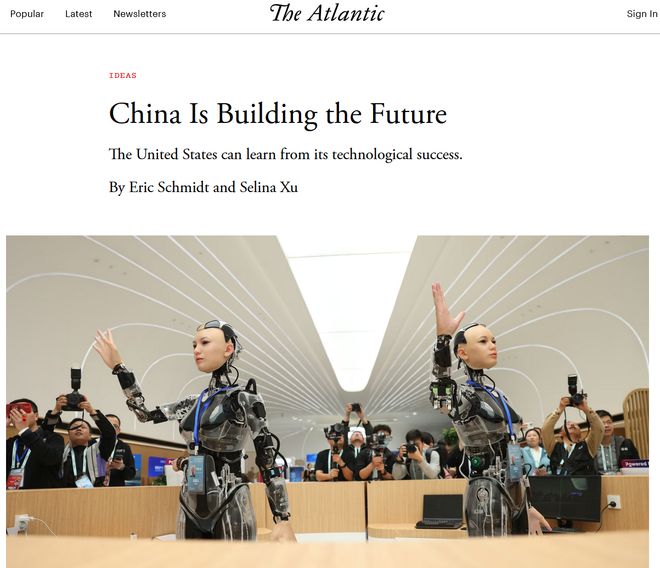
谷歌前CEO:中国正在塑造未来
Guan Cha Zhe Wang· 2025-11-10 09:33
Core Viewpoint - The article emphasizes China's remarkable resilience and innovation in technology and manufacturing, showcasing its position as a global leader despite economic slowdowns [1][4][6]. Group 1: China's Technological and Manufacturing Dominance - China is the world's largest manufacturer and exporter, producing over two-thirds of global electric vehicles, four-fifths of photovoltaic components and battery cells, and approximately 60% of wind turbines [1][4]. - The country processes the majority of the world's rare earth materials, essential for various technologies from chips to military aircraft [1]. - China's industrial robot installations account for about half of the global total, with high-speed rail mileage and 5G base stations also representing over 70% and 50% of the global totals, respectively [4]. Group 2: Success Stories of Chinese Companies - Xiaomi, once seen as an imitator of Apple, has become one of China's most valuable companies with a market capitalization of approximately $150 billion and is set to launch its first electric vehicle in 2024 [4]. - Huawei has expanded from telecommunications equipment to producing automotive components, while Alibaba is developing AI inference chips for its AI models [5]. - The article highlights the importance of China's existing supply chain, infrastructure, and skilled workforce in supporting the rapid development of these companies [4][5]. Group 3: Open Source AI and Global Influence - The open-source movement in China's AI sector is flourishing, with major companies like Alibaba, ByteDance, and Baidu releasing open-source AI models, which could enhance China's technological competitiveness and attract more developers [5][6]. - China holds 70% of global AI patent authorizations and leads in clean energy technology patent applications, indicating its growing influence in these fields [6]. Group 4: Implications for the U.S. and Global Dynamics - The article suggests that if the U.S. aims for re-industrialization, it must focus on supporting research, attracting talent, and removing regulatory barriers, while acknowledging its shortcomings in hardware and AI diversity [6][7]. - A warning is issued that if the U.S. continues to adopt a hostile stance towards China, it risks becoming more closed off and protectionist, potentially losing its status as a leading global power [7].




英伟达又投了,这家AI大模型公司要做美国“DeepSeek”
Hua Er Jie Jian Wen· 2025-10-10 03:06
Group 1 - Nvidia led a $2 billion funding round for Reflection AI, investing $800 million and increasing the company's valuation to $8 billion [1] - Reflection AI aims to create an open-source AI model to compete with proprietary models like those from OpenAI and Google, addressing a perceived gap in the market [1][3] - The funding round occurred just seven months after a previous $130 million Series A round, highlighting a significant increase in valuation from approximately $545 million [1] Group 2 - Nvidia's investment strategy includes both open-source and closed-source AI models, ensuring a competitive edge in a diversifying technology landscape [2] - The collaboration between Nvidia and Reflection AI involves technical support, enhancing Reflection AI's computational efficiency and model performance [2] - The AI industry is witnessing a shift towards open-source models, with Reflection AI positioning itself as a challenger to established players [3] Group 3 - Reflection AI's CEO emphasizes the need for the U.S. to establish a competitive advantage in open-source AI, likening the current situation to a space race during the Cold War [3] - The company acknowledges the increasing demand for funding to maintain competitiveness in a rapidly evolving market [3] - Reflection AI's leadership is optimistic about the company's potential to grow into a major player, potentially surpassing current large-scale cloud service providers [3]