
异质结(HJT)电池

Search documents
马斯克团队来华密访光伏企业,重点看的是什么?
36氪· 2026-02-10 13:30
Core Viewpoint - The recent visit of Elon Musk's team to several Chinese photovoltaic companies has sparked significant market interest and speculation about potential collaborations in the solar energy sector [5][6]. Market Reaction - Following the news, Chinese photovoltaic stocks experienced notable price increases, with companies like JinkoSolar seeing a 36% surge over two trading days, while GCL-Poly and TCL Zhonghuan also reported substantial gains of 26% and 16%, respectively [6]. - Analysts suggest that the stock price increases are driven more by market sentiment and expectations rather than fundamental changes in the companies' performance [9]. Industry Insights - The visit reflects a strategic interest from global tech giants in the renewable energy sector, particularly as the demand for stable and efficient power sources grows alongside advancements in artificial intelligence [7]. - Chinese companies dominate the global photovoltaic supply chain, accounting for over 70% of production capacity and shipments, making them essential for Musk's ambitions in space solar energy [10]. Technological Focus - Musk's team showed particular interest in next-generation technologies such as Heterojunction (HJT) and perovskite solar cells, which are believed to offer advantages in efficiency and cost reduction [14][15]. - HJT technology is noted for its higher efficiency and lower production costs, while perovskite cells are recognized for their performance in low-light conditions and potential for lightweight applications in space [15]. Future Considerations - Despite the excitement, industry experts caution that the current stock price increases may not be sustainable without concrete orders or agreements, as the economic viability of space solar energy remains uncertain [11][20]. - The photovoltaic industry is currently undergoing a significant adjustment phase, with challenges in supply and demand dynamics that need to be addressed [12]. Strategic Implications - The interactions between Musk and Chinese photovoltaic companies may lead to customized battery solutions for specific applications, but the realization of these opportunities will depend on the ability to manufacture these technologies at scale and low cost [17]. - The broader implications of Musk's interest signal a potential shift in energy paradigms and industry directions, igniting public imagination about the future of energy [20].

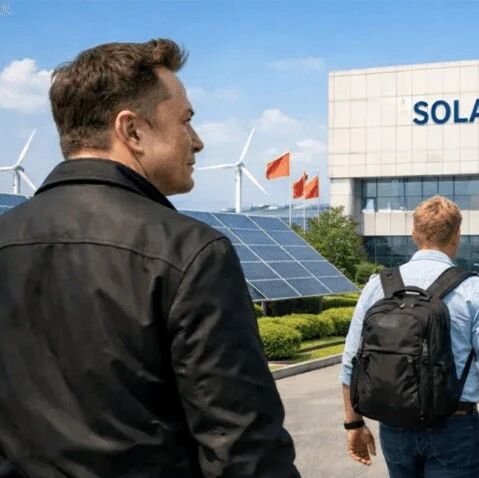
2500亿!马斯克团队秘密访华,美国太空光伏梦,只有中国能“接单”
Sou Hu Cai Jing· 2026-02-05 05:19
Group 1 - Elon Musk has become the world's first billionaire with a net worth exceeding $800 billion while facing scrutiny over past communications with Jeffrey Epstein [1] - Musk's companies, SpaceX and Tesla, are reportedly expanding their business by sourcing materials in China, particularly in the booming sector of space photovoltaics [3][16] - The core challenge for Musk's ambitious plans, including sending humans to Mars and establishing a satellite network, is the need for reliable energy sources in space, which solar energy can provide [5] Group 2 - Musk has announced a goal to achieve 100 gigawatts of solar energy capacity within three years, equivalent to the output of several large nuclear power plants, to power AI data centers and future extraterrestrial bases [7] - The merger of Musk's AI company xAI with SpaceX has resulted in a valuation exceeding $1 trillion, aimed at addressing the energy demands of AI operations in space [7] - The production of "space-grade" solar cells is limited, and the most viable manufacturing capabilities are found in China, which has a complete and efficient solar industry supply chain [9][13] Group 3 - Chinese companies are leading in the production of advanced solar technologies, such as heterojunction (HJT) and perovskite solar cells, which are essential for space applications due to their high efficiency and durability [11] - The U.S. lacks the manufacturing capacity to meet Musk's ambitious solar energy production goals, making reliance on Chinese manufacturing necessary for the success of his space photovoltaic plans [13][15] - Chinese solar firms are not only focused on terrestrial applications but are also proactively developing technologies for space photovoltaics, aligning with SpaceX's requirements [15][16]

光伏行业协会发声:太空光伏技术仍处于探索和验证的初期阶段!光伏ETF华夏(515370)太空光伏含量指数维度全市场第一
Mei Ri Jing Ji Xin Wen· 2026-02-05 03:56
Group 1 - The core viewpoint of the article highlights the significant market interest in space photovoltaic technology, driven by recent developments and discussions led by Elon Musk's team, which has sparked a wave of investment and speculation in the sector [1][2] - The Chinese Photovoltaic Industry Association indicates that the success of space photovoltaic applications hinges on the development of mature and replicable manufacturing capabilities, as well as a reliable long-term verification system [1] - Current leading technology in space applications is Gallium Arsenide (GaAs) batteries, known for their high conversion efficiency and radiation resistance, despite their higher costs [1][2] Group 2 - The market is optimistic about Heterojunction (HJT) and perovskite technologies, although these are still in the experimental phase and not yet ready for large-scale commercial deployment [2] - According to CITIC Securities, the demand for space photovoltaic technology is real, with projections indicating a significant increase in satellite launches from 5,000 to 50,000 annually between 2025 and 2040, maintaining GaAs batteries' dominance in the short term [2] - The overall market for photovoltaic cells in the satellite sector is expected to reach 328.8 billion yuan, with a potential growth of over 30 times compared to the short-term market [2] Group 3 - The Huaxia Photovoltaic ETF (515370) tracks the CSI Photovoltaic Industry Index, which includes companies across the photovoltaic supply chain, reflecting the overall performance of the industry [3] - The index has a significant exposure to space photovoltaic technology, with 18.49% of its composition dedicated to this area, ranking first in the market [3]


谁是太空算力的“天选之子”?丨每日研选
Shang Hai Zheng Quan Bao· 2026-01-09 01:00
Core Insights - The commercial aerospace sector is becoming a focal point in the A-share market, driven by the transition of "space computing" from science fiction to commercial deployment [1] - The demand for space photovoltaics is experiencing a historic opportunity due to revolutionary breakthroughs in downstream application scenarios, particularly in the on-orbit data center market, projected to reach $39.09 billion by 2035 with a compound annual growth rate of 67.4% [1] - The unique requirements of computing satellites are reshaping the technology route for space photovoltaics, moving towards low-cost, lightweight, and high-efficiency silicon-based technologies [1] Group 1: Technology and Market Trends - Heterojunction (HJT) batteries are expected to lead in the short to medium term due to their low-temperature processing, compatibility with ultra-thin silicon wafers, and flexible characteristics [2] - P-type ultra-thin HJT batteries can significantly reduce launch payloads and costs while adapting to the new "foldable" solar wing structures, which are the mainstream direction for low Earth orbit satellites [2] - The next-generation technology represented by perovskite is seen as a long-term game-changer, although it requires more time to mature [2] Group 2: Investment Opportunities - Investment strategies should focus on three main lines: 1. Core suppliers of the current dominant technology, gallium arsenide, such as Qianzhao Optoelectronics and Sanan Optoelectronics [2] 2. Companies actively developing P-type HJT and next-generation perovskite technologies, including Dongfang Risheng, GCL-Poly, and Junda Co., along with leading equipment manufacturers like Maiwei and Jiejia Weichuang [2] 3. Opportunities across the entire supply chain benefiting from the expansion of space scenarios, including special functional materials and high-end components [3]