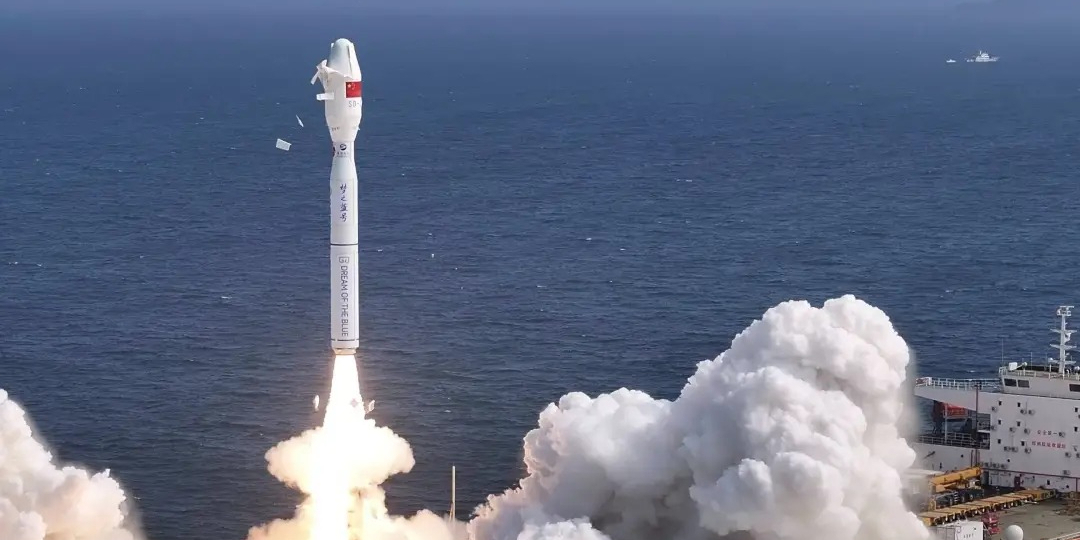
引力二号火箭

Search documents
2月3日主题复盘 | 光伏板块再度爆发,航天也有大幅反弹,光通信持续强势
Xuan Gu Bao· 2026-02-03 09:11
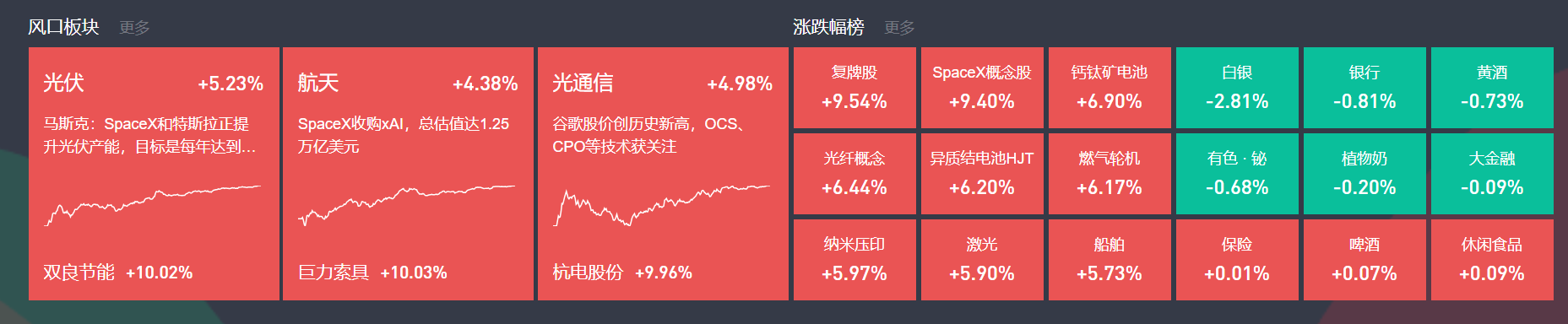
Market Overview - The market experienced a rebound with the Shanghai Composite Index and ChiNext Index rising over 1%, while the Shenzhen Component Index increased by more than 2% [1] - The space photovoltaic concept stocks surged, with companies like Dike Co. and Haiyou New Materials hitting the daily limit [1] - CPO and other computing hardware stocks continued their upward trend, with companies such as Robotec and Tiantong Co. also reaching the daily limit [1] - The commercial aerospace sector saw strong performance, with stocks like Aerospace Development and Aerospace Control hitting the daily limit [1] - Overall, more than 4,800 stocks in the Shanghai and Shenzhen markets were in the green, with a total trading volume of 2.56 trillion [1] Hot Topics Photovoltaics - The photovoltaic sector saw significant gains, with stocks like Shuangliang Energy, Aotemi, Lushan New Materials, and Foster hitting the daily limit [4] - Shuangliang Energy's stock price reached 10.10, with a rise of 10.02%, and a market capitalization of 18.925 billion [5] - Lushan New Materials' stock price increased by 10% to 26.51, with a market capitalization of 4.285 billion [6] - The demand for space photovoltaics is expected to grow significantly, with a market size potentially reaching hundreds of billions by 2030 [6] Aerospace - The aerospace sector rebounded sharply, with stocks like Juliyou and Runbei Aerospace hitting the daily limit [7] - SpaceX announced the acquisition of xAI, with a combined valuation expected to reach 1.25 trillion [7][8] - The domestic market is anticipated to enter the era of reusable rockets by 2026, with both commercial and state-owned companies advancing their projects [9] Optical Communication - The optical communication sector experienced a surge, with stocks like Hangdian Co. and Tiantong Co. hitting the daily limit [10] - Alphabet's stock reached a historical high, with expectations for strong fourth-quarter earnings [10] - The OCS project aims to standardize optical switching technology, with significant improvements in network performance reported [12] CPO Technology - CPO technology shipments are projected to scale up significantly from 2026 to 2027, with penetration rates expected to reach 50.6% by 2029 for 3.2T CPO [13]





商业火箭迎关键验证窗口:发动机决定太空探索深度,3D打印则是降本核心!
Hua Er Jie Jian Wen· 2026-01-23 12:29
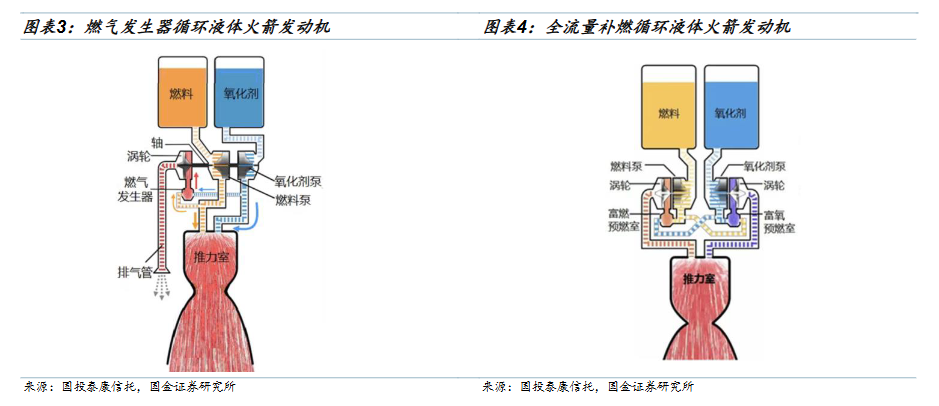
Core Insights - The Chinese commercial space industry is entering a critical development phase, with 2026-2027 identified as a key validation window for medium to large liquid rocket companies, marking the first flights of several rockets and the practical testing of reusable technology [1][3] - The demand for satellite internet and the need for cost-effective launch capabilities are becoming core competitive advantages, with companies needing to achieve a payload capacity of at least 2.8 tons for profitability in near-polar orbits [1][4] - Engine technology advancements, particularly full-flow staged combustion and 3D printing, are seen as the most certain investment logic within the industry [1][5] Group 1: Market Dynamics - The transition from small solid rockets to medium and large liquid reusable rockets is causing profound changes in the supply chain, with core components like 3D printing and large tanks gaining market attention due to their reliability and cost-effectiveness [2] - The success record and payload capacity of commercial rockets are fundamental standards for assessing their commercial value, with a shift towards liquid rockets and reusable technology driven by large-scale satellite networking demands [3][4] Group 2: Technical Developments - The engine evolution is trending towards higher thrust and full-flow staged combustion, with current engines primarily using gas generator cycles, while future designs are expected to adopt more efficient technologies [5][8] - The demand for increased payload capacity is pushing the need for engines with thrust levels reaching 120 tons, and companies are exploring innovative recovery methods to reduce costs [4][5] Group 3: 3D Printing Impact - 3D printing has become a core production capability in commercial aerospace, significantly reducing production cycles and weight, with over 60% of parts in new rocket engines being produced through this technology [9][10] - The Chinese 3D printing market is projected to reach approximately 41.5 billion yuan in 2024, with the aerospace sector accounting for about 16.7% of this market [9][10] Group 4: Structural and Control System Innovations - Rocket structural components are evolving towards larger sizes to meet increased payload demands, with materials like stainless steel and carbon fiber composites being adopted to reduce weight and costs [12] - The control systems are also being upgraded to meet the high-frequency launch requirements of commercial space, with a shift from traditional electric servos to electromechanical hydraulic systems [12]
我国三大万颗星座计划,推动商业航天进入高速发展期
Huan Qiu Wang· 2025-12-06 01:21
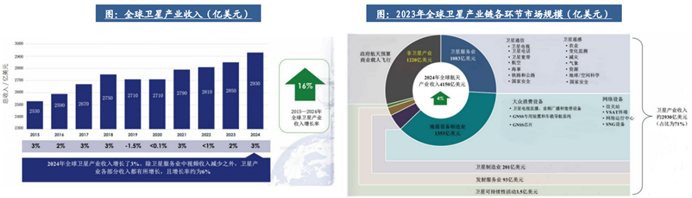
Core Insights - The global satellite internet constellation is rapidly developing, with major players including Starlink, GW constellation, G60, Honghu-3, OneWeb, and Kuiper, particularly highlighting the advancements of SpaceX's Starlink project which has launched over 10,000 satellites as part of a planned 42,000 satellites [1] - China is also making significant strides with three major satellite constellation plans, including China Star Network (GW constellation), Shanghai Yuanxin (G60 Qianfan constellation), and Blue Arrow Hongqing Technology (Honghu-3 constellation), aiming to launch a total of 116 satellites by October 2025 [1] - The commercial space industry is characterized by market-driven activities where enterprises, including private and mixed-ownership companies, invest, operate, and bear risks across the entire aerospace value chain, covering technology R&D, manufacturing, launching, and application [1] Industry Developments - The report indicates that the launch schedule for national rockets like Long March 12, Long March 8A, and Long March 6 modified is tight due to other national space missions, leading to slower than expected overall launch progress [3] - There is an urgent need for high-capacity, low-cost, and reliable reusable rockets, with new commercial rocket models such as Zhuque-3, Tianlong-3, and others expected to debut by the end of 2025, which could accelerate the deployment of domestic low-orbit satellite constellations [3] - The satellite manufacturing process is evolving towards modular design, automated testing, and mass assembly, which is expected to release production capacity, while rocket launches are transitioning to reusable, low-cost, and high-capacity models, indicating a shift from validation to engineering application and large-scale development [3]
山东“向海问天” 底气何在?
Jing Ji Guan Cha Wang· 2025-09-12 11:25
Core Viewpoint - Shandong Province is emerging as a significant player in the commercial aerospace sector, leveraging its coastal advantages for maritime rocket launches, with a total of 18 successful sea launches and 115 satellites deployed to date [2][4]. Group 1: Maritime Launch Capabilities - The successful launch of the Jielong-3 Yao-7 rocket from the Yantai Haiyang Dongfang Spaceport marks a significant milestone in Shandong's maritime launch capabilities [2]. - Shandong has established three major launch sites in Haiyang, Rizhao, and Weihai, benefiting from a 3,505 km coastline that enhances flexibility and cost-effectiveness compared to land launches [2][10]. - The Dongfang Spaceport has completed 18 maritime launch missions, positioning itself as the only commercial maritime launch hub in China [4]. Group 2: Industry Ecosystem Development - Shandong is building a complete industrial ecosystem around maritime launches, satellite manufacturing, and space information applications, supported by a robust industrial base [2][4][10]. - The Dongfang Spaceport has attracted 30 aerospace projects with a total investment of 32.2 billion yuan, fostering a collaborative operational model [5]. - The province's industrial structure includes key players like Dongfang Spaceport, Jinan Steel Group, and Dongfang Space, each focusing on different aspects of the aerospace supply chain [3][9][11]. Group 3: Technological Advancements - The Jinan Satellite Assembly Base, developed by Jinan Steel Group, is set to produce 100 satellites annually, marking a significant advancement in satellite assembly capabilities in Shandong [7][8]. - Dongfang Space has achieved breakthroughs in rocket engine technology, enhancing the capabilities of its "Gravity" series rockets, which are designed for high payload capacity and reusability [9]. - The establishment of a global low-orbit satellite IoT constellation by Dongfang Space aims to provide comprehensive connectivity solutions, further solidifying Shandong's position in the aerospace sector [5][6]. Group 4: Strategic Planning and Future Outlook - The Shandong Provincial Government has outlined a long-term development plan for the aerospace industry, aiming to enhance core competitiveness by 2030 [12]. - The province is focusing on differentiated industrial layouts across cities to avoid competition and resource wastage, while also integrating with national strategies to secure more projects and policies [12][13]. - The commercial aerospace sector is recognized as a new growth engine in China's economic transformation, with increasing government support and strategic importance [11][12].