
手机玻璃

Search documents
(投资中国)美国康宁公司:以先进技术与中国共赴创新未来
Zhong Guo Xin Wen Wang· 2025-12-01 13:22
Core Viewpoint - Corning's commitment to the Chinese market is driven by its strategic investments and technological advancements, aligning with China's industrial development and consumer preferences [1][2]. Group 1: Investment and Development - Corning has established a complete value chain in China, including R&D, manufacturing, and supply chain, since entering the market in 1980 [1]. - The company has invested an additional $500 million in China this year, focusing on areas such as optical communications, AI data centers, automotive glass, and display technology [1][2]. - Corning's first wholly-owned factory in China was established in 2000, and it has since built several advanced production lines, including the first 10.5 generation glass substrate production line in 2015 [1]. Group 2: Market Confidence and Localization - The company expresses confidence in the vitality and potential of the Chinese market, attributing this to the deep localization of its operations [2]. - Corning views China as the only market outside North America where all its business and functional departments are present, reflecting its long-term commitment [2]. - The strengthening of intellectual property protection and consistent policy execution in China has provided a sense of security for foreign enterprises [2]. Group 3: Consumer Trends and Future Outlook - The younger generation in China is reshaping consumer preferences, which influences Corning's R&D direction towards products that enhance quality of life [2]. - Corning aims to continue focusing on cutting-edge fields such as new displays and life sciences, enhancing collaboration with Chinese customers for future innovations [2].

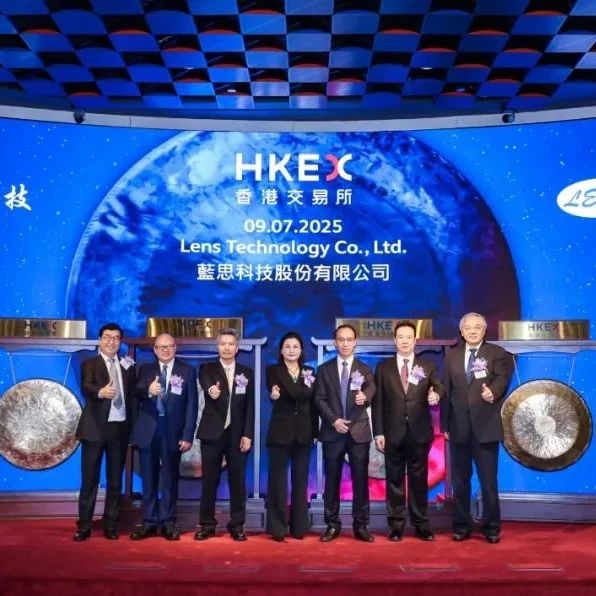
“全球手机玻璃女王”,港交所敲钟!苹果、小米、特斯拉都是她客户
21世纪经济报道· 2025-07-12 04:11
Core Viewpoint - The article highlights the successful listing of Lens Technology on the Hong Kong Stock Exchange, marking a significant milestone in the company's globalization strategy and its ambition to diversify beyond its reliance on Apple as a major client [1][3][16]. Group 1: Company Overview and Milestones - Lens Technology completed its global offering of 262 million shares at an issue price of HKD 18.18 per share, raising approximately HKD 4.768 billion [1]. - The founder, Zhou Qunfei, emphasized that the Hong Kong listing is a key step in the company's globalization strategy, aiming to integrate international capital with China's manufacturing advantages [3]. - The company has achieved significant revenue growth, with sales increasing from CNY 60 billion in 2011 to an expected CNY 699 billion in 2024, representing over tenfold growth in 13 years [6]. Group 2: Dependency on Apple and Market Challenges - Apple has played a crucial role in Lens Technology's growth, with the company becoming one of Apple's core screen suppliers around the time of the first iPhone launch in 2007 [5]. - The company's revenue from its largest customer (Apple) exceeded 50% in 2020, raising concerns about over-reliance on a single client [6]. - In 2021, Lens Technology faced significant profit declines, with net profit dropping by 34.97% year-on-year in Q3 and turning to a loss of CNY 1.227 billion in Q4 [6][7]. Group 3: Diversification and New Growth Areas - To mitigate risks associated with dependency on Apple, Lens Technology has been exploring new growth avenues, including the automotive sector since 2015 [7][8]. - By 2021, the company's revenue from automotive electronics reached CNY 9.72 billion, with collaborations with high-end electric vehicle manufacturers like Tesla [8][9]. - The company has also ventured into the photovoltaic sector, investing CNY 1 billion to establish a new energy company, indicating a commitment to diversifying its business portfolio [10][12]. Group 4: Globalization Strategy - Lens Technology aims to expand its global footprint by establishing production lines in Vietnam and Thailand, focusing on smart terminal components and automotive products [14][15]. - The company has a market share of 13.0% in the global precision structure components and module solutions industry and 20.9% in the global smart automotive interaction systems industry as of 2024 [15]. - The IPO in Hong Kong has attracted significant interest from international investors, with a subscription rate of 462.76 times for the public offering, indicating strong market confidence [16].


股再创新高。港股昨日因公众假期本等多国征收高关税。
Xin Yong An Guo Ji Zheng Quan· 2025-07-02 02:21
Market Overview - The US Senate passed a tax reform bill, with the House of Representatives set for a final vote on Wednesday[8] - The Shanghai Composite Index rose by 0.39% to 3457.75 points, while the Shenzhen Component increased by 0.11%[1] - The Hang Seng Index fell by 0.87% to 24072.28 points, with the Hang Seng Tech Index down 0.72% and the Hang Seng China Enterprises Index down 0.96%[1] Banking Sector - Major US banks, including JPMorgan Chase and Goldman Sachs, raised quarterly dividends after passing the Federal Reserve's stress tests[12] - JPMorgan's board authorized a $50 billion stock buyback program[12] Economic Indicators - US personal income decreased by 0.4% in May, while personal spending fell by 0.1%[17] - The PCE price index year-on-year increased to 2.3% in May, with the core PCE price index at 2.7%[17] Trade Relations - Trump threatened to impose high tariffs on Japan and other countries, potentially forcing Japan to pay tariffs of 30% or 35%[12] - The US Treasury Secretary expressed hope for faster exports of rare earth magnets from China following a recent agreement[12]