投资信托

Search documents
Nomura (NMR) - 2026 Q3 - Earnings Call Transcript
2026-01-30 10:32
Financial Data and Key Metrics Changes - Return on equity was 10.3%, meeting the 2030 target of 8%-10% for the seventh consecutive quarter [3] - Group-wide net revenue reached JPY 551.8 billion, a 7% increase from the previous quarter [3] - Income before income taxes decreased by 1% to JPY 135.2 billion, while net income also fell by 1% to JPY 91.6 billion [3] - Earnings per share for the quarter were JPY 30.19 [3] Business Line Data and Key Metrics Changes - Wealth Management saw a growth of approximately 30% compared to the previous quarter, with net revenue increasing by 14% to JPY 132.5 billion [4][8] - Investment Management's business revenue reached an all-time high, but profits fell due to weaker investment gains and one-time expenses related to the Macquarie acquisition [4][12] - Wholesale net revenue rose by 12% to JPY 313.9 billion, with investment banking net revenue increasing by 31% to JPY 57.1 billion [15][17] Market Data and Key Metrics Changes - Recurring revenue assets saw a net inflow of JPY 503.9 billion, reaching an all-time high of JPY 28.1 trillion by the end of December [10][11] - The number of flow business clients increased by around 270,000 to 1.53 million, driven by buoyant market conditions [11] Company Strategy and Development Direction - The company announced a share buyback program with a limit of 100 million shares and JPY 60 billion in amount, aimed at enhancing shareholder return and capital efficiency [5] - The company is focused on maximizing synergies between existing and newly acquired businesses, particularly in the Investment Management division [26] Management's Comments on Operating Environment and Future Outlook - Management noted that client sentiment remains favorable despite some selling pressures in the market, with a shift from savings to investment being a sustainable trend [21][22] - The company expects a solid pipeline in investment banking, despite a slower start in Q4 due to seasonal factors [22] Other Important Information - Group-wide expenses increased by 10% to JPY 416.5 billion, driven by one-time costs associated with acquisitions and strategic investments [19] - The common equity Tier 1 ratio at the end of December was 12.8%, with a slight decrease attributed to changes in regulatory capital calculations following the Macquarie acquisition [20] Q&A Session Summary Question: Regarding Laser Digital's losses and position management - Management acknowledged the losses due to market fluctuations and emphasized the importance of precise position management to control volatility [31] Question: Sustainability of Wealth Management's net inflow - Management refrained from making definitive comments on sustainability but noted a significant shift in retail investor behavior towards investment [32] Question: Wealth Management pricing strategy - Management declined to comment on internal discussions regarding commission rate increases, focusing instead on value provision to customers [38] Question: Timing and scale of buyback - Management explained that the timing was influenced by the recent acquisition and the need to meet investor expectations [39] Question: Impact of personnel costs and deferred compensation - Management provided details on the expected impact of accounting changes on personnel costs, estimating around JPY 8 billion for Q4 [52] Question: Long-term strategy for Laser Digital - Management discussed the need for a thorough strategy to manage the growth and volatility of the digital asset business while ensuring diverse activities [54]

Nomura (NMR) - 2026 Q3 - Earnings Call Transcript
2026-01-30 10:32
Financial Data and Key Metrics Changes - Return on equity was 10.3%, meeting the 2030 target of 8%-10% for the seventh consecutive quarter [3] - Group-wide net revenue reached JPY 551.8 billion, a 7% increase from the previous quarter [3] - Income before income taxes decreased by 1% to JPY 135.2 billion, while net income also fell by 1% to JPY 91.6 billion [3] - Earnings per share for the quarter were JPY 30.19 [3] - Pre-tax income across all four divisions rose 8% to JPY 142.9 billion, the highest level in 18.5 years [4] Business Line Data and Key Metrics Changes - Wealth Management saw a growth of approximately 30% compared to the previous quarter, with net revenue increasing by 14% to JPY 132.5 billion [4][8] - Investment Management's business revenue reached an all-time high, but profits fell due to weaker investment gains and one-time expenses from an acquisition [4][12] - Wholesale net revenue rose 12% to JPY 313.9 billion, with Investment Banking net revenue increasing by 31% to JPY 57.1 billion [15][17] Market Data and Key Metrics Changes - Recurring revenue assets experienced a net inflow of JPY 503.9 billion, reaching an all-time high of JPY 28.1 trillion [10][11] - The number of flow business clients increased by around 270,000 to 1.53 million, driven by buoyant market conditions [11] - Equities revenue grew by 4%, while bonds saw a decline of 25% due to market conditions [10] Company Strategy and Development Direction - The company announced a share buyback program to enhance shareholder returns, with a limit of 100 million shares and JPY 60 billion in total [5] - The focus remains on maximizing synergies between existing and newly acquired businesses, particularly in the Investment Management division [25][26] - The company aims to continue fostering growth in the digital asset market while managing volatility [23] Management's Comments on Operating Environment and Future Outlook - Management expressed confidence in the strong performance across all divisions, despite one-time costs associated with acquisitions [21] - The outlook for January indicated stable client sentiment and a shift in household financial assets towards investments [21] - Management acknowledged the challenges in the domestic rates business due to increased market volatility but noted solid performance in other areas [46] Other Important Information - Group-wide expenses increased by 10% to JPY 416.5 billion, driven by one-time costs and strategic investments [19] - The Common Equity Tier 1 ratio at the end of December was 12.8%, with a slight decrease attributed to changes in regulatory capital calculations [20] Q&A Session Summary Question: Regarding losses in Laser Digital and position management - Management acknowledged the losses and stated that they are taking measures to control volatility while maintaining long-term commitments in the digital asset space [31][32] Question: Sustainability of net inflow in Wealth Management - Management refrained from making definitive comments on sustainability but noted a significant shift from savings to investments among retail investors [32] Question: Wealth Management pricing strategy - Management declined to comment on internal discussions regarding commission rate increases, focusing instead on value provision to customers [38][39] Question: Timing and scale of buyback - Management explained that the timing was influenced by the recent acquisition and the need to meet investor expectations [39][40] Question: Impact of personnel costs and deferred compensation - Management provided details on the expected impact of accounting changes on personnel costs, estimating around JPY 8 billion for the current quarter [52] Question: Long-term strategy for Laser Digital - Management emphasized the need for a thorough discussion on risk management and the growth strategy for the digital asset business [55]
Nomura (NMR) - 2026 Q3 - Earnings Call Transcript
2026-01-30 10:30
Financial Data and Key Metrics Changes - Return on equity was 10.3%, meeting the 2030 target of 8%-10% for the seventh consecutive quarter [3] - Group-wide net revenue reached JPY 551.8 billion, a 7% increase from the previous quarter [3] - Income before income taxes decreased by 1% to JPY 135.2 billion, while net income also fell by 1% to JPY 91.6 billion [3] - Earnings per share for the quarter were JPY 30.19 [3] - Pre-tax income for all four divisions rose 8% to JPY 142.9 billion, the highest level in 18.5 years [4] Business Line Data and Key Metrics Changes - Wealth Management saw a growth of around 30% compared to the previous quarter, with net revenue increasing 14% to JPY 132.5 billion [4][7] - Investment Management's business revenue reached an all-time high, but profits fell due to weaker investment gains and one-time expenses from the Macquarie acquisition [4][12] - Wholesale net revenue rose 12% to JPY 313.9 billion, with Investment Banking net revenue increasing by 31% to JPY 57.1 billion [15][17] - Banking net revenue increased by 7% to JPY 13.7 billion, with income before income taxes rising 31% to JPY 4.2 billion [18] Market Data and Key Metrics Changes - Recurring revenue assets saw a net inflow of JPY 503.9 billion, reaching an all-time high of JPY 28.1 trillion [11] - Total sales rose to JPY 6.6 trillion, with equities growing by 4% and bonds declining by 25% [9][10] - The number of flow business clients increased by approximately 270,000 to 1.53 million, driven by buoyant market conditions [11] Company Strategy and Development Direction - The company announced a share buyback program to enhance shareholder return and capital efficiency, with a limit of 100 million shares and JPY 60 billion [5] - The focus remains on maximizing synergies between existing and newly acquired businesses, particularly in the Investment Management division [25][26] - The company aims to continue capturing growth in crypto markets while managing volatility through tighter control over positions and risk exposure [23] Management's Comments on Operating Environment and Future Outlook - Management expressed confidence in the strong performance across all segments, with stable revenue growth and positive client flows [21] - The outlook for January indicated that Wealth Management's net revenue was on par with Q3 levels, despite some market selling pressures [21] - Management acknowledged the challenges posed by market volatility but emphasized a solid pipeline in Investment Banking [22] Other Important Information - Group-wide expenses increased by 10% to JPY 416.5 billion, driven by one-off costs and strategic investments [19] - The common equity Tier 1 ratio at the end of December was 12.8%, with Tier 1 capital rising to JPY 3.6 trillion [20] Q&A Session Summary Question: Regarding Laser Digital's losses and position management - Management confirmed that there were long positions taken and emphasized the importance of a robust risk management framework to control volatility [30][31] Question: Sustainability of Wealth Management's net inflow - Management refrained from making definitive comments on sustainability but noted a significant shift from savings to investment among retail investors [32] Question: Wealth Management pricing strategy - Management focused on value provision to customers and did not provide specific details on potential pricing changes [36] Question: Timing and scale of buyback - The buyback was timed to align with the completion of the Macquarie acquisition, and the size was determined based on investment strategy and shareholder return considerations [37] Question: Impact of personnel costs and deferred compensation - Management indicated an expected impact of about JPY 8 billion in Q4, with a gradual normalization of costs in subsequent years [41] Question: Long-term strategy for Laser Digital - Management acknowledged the need for a thorough discussion on growing the business while managing risk exposure [42]
TMGM官网:日本股市上涨,为何本土散户资金持续流向海外?
Sou Hu Cai Jing· 2026-01-05 06:13
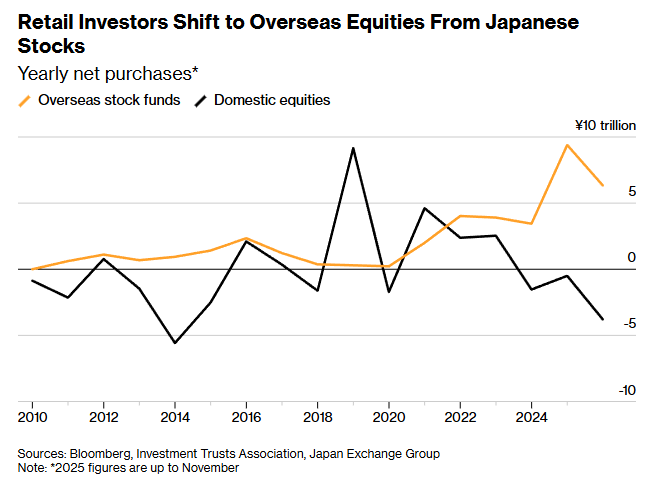
Group 1 - The Japanese financial market is witnessing a significant trend where retail investors are increasingly shifting their funds to overseas markets despite a strong domestic stock market performance [1][4] - As of November last year, Japanese retail investors net sold approximately 3.8 trillion yen in domestic stocks and related investment trusts, marking a record high in over a decade [1] - In contrast, net purchases of overseas stocks through investment trusts are nearing a record level of approximately 9.4 trillion yen [1] Group 2 - Key factors driving this trend include a weakening yen, which enhances the attractiveness of overseas assets, particularly U.S. tech stocks, due to additional returns from currency exchange [4] - Long-standing market habits, where investors have developed a tendency to sell high and take profits, continue to influence funding decisions despite changes in market conditions [4] - The introduction of tax-exempt investment accounts in Japan has lowered investment barriers, facilitating the flow of funds to overseas markets [4] Group 3 - Continuous capital outflow is putting pressure on the yen's exchange rate, as the yield gap between Japanese and U.S. government bonds remains significant, and domestic real interest rates are in negative territory [4] - Current allocations by Japanese retail investors are heavily concentrated in overseas tech stocks, which are at historically high valuations, raising concerns about potential market volatility if the global tech investment boom adjusts [4] - Analysts suggest that investors may need to consider diversifying their asset allocations in the future [4]

Nomura (NMR) - 2026 Q2 - Earnings Call Transcript
2025-10-28 10:30
Financial Data and Key Metrics Changes - Group-wide net revenue was ¥515.5 billion, down 2% from the previous quarter, while income before income taxes fell 15% to ¥136.6 billion and net income decreased 12% to ¥92.1 billion [3] - Excluding gains from real estate sales in the previous quarter, net revenue increased by 10% and net income rose by 40%, indicating steady growth [3] - Earnings per share for the quarter were ¥30.49, and return on equity was 10.6%, achieving the quantitative target for 2030 for the sixth consecutive quarter [3][20] - Income before income taxes in international regions rose 63% to ¥44.9 billion, marking the ninth consecutive quarter of profitability [3] Business Line Data and Key Metrics Changes - Wealth Management net revenue increased 10% to ¥116.5 billion, with income before income taxes growing 17% to ¥45.5 billion, the highest in about 10 years [7] - Investment Management net revenue reached ¥60.8 billion, up 20%, and income before income taxes amounted to ¥30.7 billion, up 43% [9] - Wholesale division net revenue came to ¥279.2 billion, up 7%, with Global Markets net revenue increasing by 6% and Investment Banking net revenue rising by 15% [12] Market Data and Key Metrics Changes - Recurring revenue assets in Wealth Management saw a net inflow of ¥289.5 billion, totaling ¥26.2 trillion at the end of September [8][9] - Investment Management achieved assets under management exceeding ¥100 trillion, with net inflows amounting to ¥498 billion [10] - The overall trend in the market showed strong client activity and revenue growth, particularly in equities and investment banking [12][20] Company Strategy and Development Direction - The company aims to transform Japan into an asset management powerhouse by building trust with clients and providing tailored asset management services [21] - The focus remains on self-sustained growth in Wholesale, with a commitment to maintaining a balance between investment opportunities and shareholder returns [27][41] - The management is proactive in enhancing security measures to protect against phishing scams, which have impacted profits [18][19] Management's Comments on Operating Environment and Future Outlook - The management noted that stock indices in Japan and other major economies rose steeply, contributing to strong earnings [20] - There is an expectation of continued strong performance in Wealth Management and Investment Banking, with a solid pipeline of opportunities [21][44] - The management is cautious about potential normalization in equity performance but remains optimistic about maintaining stable revenues [39][41] Other Important Information - The company plans to pay a dividend of ¥27 per share, resulting in a dividend payout ratio of 40.3% [6] - Group-wide expenses increased by 4% to ¥378.8 billion, with compensation and benefits rising due to performance-linked bonuses [15] - The CET1 ratio at the end of September was 12.9%, within the target range, but expected to decrease post-acquisition of Macquarie Group's U.S. asset management business [17] Q&A Session Summary Question: Concerns about personnel expenses and CET1 ratio - The CFO acknowledged that compensation and benefits increased due to bonuses linked to earnings and larger-than-usual retirement payments [26] - Regarding the CET1 ratio, the company remains committed to a 40% dividend payout and a total payout ratio of 50% or above, balancing shareholder returns with investment opportunities [27] Question: Market revenue and risk-taking - The CFO explained that while credit trading contributed solidly to revenue, the company is mindful of concentration risks and is selective in deal-making [29][30] Question: October revenue environment and tax burden - The CFO indicated that fixed income trends are strong, and overall Wholesale division revenue is expected to remain stable [35] - The increase in tax burden is attributed to various technical issues, with the CFO unable to provide detailed explanations [36] Question: Sustainability of equity product revenue - The CFO noted strong performance in equities across regions, with expectations for some normalization in the future [39][40] Question: Investment Banking pipeline and ROE - The CFO highlighted a strong advisory pipeline in Japan and international markets, with expectations for continued strength in DCM [45] - The base ROE is gradually improving, and while discussions about raising targets are ongoing, the focus remains on maintaining at least 8% ROE [47]
中国外贸信托荣膺三大权威奖项,用实力诠释担当
Sou Hu Cai Jing· 2025-07-10 04:57
Group 1 - The core viewpoint of the articles highlights China Foreign Trade Trust's outstanding performance in bond trading, ESG practices, and comprehensive competitiveness, leading to three significant industry honors in 2025, establishing it as a benchmark enterprise in the trust industry [1] Group 2 - In the bond market, China Foreign Trade Trust has been recognized for three consecutive years in both Shenzhen and Shanghai Stock Exchanges' bond trading rankings, achieving a trading scale of approximately 130 billion yuan in 2024 and holding a bond inventory of 70 billion yuan as of March 2025, maintaining its position in the top tier of the trust industry [3] Group 3 - The company has innovated a dual-platform model of "charity trust + foundation," winning the "Golden Bee ESG Competitiveness - Rural Revitalization Award" as the only awarded trust institution, with a cumulative charitable trust establishment of 55 cases and a total entrusted scale exceeding 150 million yuan [4] Group 4 - China Foreign Trade Trust has won the "Golden Award" for five consecutive years, receiving accolades for "Outstanding Comprehensive Competitiveness Trust Company" and "Outstanding Trust Wealth Brand," with a focus on asset service trusts, asset management trusts, and innovative business in wealth management [5] Group 5 - Looking ahead, the company aims to continue serving national strategies, deepening the advantages of the trust system, and innovating in bond trading, ESG practices, and wealth management to inject financial vitality into the real economy and contribute to rural revitalization [6]