科技股投资

Search documents
TMGM官网:日本股市上涨,为何本土散户资金持续流向海外?
Sou Hu Cai Jing· 2026-01-05 06:13
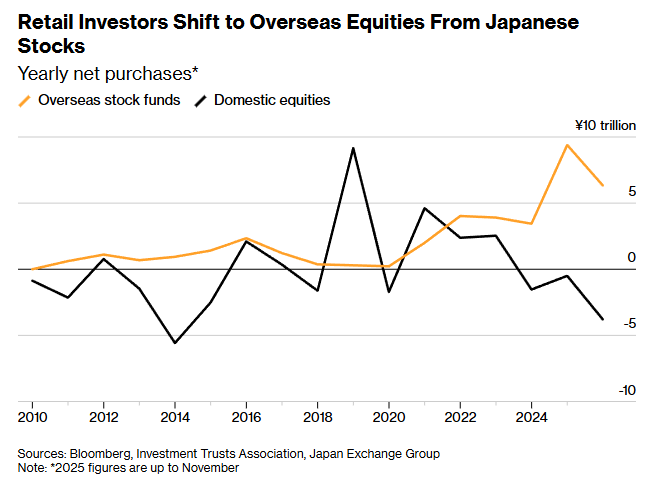
Group 1 - The Japanese financial market is witnessing a significant trend where retail investors are increasingly shifting their funds to overseas markets despite a strong domestic stock market performance [1][4] - As of November last year, Japanese retail investors net sold approximately 3.8 trillion yen in domestic stocks and related investment trusts, marking a record high in over a decade [1] - In contrast, net purchases of overseas stocks through investment trusts are nearing a record level of approximately 9.4 trillion yen [1] Group 2 - Key factors driving this trend include a weakening yen, which enhances the attractiveness of overseas assets, particularly U.S. tech stocks, due to additional returns from currency exchange [4] - Long-standing market habits, where investors have developed a tendency to sell high and take profits, continue to influence funding decisions despite changes in market conditions [4] - The introduction of tax-exempt investment accounts in Japan has lowered investment barriers, facilitating the flow of funds to overseas markets [4] Group 3 - Continuous capital outflow is putting pressure on the yen's exchange rate, as the yield gap between Japanese and U.S. government bonds remains significant, and domestic real interest rates are in negative territory [4] - Current allocations by Japanese retail investors are heavily concentrated in overseas tech stocks, which are at historically high valuations, raising concerns about potential market volatility if the global tech investment boom adjusts [4] - Analysts suggest that investors may need to consider diversifying their asset allocations in the future [4]

破茧2025|投资人的这一年,交出满意答卷
Sou Hu Cai Jing· 2025-12-31 10:41
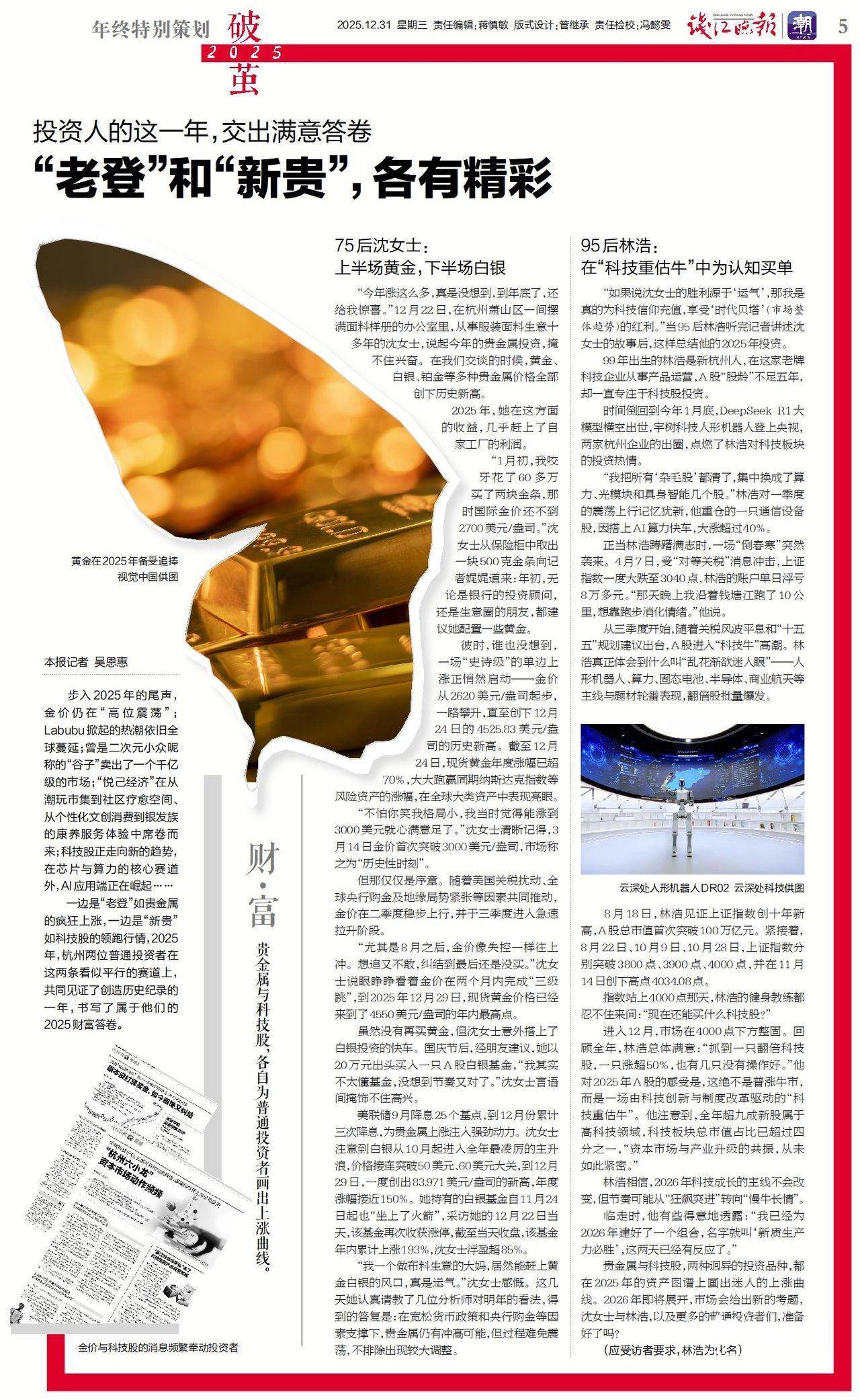
Group 1: Precious Metals Market - Gold prices have experienced a significant increase, reaching a historical high of $4,525.83 per ounce by December 24, 2025, marking an annual increase of over 70% [5][7] - Silver also saw substantial growth, with prices surpassing $72.7 per ounce, resulting in an annual increase of nearly 150% [7][8] - The rise in precious metals is attributed to factors such as U.S. tariff disruptions, global central bank gold purchases, and geopolitical tensions [7] Group 2: Technology Sector - The technology sector is undergoing a "revaluation bull market," driven by innovations in AI, computing power, and robotics, with significant stock price increases observed [10][12] - A notable surge in A-share technology stocks occurred, with the Shanghai Composite Index reaching a ten-year high and the total market capitalization of A-shares exceeding 100 trillion yuan [11][12] - Over 90% of new stocks in 2025 were in the high-tech sector, indicating a strong correlation between capital markets and industrial upgrades [12]
“老登”和“新贵”,各有精彩
Sou Hu Cai Jing· 2025-12-31 00:40
Group 1: Precious Metals Investment - Gold prices have reached historical highs, with a significant increase from $2,620 per ounce at the beginning of the year to $4,525.83 per ounce by December 24, marking an annual increase of over 70% [11][12] - Silver also saw substantial gains, with prices rising from around $20 to a peak of $83.971 per ounce, resulting in an annual increase of nearly 150% [12] - The investment in precious metals has been driven by factors such as U.S. tariff disturbances, global central bank purchases, and geopolitical tensions [11] Group 2: Technology Sector Investment - The technology sector has experienced a "revaluation bull market," with significant interest in AI and related technologies, leading to substantial gains in stocks related to computing power and robotics [13][14] - The A-share market saw the total market capitalization exceed 100 trillion yuan, with the Shanghai Composite Index reaching new highs throughout the year [15] - Over 90% of new stocks in the market were in the high-tech sector, indicating a strong correlation between capital markets and industrial upgrades [15]

1000万,足够财富自由!
Xin Lang Cai Jing· 2025-12-26 01:17
Group 1 - The article discusses the financial value of a typical career path for a young graduate, estimating a starting salary of 250,000 with a 2% annual increase, leading to a retirement pension of 90% of the final salary at age 60, which also increases at 2% annually until age 90 [1][3][23] - The present value of this cash flow is calculated using different discount rates, resulting in a value of 8.778 million at a 4% discount rate and 4.559 million at an 8% discount rate [3][23] - The article suggests that having 10 million in cash, even when invested in stable indices, can lead to financial freedom [5][24] Group 2 - The article highlights the high-risk, high-reward nature of investing in technology stocks, emphasizing the volatility and potential for significant returns if investors can endure the market cycles [13][32] - It references the performance of notable investors and funds, such as David Swensen with a 13.7% annual return and the Bridgewater flagship fund with an 11.5% return, questioning if individual investors can match these results [34][36] - The article compares two artificial intelligence-themed ETFs, noting a significant difference in their annual returns: 105.43% for the ChiNext AI ETF and 16.53% for the Sci-Tech Innovation AI ETF, attributing this to their differing investment focuses [18][37]
Bitget 报告称财报季期间代币化美股期货交易量激增 4,468%,创历史新高
Sou Hu Cai Jing· 2025-12-11 03:42
Core Insights - The demand for tokenized US stocks has seen unprecedented growth, with spot trading volume increasing by 452% month-over-month and futures trading volume surging by 4,468% during the last financial reporting season [2] Group 1: Market Trends - The report highlights three fundamental drivers behind the growth of tokenized equities: the composition of the asset class, the shift towards 24/7 accessibility, and the influence of a diverse global user base [2] - The futures market has exhibited aggressive trading behavior, particularly around large tech stocks, with notable month-over-month increases in trading volumes for Meta (40,774%), Microsoft (24,339%), and MicroStrategy (11,684%) [4] - Spot market participation shows a more balanced allocation, with Nvidia leading at 1,888% month-over-month growth, and significant increases in index funds like QQQ (3,492%) and SPY (3,247%) [4] Group 2: User Behavior and Demographics - The user base remains significantly international, with East Asia accounting for the highest proportion (39.66%), while Latin America, South Asia, Southeast Asia, and Europe also hold substantial shares [5] - High-frequency traders, referred to as "whales," average 51.7 trades per day, while retail investors tend to engage in selective trading around key events like earnings releases [5] Group 3: Company Overview - Bitget, established in 2018, is the largest universal exchange (UEX) globally, serving over 120 million users with access to millions of crypto tokens, tokenized stocks, ETFs, and other real-world assets [6] - The ecosystem aims to enhance trading intelligence through AI-powered tools and seamless access to real-world asset channels, connecting blockchain infrastructure with everyday financial scenarios [6] Group 4: Strategic Partnerships - Bitget leads cryptocurrency promotion through strategic partnerships, including being the official cryptocurrency partner of La Liga in East Asia, Southeast Asia, and Latin America [7] - The company collaborates with UNICEF to provide blockchain education support to 1.1 million people by 2027, and is the exclusive cryptocurrency exchange partner for MotoGP™ [7]

木头姐基金强势反弹,却遭遇大量质疑
财富FORTUNE· 2025-06-19 13:01
Core Viewpoint - ARK Innovation ETF, led by Cathie Wood, has rebounded over 50% since early April, but investor confidence remains low, leading to significant outflows and increased short positions [1][2]. Group 1: Performance and Investor Sentiment - Despite a strong performance, ARKK has not restored market confidence, with short positions reaching a record 37% of its float, surpassing previous pandemic peaks [2][4]. - In June alone, short sellers incurred over $300 million in mark-to-market losses due to ARKK's performance, with a 4.4% rise on a recent Monday adding approximately $93 million to their losses [2][3]. - The fund has experienced over $840 million in outflows this year, marking five consecutive weeks of net redemptions [4]. Group 2: Competitive Landscape - New single-stock ETFs are emerging, allowing investors to build potentially better-performing portfolios without relying on fund managers, which has contributed to ARKK's declining popularity [5][6]. - The asset management size of single-stock ETFs has grown to nearly $21 billion since regulatory approval in 2022, providing leveraged exposure to companies like Nvidia and Tesla [6]. - The proliferation of leveraged and inverse ETFs targeting ARKK's holdings poses a risk of obsolescence for flagship thematic ETFs like ARKK, as investors prefer direct investments [6]. Group 3: Long-term Performance - Despite recent rebounds, ARKK's five-year return is essentially zero, while the S&P 500 has seen total returns exceeding 100% during the same period [6].