抖音随心团

Search documents
2025年度本地生活盘点:六大门派围攻本地生活“光明顶”
3 6 Ke· 2025-12-12 10:38
Core Insights - The local lifestyle battle, which began with Meituan's launch of "30-minute delivery" in 2018, has intensified over the years, particularly during the pandemic with community group buying. By 2025, major players like 58.com and Dingdong Maicai have become secondary participants in this ongoing competition [1] - The competition has reached a climax with six major factions vying for dominance in the local lifestyle sector, particularly in food delivery and in-store services [1][3] Delivery Sector - The food delivery market has seen fierce competition, particularly between Meituan and JD.com, sparked by issues such as rider social security and public relations battles [1] - JD.com has launched its independent food delivery service, covering 350 cities with over 25 million daily orders, capturing more than 31% of the national market share by June 2025 [15][19] - Meituan has responded aggressively to JD.com's incursions, launching counter-offensives in both food delivery and hotel booking sectors [17][19] In-Store Services - In-store services have also become a battleground, with Douyin (TikTok) and Kuaishou introducing significant support measures for offline retailers, including zero commission and advertising support [1][3] - JD.com has announced the launch of "JD Review" and "JD True List," challenging Meituan's business model [3][6] Market Growth and Potential - The instant retail market in China is projected to reach 781 billion yuan in 2024, growing by 20.15% year-on-year, significantly outpacing the overall online retail growth [7] - The local lifestyle market is expected to reach 35.3 trillion yuan by 2025, with an online penetration rate of only 30.8%, indicating substantial growth potential [9] Strategic Moves by Major Players - JD.com has restructured its local lifestyle division, establishing a unified command for its local services and aggressively expanding its market presence [13][12] - Meituan has integrated its various business units into a "core local business" segment, resulting in a 65% year-on-year increase in order volume for its in-store services [27] - Alibaba has undergone significant restructuring of its local lifestyle business, reducing the weight of certain segments while focusing on integrating its services [32][36] Competitive Landscape - Douyin has shifted its focus away from self-operated food delivery to in-store services, leveraging its massive user base for local lifestyle business growth [40][43] - Kuaishou has downgraded its local lifestyle business, indicating a strategic retreat from the competitive landscape [6][52] - The competition among these major players is expected to continue intensifying, with each seeking to solidify their market positions [53]



淘宝闪购低调上线“到店团购”,阿里如何啃下这块硬骨头
Mei Ri Jing Ji Xin Wen· 2025-09-20 14:14
Core Viewpoint - Alibaba's Taobao Flash has quietly launched an "in-store group buying" service, expanding its local lifestyle offerings amidst fierce competition in the market [1][2]. Group 1: Business Development - The "in-store group buying" service has been launched in key commercial areas of Shanghai, Shenzhen, and Jiaxing, covering various food categories such as beverages, desserts, and local specialties [1][2]. - This move is seen as a natural progression in Alibaba's business development, enhancing the functionality of the Taobao app and filling a crucial gap in its local lifestyle segment [1][2]. Group 2: Market Context - The local lifestyle market is highly competitive, with Alibaba's actions intensifying the existing rivalry [1][3]. - Other players like Meituan and Douyin have already established a presence in the "in-store group buying" space, indicating a challenging environment for Alibaba [5][6]. Group 3: Strategic Insights - Experts suggest that Alibaba's integration of payment systems through Alipay, along with its established platforms like Gaode Map and Taobao Live, provides a competitive edge in the "in-store group buying" market [6][3]. - The rapid growth of Taobao Flash is expected to facilitate the quick rollout of the new service, leveraging abundant traffic to attract customers [6][3]. Group 4: Future Outlook - Alibaba's strategic direction is becoming clearer, with recent organizational changes aimed at transforming from an e-commerce platform to a comprehensive consumer platform [6][7]. - The company's first-quarter financial results indicate significant growth in its instant retail business, suggesting a positive trajectory for its new initiatives [6][7].

快手,杀入外卖
Zhong Guo Ji Jin Bao· 2025-08-08 13:24
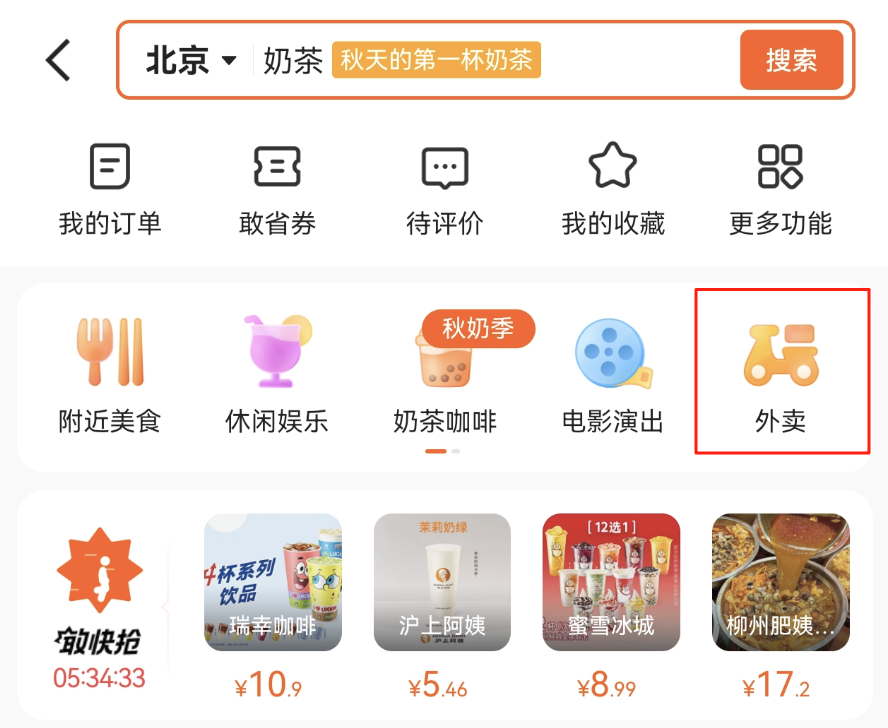
Core Insights - Kuaishou has launched an independent "takeout" entry on its group buying page, indicating its entry into the competitive food delivery market [1][3] - The takeout products primarily feature vouchers from Meituan, with some requiring orders to be placed in live streaming sessions [3][7] - Kuaishou's takeout business has seen a significant increase, with the number of paying users for local takeout products growing over three times quarter-on-quarter in Q2 [7] Group 1: Kuaishou's Strategy - Kuaishou's takeout offerings are mainly based on third-party collaborations, focusing on promoting quality dining products, with plans to expand the range of merchants and categories [7] - The acceleration of Kuaishou's takeout business aligns with its "New Tier Cities + AI" strategy, emphasizing the use of AI technology to reconstruct local service chains [8] - Industry experts suggest that Kuaishou needs to overcome challenges related to delivery speed, merchant availability, and user habits to succeed in the takeout market [8] Group 2: Competitive Landscape - Other major players in the food delivery sector, such as Douyin, are also enhancing their services, with Douyin upgrading its group buying delivery to "随心团" [8][9] - The food delivery industry is experiencing intense competition, with major platforms like Meituan, Taobao, Ele.me, and JD launching high-value subsidies to attract consumers and merchants [11] - Recent regulatory actions have prompted major platforms to call for more rational competition and to avoid disorderly promotional behaviors [11]

快手,杀入外卖!
Zhong Guo Ji Jin Bao· 2025-08-08 13:04
Core Insights - Kuaishou has launched an independent "takeout" entry on its group buying page, indicating its entry into the competitive food delivery market [2] - The takeout channel primarily features product vouchers from Meituan, with some products requiring orders to be placed in live streams, where merchants provide delivery services [2][10] Group 1: Kuaishou's Takeout Strategy - Kuaishou's takeout offerings are mainly based on third-party collaborations, focusing on promoting quality dining products, with plans to expand the range of merchants and categories in the future [10] - In Q2 of this year, the number of paying users for Kuaishou's local takeout products increased by over 300% compared to the previous quarter [10] - Kuaishou's strategy aligns with its 2025 vision of leveraging "new tier cities + AI" to reconstruct local service chains [10] Group 2: Industry Competition - Industry experts suggest that for Kuaishou to succeed in the takeout market, it needs to quickly implement a mixed model of "third-party + self-operated" delivery and shift user perception from "entertainment traffic" to "instant consumption" [11] - Other major players in the food delivery sector, such as Douyin, are also enhancing their services, with Douyin upgrading its group buying delivery to "随心团" [11] - The food delivery industry is experiencing intense competition, with major platforms like Meituan and Ele.me engaging in aggressive promotional activities, leading to calls for more rational competition practices [12]
快手,杀入外卖!
中国基金报· 2025-08-08 12:56
Core Insights - Kuaishou has launched an independent "takeout" entry on its group buying page, indicating its entry into the competitive food delivery market [1][3] - The takeout products primarily feature vouchers from Meituan, with some requiring purchases during live broadcasts [4][9] - Kuaishou's takeout business is mainly based on third-party collaborations, focusing on promoting quality dining products, with plans to expand the range of merchants and categories [9] Group 1: Kuaishou's Takeout Strategy - Kuaishou's takeout product payment user count has increased over three times quarter-on-quarter in Q2 this year [9] - The takeout service was initially launched in June 2024 without a dedicated entry, requiring users to search for takeout items under "group buying discounts" [9] - The acceleration of Kuaishou's takeout business aligns with its 2025 strategy of "New Tier Cities + AI," aiming to reconstruct local service chains using AI technology [9] Group 2: Competitive Landscape - Industry experts suggest that Kuaishou needs to achieve a breakthrough in its fulfillment capabilities by implementing a mixed model of "third-party + self-operated" services [10] - Kuaishou's advantages include a large user base and a solid presence in lower-tier markets, but it faces challenges such as slow delivery, limited merchants, and user habits [10] - Other major players like Douyin are also enhancing their food delivery services, with Douyin upgrading its group buying delivery to "Flexible Group" in November 2024 [10] Group 3: Market Dynamics - The food delivery industry is witnessing intense competition, with major platforms offering high subsidies to attract consumers and merchants [12] - Regulatory bodies have urged platforms like Ele.me, Meituan, and JD to engage in rational competition and promote healthy development in the restaurant service industry [12] - The "first cup of milk tea" marketing campaigns have intensified among delivery giants, with significant promotional activities launched in August [12][13]