指数型股票基金

Search documents
新基金发行热潮不减,权益类产品“挑大梁”
Huan Qiu Wang· 2025-10-20 06:40
Core Insights - The new fund issuance market remains active, with 29 new funds launching this week, indicating a positive attitude from fund companies towards current market conditions [1] - Equity funds dominate the issuance market, accounting for over 80% of new funds, with a notable increase in the average subscription period to 28.79 days, reflecting cautious market sentiment [1][3] Fund Types and Trends - Among equity funds, index funds, particularly ETFs and their linked funds, represent a significant portion, with 15 new funds launched, highlighting strong demand for low-cost, transparent investment products [3] - The Hong Kong stock market has emerged as a focal point, with several index funds targeting this market, providing investors with convenient tools for investment [3][4] - In contrast, bond fund issuance has cooled, with only 3 new bond funds launched this week, attributed to recent adjustments in the bond market [3][4] Investment Strategies - The market shows a demand for stable investment options, as evidenced by the launch of two mixed-FOF products aimed at risk-averse investors, offering a one-stop asset allocation solution [4] - Overall, the new fund issuance landscape is characterized by a dominance of equity funds, a focus on index products, and clear investment themes, as fund companies innovate to meet diverse investor needs in varying market conditions [4]

51只新基金,来了
Jing Ji Wang· 2025-10-14 01:50
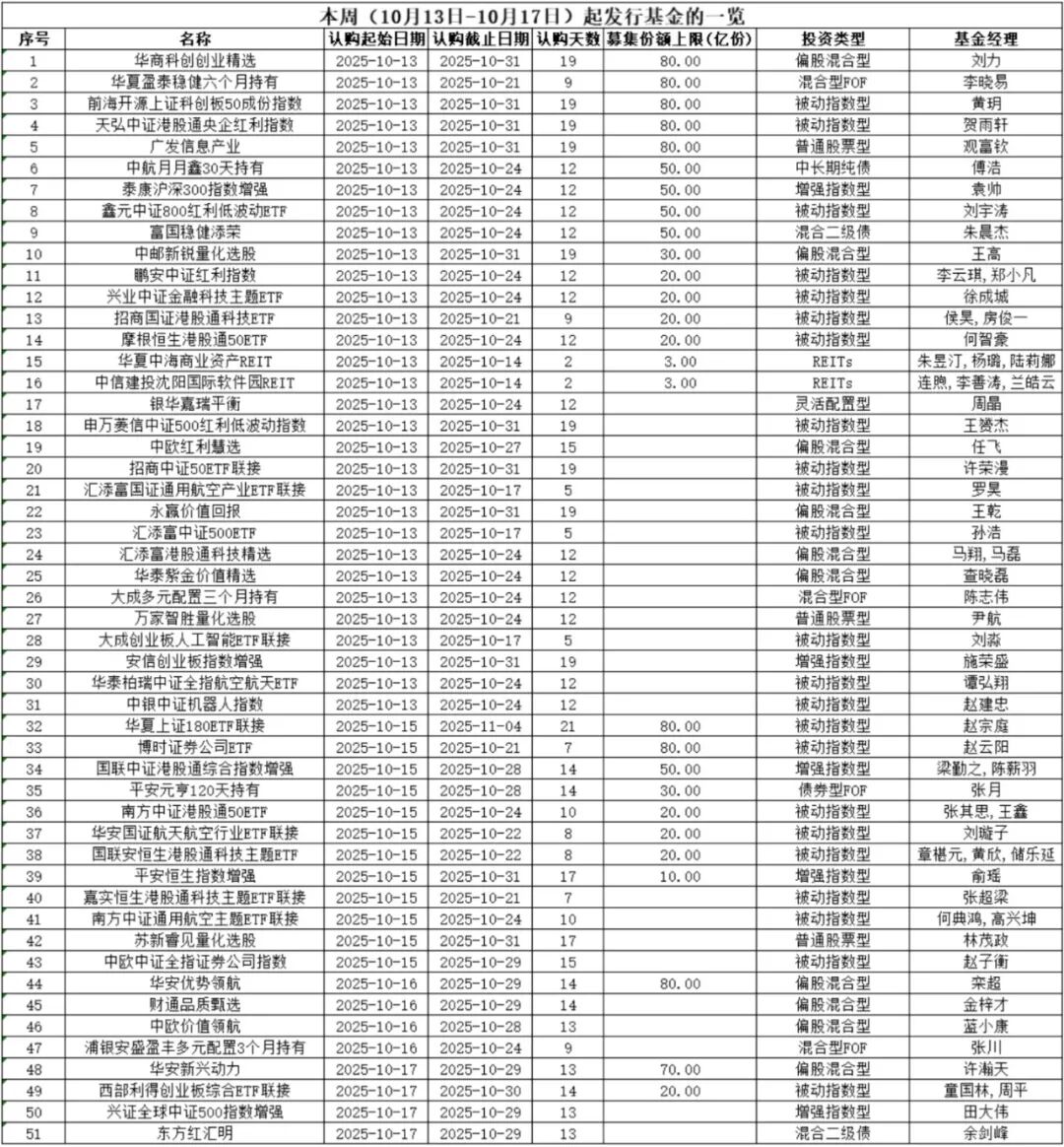
Group 1 - The core point of the article highlights a significant surge in new fund issuances following the National Day holiday, with 51 new funds launched during the week of October 13-17 [1][2][3] Group 2 - On Monday, October 13, 31 out of the 51 new funds were issued, accounting for 60.78% of the week's total [2] - The longest subscription period for new funds was 21 days, while the average subscription period was 12.59 days, indicating a notable decrease compared to previous periods [2][3] Group 3 - The majority of new funds were equity funds, with 42 out of 51 classified as such, representing 82.35% of the total [4] - Among equity funds, 28 were index funds, making up 66.67% of the equity category, with several funds linked to Hong Kong Stock Connect indices [4] Group 4 - Only 3 bond funds were launched during the week, reflecting a decline in bond fund issuance amid a recovering equity market [5] - The "fixed income plus" funds have gained attention, suggesting a shift in investor preference towards more flexible investment strategies [5]
市场回暖带动权益投资热情升温 前三季度新发基金超1100只
Zheng Quan Shi Bao Wang· 2025-10-01 08:17
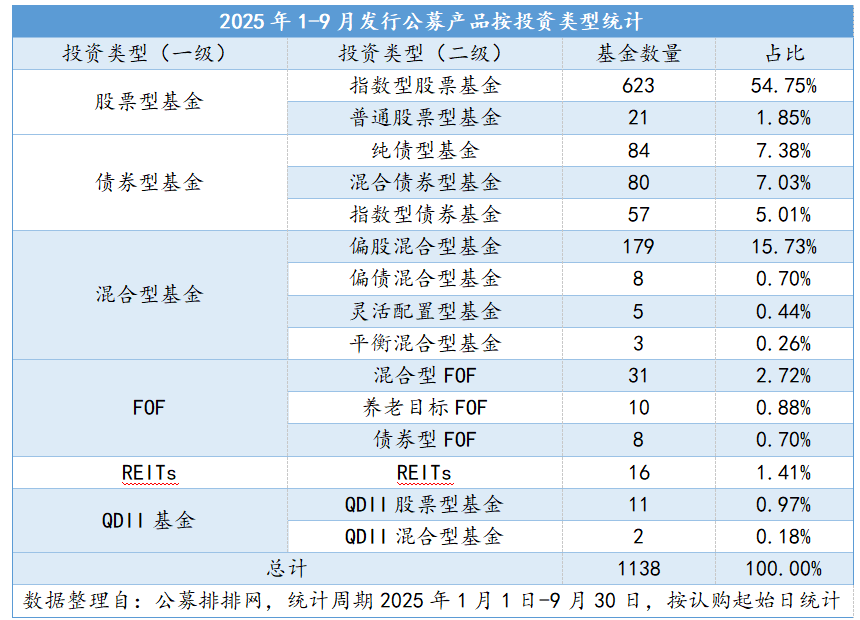
Group 1 - The core viewpoint of the articles highlights a significant increase in the issuance of new public funds, driven by a recovering A-share market and a shift in investor sentiment towards equity investments [1][2][3] - As of September 30, 2025, a total of 1,138 new funds were issued, representing a 31.87% increase compared to 863 funds in the same period of 2024 [1] - Equity funds have become the dominant category in the new fund issuance market, with 823 equity funds issued, accounting for over 70% of the total new funds [1] Group 2 - The issuance of QDII and bond funds has decreased significantly, with only 13 QDII funds issued this year, a 50% drop from 26 in 2024 [2] - Bond fund issuance also declined, with 221 new bond funds issued, representing a 17.54% decrease from 268 in the previous year [2] - Mixed funds saw a slight decrease in issuance, with 195 new mixed funds, a 2.99% decline from 201 in 2024, indicating a preference for more distinct equity funds [2] Group 3 - FOF funds have experienced the largest growth in issuance, with 49 new FOF funds, a 113.04% increase from 23 in 2024, despite only accounting for 4.31% of the total market [3] - The surge in FOF fund issuance is attributed to a growing demand for professional asset allocation among investors, as these funds help mitigate risks through diversified investments [3]
新基发行超千只!权益火热,债基遇冷
Guo Ji Jin Rong Bao· 2025-09-29 14:07
Core Insights - The overall market for new fund issuance has shown significant growth in 2025, with a total of 1,138 new funds launched, representing a year-on-year increase of 31.87% compared to 863 funds in 2024 [1] Fund Issuance by Type - Equity funds have emerged as the dominant category, with 823 equity funds issued, accounting for 72.32% of the total new fund issuance, and stock funds making up 78.25% of the equity fund total [2] - FOF (Fund of Funds) has seen the largest growth in issuance, with 49 funds launched, a 113.04% increase from 23 funds in 2024, driven by rising demand for professional asset allocation [3] - Index-based investments have surged, with 623 index stock funds out of 644 total stock funds issued, representing 96.74% of new stock fund issuance, reflecting the growing popularity of passive investment strategies [3] Market Trends - The issuance of QDII (Qualified Domestic Institutional Investor) funds and bond funds has declined, with only 13 QDII funds issued, a 50% decrease from 26 in 2024, and 221 bond funds issued, down 17.54% from 268 in the previous year [3] - Mixed funds have also seen a slight decrease in issuance, with 195 funds launched, a 2.99% decline from 201 in 2024, indicating a preference for more clearly defined stock funds in a stable market environment [4] - The favorable conditions for equity investment are attributed to relatively low valuations in the A-share market, macroeconomic stabilization, and improving corporate earnings, which have created a conducive environment for equity investments [4]
2100亿规模鑫元基金副总"降职" 南京银行系高管全面接管
Guan Cha Zhe Wang· 2025-09-05 07:19
Core Viewpoint - The recent personnel changes at Xinyuan Fund Management Co., Ltd. have raised market attention, particularly the adjustment of veteran executive Wang Hui from Deputy General Manager to Senior Specialist, which is seen as a significant shift in management dynamics [1][2]. Group 1: Personnel Changes - Wang Hui, who served as Deputy General Manager for nearly ten years, has been reassigned to a less influential role as Senior Specialist, which is unusual in the industry [1]. - The management team now has a dominant presence of executives from Nanjing Bank, which holds an 80% stake in Xinyuan Fund, indicating increased control by the major shareholder [2]. - The transition of Wang Hui is interpreted as a potential "cleaning" of management by the shareholders, especially since he lacks a background in Nanjing Bank and is nearing retirement age [2]. Group 2: Financial Performance - Xinyuan Fund reported a revenue of 356 million yuan for the first half of 2025, marking a year-on-year increase of 17.49%, and a net profit of 107 million yuan, up 15.03% [1]. - As of mid-2025, the total assets under management reached 211.78 billion yuan [1]. Group 3: Business Structure Challenges - The fund's business structure is heavily reliant on fixed-income products, with bond and money market funds accounting for 98% of total assets under management [3]. - In contrast, mixed and equity funds only total 3.05 billion yuan, representing less than 1.5% of the total [3]. - The performance of Xinyuan Fund's equity investments has lagged behind industry averages, with one-year and two-year returns of 2.58% and 5.49%, respectively, compared to industry averages of 15.69% and 9.53% [3]. Group 4: Strategic Initiatives - To address the over-reliance on fixed-income products, Xinyuan Fund has been actively launching new equity funds, with nine new funds issued in the past year, five of which are index equity funds [4]. - The company has promoted four new equity fund managers, all of whom were internally trained [4]. Group 5: Future Outlook - The ability of the new management team from Nanjing Bank to shift the focus from fixed-income dominance to equity business growth will be a critical measure of the effectiveness of the recent personnel changes [5]. - The case of Xinyuan Fund reflects broader challenges faced by bank-affiliated fund companies in transitioning their business models amid regulatory encouragement for equity fund development [5].